AutoNOMOS — Don't Just Pay AI. Verify Its Work.
Inspiration
AI agents are becoming capable of purchasing services and completing work autonomously. But a successful payment does not prove that the purchased work was actually performed or that the delivered result is supported by evidence.
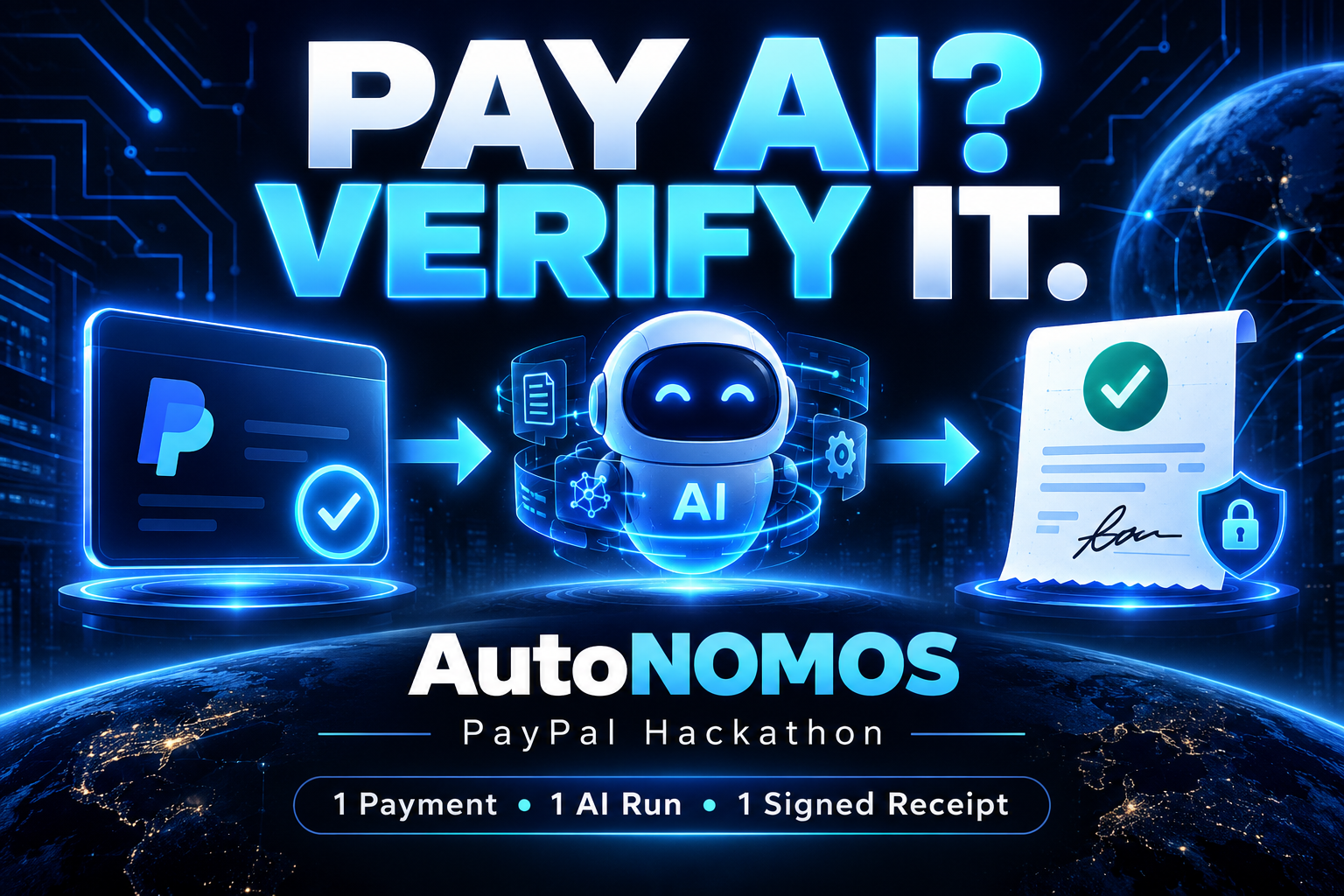
AutoNOMOS addresses this missing trust layer in agentic commerce: connecting payment verification, governed AI execution, document-grounded delivery and cryptographically verifiable receipts.
What it does
AutoNOMOS is a working, standalone application demonstrating a complete paid AI research workflow.
A buyer requests a research report based on an approved document collection and receives a fixed-price offer.
The buyer approves a $1 payment through PayPal Sandbox. AutoNOMOS captures the payment and independently checks PayPal's order record before authorizing AI execution.
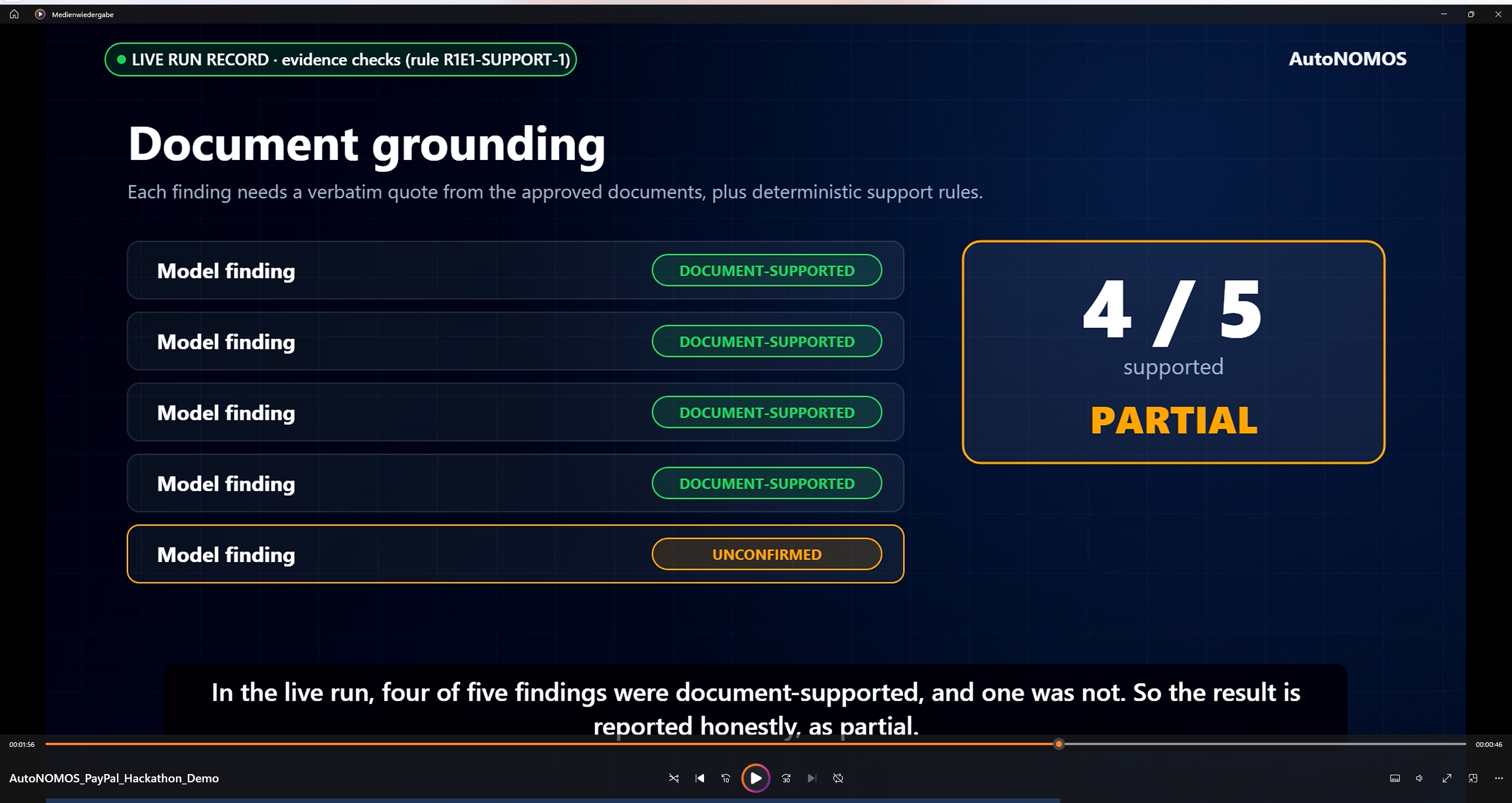
Anthropic Claude Opus 5.5 then performs the research task. Deterministic verification checks the generated findings against quotations from the approved documents.
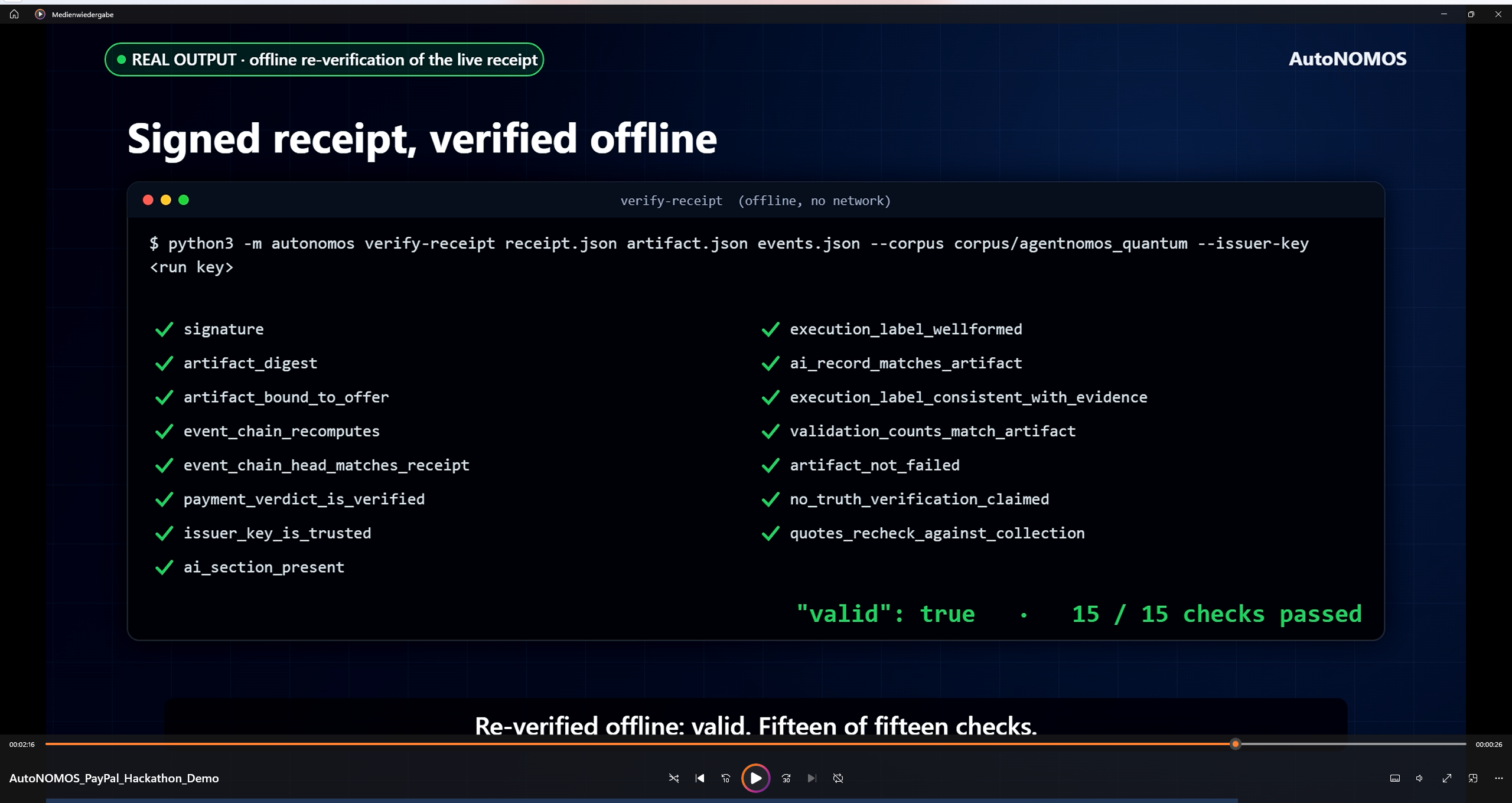
Finally, the system issues a signed Ed25519 receipt linking the offer, payment, execution evidence and delivered artifact. The receipt can be independently verified offline.
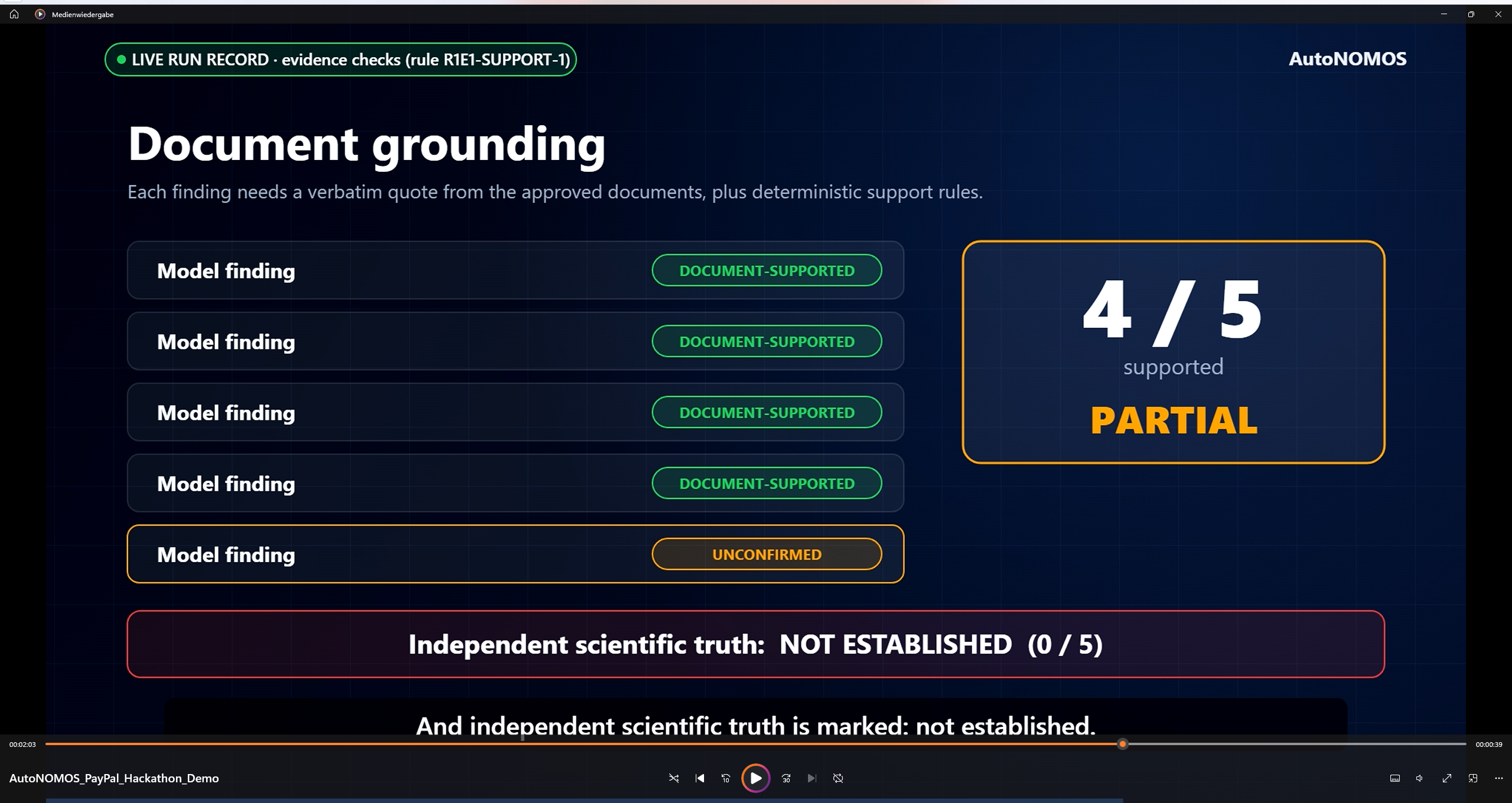
Crucially, AutoNOMOS distinguishes between document-supported claims, unconfirmed findings and independently established truth. It does not treat a valid payment or signature as proof that an AI-generated scientific conclusion is correct.
How we built it
The standalone application was developed in Python during the October 2026 hackathon period, using the Python standard library without third-party runtime dependencies.
It integrates PayPal Orders v2 in Sandbox mode, the Anthropic Messages API, deterministic document-support verification, hash-linked execution records and signed Ed25519 receipts.
Execution is governed by authorization envelopes, budget limits, single-use controls and explicit payment-state verification. The model cannot authorize its own payment or increase the agreed budget.
The application includes a local browser interface, an offline replay mode and a command-line receipt verifier.
Challenges we ran into
The most important challenge was preventing AI execution before a genuinely verified payment, including handling cancellations, ambiguous payment responses, crashes and repeated requests.
Another challenge was distinguishing cryptographic evidence integrity from factual correctness. A digitally signed receipt does not automatically mean every statement generated by an AI model is true.
We also designed bounded AI execution so a paid request cannot trigger unlimited model calls or spending.
Accomplishments that we're proud of
On October 30, 2026, we completed and independently checked an end-to-end demonstration:
1 PayPal Sandbox payment, successfully captured and verified through 9 server-side checks.
1 real Claude Opus 5.5 API request, completed only after payment verification.
4 of 5 research findings document-supported, with the remaining finding explicitly unconfirmed.
15 of 15 receipt verification checks passed.
The AI execution cost was $0.0666 at conservative internal rates, below the authorized $0.50 maximum.
The public repository also passed 346 automated tests, with four expected skips for private evidence fixtures.
What we learned
Reliable agentic commerce requires more than payment connectivity. It needs explicit authorization boundaries, independent verification and evidence that can be inspected after a transaction.
We also learned the importance of reporting incomplete research results transparently rather than converting uncertainty into an unsupported success claim.
What's next
We want to extend this approach toward reusable verification infrastructure for machine-to-machine services, stronger semantic evidence assessment, interoperable receipts and policy-controlled autonomous purchasing.
The long-term vision is an agent economy in which payments and verifiable delivery evidence work together.
Try it out
GitHub (MIT licensed):** https://github.com/AgentNOMOS/autonomos-paypal
Demo video: https://youtu.be/qSNv29Uzr98
The README provides offline setup, reproducible tests, browser replay and receipt-verification instructions. A live payment is not required to evaluate the application.
The completed payment demonstration used PayPal Sandbox test money, not production revenue. The video distinguishes offline replay footage from evidence collected during the real combined test.

Log in or sign up for Devpost to join the conversation.