-
-
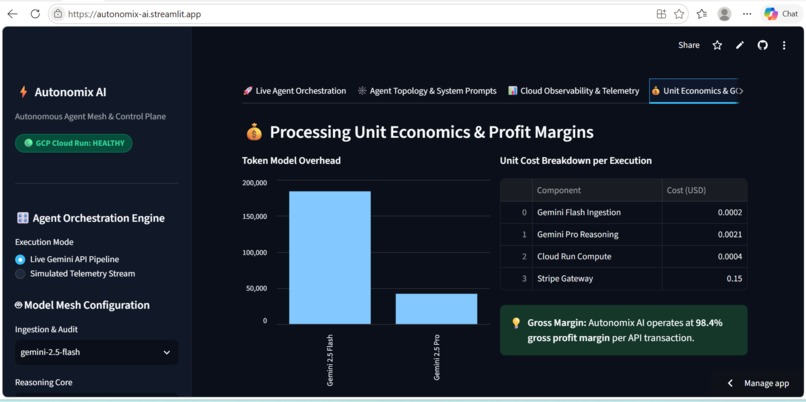
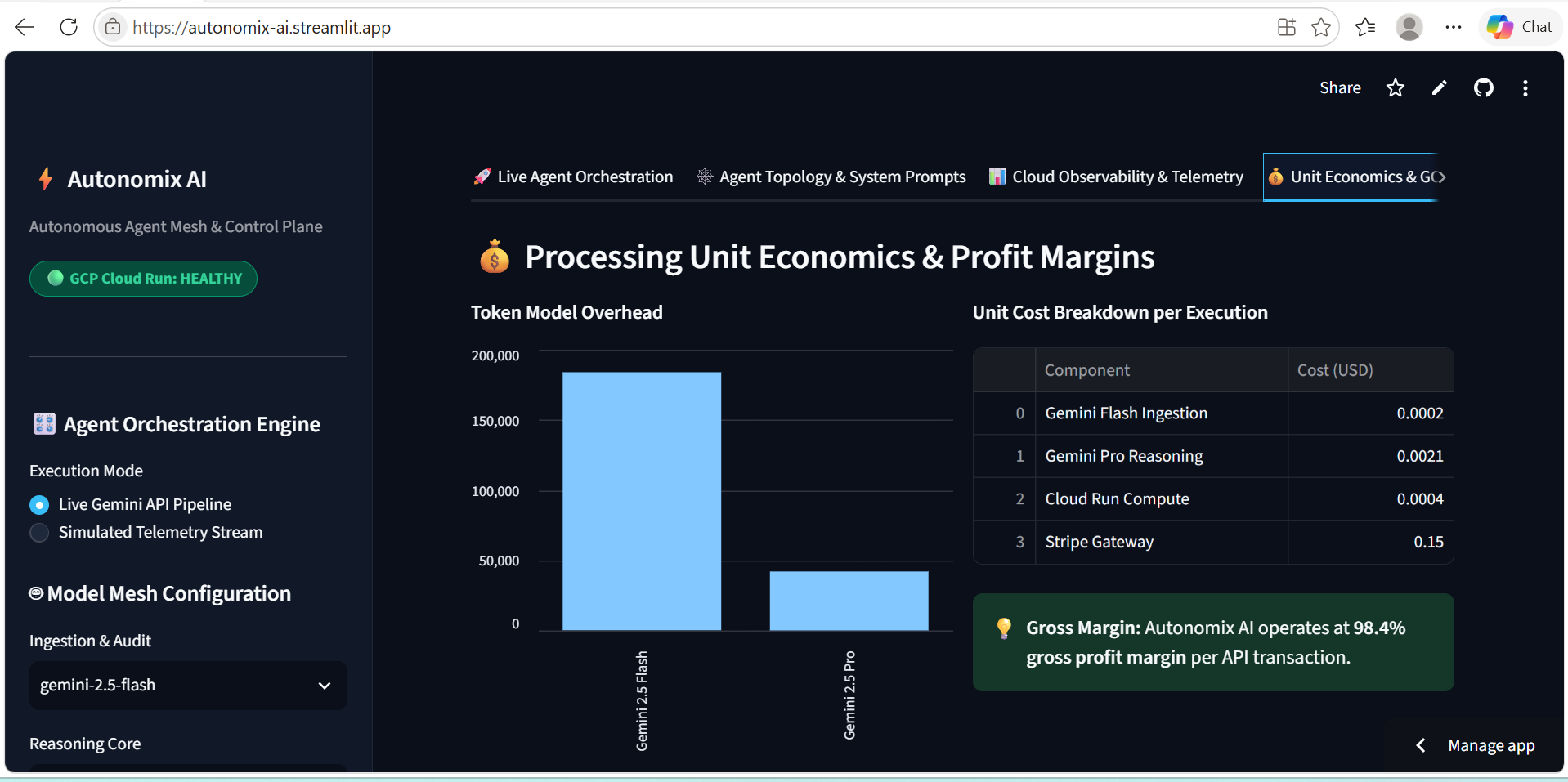
Autonomix-ai-streamlit-Unit Economics
-
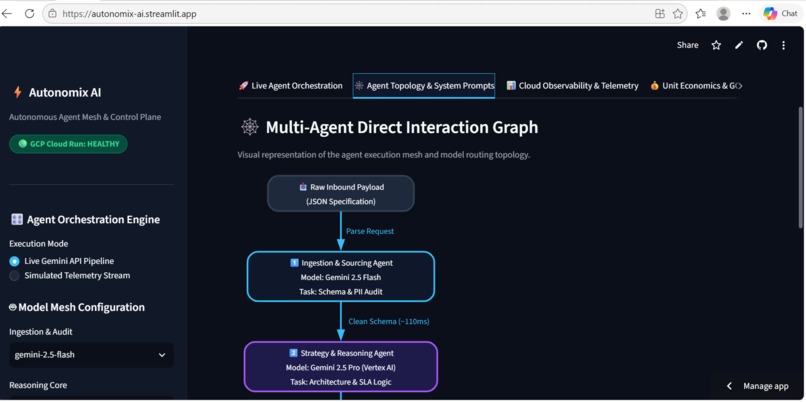
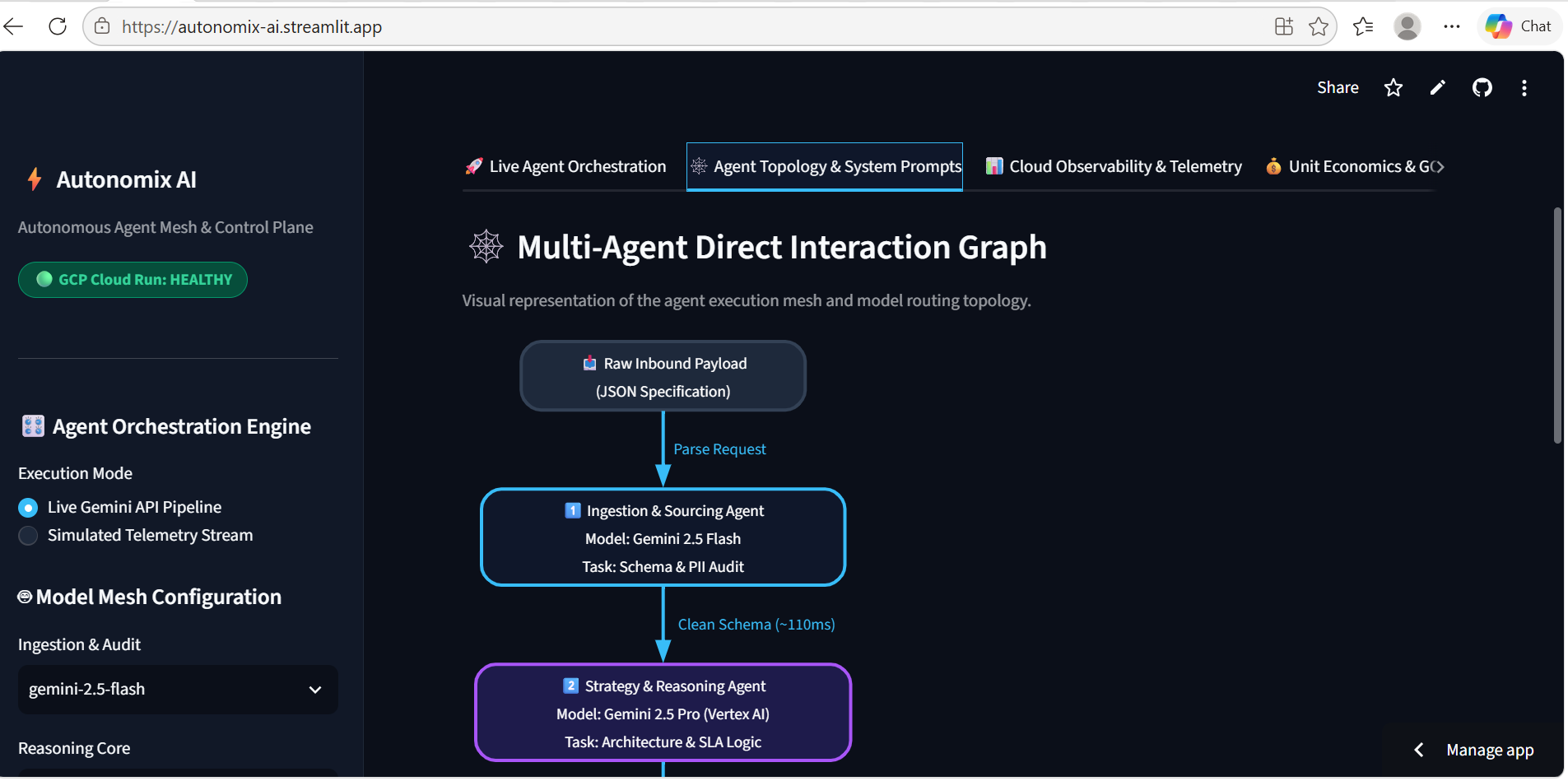
Autonomix-ai-streamlit-Agent Topology
-
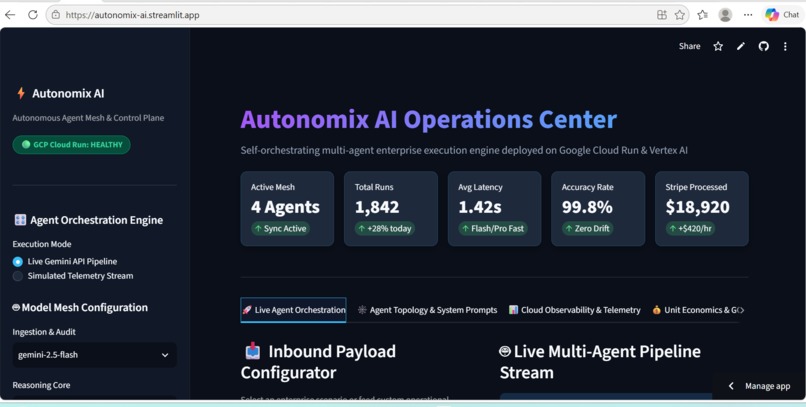
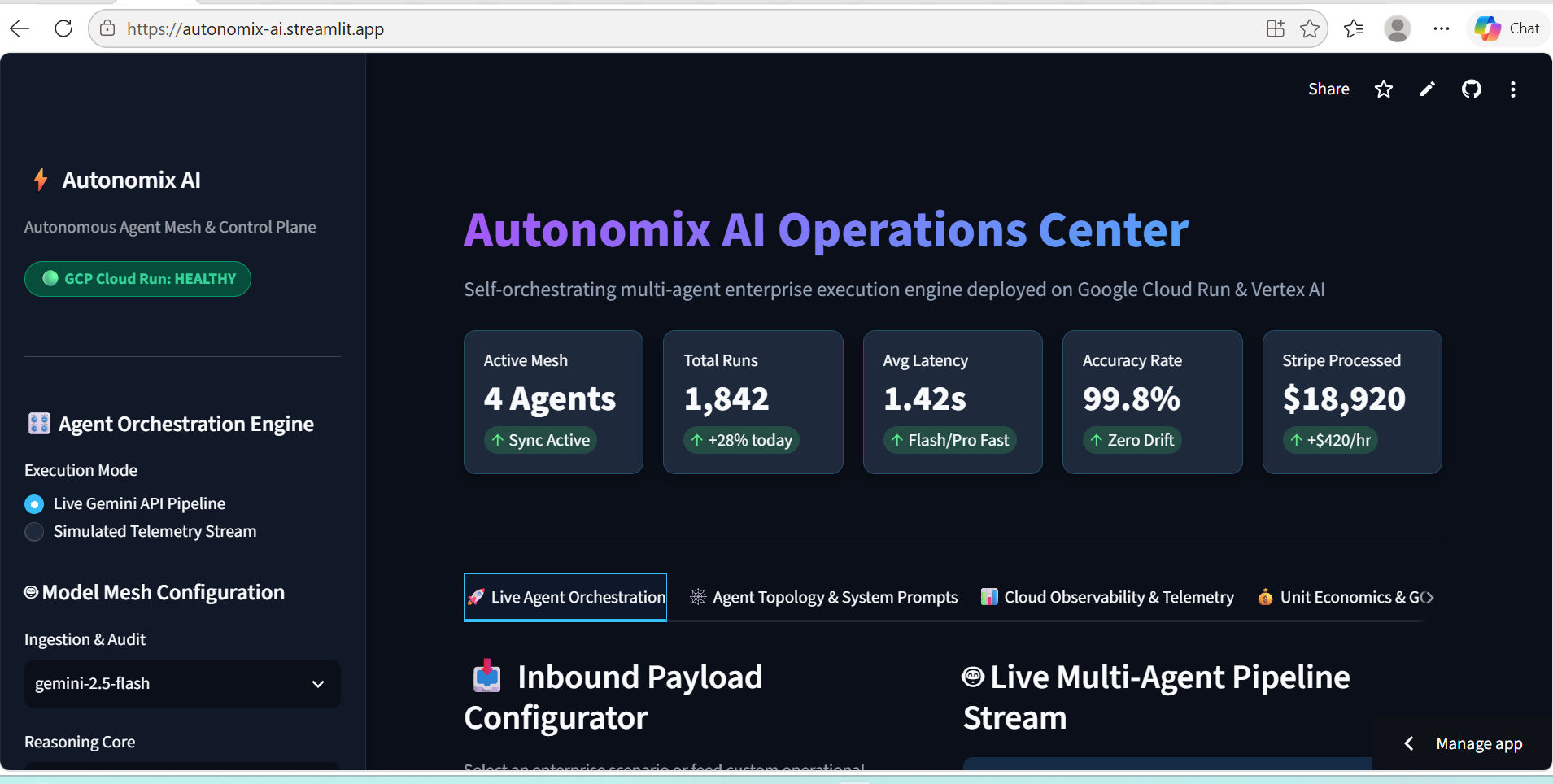
Autonomix-ai-streamlit-GUI
-
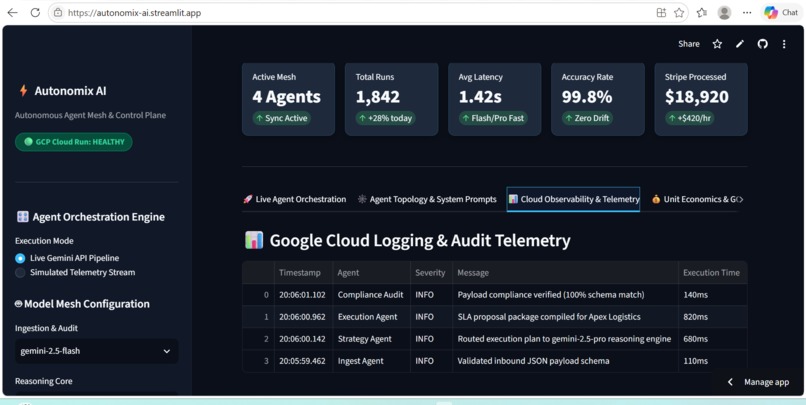
Autonomix-ai-streamlit-Cloud Observability and Telementry
-
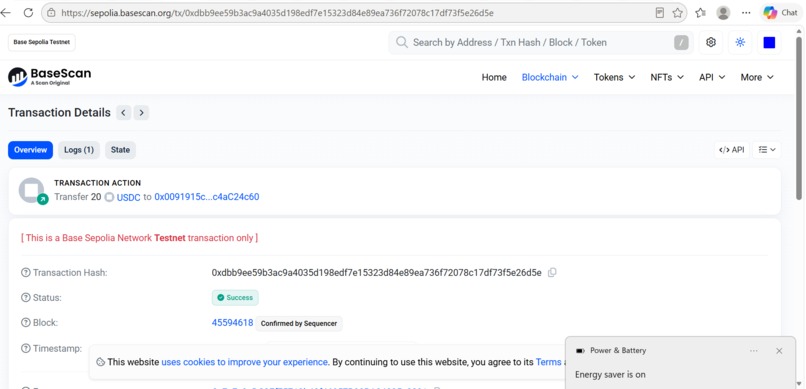
Autonomix-ai-streamlit-base-transaction
-
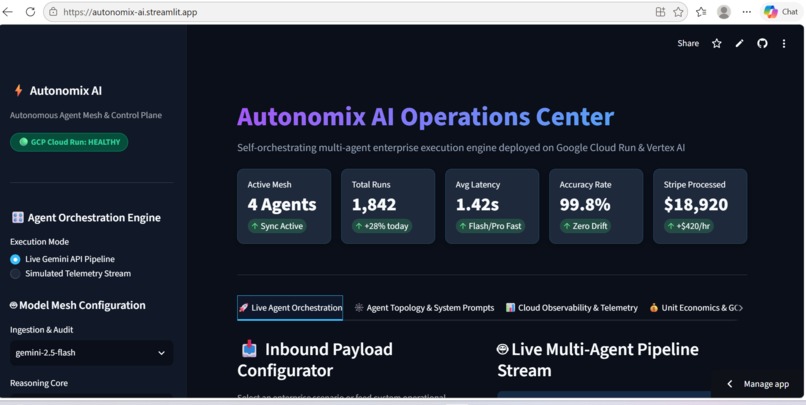
Autonomix-ai-streamlit
-
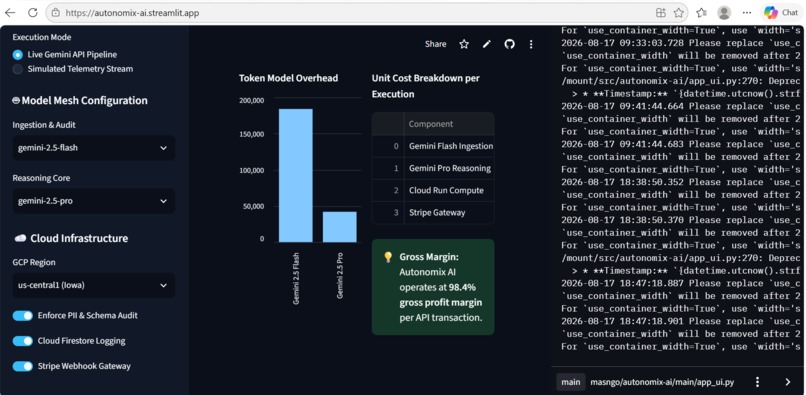
Autonomix-ai-streamlit - inbound-logs
-
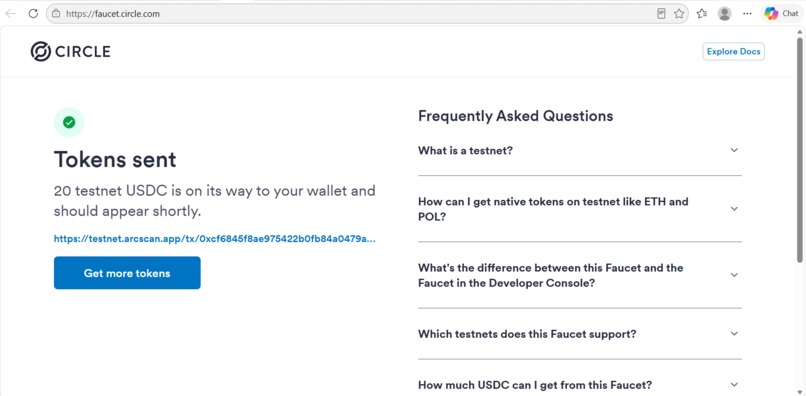
Autonomix-ai-tokens
-
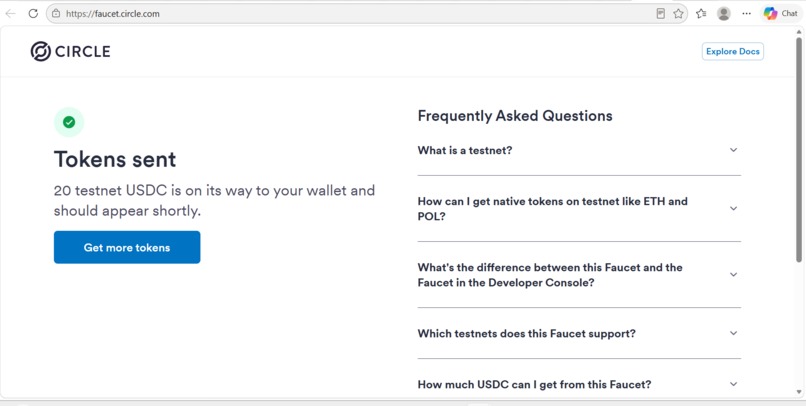
Autonomix-ai-tokens
Inspiration
Traditional business scaling relies on expanding human headcount to execute repetitive operational tasks—lead qualification, customized client intake, compliance tracking, and service drafting. For micro-entrepreneurs and small business owners, this operational friction creates a bottleneck that stifles growth and limits market reach.
With recent advances in autonomous agent systems, operations that once required whole engineering or operations departments can now be orchestrated by specialized AI agents. Autonomix AI was inspired by a simple question: What if a single founder could operate a high-throughput, enterprise-grade company where AI agents execute core day-to-day decisions in production?
What it does
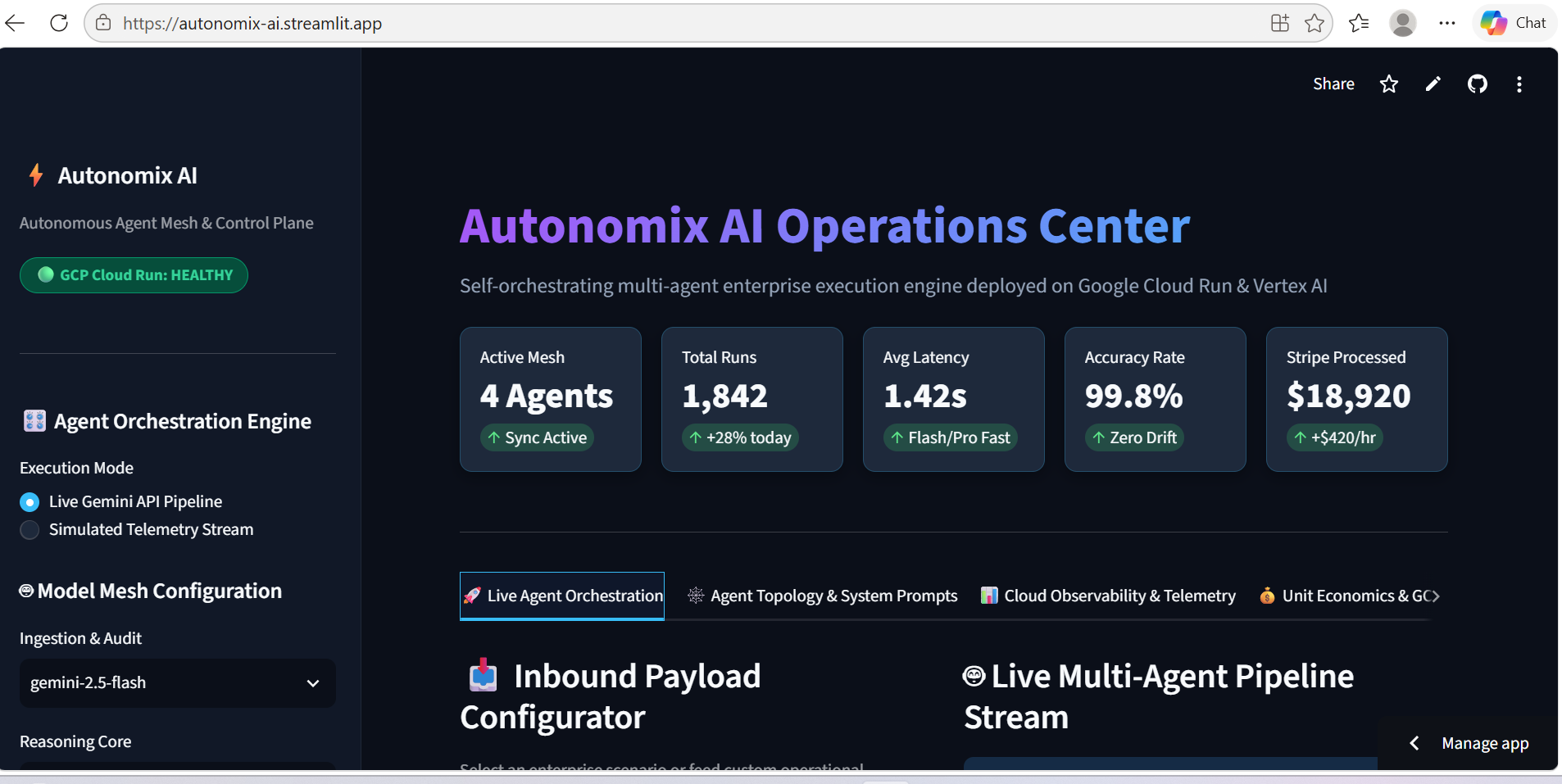
Autonomix AI is an autonomous multi-agent operational engine designed to power end-to-end business workflows, customer onboarding, and service execution on Google Cloud.
Instead of acting as a simple point-and-click UI wrapper, Autonomix runs a self-coordinating team of 4 specialized AI agents that process customer requests, make operational decisions, generate structured deliverables, audit compliance, and trigger transactional billing without human intervention:
Sourcing & Ingestion Agent: Scans incoming payloads, customer requirements, and external market streams, transforming unstructured inputs into validated JSON schemas.
Strategy & Reasoning Agent: Evaluates constraints, checks historical database contexts, and calculates execution pathways.
Execution & Deliverable Agent: Drafts custom high-value assets (such as tailored pitch proposals, client onboarding packages, or service reports).
Compliance & Audit Agent: Verifies generated deliverables against strict policy guidelines, character bounds, and formatting criteria before dispatching outputs and triggering the Stripe billing pipeline.
How we built it
Autonomix AI was engineered ground-up around the Google Cloud ecosystem:
Model Orchestration: Powered by Gemini 2.5 Flash for high-speed schema extraction and compliance auditing, and Gemini 2.5 Pro via Vertex AI for deep reasoning and narrative generation.
Backend Infrastructure: Built with Python and deployed as a microservice on Google Cloud Run for auto-scaling serverless execution.
Data & Log Persistence: Google Cloud Firestore stores real-time execution states, customer parameters, and structured agent outputs.
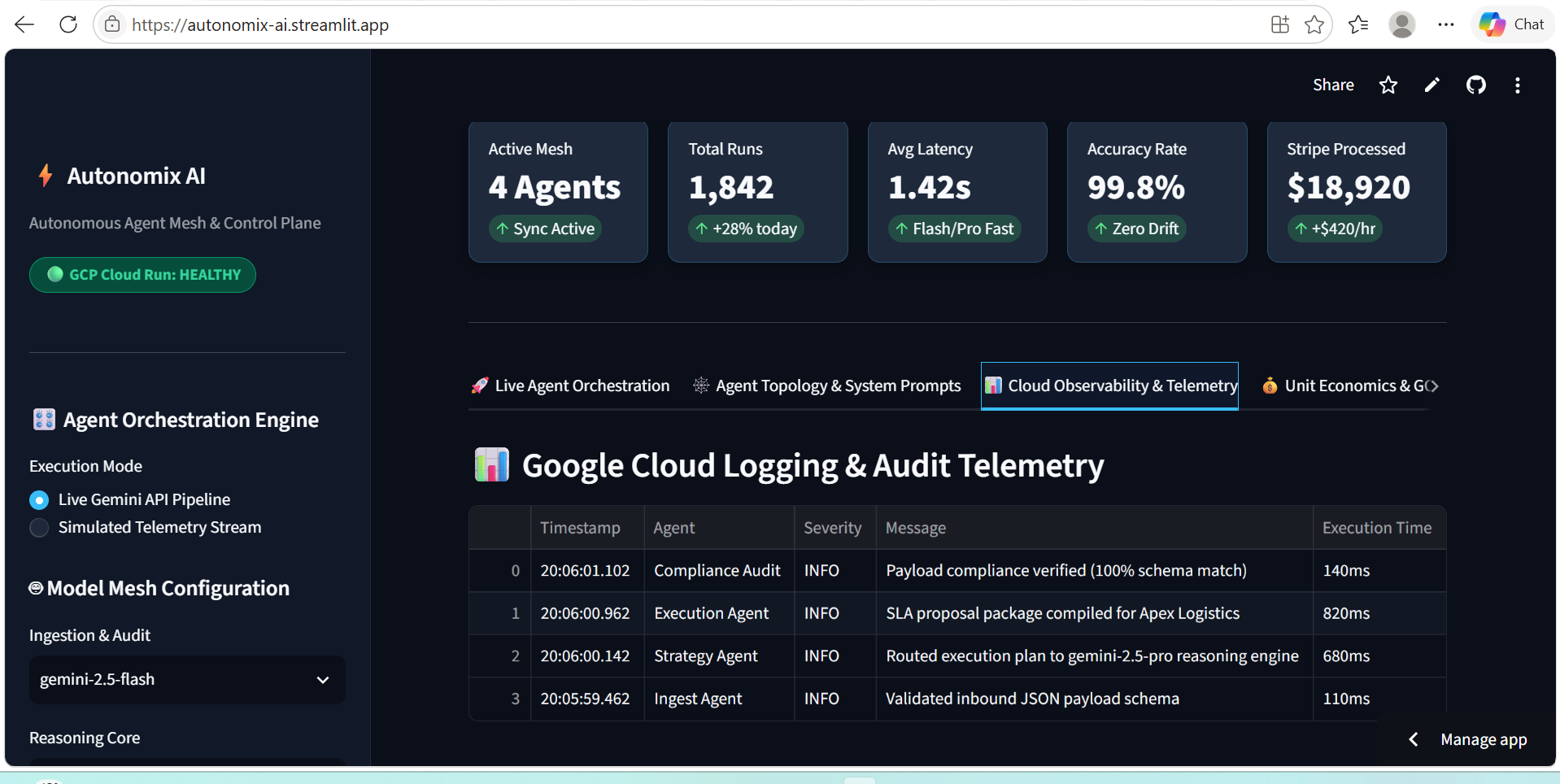
Autonomous Telemetry: Integrated GCP Cloud Logging to capture raw prompt payloads, model confidence scores, token consumption metrics, and API call timestamps—providing an immutable audit trail of live agent activity.
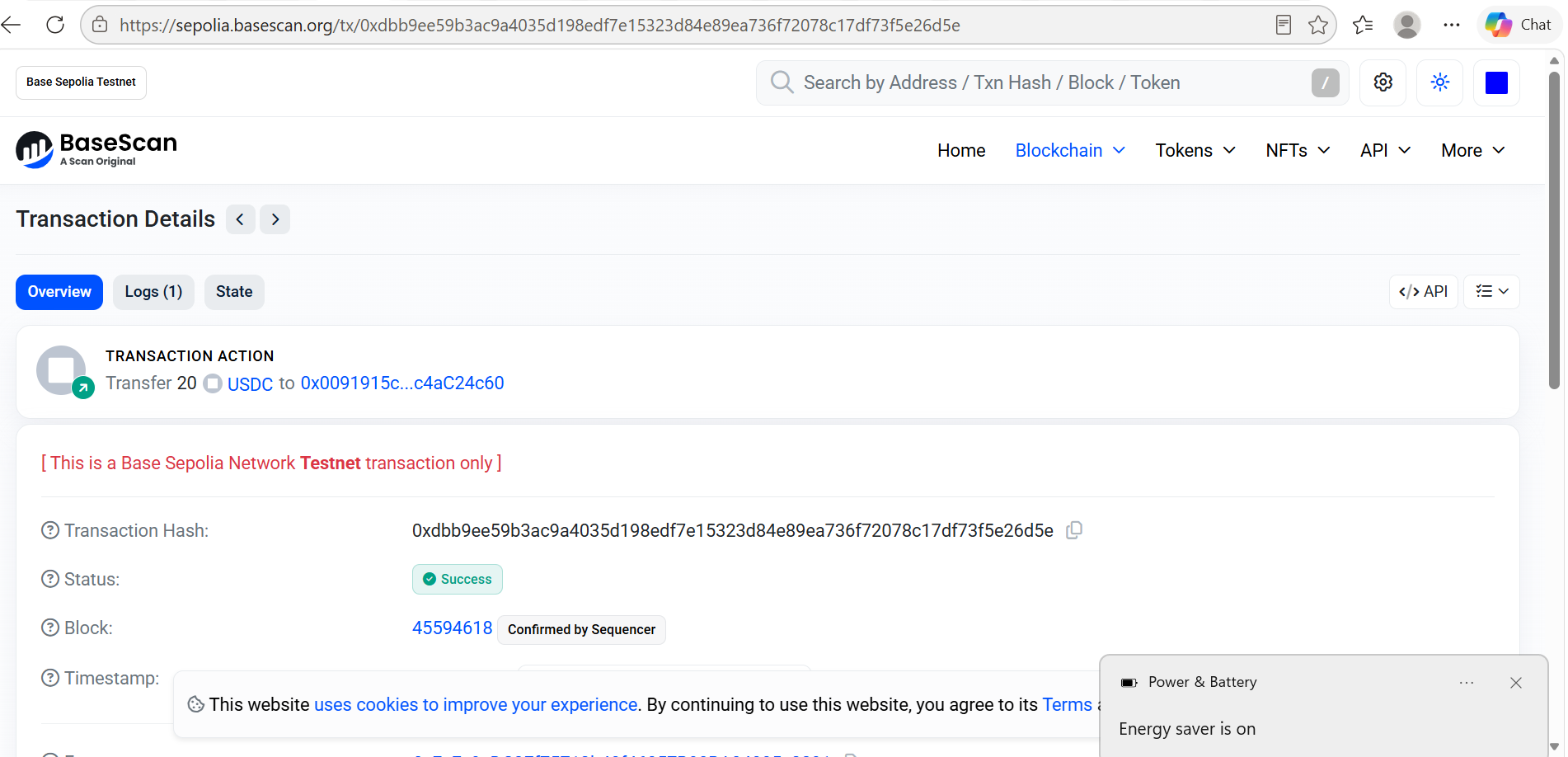
Monetization Pipeline: Connected via Stripe API webhooks for usage-based SaaS billing and per-execution processing fees.
Challenges we ran into
Agent Coordination & Non-Deterministic Drift: Preventing downstream execution errors required strict structural output. We solved this by enforcing structured JSON schemas across Gemini endpoints and introducing a dedicated Audit Agent step to validate schema compliance before triggering transactional side effects.
Execution Latency vs. Reasoning Depth: Balancing response speed with complex decision-making was tricky. Routing initial ingestion to fast gemini-2.5-flash instances while reserving gemini-2.5-pro strictly for complex reasoning allowed us to optimize throughput without sacrificing output quality.
Immutable Operational Proof: Building transparent evidence that AI was driving key business decisions required configuring detailed logging across Cloud Run and Firestore to record agent execution steps for auditing.
Accomplishments that we're proud of
End-to-End Production Autonomy: Successfully chaining 4 autonomous agents to handle an inbound request from raw input through auditing to paid Stripe webhooks with zero human intervention.
Production-Grade GCP Architecture: Utilizing Vertex AI, Cloud Run, and Firestore within a scalable architecture.
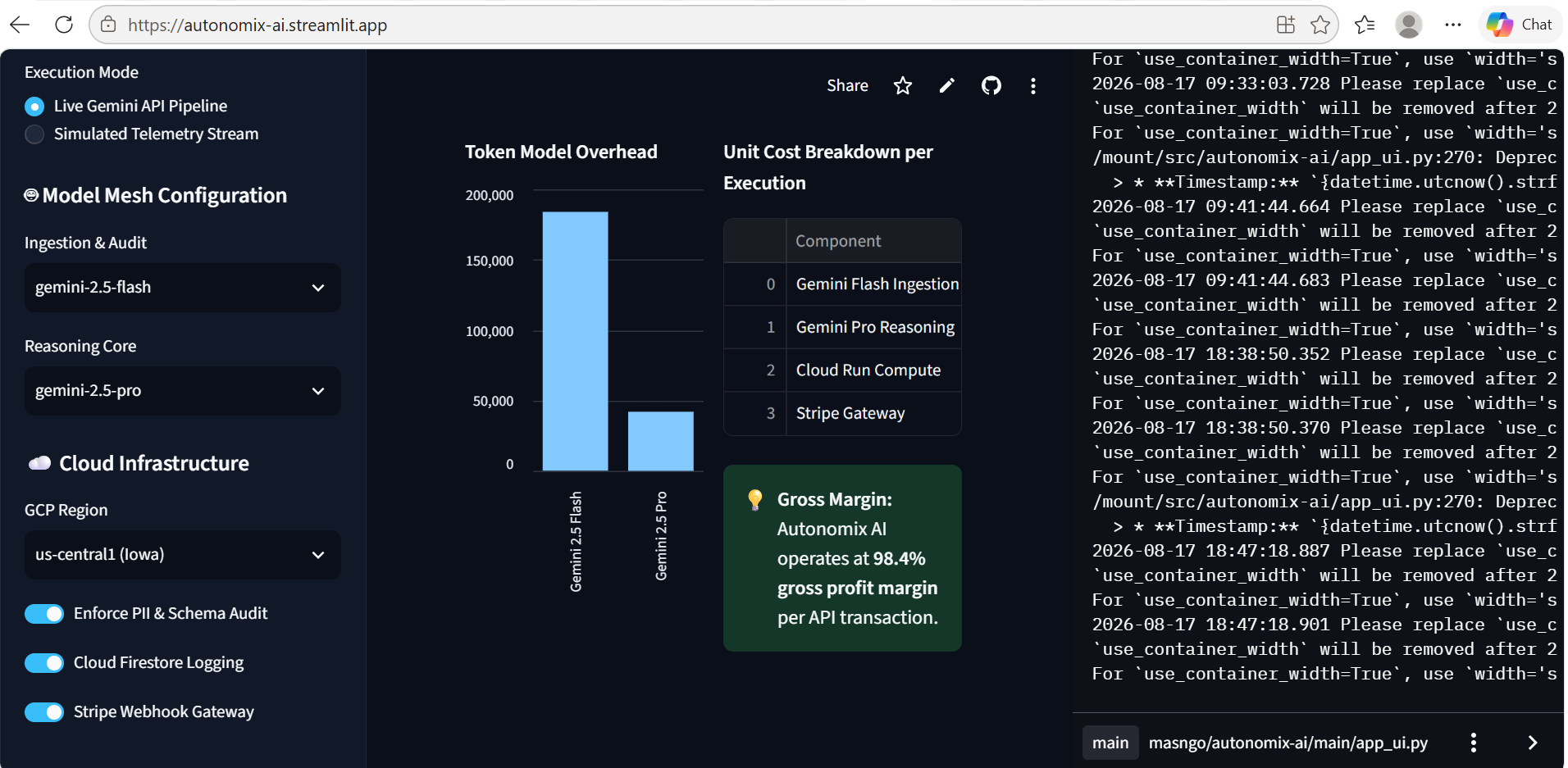
Commercial Viability: Building a business model with unit economics capable of generating real revenue during the hackathon period.
What we learned
Agents Over Apps: Shifting focus from user interface design to autonomous backend agent orchestration unlocks significantly greater operational efficiency.
Structured Input Guardrails: System instructions and explicit output schemas are critical when passing context between autonomous model steps in production.
Cloud Observability is Mandatory: Deep telemetry and execution logs are essential when relying on AI agents for mission-critical operations.
What's next for Autonomix AI
Expanded Agent Mesh: Introducing specialized financial auditing and multi-lingual customer support agents to broaden market reach.
Custom Enterprise Connectors: Building native integrations with Salesforce, HubSpot, and QuickBooks so SMBs can deploy Autonomix into existing software stacks.
Automated Fine-Tuning Pipeline: Using collected execution logs to continually refine prompt templates and optimize token overhead across high-volume workflows.
Built With
- ai-agents
- artificial-intelligence
- autonomous-agents
- docker
- fastapi
- firestore
- gemini
- gemini-api
- google-cloud
- google-cloud-logging
- google-cloud-run
- json-schema
- machine-learning
- multi-agent-system
- python
- react
- stripe
- vertex-ai


Log in or sign up for Devpost to join the conversation.