What is AutoNAS?
AutoNAS is an intelligent Neural Architecture Search system that uses AI agents and and reinforcement learning to design optimal neural networks automatically.
The Problem We Solve
Traditional NAS requires:
- 🔥 Days/weeks of GPU training to evaluate each architecture
- 💰 $10,000s in cloud compute costs Traditional NAS methods require expensive GPU training (hours to days)
- 🧠 Deep expertise in neural network design
- Manual architecture design is trial-and-error
Neural Architecture Search (NAS) Market Overview
- Purpose: Enhances model performance, efficiency, and deployment adaptability across AI domains.
- 2024 Market Size: Estimated between $420M – $670M globally.
- Forecast (2033): Expected to reach ~$3.28B, driven by AutoML, edge AI, and enterprise AI adoption.
- Growth Drivers:
- Rising demand for efficient AI models.
- Expansion of cloud-based AutoML platforms.
- Edge and hardware-aware AI optimization.
- Reduced time and cost for model development.
Our Solution
AutoNAS delivers:
- Chat-based interface - describe your requirements in natural language
- ⚡ Zero-cost evaluation - instant architecture scoring without training for quick check
- Daytona sandbox training - for real validation
- Online RL - learns and improves in real-time as you search
- Complete automation - from user query to production-ready PyTorch code
- 🤖 AI agents that understand your requirements
Three Core Innovations
1️⃣ Zero-Cost NAS (Instant Architecture Evaluation)
- Uses NASWOT, Synflow, GradNorm proxies
- Evaluates architectures in milliseconds (not hours)
- Backed by NAS-Bench-201: 15,625 pre-computed architectures
2️⃣ Multi-Agent Orchestration
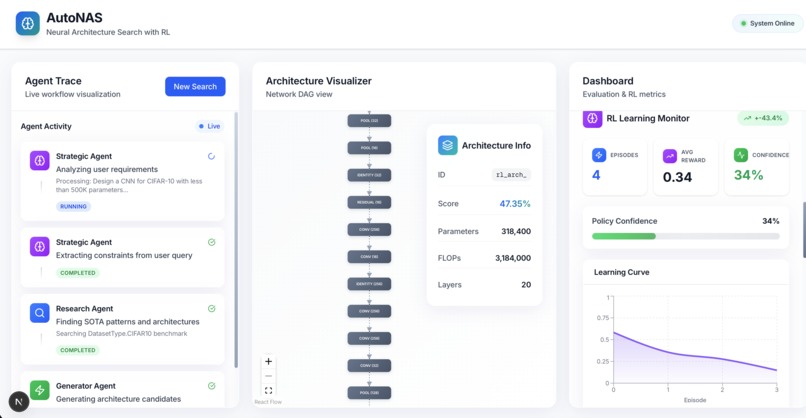
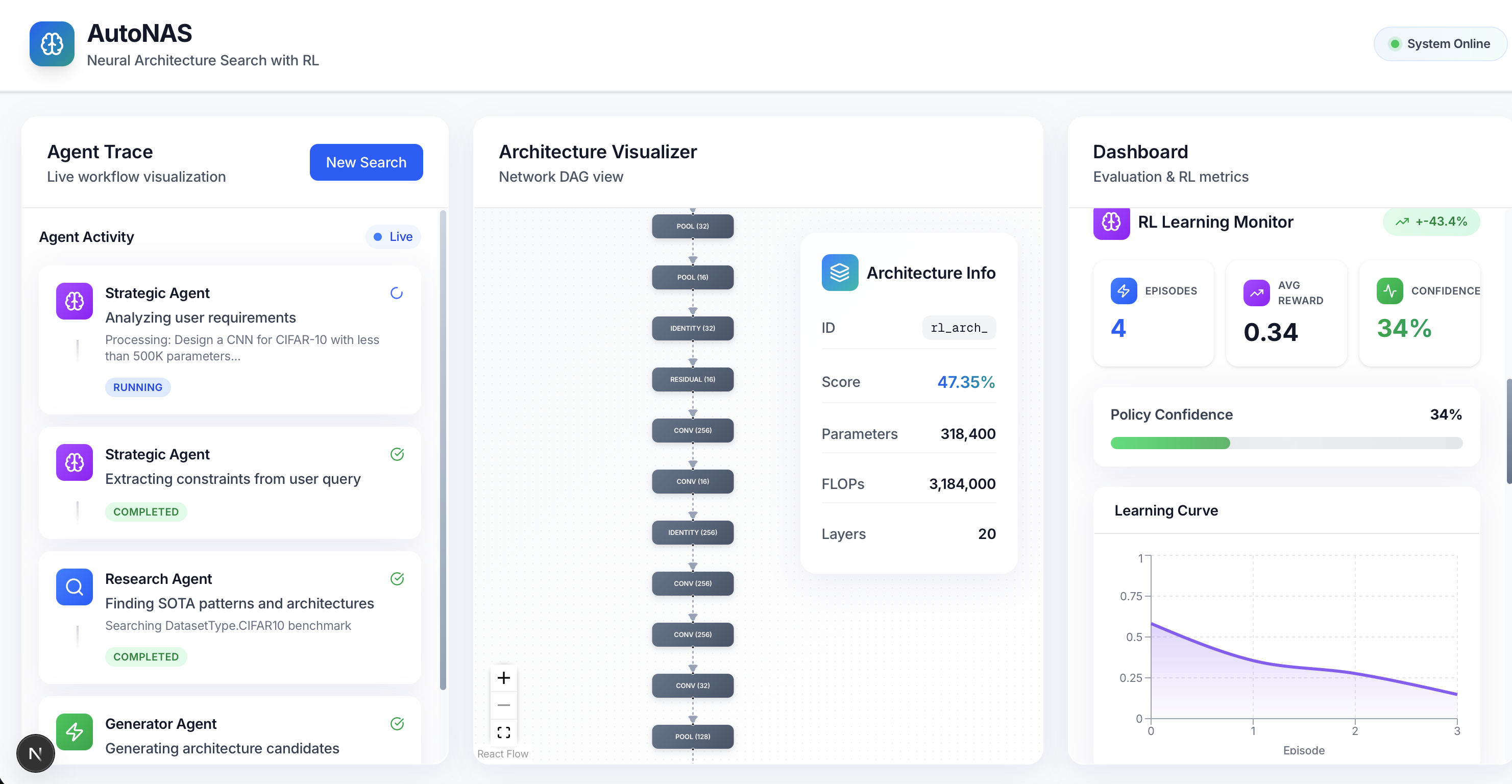
- Strategic Agent: Understands natural language requirements
- Research Agent: Finds state-of-the-art patterns
- Generator Agent: Creates & evaluates candidates
- Validation Agent: Ensures code correctness
3️⃣ Online Learning with Serverless RL
- W&B Serverless RL trains policies in the cloud
- Learns from every architecture evaluation
- Gets smarter over time without local infrastructure
System Architecture
High-Level Design
┌─────────────────────────────────────────────────────────────┐
│                     Frontend (Next.js)                      │
│  Natural Language Query → Real-time Results & Visualizations│
└─────────────────────┬───────────────────────────────────────┘
                      │
              ┌───────▼───────┐
              │  FastAPI REST │
              │   + WebSocket │
              └───────┬───────┘
                      │
        ┌─────────────┼─────────────┐
        │             │             │
┌───────▼────────┐ ┌─▼──────────┐ ┌▼─────────────┐
│ Strategic Agent│ │ Zero-Cost  │ │ Serverless RL│
│  (Google ADK)  │ │    NAS/Daytona     │ │   (W&B)      │
└───────┬────────┘ └────────────┘ └──────────────┘
        │
   ┌────┴────┬─────────┐
   │         │         │
┌──▼──┐ ┌───▼───┐ ┌───▼──────┐
│Rsch │ │  Gen  │ │   Val    │
│Agent│ │ Agent │ │  Agent   │
└─────┘ └───────┘ └──────────┘
Design Rationale
- Modular: Each agent is independent and specialized
- Scalable: Serverless RL handles computation in the cloud
- Observable: Weave traces every LLM call for debugging
Agent Orchestration & End-to-End Workflow
Complete User Journey
Step 1: User Input (Natural Language)
"Find me a CNN for CIFAR-10 with under 1M parameters"
Step 2: Strategic Agent (Google ADK + Gemini)
- Parses natural language using Gemini 2.5 Flash
- Extracts constraints: dataset=cifar10, max_params=1M
- Coordinates the workflow
Step 3: Research Agent (Tavily API)
- Searches academic papers and benchmarks
- Finds SOTA patterns: ResNet blocks, SE modules, etc.
- Returns design insights
Step 4: Generator Agent (LLM + RL)
- LLM-based generation: Creates diverse candidates
- RL-based generation: Uses learned policy for better suggestions
- Zero-Cost evaluation: NASWOT + Synflow scores in <100ms
- Logs to W&B: (state, action, reward) for online learning, Traces for LLM chat observability
Step 5: Results to User
- Top-ranked architectures with explanations
- Real-time learning curves showing RL improvement
- Pareto frontier visualization (accuracy vs. efficiency)
- Detailed evaluation metrics
Complete Tech Stack
🧠 AI & LLM Infrastructure
| Technology |
Purpose |
Why We Use It |
| Google Cloud AI |
Multi-agent orchestration |
|
| → ADK (Agent Dev Kit) |
Agent framework |
Structured agent design with built-in tools |
| → Gemini 2.5 Flash |
LLM backbone |
Fast inference, strong reasoning |
📊 ML Ops & Observability
| Technology |
Purpose |
Why We Use It |
| Weights & Biases |
ML experiment tracking |
|
| → Serverless RL |
Online policy learning |
PPO training without local GPU infra |
| → Weave |
LLM call tracing |
Debug agent chains, cost tracking |
🔍 Research & Search
| Technology |
Purpose |
Why We Use It |
| Tavily API |
Research agent search |
Academic paper search, SOTA patterns |
🛡️ Safe Code Execution
| Technology |
Purpose |
Why We Use It |
| Daytona |
Validation agent sandbox |
Run generated code in isolated Python env |
🏗️ Infrastructure
| Technology |
Purpose |
Why We Use It |
| FastAPI |
Backend REST API |
Async support, WebSocket for real-time |
| Next.js 14 |
Frontend framework |
React Server Components, fast UX |
| TypeScript |
Type safety |
Catch errors at compile time |

Log in or sign up for Devpost to join the conversation.