-
-
AutoMoney — AI Trend Discovery and Multi-Platform Content Automation
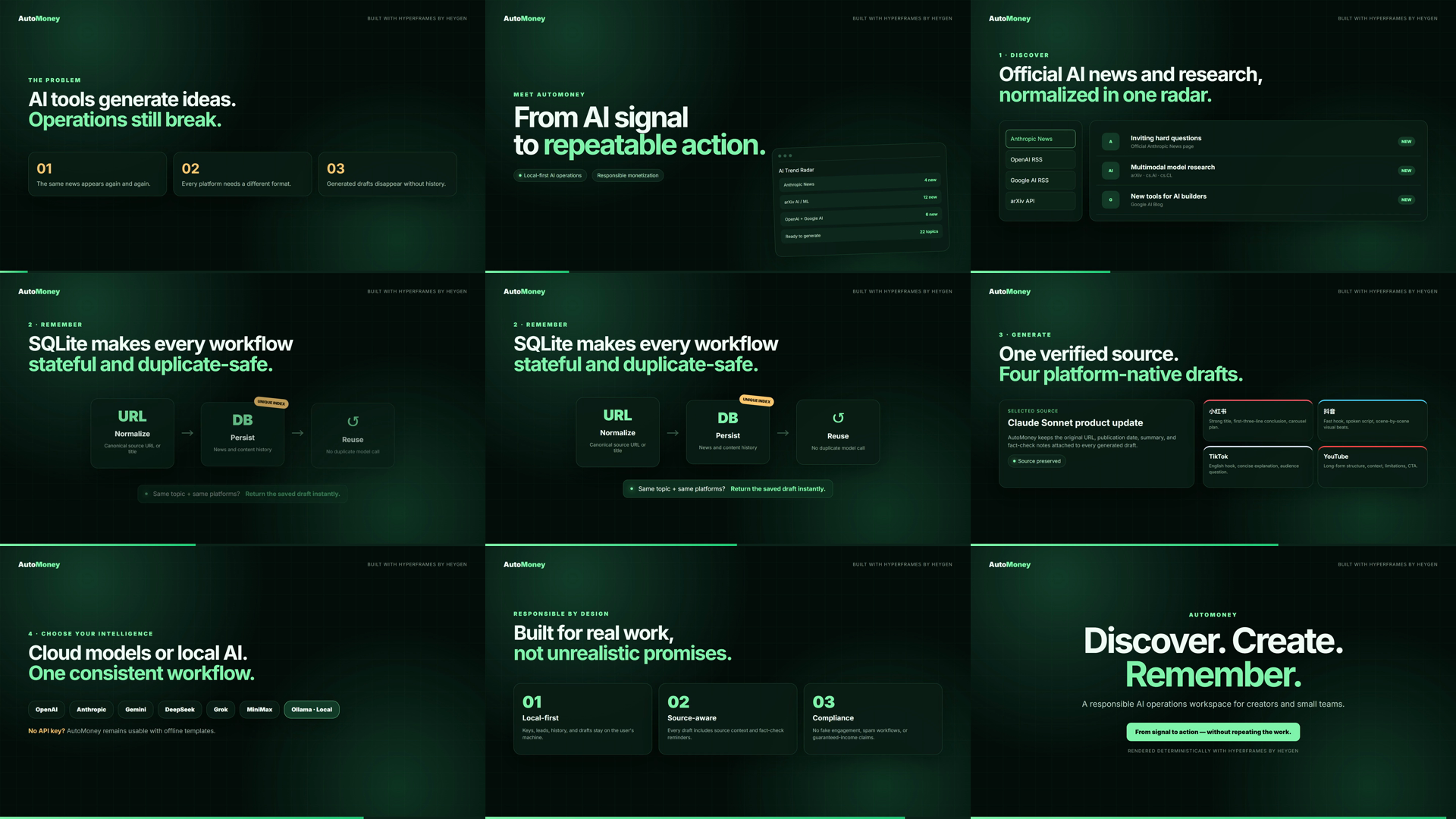
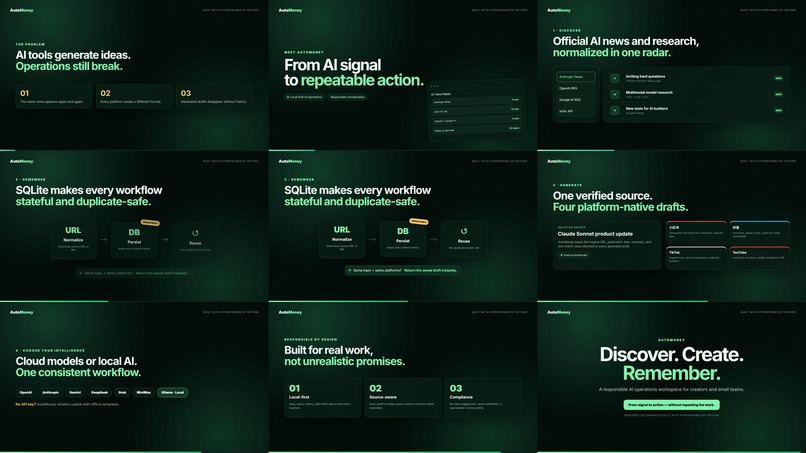
Inspiration Many freelancers, creators, and small businesses want to use AI to earn income, but most tools stop at generating generic ideas. The harder part is turning an idea into a repeatable workflow: finding relevant opportunities, creating platform-specific content, tracking leads, preserving useful history, and avoiding duplicate or misleading output. We built AutoMoney to bridge that gap. Instead of promising “one-click passive income,” it acts as a practical AI operations workspace that helps users move from opportunity discovery to content creation and customer follow-up. What it does AutoMoney is a local-first AI business and content operations platform. It helps users: Discover recent AI papers and official company news from sources such as arXiv, OpenAI, Anthropic, and Google AI. Avoid repeatedly showing previously discovered news. Turn a paper, product release, or news item into platform-specific content for Xiaohongshu, Douyin, TikTok, and YouTube. Generate hooks, titles, scripts, captions, hashtags, visual plans, and fact-checking notes. Prevent duplicate content generation by reusing saved drafts for the same topic and platform combination. Create practical service offers, outreach messages, pricing suggestions, delivery checklists, and daily action plans. Track potential customers and next actions. Connect to OpenAI, Anthropic, DeepSeek, MiniMax, Gemini, Grok, or a local Ollama model. Continue working with offline templates when no API key is configured. Apply compliance checks to discourage spam, fake engagement, unrealistic income claims, and other risky behavior. How we built it AutoMoney uses a lightweight, local-first architecture built with Node.js and a browser-based interface. The backend: Fetches AI papers through the arXiv API. Reads official RSS feeds from OpenAI and Google AI. Parses Anthropic’s official News page because its previous RSS endpoint is no longer available. Normalizes and deduplicates news from different sources. Uses native Node.js SQLite with WAL mode for persistent and concurrent storage. Stores discovered news by unique URL. Stores generated content using a unique key derived from the source URL or title and the selected platform combination. Prevents simultaneous requests from generating the same draft twice. Routes generation requests to configured AI providers, with automatic fallback to local templates. The frontend is implemented with HTML, CSS, and JavaScript. It provides an AI trend radar, manual topic entry, multi-platform selection, provider configuration, content results, lead tracking, and searchable generation history. Sensitive API keys remain on the user’s machine and are never collected through simulated logins, browser cookies, or unofficial authentication methods. Challenges we ran into One challenge was dealing with inconsistent external sources. Some publishers provide RSS feeds, while others change or remove their feeds. Anthropic’s previous RSS URL returned a 404 response, so we created a parser for its official News page while keeping source failures isolated. If one source fails, the remaining sources can still return results. Another challenge was reliable deduplication. Deduplicating only within one request was not enough because restarting the application or searching again could surface the same stories. We introduced persistent SQLite records and database-level unique constraints to distinguish newly discovered news from previously processed items. Content generation had a similar problem. Users could click the generation button multiple times and spend model tokens producing nearly identical drafts. We solved this with a persistent uniqueness key and an in-memory generation lock. Repeated requests now reuse an existing result, including during concurrent requests. Supporting several AI providers was also challenging because their request formats, authentication mechanisms, and response structures differ. We built a common provider layer and retained an offline template mode so that the application remains usable without external services. Accomplishments that we're proud of We are proud that AutoMoney goes beyond a basic prompt interface and delivers an end-to-end operational workflow. Key accomplishments include: Persistent news and content deduplication backed by SQLite. Multi-platform content generation from one verified source. Support for cloud and fully local AI models. Graceful recovery when an external source or AI provider fails. Offline operation without an API key. Built-in fact-check reminders and platform-specific compliance guidance. Local storage of provider settings, lead records, news history, and generated drafts. Protection against duplicate model calls, reducing both cost and unnecessary content repetition. A practical focus on responsible monetization rather than unrealistic “automatic income” claims. What we learned We learned that building a useful AI product is less about adding more prompts and more about managing state, reliability, and user trust. Persistent history is essential. Without it, an AI workflow repeatedly discovers the same information and regenerates the same output. Database constraints are more reliable than depending only on application-level checks. We also learned that external content sources change frequently. A production-ready aggregator needs independent failure handling, fallback extraction methods, normalized data, and clear error reporting. Most importantly, responsible AI monetization tools should help users perform real work—not promise guaranteed outcomes. Sources, limitations, fact-checking steps, and platform rules need to be part of the workflow rather than an afterthought. What's next for AutoMoney Our next steps are to evolve AutoMoney from a local content workspace into a complete, measurable AI operations system. Planned improvements include: Semantic deduplication to detect different URLs covering the same underlying story. Full-text search, filtering, and reopening of historical drafts. Optional regeneration and version comparison when users deliberately want a new angle. Automated content calendars and scheduled publishing integrations. Performance tracking across platforms. Lead pipeline analytics and follow-up reminders. Team workspaces with roles and approval workflows. Source credibility scoring and stronger citation support. More official news sources and resilient extraction adapters. Migration of lead and business-plan history into SQLite. Encrypted local API-key storage. Export to Markdown, CSV, and common content-management tools. A plugin architecture for custom sources, platforms, and AI providers. Our long-term vision is for AutoMoney to become a responsible AI operating layer that helps individuals and small teams discover opportunities, create useful content, organize customer work, and learn from every completed workflow.


Log in or sign up for Devpost to join the conversation.