-
-
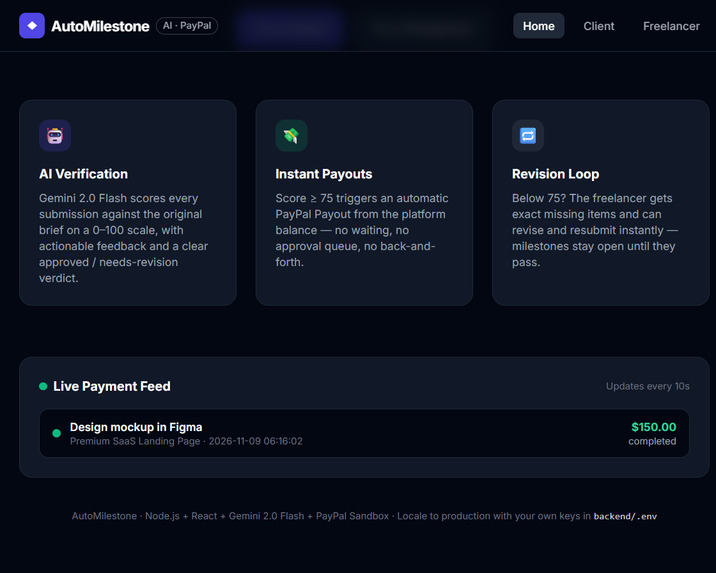
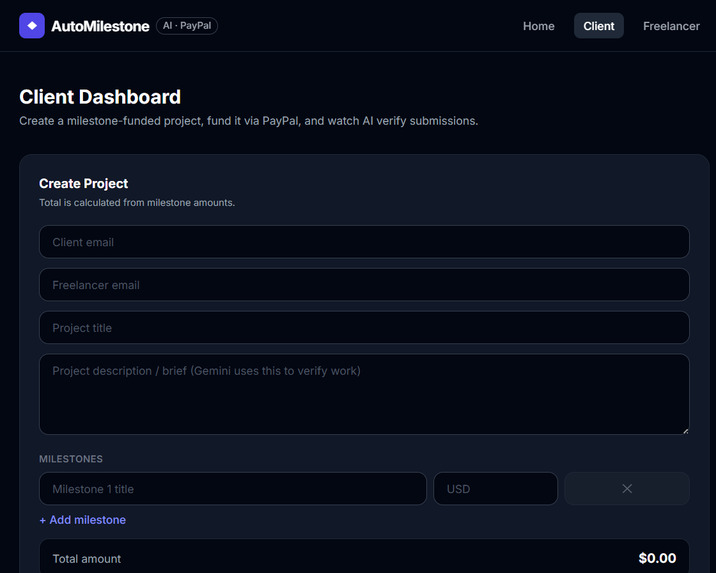
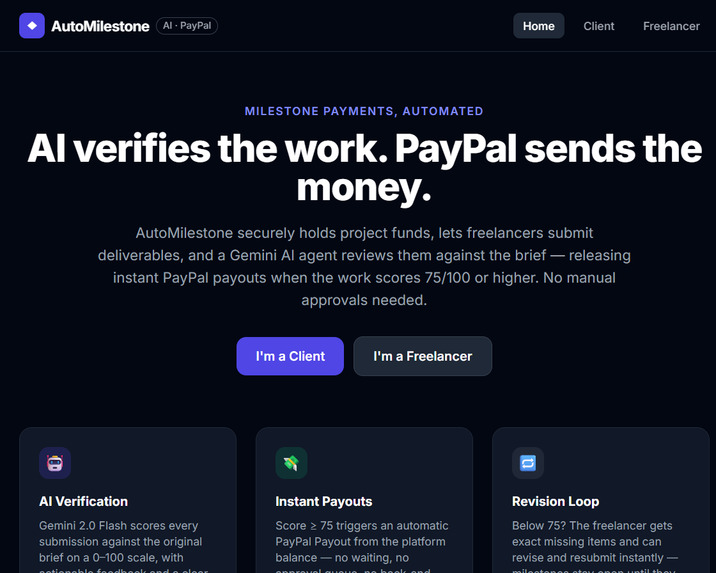
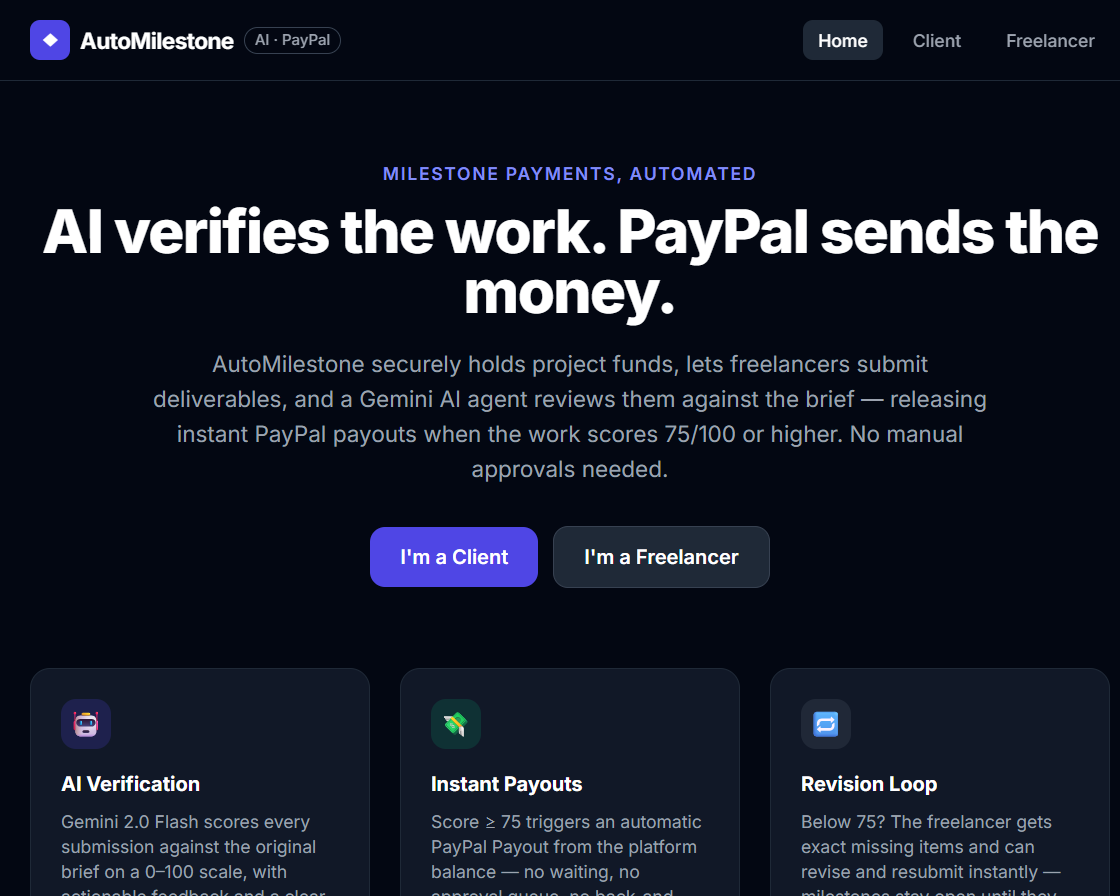
Home-Landing
-
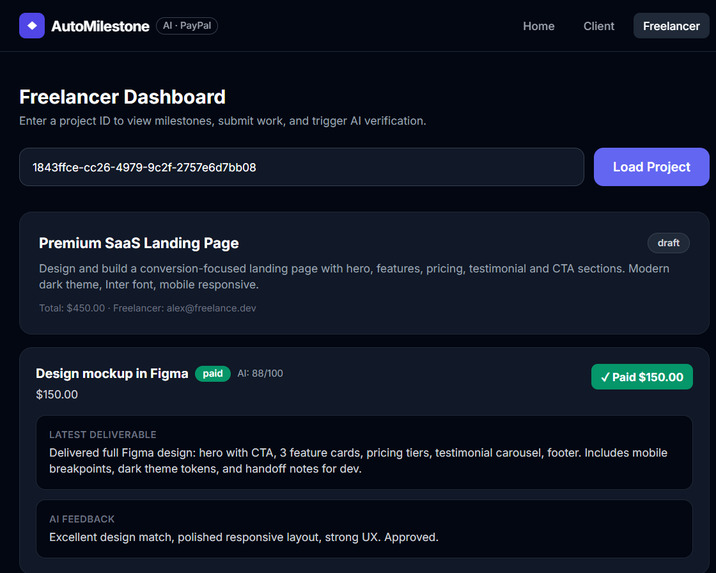
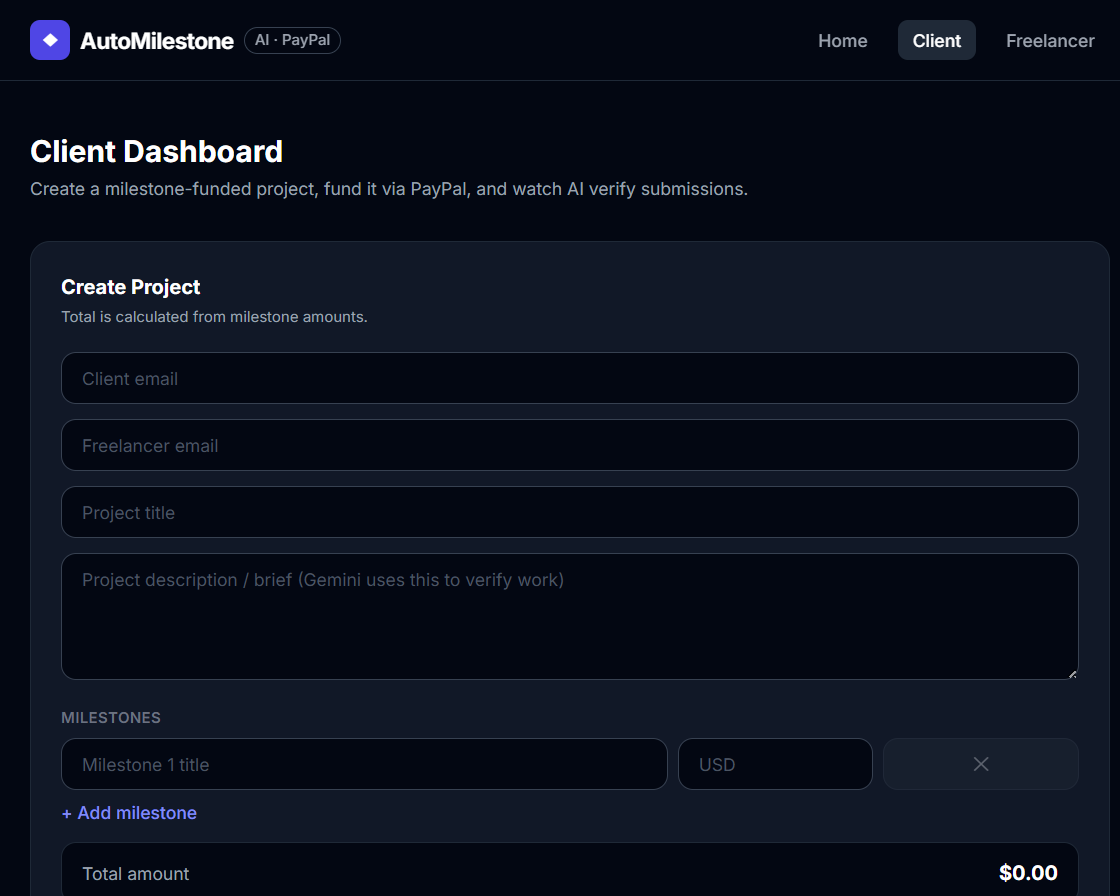
Client-create
-
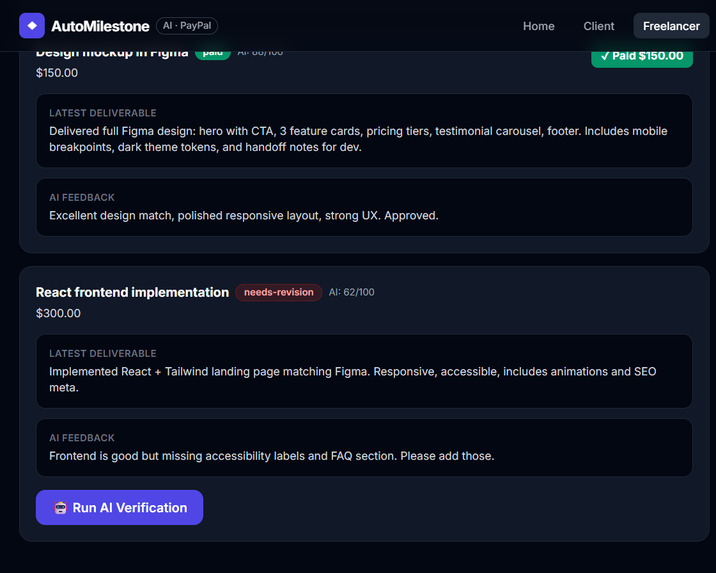
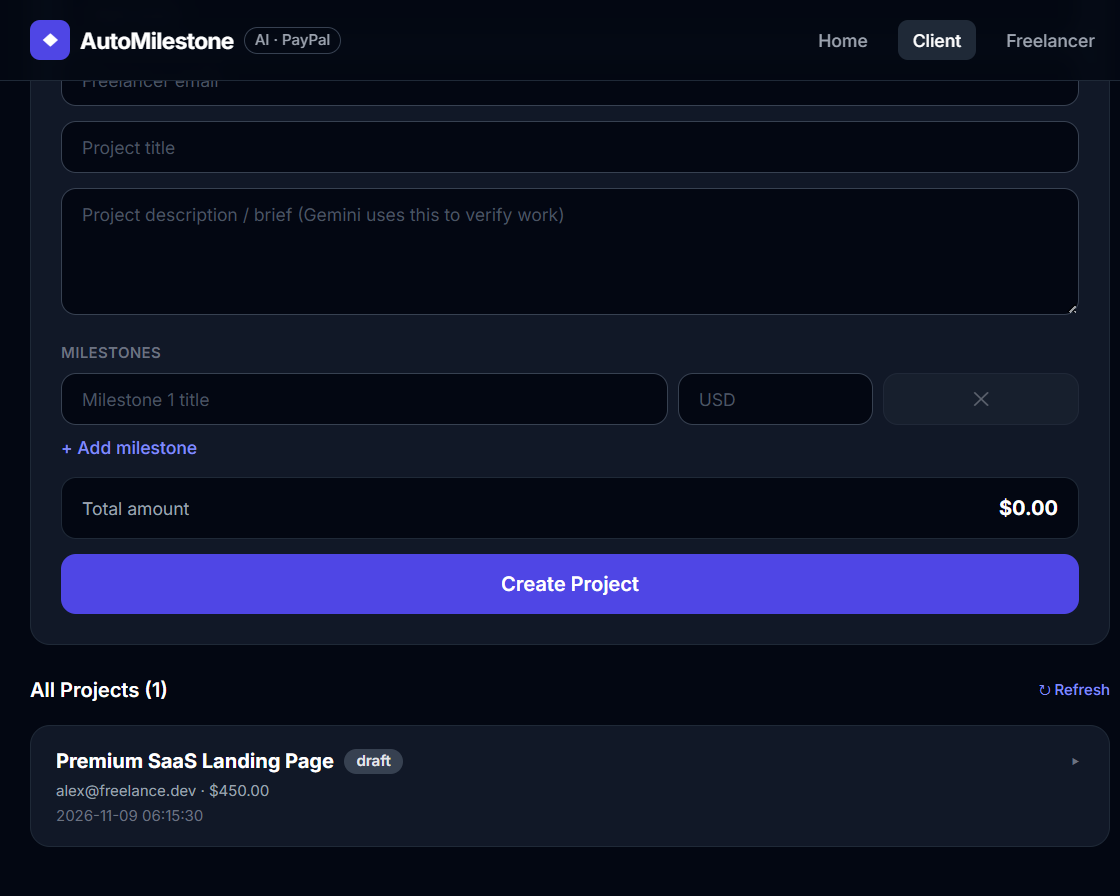
Client-project-list
-
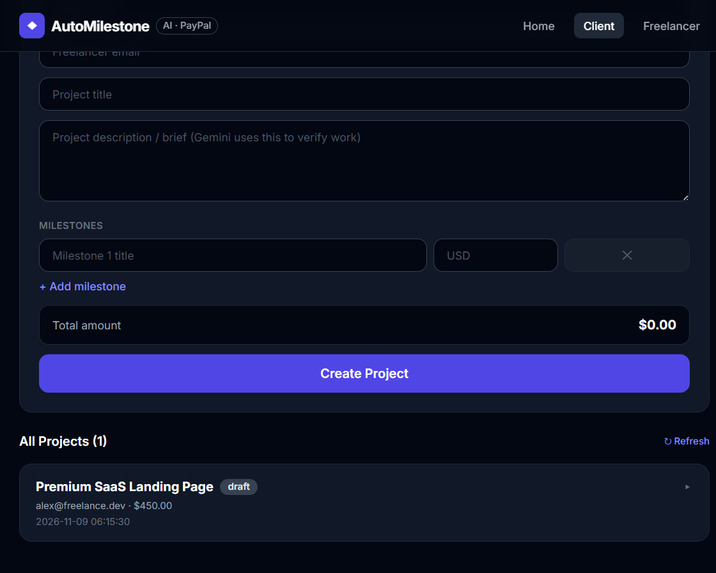
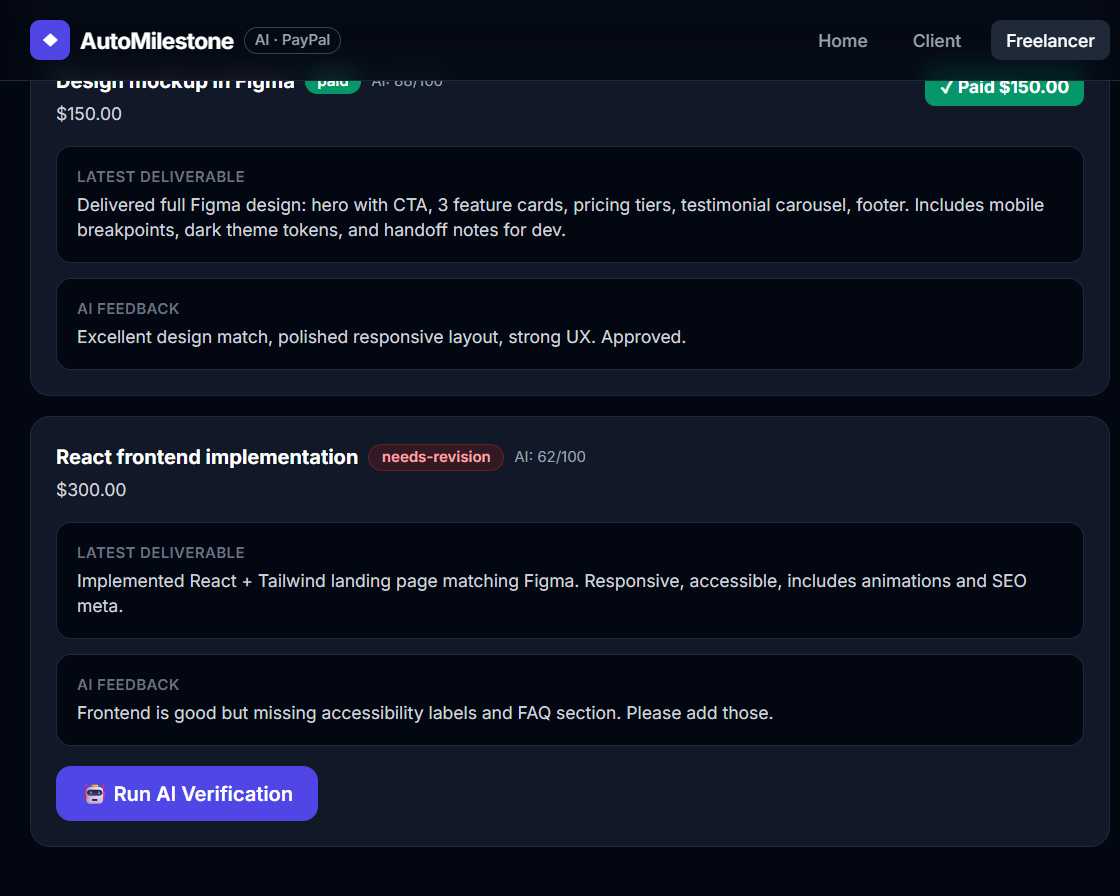
Freelancer-verify
-
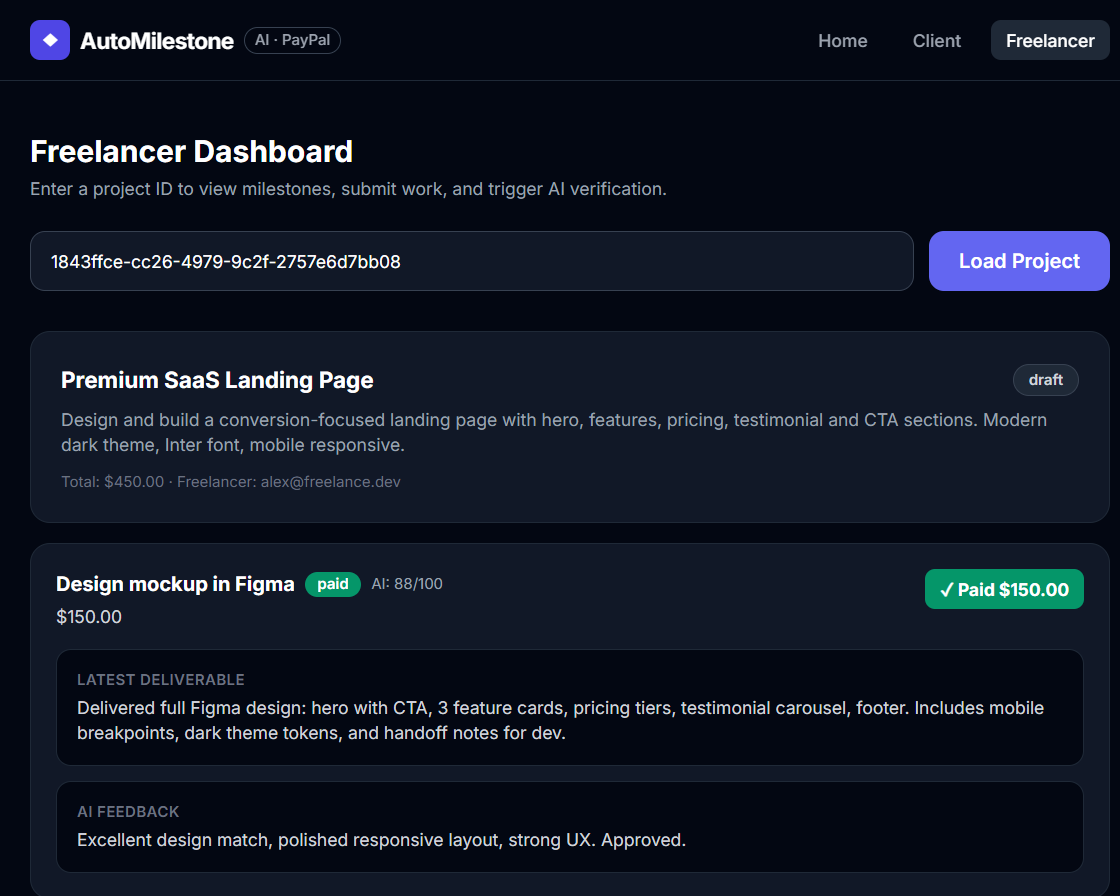
ai-approved-paid
-
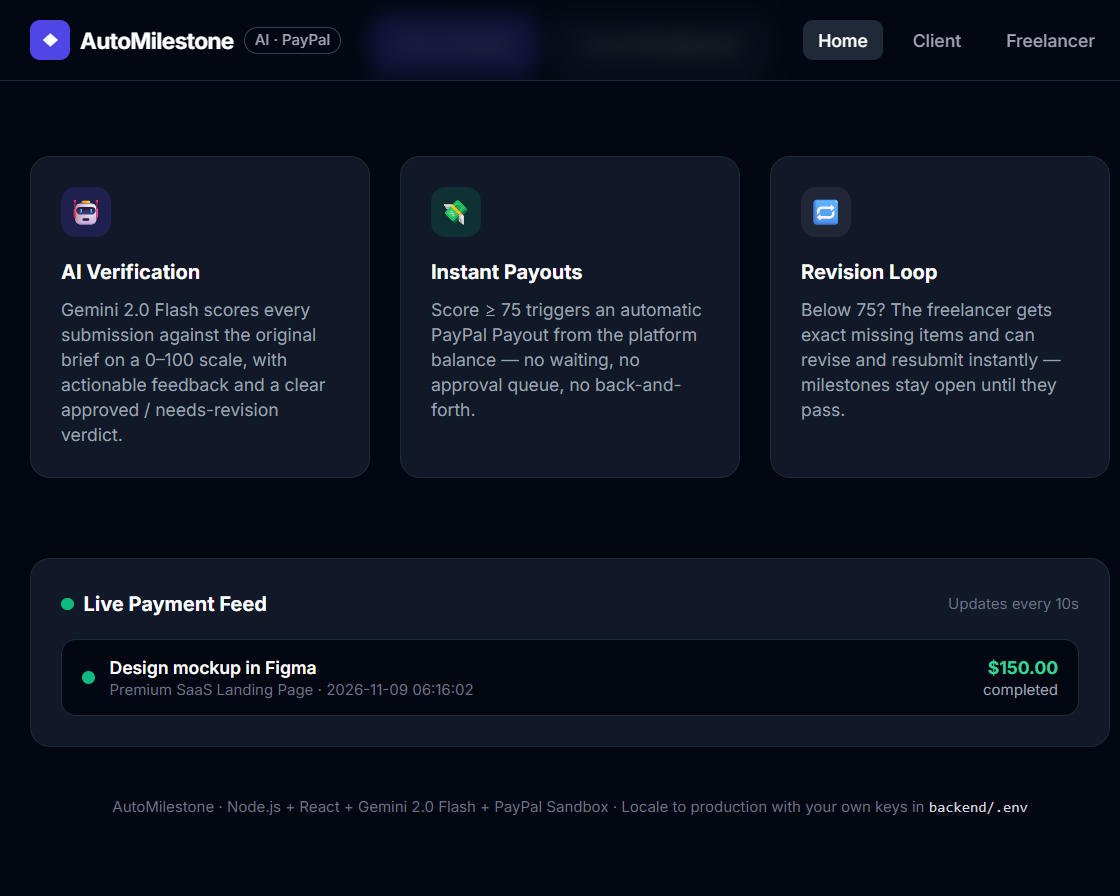
live-payment-feed
Inspiration Freelancing still runs on trust gaps. Clients pay upfront and pray the freelancer delivers, freelancers deliver and chase invoices for weeks, and manual approvals kill momentum. We kept asking: what if payment wasn't tied to time, but to verified quality?
Inspiration came from that frustration — what if an AI could read the original brief, review the actual deliverable like a real reviewer, and release money instantly only when the work is really good? No human in the middle, no awkward "approve it" messages, just work → verify → pay.
AutoMilestone was born from the idea that AI verification + programmable payouts can make freelancing boring in the best way: transparent, fast, and fair to both sides.
What it does AutoMilestone is an AI-powered freelancer payment automation platform built around milestone-based escrow.
A client creates a project with 1+ milestones (title + USD amount). The client funds it via PayPal Orders API, so money is held escrow-style. A freelancer opens the project by ID, submits their deliverable_text, and clicks "Run AI Verification".
Our Google Gemini 2.0 Flash agent reviews the submission against the original brief and milestone title. It returns a structured score (0-100) with feedback and missing items. If the score is ≥75, the backend automatically fires a PayPal Payout to the freelancer, creates a payment record, and marks the milestone paid — no manual approval needed. If it's below 75, the freelancer gets exact revision feedback and can resubmit.
Everything is visible live: client dashboard, freelancer dashboard, and a polling Live Payment Feed that updates every 10 seconds when webhooks confirm PAYMENT.PAYOUTS-ITEM.SUCCEEDED.
How we built it We built a production-ready monorepo from scratch:
Backend — Node.js 18+ + Express 4 + SQLite:
better-sqlite3 with auto-migrated schema (projects, milestones, payments) REST APIs for projects, milestones, verify, PayPal orders, payments, and webhooks geminiService calls Gemini 2.0 Flash with a strict raw-JSON-only prompt ({approved, score, feedback, missing}), enforcing score>=75 → approved server-side with parse-error fallback paypalService handles OAuth token (cached), Orders create/capture, and Payouts via native fetch with timeouts render.yaml for one-click Render deployment Frontend — React 18 + Vite + Tailwind v3:
Dark SaaS theme (bg-gray-950, indigo/emerald accents), Inter font React Router v6: /, /client, /freelancer with persistent navbar Core components: AIVerifier (idle → loading → approved/rejected), CreateProject, MilestoneCard, PayButton (@paypal/react-paypal-js), PaymentFeed Custom useToast hook + skeleton loaders + double-submit guards Security hardening (post-hack build):
helmet + PayPal-safe CSP, CORS allowlist, 256kb body cap, rate-limits (general/writes/sensitive) express-validator for UUIDs, emails, amounts, length caps; idempotency (409 if already paid); webhook signature verification; 15s PayPal / 30s Gemini timeouts; prompt marked as untrusted data to mitigate injection; optional X-API-Key gate Challenges we ran into Node 24 + better-sqlite3 native build failure: Took 2 days to realize v11 had no prebuilt binary for Node 24 — every install failed with gyp ERR!. Fixed by upgrading to better-sqlite3@^12.2.0 with prebuilt binaries. Gemini JSON discipline: Gemini loves to wrap JSON in markdown fences. We added stripping + strict JSON.parse in try/catch, plus a fallback (score:0, "AI parse error") so a bad output never triggers a payout. Financial integrity risks: A double-click or webhook spoof could have caused a double payout. We added 409 already-paid checks, transaction-wrapped verify+pay, and PayPal webhook signature verification before flipping pending → completed. CSP vs PayPal SDK conflict: Helmet's default CSP blocked PayPal's JS SDK. We scoped CSP explicitly for paypal.com / paypalobjects.com while keeping 'self' as default. Quota + UX balance: Gemini quota errors and slow PayPal calls needed graceful fallbacks, 20s frontend timeouts, and disabled buttons to prevent double-verify. The "AI service temporarily unavailable" state had to look intentional, not broken. Accomplishments that we're proud of End-to-end automation in one flow: POST /api/projects → PayPal fund → submit → verify → payout → payment row → live feed — all verified with a 12/12 security smoke test (valid 201, bad-email 400, bad-UUID 400, large-payload 413, CSP present). A true revision loop, not just approve/reject: AI returns actionable missing[] bullets; freelancer revises and resubmits without losing the milestone. Production-style engineering: Rate-limits, validation, timeouts, token cache, redacted logs, prepared statements, graceful shutdown — not just a demo CRUD. Polished frontend: 103-module Vite build, confetti-flash on approval, live pulsing payment feed, dark SaaS polish in ~4 days. Shipped monorepo: Backend + frontend + render.yaml + README + SECURITY.md, pushed and deployed-ready on GitHub. What we learned LLMs are not deterministic — don't trust them with money. We learned to enforce thresholds server-side, validate JSON shape, cap output lengths, and always have a safe fallback (no payout on parse error). Prompt injection is real. Treating user deliverables as data between tags, not instructions, is essential even for a hackathon project. SQLite + prepared statements is surprisingly powerful for a hackathon — WAL mode, busy timeout, foreign keys, and zero-config deployment beat writing auth + Postgres in 48 hours. Security can't be an afterthought. Headers, validation, and idempotency took us a full day, but they turned a demo into something we could actually demo to investors. PayPal Sandbox is a second codebase. Token expiry, webhook IDs, payout permissions, and live vs sandbox hosts each broke us once — checklists save hours. What's next for AutoMilestone Real user auth: Replace the simple API-key gate with per-user JWT/OAuth so clients only see their projects and freelancers only theirs. Production money: Switch from Sandbox to Live PayPal, add dispute/human-review fallback when AI is borderline (70-80), and add idempotency keys on payout retries. Scale the data layer: Migrate SQLite → Postgres for multi-instance, add analytics (AI score trends, on-time rate, payout latency). Better AI: Ensemble verification (Gemini + image/PDF/file attachment review), project-specific rubrics, and multi-language brief support. Marketplace: Public project board, freelancer profiles, multi-currency escrow, invoicing/tax exports, and a mobile app. AutoMilestone started as "AI verifies the work. PayPal sends the money." — next is making it the default rail for fair, instant freelance payments.
What's next for AutoMilestone
Built With
- axios
- cors
- dotenv
- express-rate-limit
- express-validator
- express.js
- github
- google-gemini
- helmet
- javascript
- netlify
- node.js
- paypal
- react
- render
- rest-api
- sqlite
- tailwind-css
- uuid
- vite

