Inspiration
I am a Theatre major at SMU, and for our Fall musical we are needing to pay for a professional sound-mixer due to the complexity of live sound-mixing. Actors' mic's are constantly being switched on and off, and keeping track of all the sliders, volume, and staying in time with the actors is incredibly challenging with noticeable consequences of failure.
What it does
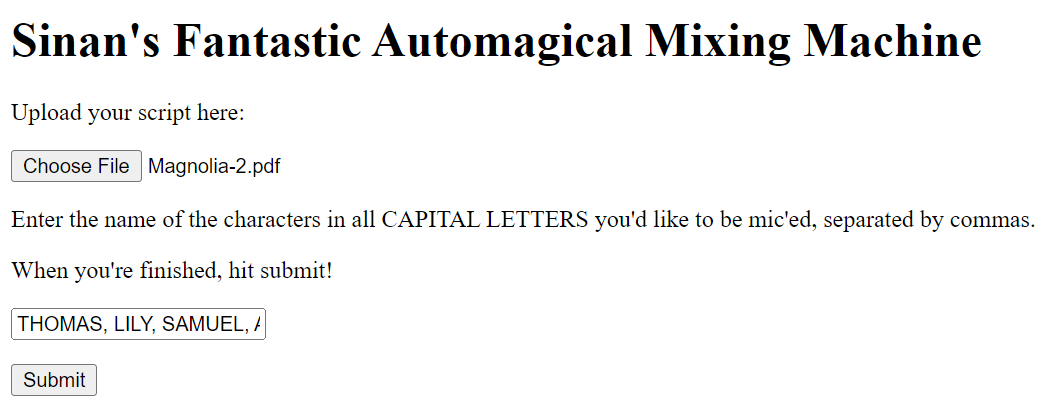
AutoMic asks for the input of which characters should be mic'ed, then scans a pdf of the script to see which characters are speaking on each page. The sound operator would simple have to hit "Next Page" as opposed to constantly moving switches.
How we built it
We scanned the pdf with PyPDF2, which also denotes pages. We then split the text into words then searched for the character's name (which is input by the user). A 2D array was then created with columns relating to characters, each row a page, and 1's standing for the character speaking on the page and 0's standing for the character not being on the page.
Challenges we ran into
The main challenge was pure lack of knowledge/experience in what we were trying to do- especially on the front end. Working with the pdf took about as long as expected, but the creation of a visual interface proved significantly more challenging than expected. We did the most we could in the time we had.
Accomplishments that we're proud of
We are proud that, despite this being our first Hackathon, we managed to get a working scan and parse of a pdf. This lays the foundation of the rest of the work ahead. We also got to begin work with Flash in the creation of an API and made decent progress!
What we learned
This entire experience was filled with learning. We got to brush up on our Python skills, including validation of logic and reading of an external file. We also got to begin work with an API, which was new territory for us all.
What's next for AutoMic
The ideal result of AutoMic is a completely autonomous, live sound-mixing product. It would be able to take in decibel readings to do on-the-spot volume adjustment of actor mic's. It would include speech-to-text software to determine near-exact placement in the script so that instead of being a page-by-page accurate product, it would be almost line-by-line accurate (getting as close to the manual operator as possible). More immediately, it would be able to scan all types of formatting for pdf scripts (as playwrights may denote characters, stage directions, bolding, etc. differently), overall making the software more robust. As needs for a production vary, there should be an intuitive GUI for the sound designer to work with to set up the software for the production prior to performance days if necessary.

Log in or sign up for Devpost to join the conversation.