-
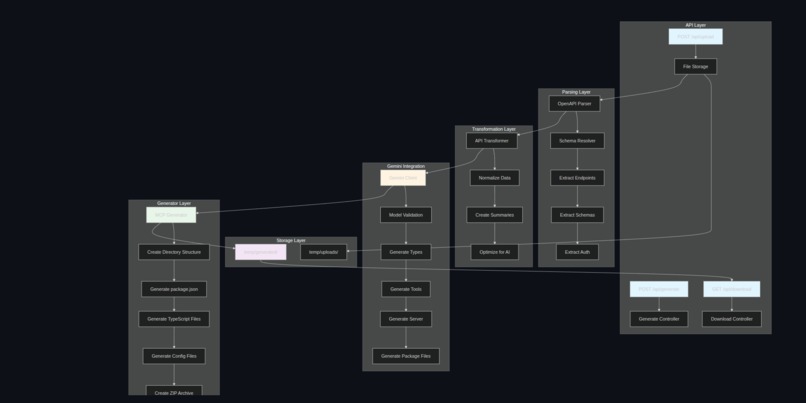
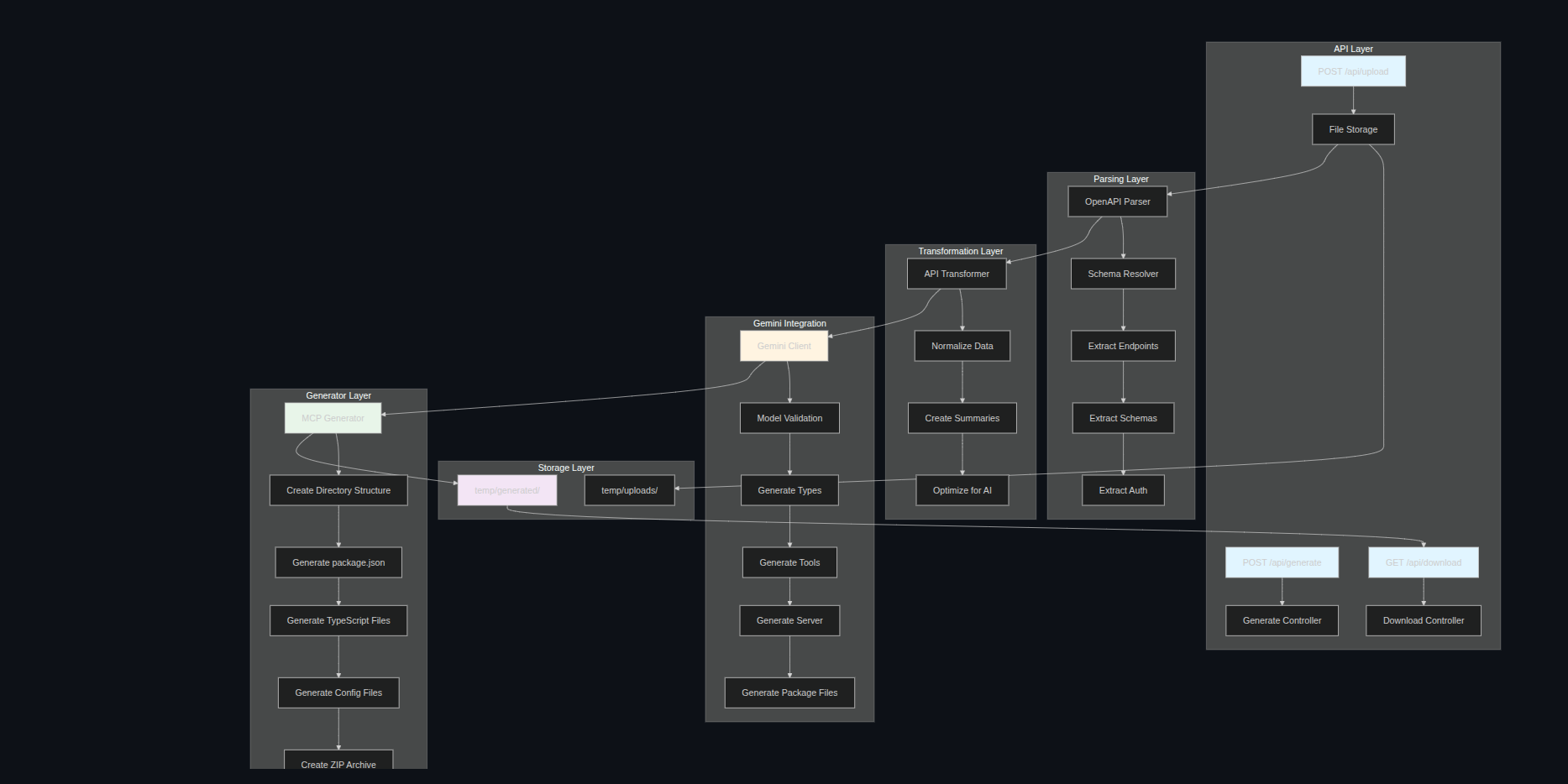
architecture
-
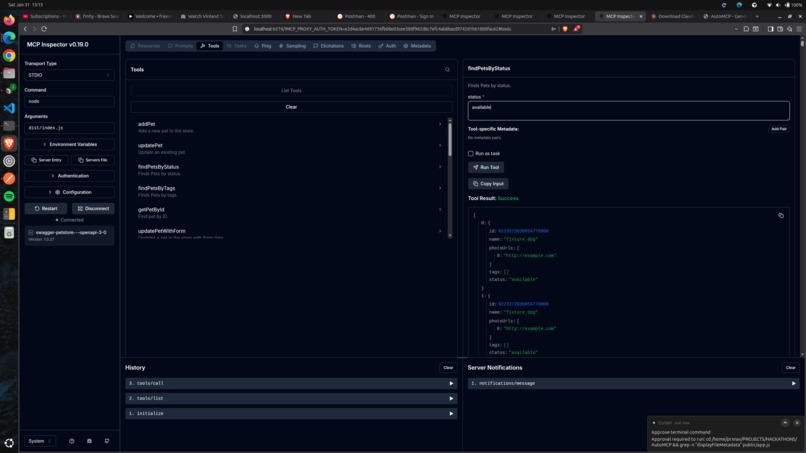
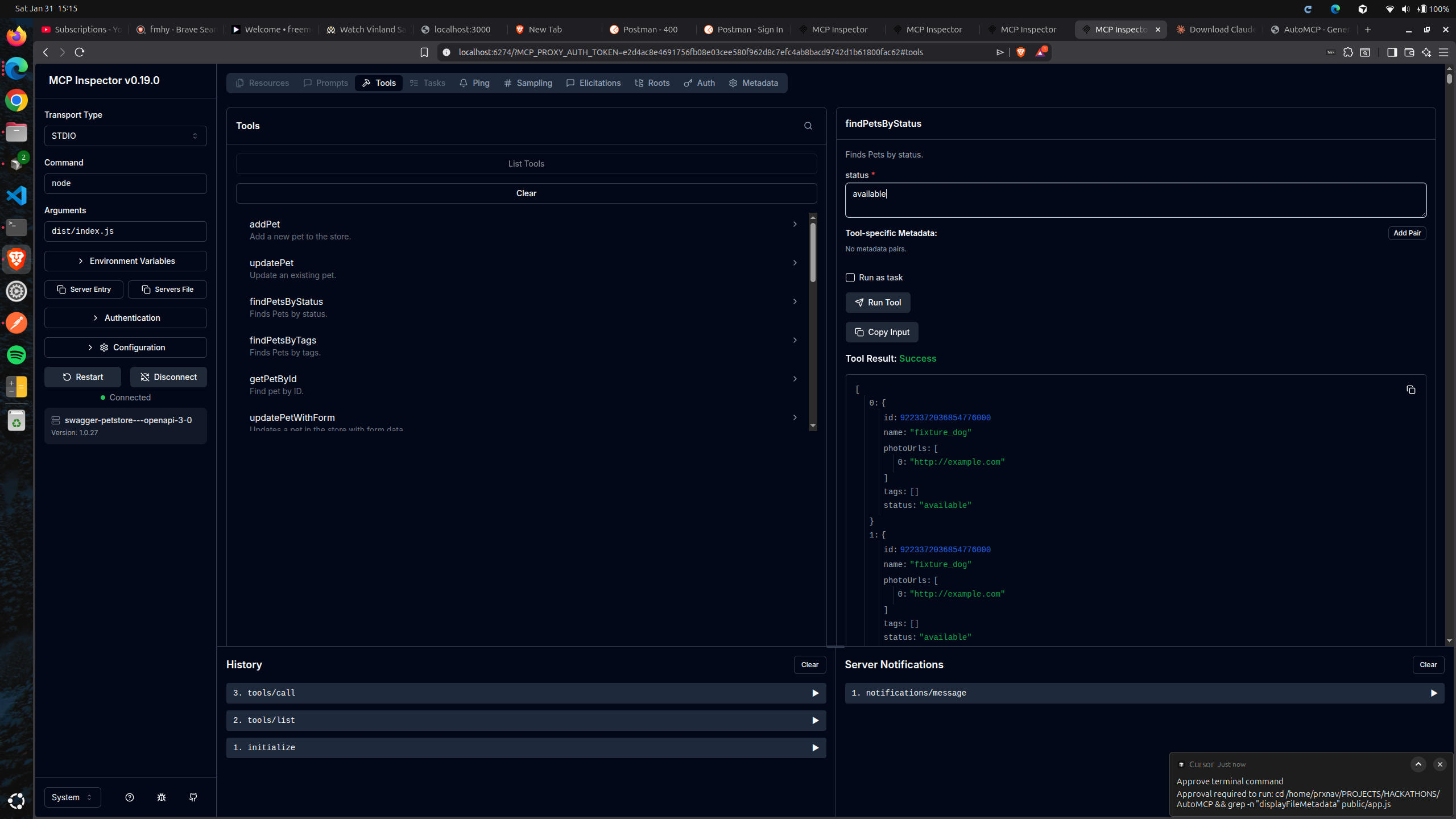
mcp inspector preview of the generated mcp server (can call successfully to the backend api mentioned by user).
AutoMCP: Automating MCP Server Generation with AI
The Inspiration 💡
Creating MCP servers manually is tedious—writing boilerplate code, defining tool schemas, handling authentication. We asked: what if we could automate this?
AutoMCP bridges API documentation and AI agent integration. Developers upload OpenAPI/Swagger docs and get a production-ready MCP server in minutes, not hours.
What We Learned 📚
Prompt Engineering: Structured, context-rich prompts with clear examples produce better code. We learned to break complex tasks into focused prompts (types → tools → server).
Schema Resolution: OpenAPI's $ref references create complex dependency graphs. We implemented recursive resolution with cycle detection to handle nested schemas.
Error Resilience: External APIs fail. We added retry logic, model validation, and auto-detection to gracefully handle Gemini API issues.
Type Safety: Generating TypeScript that compiles requires careful schema-to-type conversion and handling optional vs required parameters.
How We Built It 🏗️
Architecture
Upload → Parser → Transformer → Gemini AI → Generator → ZIP Package
1. Parsing Layer (src/parsers/)
- OpenAPI 3.x parser (JSON/YAML)
- Extracts endpoints, parameters, schemas, auth schemes
- Recursive
$refresolution with cycle detection
2. Transformation Layer (src/transformers/)
- Normalizes data for AI consumption
- Reduces token usage while preserving context
- Creates endpoint summaries
3. Gemini Integration (src/gemini/)
- Multi-stage code generation:
- Types → Tool Definitions → Implementations → Server
- Retry logic with exponential backoff
- Model validation and auto-detection
- Extracts code from markdown responses
4. Package Generator (src/generators/)
- Assembles complete npm package
- Generates
package.json,tsconfig.json, config files - Creates ZIP archive for distribution
5. REST API (src/api/)
- Express.js endpoints: upload, generate, download, status
- Local file storage with UUID sessions
- File upload handling with multer
Tech Stack
- TypeScript + Express.js
- Google Gemini AI for code generation
- js-yaml for OpenAPI parsing
- @modelcontextprotocol/sdk for MCP protocol
Challenges We Faced 🚧
1. Model Availability: gemini-3.0-pro didn't exist, gemini-1.5-pro wasn't available. Solution: Implemented model validation with fallback to gemini-pro.
2. URL Construction: Generated code used new URL() which failed with relative paths. Solution: Switched to string concatenation with trailing slash handling.
3. Schema References: Complex $ref graphs with potential cycles. Solution: Recursive resolution with visited set for cycle detection.
4. Token Limits: Large APIs exceeded limits. Solution: Multi-stage generation (types separately, tools individually).
5. Type Safety: Ensuring generated TypeScript compiles. Solution: Explicit schema-to-type conversion with proper annotations.
Impact 🌟
- Time Savings: Hours → minutes for MCP server creation
- Zero Boilerplate: Eliminates repetitive code writing
- Protocol Compliance: Ensures MCP standards automatically
- Production-Ready: Generated code includes error handling, types, docs
Future Enhancements 🚀
- Postman collection support
- Web UI dashboard
- Batch generation
- Cloud storage integration
- CI/CD templates
Technical Highlights 🔬
Performance: Parallel tool generation, schema caching, lazy loading
Security: Path validation, file size limits, UUID sessions, input sanitization
Code Quality: TypeScript strict mode, comprehensive error handling, detailed logging
Built in 2 hours with passion, powered by Gemini AI.
Built With
- express.js
- node.js
- typescirpt

Log in or sign up for Devpost to join the conversation.