-
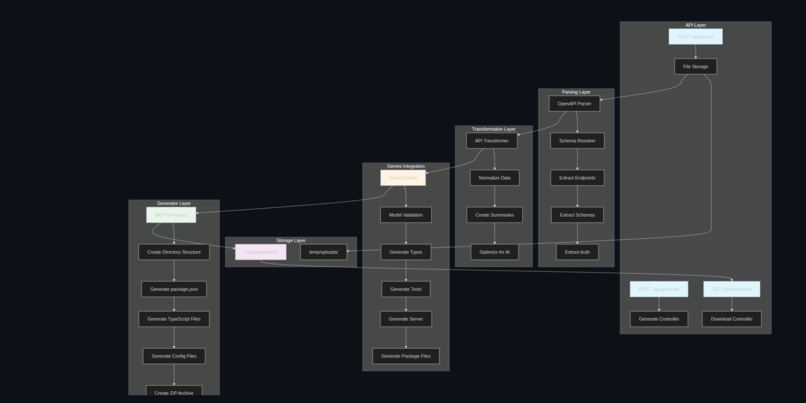
workflow
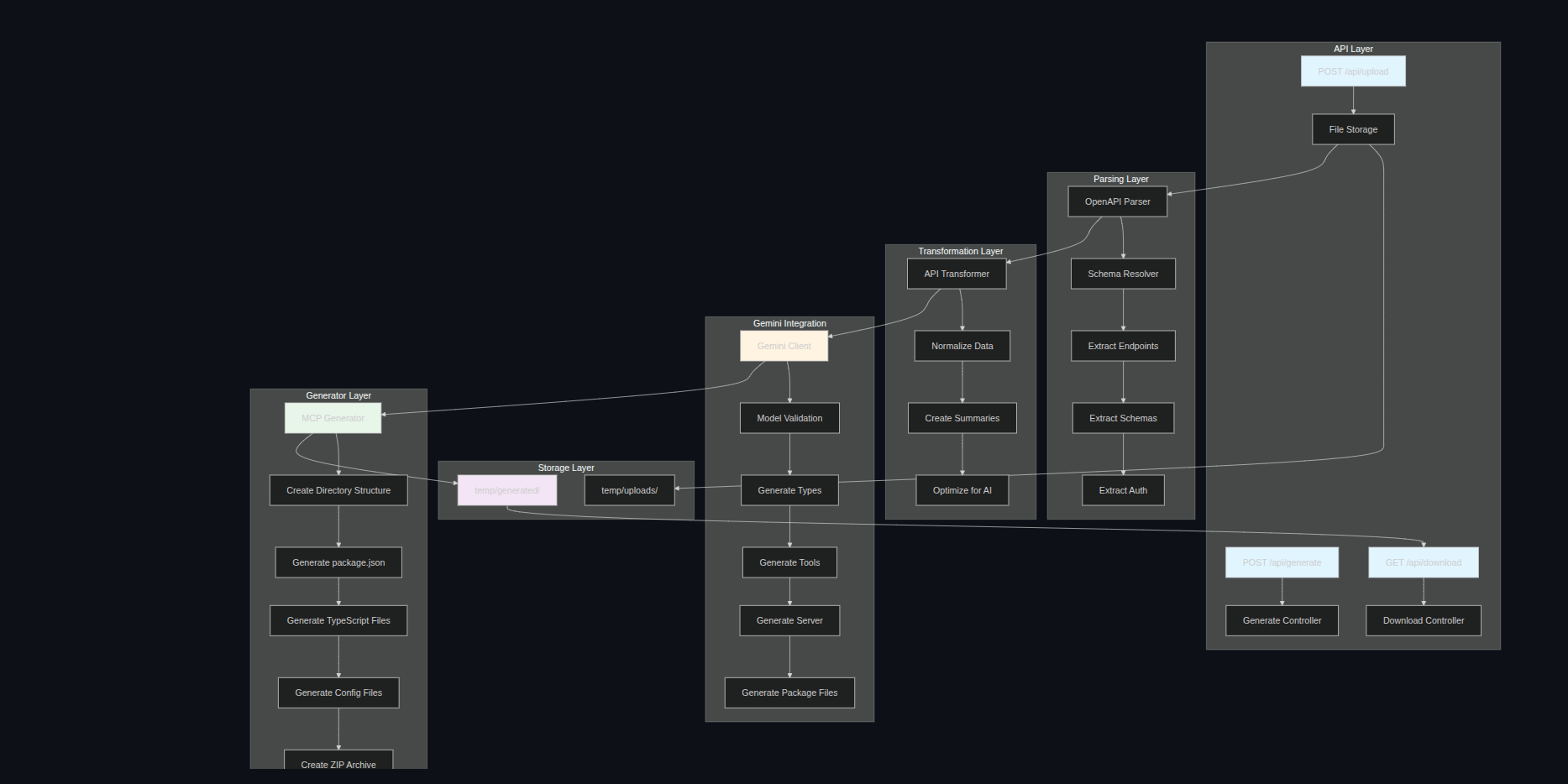
InsAutoMCP: Automating MCP Server Generation with AI
The Inspiration 💡 Creating MCP servers manually is tedious—writing boilerplate code, defining tool schemas, handling authentication. We asked: what if we could automate this?
AutoMCP bridges API documentation and AI agent integration. Developers upload OpenAPI/Swagger docs and get a production-ready MCP server in minutes, not hours.
What We Learned 📚 Prompt Engineering: Structured, context-rich prompts with clear examples produce better code. We learned to break complex tasks into focused prompts (types → tools → server).
Schema Resolution: OpenAPI's $ref references create complex dependency graphs. We implemented recursive resolution with cycle detection to handle nested schemas.
Error Resilience: External APIs fail. We added retry logic, model validation, and auto-detection to gracefully handle Gemini API issues.
Type Safety: Generating TypeScript that compiles requires careful schema-to-type conversion and handling optional vs required parameters.
How We Built It 🏗️ Architecture Upload → Parser → Transformer → Gemini AI → Generator → ZIP Package
- Parsing Layer (src/parsers/)
OpenAPI 3.x parser (JSON/YAML) Extracts endpoints, parameters, schemas, auth schemes Recursive $ref resolution with cycle detection
- Transformation Layer (src/transformers/)
Normalizes data for AI consumption Reduces token usage while preserving context Creates endpoint summaries
- Gemini Integration (src/gemini/)
Multi-stage code generation: Types → Tool Definitions → Implementations → Server Retry logic with exponential backoff Model validation and auto-detection Extracts code from markdown responses
- Package Generator (src/generators/)
Assembles complete npm package Generates package.json, tsconfig.json, config files Creates ZIP archive for distribution
- REST API (src/api/)
Express.js endpoints: upload, generate, download, status Local file storage with UUID sessions File upload handling with multer Tech Stack TypeScript + Express.js Google Gemini AI for code generation js-yaml for OpenAPI parsing @modelcontextprotocol/sdk for MCP protocol Challenges We Faced 🚧
Model Availability: gemini-3.0-pro didn't exist, gemini-1.5-pro wasn't available. Solution: Implemented model validation with fallback to gemini-pro.
URL Construction: Generated code used new URL() which failed with relative paths. Solution: Switched to string concatenation with trailing slash handling.
Schema References: Complex $ref graphs with potential cycles. Solution: Recursive resolution with visited set for cycle detection.
Token Limits: Large APIs exceeded limits. Solution: Multi-stage generation (types separately, tools individually).
Type Safety: Ensuring generated TypeScript compiles. Solution: Explicit schema-to-type conversion with proper annotations.
Impact 🌟 Time Savings: Hours → minutes for MCP server creation Zero Boilerplate: Eliminates repetitive code writing Protocol Compliance: Ensures MCP standards automatically Production-Ready: Generated code includes error handling, types, docs Future Enhancements 🚀 Postman collection support Web UI dashboard Batch generation Cloud storage integration CI/CD templates Technical Highlights 🔬 Performance: Parallel tool generation, schema caching, lazy loading
Security: Path validation, file size limits, UUID sessions, input sanitization
Code Quality: TypeScript strict mode, comprehensive error handling, detailed logging piration
What it does
How we built it
Challenges we ran into
Accomplishments that we're proud of
What we learned
What's next for AutoMCP
Built With
- express.js
- node.js
- typescirpt


Log in or sign up for Devpost to join the conversation.