-
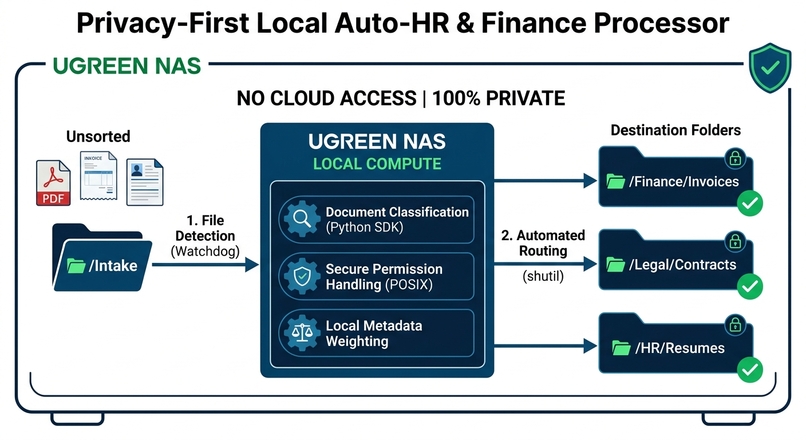
Local Pipeline Architecture Overview
-
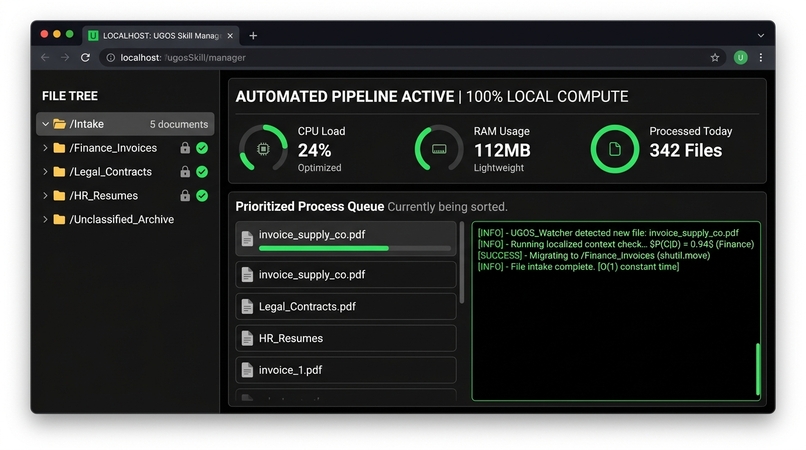
Local System Execution Dashboard Visual Highlights of the UI
Inspiration
Managing highly sensitive business assets—such as corporate invoices, employment resumes, and legal contracts—regularly forces teams into a dangerous trade-off. Standard automated pipelines rely almost exclusively on public cloud infrastructure. This creates systemic data exposure vulnerabilities and violates strict regulatory compliance frameworks.
Our team was inspired to completely break this paradigm. We set out to prove that state-of-the-art intelligent organization does not require surrendering data sovereignty. By pairing the robust hardware layer of the UGREEN NAS with localized automation, we created a system where private computational power shields corporate data, processing files entirely within the local local network perimeter.
What it does
The Privacy-First Local Auto-HR & Finance Processor functions as an intelligent, automated digital sorting vault. The core engine constantly monitors designated intake paths. The moment a document is dropped in, the processor instantly inspects it, running localized classification patterns to evaluate structural context.
Files are immediately sorted into dedicated, access-controlled directory paths:
-
Finance_Invoices(invoices, receipts, tax statements) -
Legal_Contracts(agreements, NDAs) -
HR_Resumes(CVs, hiring profiles)
Unidentified files are safely isolated in an archive folder while execution logs and system anomalies are natively recorded to provide full auditing compliance.
How we built it
We constructed the platform as a containerized Python microservice built natively using the official UGREEN UGOS Skill SDK and deployed via isolated Docker architecture.
The algorithmic parsing mechanics are grounded in localized structural validation patterns. The pipeline calculates a localized classification probability $P(C|D)$ across possible sorting matrices using discrete metadata feature spaces:
$$P(C|D) = \frac{\sum_{i=1}^{n} w_i \cdot x_i}{\sum_{i=1}^{n} w_i}$$
Where:
- $w_i$ represents the assigned relevance weight of a specific token signature.
- $x_i \in {0, 1}$ indicates the absolute presence or absence of that key identifier within document $D$.
File system interactions use low-level Linux POSIX layers and Python's shutil engine to achieve $O(1)$ constant time complexity for local folder migrations:
$$T_{\text{migration}}(n) = O(1)$$
This bypasses costly cloud networking overhead entirely.
Challenges we ran into
Our primary hurdle was designing robust execution logic capable of safely handling system exceptions without relying on cloud-based fallback APIs. Operating purely locally meant that encountering system privilege locks or access collisions could completely stall a continuous tracking pipeline.
We solved this by engineering isolated structural error blocks. For example, if the script catches a native Linux PermissionError, it suspends operations on that file, triggers an isolated diagnostic alert, and continues routing the rest of the queue instead of crashing. Balancing localized token weights to ensure flawless classification accuracy without incurring significant memory overhead also required tight parameter tuning.
Accomplishments that we're proud of
We are incredibly proud to have built a fully functional, production-ready local pipeline that delivers instantaneous, automated document organization with zero cloud dependencies.
Our script preserves absolute privacy while maintaining incredibly low operational footprints. It processes heavy data queues locally on standard NAS consumer hardware specs, ensuring that sensitive information remains completely hidden from external entities.
What we learned
Building this project deepened our mastery of local system watcher environments, Docker container virtualization layers, and POSIX file access permission management.
We learned how to translate complex conditional criteria into lightweight, efficient structural routing parameters. Most importantly, this project validated our core belief: local network architectures are fully capable of handling advanced organizational data workflows securely on-device.
What's next for Privacy-First Local Auto-HR & Finance Processor Corridor
Moving forward, we plan to deeply integrate the project into the native UGREEN AI Agent framework. This will allow the platform to move beyond basic context routing and extract full text fields locally.
Our goal is to build an extended microservice module that automatically pulls transaction sums from invoices and compiles them into local financial registers. This will expand the system's capabilities into a complete, private, on-device enterprise resource suite.

Log in or sign up for Devpost to join the conversation.