Inspiration
Filmmaking is inherently creative, yet pre-production is weighed down by administrative tasks. Script supervisors and assistant directors spend countless hours manually dissecting screenplays to extract locations, characters, props, costumes, and practical effects. Manually cataloging every required element from a 120-page script drains time that could be spent on storytelling. We were inspired to build an intelligent assistant that instantly bridges the gap between raw screenplay prose and production logistics.
What it does
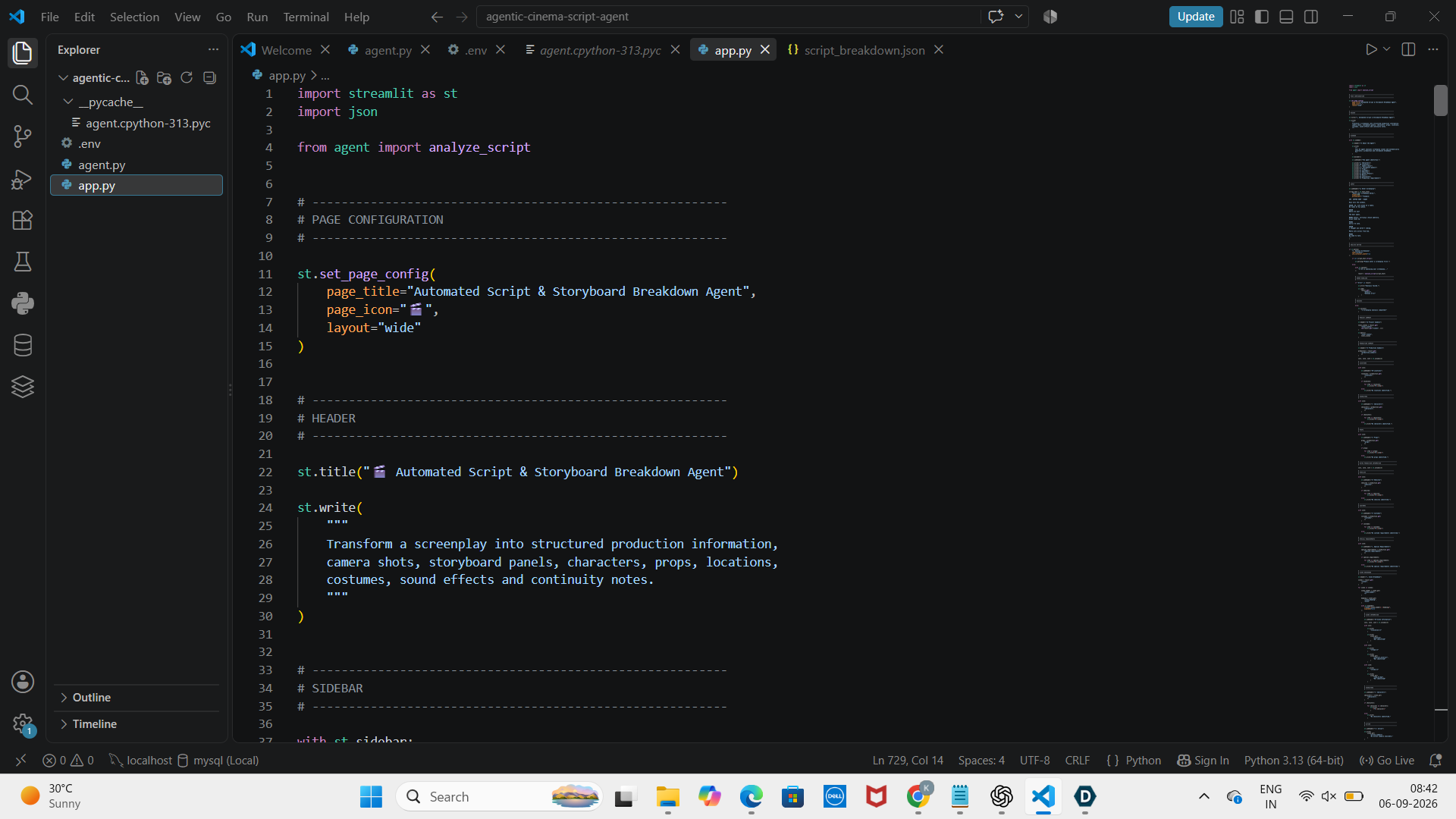
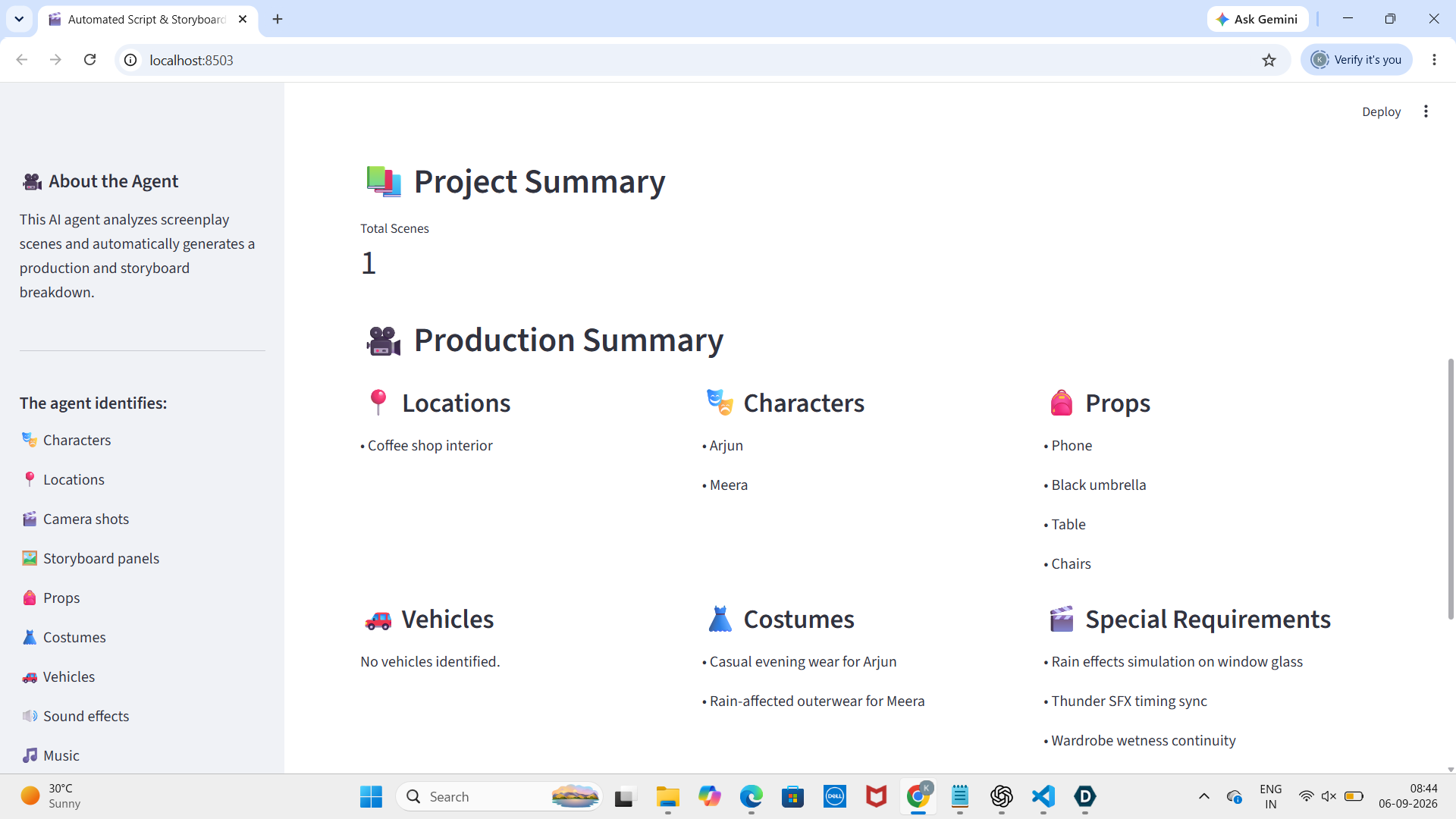
The Automated Script & Storyboard Breakdown Agent eliminates this manual bottleneck by turning raw screenplay text into structured production intelligence in seconds. Powered by Google’s Gemini API and delivered through an intuitive Streamlit dashboard, our agent automatically categorizes scene elements into actionable production data. Beyond organizing logistics, it generates tailored, shot-by-shot visual prompts designed specifically for AI image generators, allowing directors to visualize storyboards instantly. It also includes one-click structured JSON export capabilities for seamless pipeline integration.
How we built it
The project relies on a lightweight stack built for rapid deployment and high performance:
- Frontend: Streamlit for an intuitive, responsive dashboard interface.
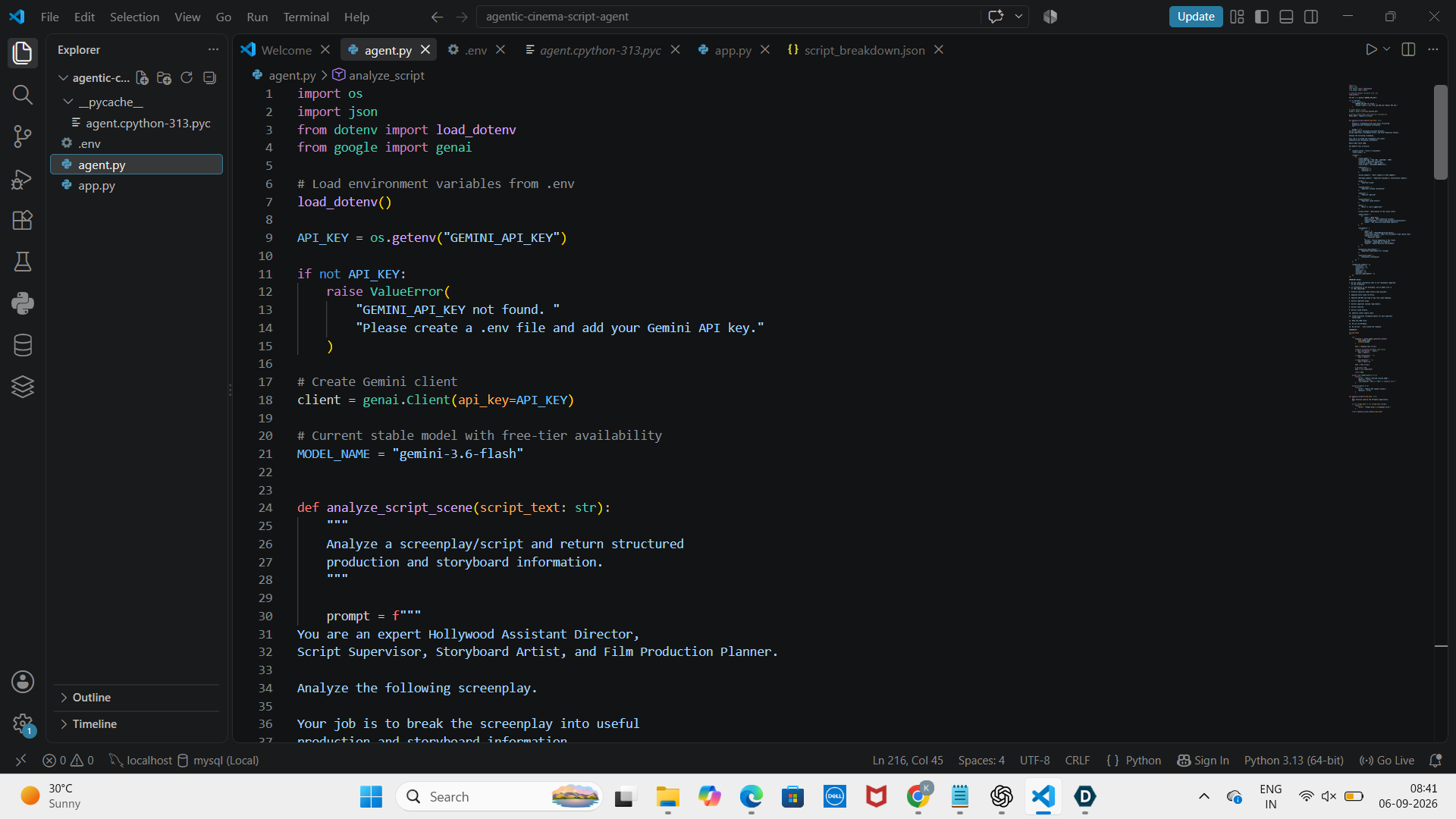
- Backend: Python utilizing the official Google GenAI SDK.
- Core Intelligence: Google Gemini API for parsing unstructured screenplay text into structured data schemas.
Challenges we faced
- API Authentication & Parsing: Early iterations encountered authentication errors ($401$ and $404$ status codes) and raw code block formatting issues. Resolving this required transitioning to the official
google-generativeaiSDK and implementing clean data stripping logic. - Structuring Unstructured Data: Screenplays vary heavily in format. Defining strict system instructions was essential to ensure consistent field extraction across varied scene structures.
What we learned
Building this agent highlighted the strength of combining LLMs with structured UI frameworks:
- Prompt Engineering for JSON: Enforcing structured JSON outputs from complex text dramatically simplifies dashboard rendering.
- Time Complexity Reduction: Manual script breakdown scales linearly with scene count ($O(n)$ where $n$ is the number of scenes), requiring human evaluation time $T_{\text{manual}} \approx k \cdot n$. With our agent, processing time per scene is reduced to near-constant API latency:
$$T_{\text{agent}} = \max(T_{\text{latency}}, c) \ll T_{\text{manual}}$$
This drastically optimizes pre-production efficiency for modern creative teams.


Log in or sign up for Devpost to join the conversation.