Inspiration
It all started from two obscure repetitive tasks: open shutters through two pulleys in a specific order. Every morning when the sun rose, we'd open our blinds to get natural lighting in the dorm room; however, in this specific dorm room, two pulleys in sequence were required to open the shutters. After pondering on the possibility of automation, we looked at a general case where anyone could use a singular general component that can be integrated in any DIY automation project one could possibly desire.
What it does
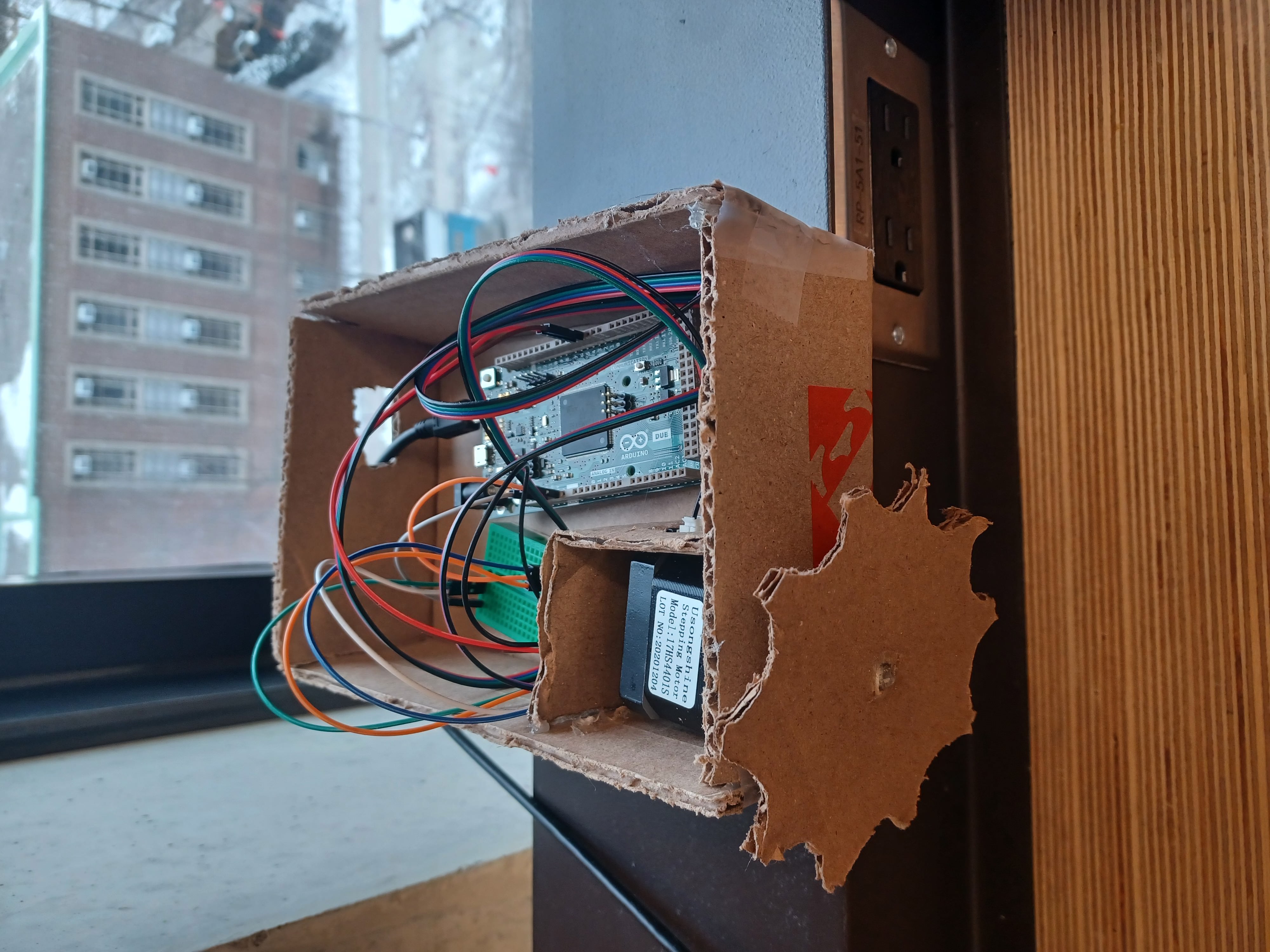
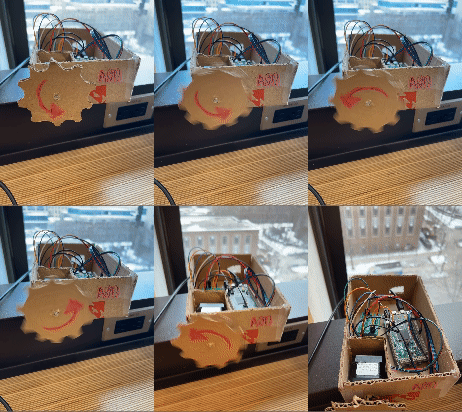
The product enables the user to make use of a coupled shaft and rotary motion to automate any simple task which uses a transferable motion. This is joined with custom parts to aid in these special attachments, and subsequently, the user will be able to control this automation from a smart device for any presets or customizability they may have.
How we built it
The product is comprised of three main components: mechanical design, hardware design, and lastly software design. We used SolidWorks to model and 3D-print an enclosure for all hardware components, adding an edge in product appeal in design. We used Arduino Due for a large threshold for analog pin usage, and used a high torque stepper motor as well as a stepper motor driver to control speed, direction, power, and partial revolutions for a higher user quality experience as well as high adaptability for more applications. Bluetooth was established using the ESP32 microcontroller to establish single sided communication from the app to the Arduino Due board. Lastly, we used the MIT App Inventor to program and develop an android application where the user can enter desired inputs for already preloaded motor presets over bluetooth communication logic.
Challenges we ran into
This project was as challenging as it was ambitious. We ran into numerous technical challenges including: establishing bluetooth for Arduino over ESP32 board, mechanical design that can sufficiently support the stepper motor without any internal movement, how software programmable backend logic was often deemed out of scope over the 24 hour deadline, as well as numerous occasions where hardware failed during build and prototyping.
Accomplishments that we're proud of
Over the span of 24 hours, we have achieved milestones including mechanical design housing completion, stepper motor hardware completion, overall Arduino wiring and component diagrams completion, and establishing Bluetooth for Arduino over ESP32 microcontroller. The mechanical design was started 2 hours before the deadline, and the use of rapid prototyping and design was crucial for the ".stl" file to be submitted. The challenge with the mechanical design was not only the time constraint, but also how hardware placement wasn't finalized during the ideation process. Due to this reason, we celebrate the completion of the mechanical design. Entering MakeUofT with very minimal prior knowledge, the hardware components placement and design was definitely the biggest challenge. To overcome this, a lot of time was spent troubleshooting why certain hardware components weren't performing up to standard through various voltage calculations and wiring diagrams. Lastly, establishing bluetooth for Arduino over the ESP32 microcontroller was one of the largest celebrated successes. We had to incorporate the use of signal processing as well as programming a suitable backend technology that can efficiently send out data while the app is running.
What we learned
In the last 24 hours, we learned a substantial amount about our technical skills as well as soft skills. Firstly, as mentioned earlier, our team entered the competition with minimal knowledge about Arduinos, motors and other important components. As a result, this meant that we had to learn about the components and apply what we learnt to the project. Additionally, we learned a lot about IoT and connectivity through Bluetooth and wifi modules which we can now use in other projects. The workshops offered were also very helpful and helped us navigate different fields related to robotics including computer vision which was super interesting. In terms of the new soft skills, we learned a lot about efficiency, perseverance and teamwork. Since we were trying to learn and apply our skills at the same time, it was very easy to lose track of time so it was important to pace ourselves and work smartly. Furthermore, perseverance was important as there were many roadblocks when it came to coding and trying to connect the Bluetooth and wifi. Both tasks were frustrating and often tedious and required lots of patience. Lastly, teamwork was the most strengthened skill. As we split up the work and all hit roadblocks, there were many times when things did not go the way expected. Instead of getting frustrated at each other, we ensured that the problem did not overcome us and worked together as a team to overcome the problem. All in all, we are grateful that UofT provided us with this opportunity. Even though there were many adversities we faced and there were many changes made to the project, we made major progress in our knowledge in all areas of robotics: hardware, 3D modelling, firmware and systems design. We believe that this knowledge will be incredibly useful to us as we advance in our careers.
What's next for Automated Rotary Arm Machine (ARM)
As a group of ambitious hackers and makers, we will strive to learn more about the concepts we don't know. We gained a plethora of knowledge about something that we are just getting introduced to. We plan on participating in future Hackathons and Make-a-thons to get exposed to the vast advancements that can be made in the world of technology. This Make-a-thon forced us to think out of the box and get out of our comfort zone. We tried our best to build something from scratch and while we may not have achieved what we set out to do, we are highly grateful for this opportunity. We are focused on completing this project and showcase that our idea can be brought to life. There are several refinements that we know we can make to improve our design and our code. For example, make attachments that will help integrate our prototype with several applications.
Acknowledgements
Chatgpt to help us begin our learning process in terms of Arduino, making apps and the wifi plus Bluetooth modules


Log in or sign up for Devpost to join the conversation.