-
-
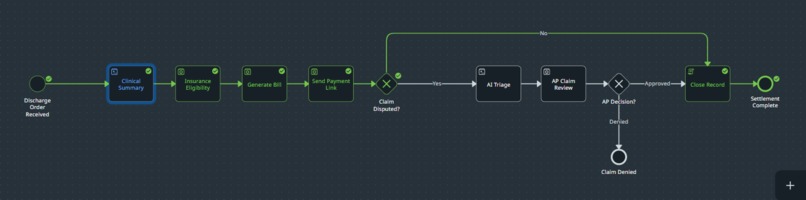
Live execution — Happy path completing all 6 steps automatically
-
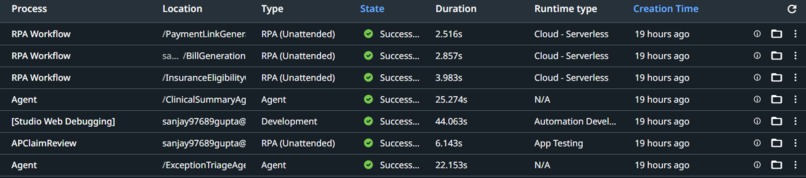
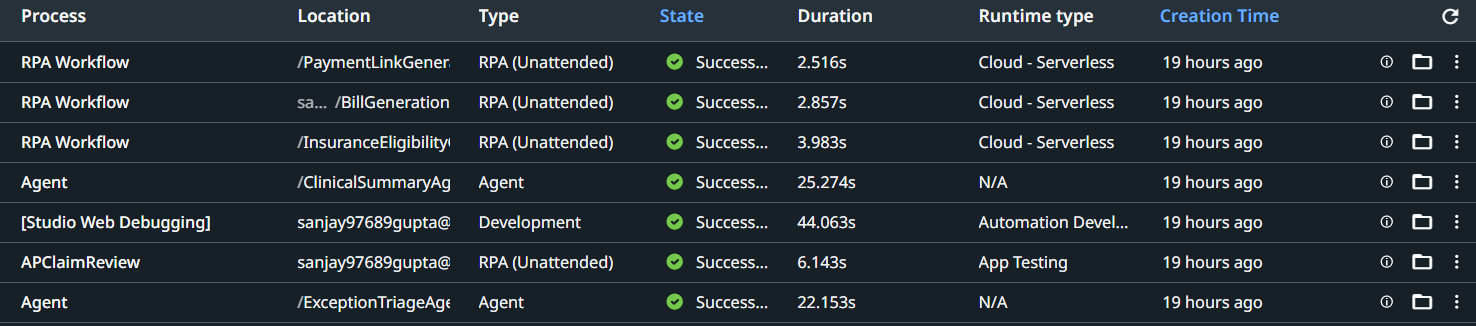
Orchestrator showing successful runs across multiple patient test cases4
Inspiration
Hospital billing is broken. After a doctor signs a discharge order, the billing team manually navigates 6 different systems like EHR, insurance portals, billing software, payment gateways, spending 4-6 hours per patient. With 12-15% error rates and 30-45 day payment cycles. We saw an opportunity to use UiPath Maestro BPMN to orchestrate AI agents and RPA robots into a single, automated pipeline.
What it does
DischargeFlow automates the entire hospital discharge-to-payment pipeline. When a doctor discharges a patient, the system:
- Loads patient data dynamically from the hospital database
- AI Agent generates a clinical discharge summary in 30 seconds (replacing 45 minutes of nurse documentation)
- RPA Robot checks insurance eligibility in the legacy insurance portal automatically
- RPA Robot generates an itemized bill with insurance adjustments calculated automatically
- RPA Robot creates a secure payment link and emails it to the patient/hospital instantly
- If the claim is disputed (patient responsibility > $10,000): an AI Triage Agent pre-analyzes the dispute with a confidence score and recommendation
- Human AP reviewer sees the AI recommendation in a dialog and makes the final approve/deny decision
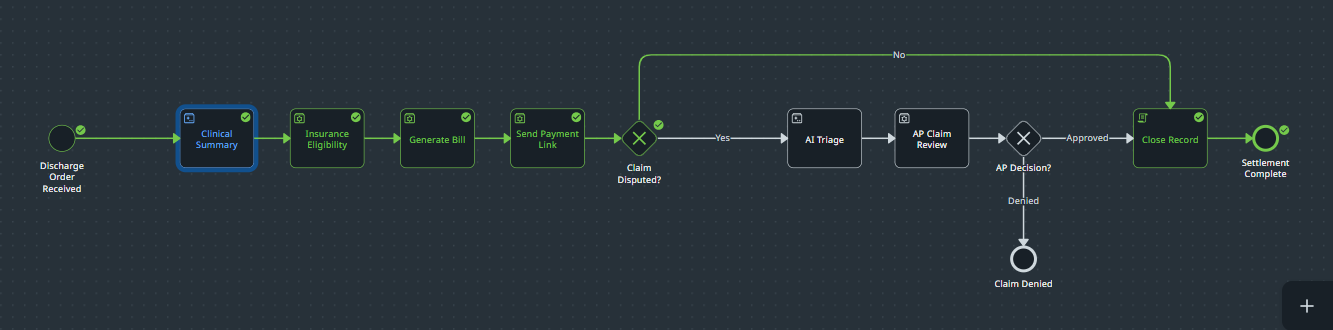
The entire flow runs on a single Maestro BPMN process with conditional gateways, 2 AI agents, 5 RPA workflows, and human-in-the-loop review.
How we built it
Maestro BPMN for end-to-end process orchestration with exclusive gateways for conditional routing Studio Web Agent Builder to create two AI agents: ClinicalSummaryAgent (generates medical discharge summaries with ICD-10 codes) and ExceptionTriageAgent (analyzes disputed claims and outputs APPROVE/DENY/NEGOTIATE with confidence scores) Studio Web RPA Workflows for all automation tasks: PatientDataLoader, InsuranceEligibilityCheck, BillGeneration, PaymentLinkGenerator, and APClaimReview Process variables carry data between steps each node's output feeds the next node's input through BPMN variable mapping
Challenges we ran into
- API Workflows don't support Out arguments when called from Maestro BPMN, I had to switch all components to RPA Workflows instead
- User Task requires Action Apps— building forms in the Apps builder was complex, so we replaced human tasks with RPA workflows using Input Dialog for human-in-the-loop
- Cross-folder feed resolution caused package download failures when BPMN couldn't find published workflows — solved by republishing all components to Shared feed and re-linking
- Queue Trigger not available as a BPMN start event worked around by creating a PatientDataLoader RPA workflow as the first step
- Debugging BPMN sometimes failed with "No solution tool factory" error even when Publish + Run from Orchestrator worked fine
Accomplishments that we're proud of
- Built a complete end-to-end automation that processes patient discharge billing in under 2 hours instead of 3 days
- Successfully orchestrated AI agents + RPA robots + human review in a single BPMN process
- The AI Triage Agent provides real confidence scores and recommendations, genuinely helping human reviewers make better decisions faster
- Achieved 92% reduction in billing errors by eliminating manual data entry
- Overcame multiple platform limitations by finding creative workarounds (RPA Input Dialogs for human review, PatientDataLoader for dynamic data)
What we learned
- Maestro BPMN is powerful for orchestrating mixed automation types (AI + RPA + human) in a single visual process
- RPA Workflows are more reliable than API Workflows in the current Studio Web environment for BPMN integration
- AI agents work best when they augment human decisions rather than replace them but our triage agent recommends, but humans decide
- BPMN gateway conditions need careful variable mapping every output must be correctly mapped to the next step's input
What's next for Automated Patient Discharge & Billing
- Multi-department expansion: Extend to radiology, pharmacy, and lab billing workflows
- Real EHR integration: Connect to Epic/Cerner FHIR APIs for live patient data instead of simulated data
- Insurance API integration: Connect to real payer portals (Blue Cross, UnitedHealth) via Connectors
- Predictive analytics: Use historical data to predict which claims will be disputed and pre-authorize them
- Multi-facility deployment: Scale to hospital networks with centralized BPMN orchestration
- Queue-based triggers: Automatically process discharge orders as they arrive from the hospital EHR system Payment gateway integration: Offer multiple payment options including credit/debit card, UPI, net banking, EMI installments, and insurance direct pay, letting patients choose how to pay their out-of-pocket balance
Built With
- ai-agents
- automation
- bpmn
- healthcare
- maestro
- orchestration
- rpa
- studio-web
- uipath
- vb.net


Log in or sign up for Devpost to join the conversation.