-
-
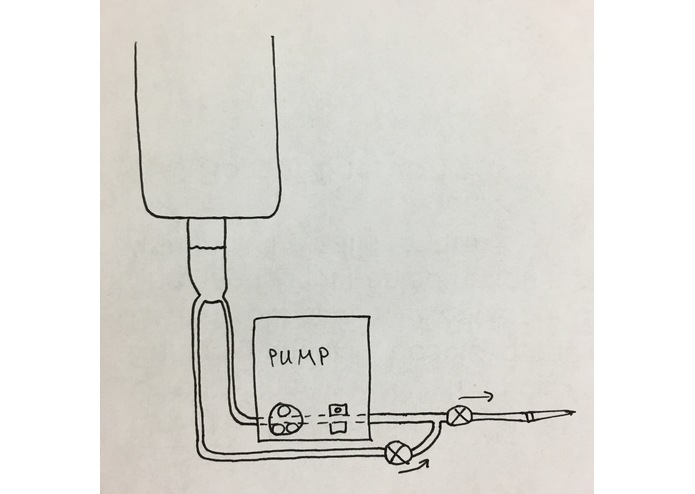
Original sketch of the implemented pump.
-
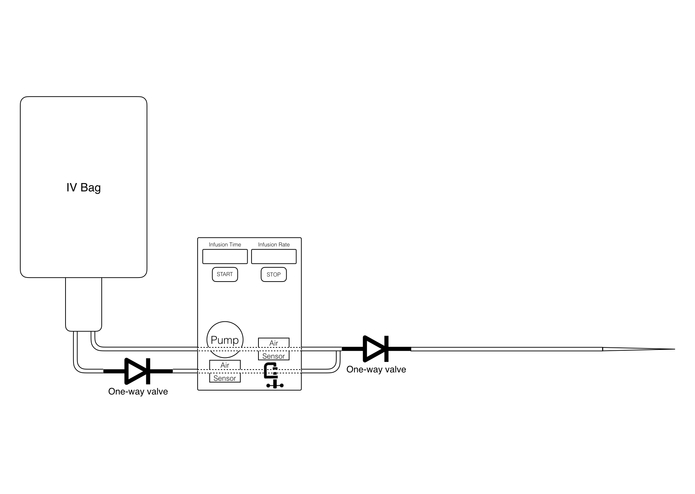
Sketch of the idealized pump that implements addition features for robust and desirable performance/operations.


Inspiration
What it does
I am trying to automate air bubble removal from IV tubing, removing the need for some end-user maintenance.
How I built it
Challenges I ran into
The peristaltic pump used in this project requires a lot of driving power and has a lot of internal friction. This makes it difficult for it to take in a PWM signal (calculated from user-input infusion rate) to run the pump at lower speeds. However, this would be resolved if an appropriate pump were used. The main feature this project attempts to implement is the concept of pump reversal, not necessarily accuracy.
Accomplishments that I'm proud of
What I learned
What's next for Automated IV Pump Occlusion Alleviation
As mentioned above, the pump mechanism does not run well or consistently at any speed less than 100% due to the nature of PWM and the internal friction of the peristaltic pump rollers. Using a more well-suited pump would be the next advancement. Additionally, the bubble detector does not use standard IV tubing diameter, so I needed to step it down / adapt it to fit the system. Because this changes flow rates (and even causes a current bubble to break up into more, smaller bubbles), a similar air detector that accommodates standard tubing sizes would be a welcome addition. Lastly, the secondary branch of tubing continues to flow when the main branch flows. The addition of a clamp/pinching mechanism to stop the secondary branch would be another step to ensure higher flow rate accuracy.
Built With
- 2-arduino-unos
- adafruit-peristaltic-liquid-pump
- h-bridge
- hc-05-bluetooth-modules
- introtek-ad9-ultrasonic-air-bubble-detector
- lcd-display
- sparkfun-ir-remote

Log in or sign up for Devpost to join the conversation.