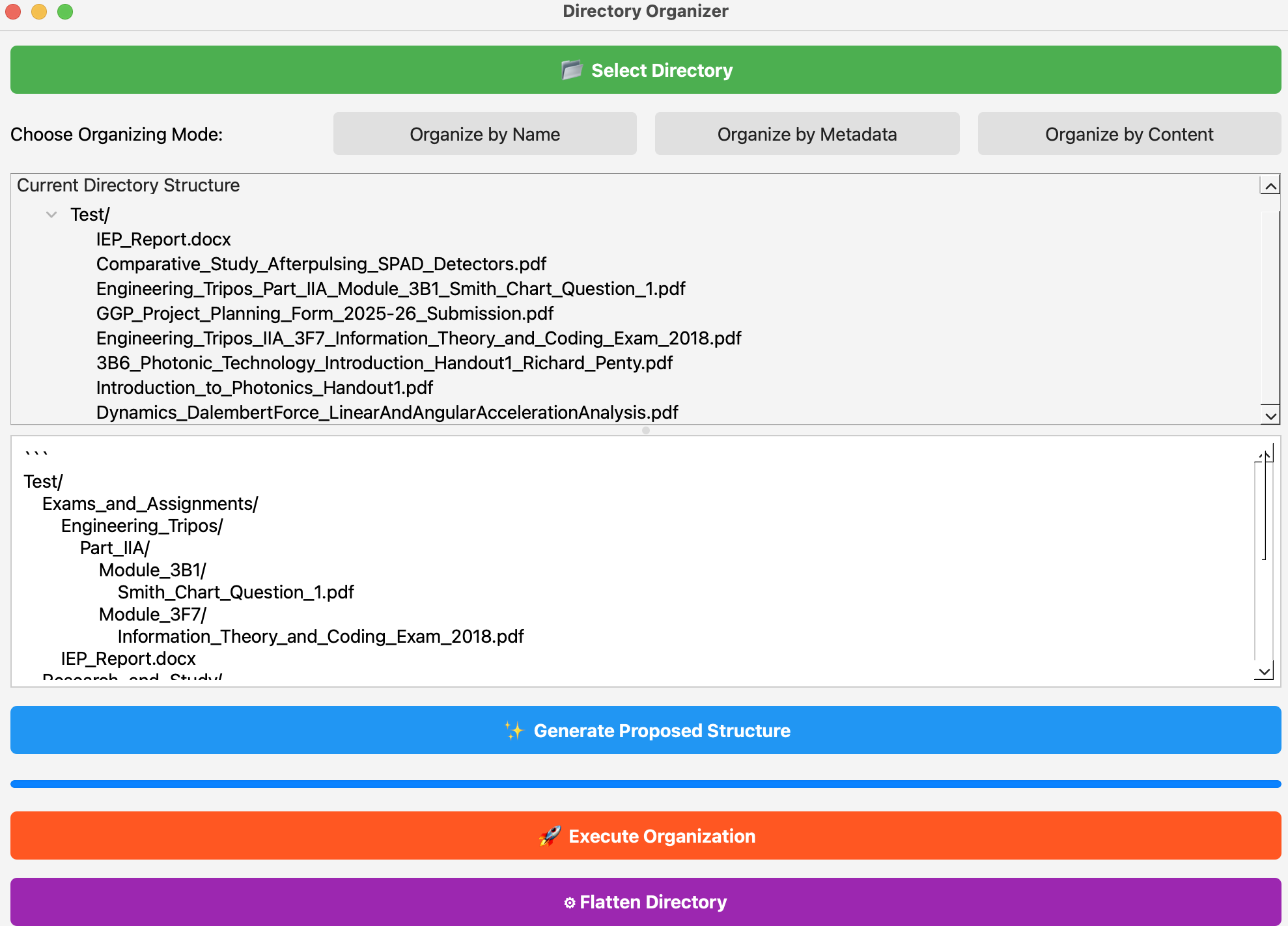
Inspiration Managing large volumes of files efficiently is a common challenge for individuals and organizations alike. Manual file organization is time-consuming and often leads to cluttered directories. Our goal was to develop an intelligent, automated system that categorizes files based on their content and context, streamlining digital file management.
What it does
Automated File Categorization analyzes a directory structure and suggests an optimized organization based on file types, content, and metadata. It leverages AI-driven classification to predict user occupation and recommend a structured folder hierarchy. Additionally, it automates the movement of files into appropriate directories based on these suggestions, reducing manual effort and enhancing accessibility.
How we built it
File Analysis & Preprocessing: We used Python to extract text from different file formats, including PDFs, text documents, and images
AI-Powered Categorization: GPT-4o was leveraged to analyze directory structures and generate an improved folder hierarchy. The system iteratively refines its suggestions based on user feedback.
Automation & Execution: We implemented a script that reads the proposed hierarchy and automatically organizes files accordingly. The script ensures files are placed in logical locations and maintains a clean directory structure.
Challenges we ran into
Handling Hidden & Non-Text Files: Some files lacked metadata or textual content, requiring additional heuristics for classification.
Ensuring GPT-4 Responses Were Complete: The AI's output sometimes got truncated, requiring iterative querying to obtain a full folder structure.
Cross-Platform Compatibility: Ensuring the script functions across different operating systems with varied file structures and permissions.
Accomplishments that we're proud of
Successfully developed an AI-assisted categorization system that predicts user intent and optimizes folder structures.
Built a fully automated file organization pipeline that minimizes manual effort.
What we learned
Effective AI Integration: Leveraging AI for structured predictions enhances automation and efficiency.
Importance of Iterative Processing: Handling long AI-generated responses requires smart querying techniques.
What's next for Automated File Categorization
Enhanced AI Categorization: Incorporating more advanced NLP models like transformer-based classifiers for better accuracy.
Cloud Integration: Allowing users to organize files across cloud storage solutions like Google Drive and OneDrive.
Customization & Learning: Enabling the system to learn from user preferences and adapt categorization rules over time.

Log in or sign up for Devpost to join the conversation.