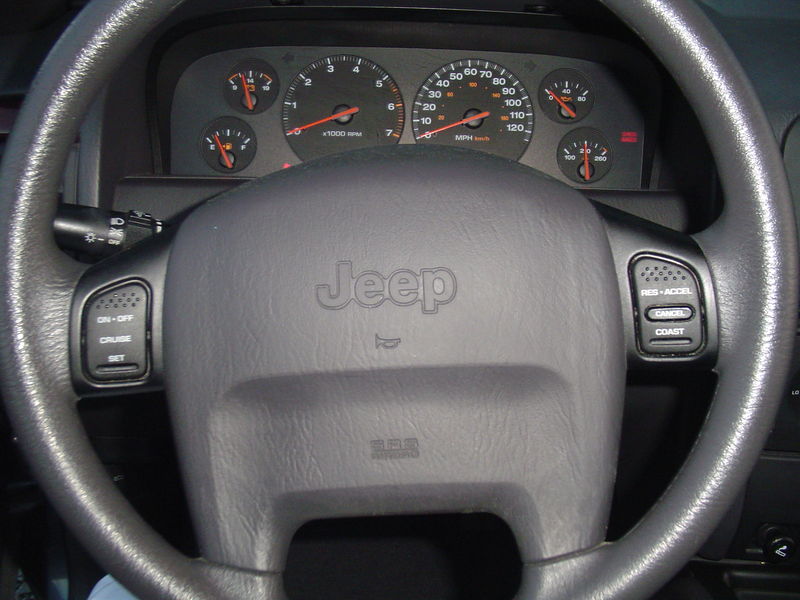
Summary Cruise control is one of the most neglected innovations to be included in most cars. Since its invention, cruise control has been relatively static: set a speed and put your foot over the brake to be ready should you need to slow or stop the vehicle. The Problem The sheer simplicity, however, does not take into account the fundamental nature of cruise control's primary use case: highway driving. On any two or more-lane high-speed road, it is highly unlikely that every vehicle will be moving at the same speed that your vehicle is cruising at. Frequently, drivers using cruise control must slow down if they approach a vehicle moving at a slower speed. This disengages the cruise control, requiring the driver to either re-engage cruise mode or pass the slower vehicle. This can have significant impacts on the surrounding traffic flow: The driver that disengages cruise control is forced to slow down, though will always overcompensate due to the nature of cruise control, requiring re-acceleration. This over-decelleration and subsequent reacceleration uses extra fuel and produces more emissions. Drivers that have matched the speed of the vehicle that has disengaged cruise control are also forced to disengage cruise control to compensate for the sudden decrease in speed. Depending on the rate of decelleration, this may be a safety hazard. Because of these side effects of using cruise control, it's usefulness in some areas is significantly limited. The Solution By broadcasting relative vehicle positions, velocity and acceleration data, and cruise control settings, cruise control can be automated to decellate when a vehicle being approached is moving at or is set to cruise at a slower speed. If the vehicle being approached (the "forward" vehicle) has slowed its cruise setting, the approaching vehicle can use this information to automatically gradually lower its cruise setting to match that of the forward vehicle. This would eliminate human error and over/undercompensation during the cruise control disengagement process, and consequently would save fuel. If an approaching vehicle (which has already automatically lowered its cruise speed) detects that the forward vehicle has either exited the roadway, sped up, or changed lanes, it can use the "mesh" data to automatically increase the cruise speed to its original setting. Using this data (possibly supplemented by data from distance or optical sensors), an alarm could be raised to alert the approaching driver when the forward driver has suddenly decreased his or her velocity or has dropped out of cruise mode. This can help to prevent potentially scenarios by giving the approaching driver (and any drivers behind his or her vehicle) advanced warning of sudden traffic pattern changes. Benefits Decreased congestion on high-speed roads Decreased traffic accidents resulting from collisions at cruise-velocity Decreased emissions and fuel usage caused by over and undercompensation when disengaging cruise control Increased cruise control ease-of-use Potential decreases in travel time due to decreased braking and reacceleration Practicality The technology necessary for such an innovation is readily available. Short-range wireless communication, distance sensors and cameras, and geopositioning devices are all commercially available and available to consumers at reasonable cost. The software which is capable of performing the necessary calculations is also either available or would be trivial to build using freely distributed libraries, APIs, and open-source packages. The computational capacity required for interpreting sensor data and compiling incoming traffic data into useful commands is readily available in off-the-shelf, low-power chips at a reasonable cost. Complexities Certain complexities would require further investigation, experimentation, and research to bring such a system to fruition: A novel means of determining which lane a vehicle is traveling in would need to be implemented. A standard communication protocol would need to be standardized for vehicle-to-vehicle communication. Extensive user experience testing and improvement would need to be conducted to ensure drivers are not confused or alarmed by the system. Thorough testing of such a system would need to be conducted. Shortcomings Significant effort would be needed to ensure that the traffic data being broadcast is accurate. A vehicle broadcasting manipulated data could bring traffic to a gridlock, or worse, cause an accident. A combination of sensor and readily available heading information could be used to verify nearby vehicle information. Inconsistencies or conflicting data would simply automatically disable the cruise adjustment system, falling back to the current technology. As a fail-safe, the cruise adjustment system would ideally be a separate component from the cruise control system to avoid a worst-case "cascading failure."
Automated Cruise Control Adjustment
Updates

Leave feedback in the comments!
Log in or sign up for Devpost to join the conversation.