-
-
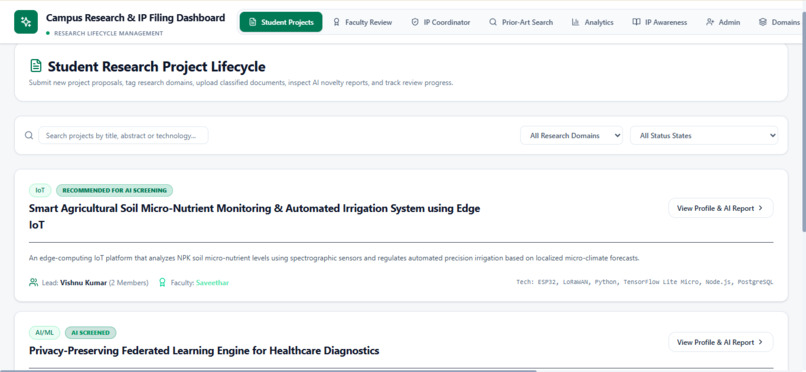
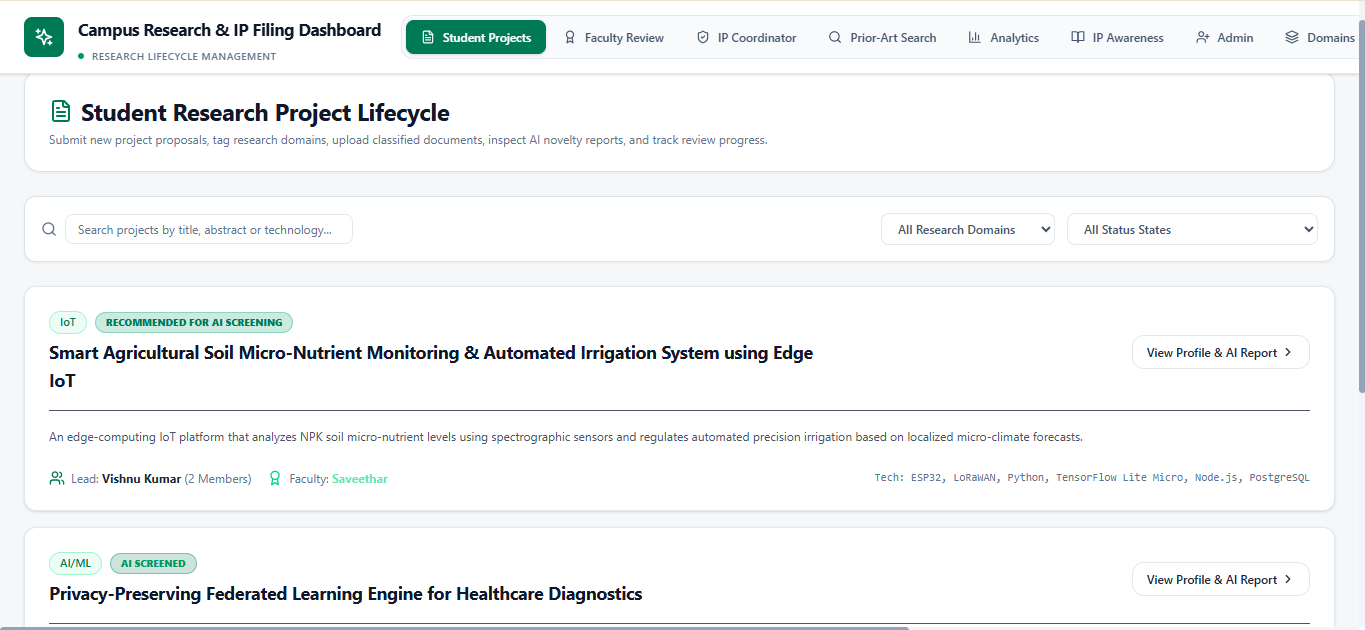
STUDENT PAGE
-
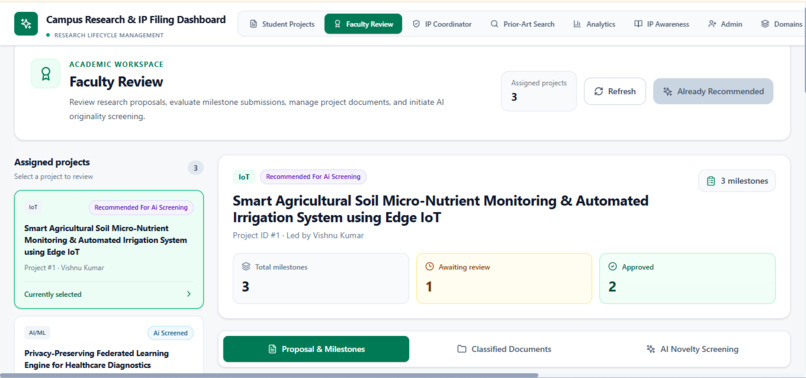
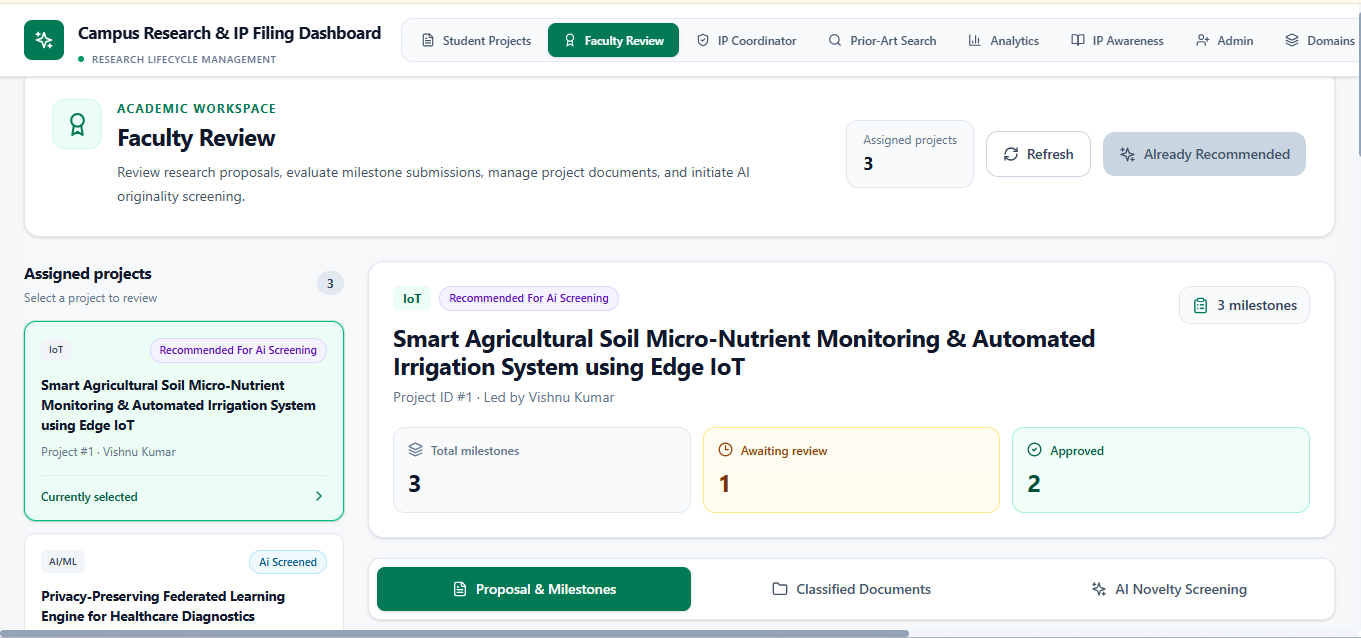
FACULTY PAGE
-
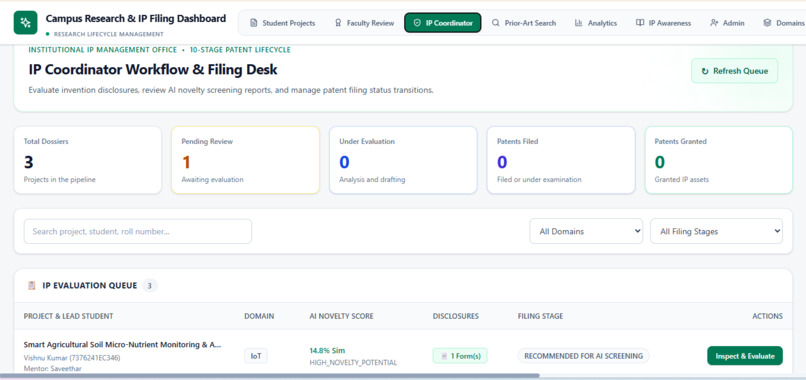
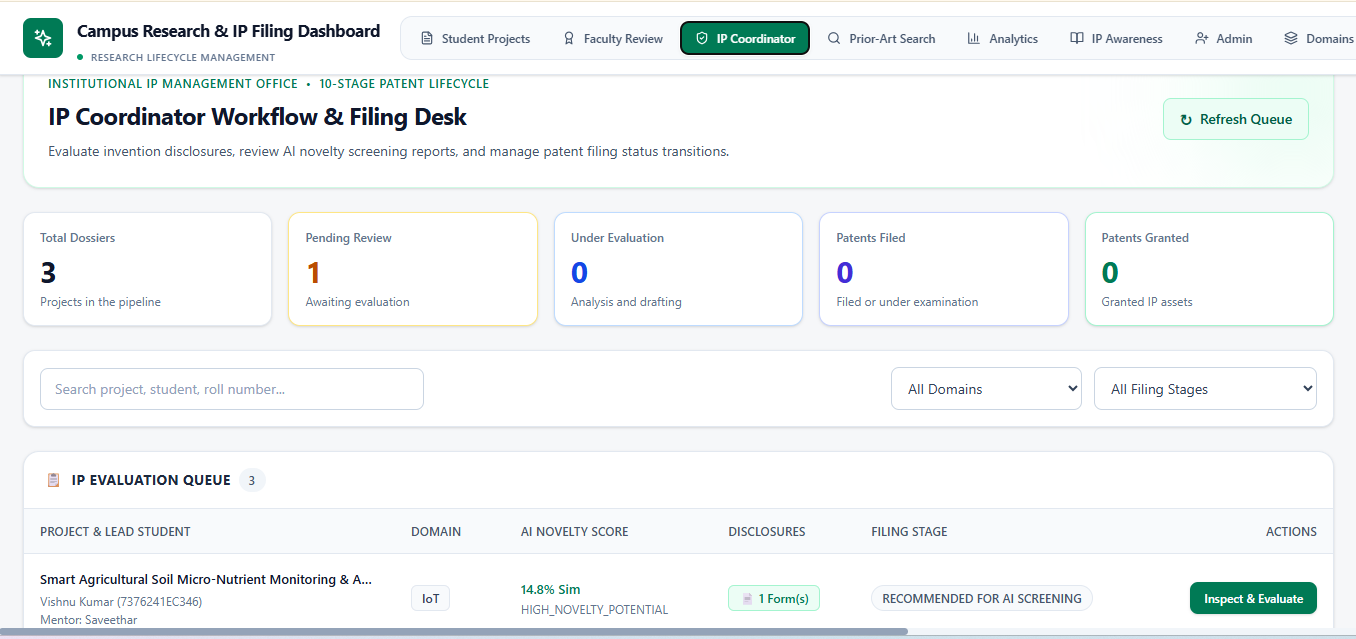
IP COORDINATOR
-
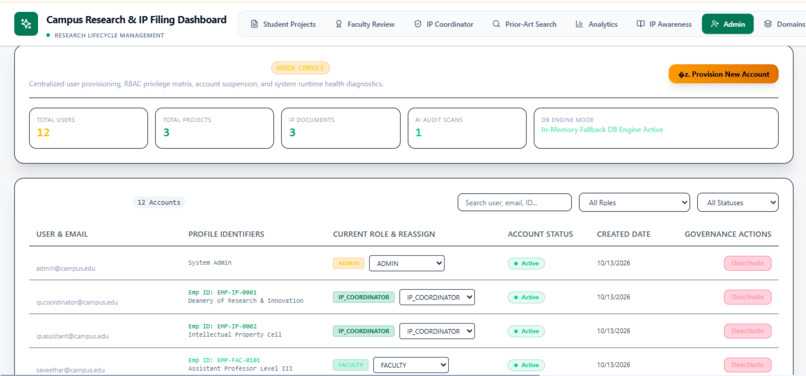
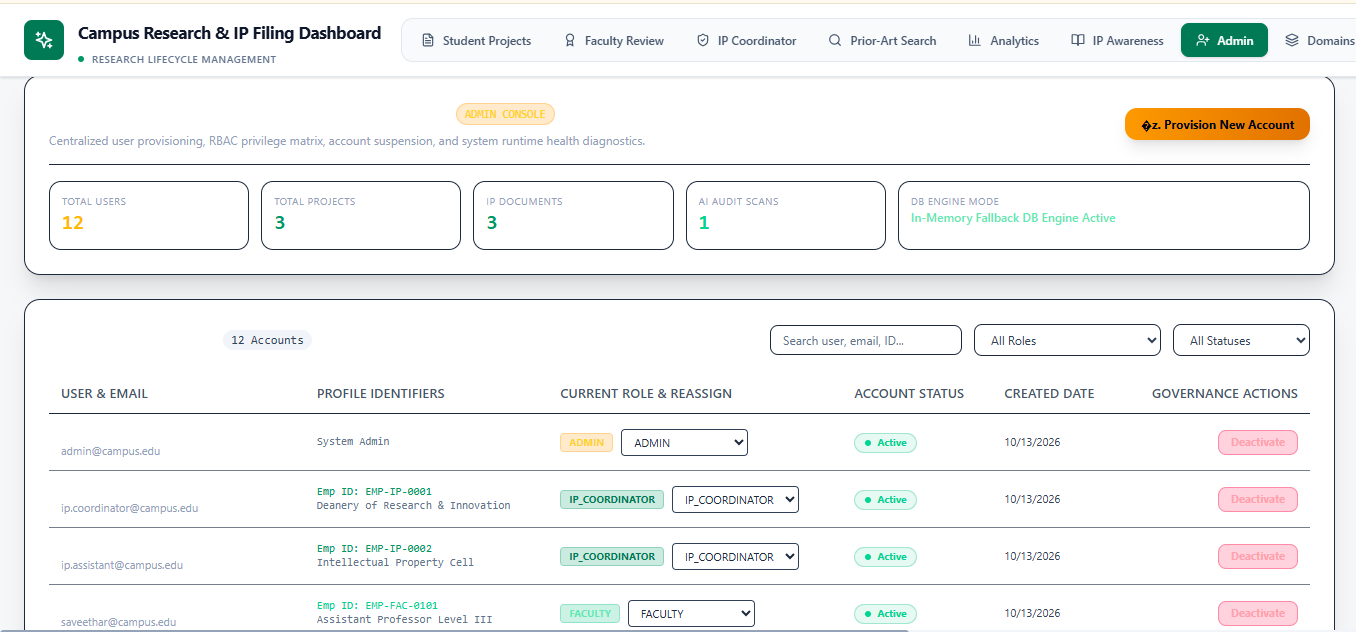
ADMIN LOGIN PAGE
## Inspiration
We were inspired by the need for a centralized platform to manage student projects across different domains, such as IoT, Full Stack Development, FinTech, Embedded Systems, and Artificial Intelligence. Many students develop innovative projects but may not know how to evaluate their originality or explore intellectual property protection. We wanted to connect students, faculty mentors, and the college IP Coordinator through a single platform that encourages innovation, improves project monitoring, and creates awareness about patents.
What it does
Our platform manages the student project lifecycle, from initial submission to faculty evaluation and potential IP processing. It provides role-based access for Students, Faculty, IP Coordinators, and Administrators. Students can submit projects under specific domains, upload documents, track milestones, and receive feedback. Faculty members can review projects, suggest improvements, and monitor progress. An AI-assisted originality and novelty screening module is designed to identify potentially similar concepts and highlight possible innovative features. The IP Coordinator can review the findings and decide whether a project should proceed to further IP evaluation. The platform also includes an IP Awareness Center to educate students about patents and intellectual property
How we built it
We plan to build the frontend using React.js and Tailwind CSS, the backend using Node.js and Express.js, and the database using PostgreSQL. JWT authentication and role-based access control will help secure user accounts and restrict access according to user roles. We are following a modular development approach, implementing the application structure, authentication, project management, faculty reviews, milestone tracking, AI-assisted screening, and IP status management in stages. We also plan to test the complete workflow and prepare the application for cloud deployment using Google Antigravity as our development environment.
Challenges we ran into
One of our main challenges is designing a system that supports multiple user roles while maintaining secure access to projects and documents. Another challenge is evaluating project originality responsibly because AI cannot guarantee that an invention is unique or patentable. Our approach is to use AI as a preliminary screening and decision-support tool, while leaving final IP evaluation to the college IP Coordinator. Integrating the different modules into a reliable end-to-end workflow and maintaining accurate project status records are also important challenges we aim to address.
Accomplishments that we're proud of
We are proud of developing a project concept that brings student project management, faculty mentoring, AI-assisted originality screening, and intellectual property awareness together in one platform. The proposed workflow connects students, domain-specific faculty members, and the IP Coordinator, creating a structured process for project improvement and potential IP evaluation. We are also focusing on transparency, role-based permissions, milestone tracking, and project history to make the system useful for academic institutions.
What we learned
Through this project, we aim to strengthen our understanding of full-stack development, database design, authentication, role-based access control, API integration, AI-assisted analysis, software testing, and deployment. We are also learning that AI-generated similarity assessments must be interpreted carefully and that intellectual property evaluation requires appropriate human expertise. The project has helped us understand how technology can support academic collaboration and encourage students to consider the potential value of their innovations.
What's next for AUTOMATED CAMPUS RESEARCH AND COLLABORATIVE IP MANAGEMENT
Our next step is to implement and test the platform module by module. We plan to complete authentication and role management first, followed by domain-based faculty assignment, project submissions, milestone reviews, document management, and notifications. We will then integrate the AI-assisted originality screening module and develop the IP Coordinator dashboard and IP Awareness Center. Finally, we aim to test the complete project lifecycle, improve security and usability, and deploy a working prototype for demonstration. In the future, we hope to enhance similarity analysis using reliable research and patent references and extend the platform to support more departments and academic projects.
Built With
- antigravity
- artificial-intelligence
- express.js
- java
- javascript
- jwt-authentication
- node.js
- postgresql
- react
- rest-api
- role-based-access-control
- tailwind-css

Log in or sign up for Devpost to join the conversation.