-
-
Architecture
I live in São Paulo. Twenty-two million people, and a commute that is never the same trip twice.
Two things run my week here, and they are not the same thing. The first is time — where it goes, and what it is worth. The second is safety: this is a city where a single afternoon of rain closes streets that were fine an hour earlier, and where "leave at 6" and "leave at 6:20" can be a flooded avenue apart.
So I delegate. My agenda, my work blocks, my personal errands — I hand them to an assistant and let it hold the shape of my day. But every tool I tried held only half the problem.
Then I went looking at what already existed, and found the market split into three halves nobody had stitched together:
- Pricing time exists only as static toy calculators. No memory, no real data, no action.
- Measuring time is mature — RescueTime, Toggl, Reclaim — but none of them attach a monetary dimension to personal life, and none of them suggest or execute an automation.
- Recommending and executing automation is mature only in enterprise process mining, on five- and six-figure contracts.
The signals were sharp. Zapier owns the largest automation graph on earth and still reports only time saved — a flat two-minute guess per task, Enterprise plan only. Never money. Microsoft is the one company that productized hours into dollars, and it is org-aggregate and recommends nothing. And Yohana, backed by Panasonic, shut down in September 2025 — a well-funded human concierge that could not prove it saved anyone anything measurable.
That is the whole thesis. An assistant that cannot show you what it bought back is a subscription you eventually cancel. I wanted the loop closed: find the leak, price it in reais, fix it, and prove it.
What it does
The loop is Proof of Time: capture → price → rank → execute → prove.
Price your hour first. Setup asks the one thing nothing can be computed without, and asks it once: what an hour of your life is worth. Type the rate, or type what you earn and how many hours you work and watch it derive — R$18,000 a month over a 45-hour week is R$92.31 an hour, over 52/12 weeks, the same conversion the engine uses. The money moves while you type: the routines already on record are re-priced in front of you, and the dishwasher's payback goes from 2.2 months to 1.2. A rate nobody can find is a rate nobody trusts, so it sits at the top of the P&L, one click from being changed — and the agent can change it too, mid-sentence, by voice.
Capture. You tell the agent your routine in chat or by voice, or you photograph a handwritten list, a pile of boletos, a school note. Gemini reads the pixels; the analyst confirms the numbers with you before anything is saved.
Price. A deterministic Go engine computes the Cost of Inaction — what a routine costs you every month by not being automated:
$$\text{CoI}{\text{month}} = \sum{i} m_i \times f_i \times r$$
where \( m_i \) is minutes per occurrence, \( f_i \) is occurrences per month, and \( r \) is your hourly rate. For the demo profile — five declared routines at R$50/hour — that is R$3,366.08 a month, 67.3 hours.
Rank. Routines are matched against a 25-recipe catalog and ranked by payback. The dishwasher recipe recovers R$1,375 a month against a R$3,000 appliance:
$$\text{payback} = \frac{3000}{1375} \approx 2.18 \text{ months}$$
Negative-net automations are never proposed at all.
Execute — and, under a signed envelope, without being asked. You sign one Spending Authorization up front: a standing delegation carrying a per-purchase cap, a merchant allowlist and a hard expiry. Under it the agent completes purchases with nobody watching — it buys the R$350 grocery basket by itself and tells you afterwards. The R$3,000 dishwasher is above the cap, so it stops and asks for a signature.
Prove. The Savings Ledger accumulates hours and reais bought back, with the signed AP2 receipt attached to every purchase.
And it remembers you. Facts about how you live are extracted from every conversation into Vertex AI Agent Engine Memory Bank, scoped to you — that you teach English online in back-to-back evening Zoom classes, that you want double confirmation above R$500, that you prefer short answers. A voice call has no history of its own, so those facts are recalled and put in front of the model before the first word, and the Talk tab shows you exactly what it walked in knowing. What you say out loud in one call is what the typed chat knows in the next.
Hanging up is not the end of the conversation either. The transcript persists, so reopening Talk picks up where you left off, and the graph reads the finished call and writes down the routines you described — say "forty minutes a day organising class materials" on a call and it is a tracked, priced routine on your P&L before you close the tab. It is told to save nothing when you were only asking questions: inventing a routine would put a number on the P&L you never said.
And the São Paulo half — the reason this is not just a productivity toy. Every morning the agent builds a Daily Briefing: when to leave for each appointment, what the traffic is costing you in reais, what to wear, and whether your route crosses somewhere that floods.
How I built it
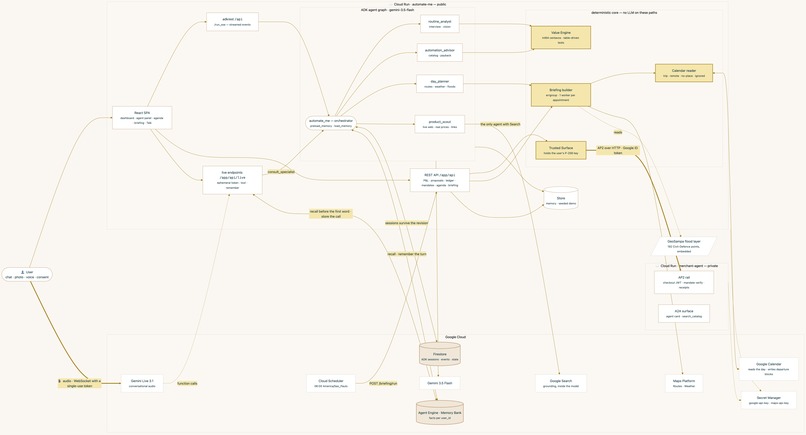
A multi-agent system on ADK Go v2.2.0 with Gemini 3.5 Flash, deployed on Google Cloud Run.
A root automate_me orchestrator routes to four specialist sub-agents — routine_analyst,
automation_advisor, day_planner and product_scout — over function tools that wrap
deterministic Go modules. The
LLM converses and routes; the engine computes. The Talk tab is a live
Gemini Live API session: gemini-3.1-flash-live is
the front of house, and every judgement it makes is handed to the 3.5 graph through
consult_specialist, because the only conversational Live model should not also be the brain.
The Product Scout is the one sub-agent with Gemini's built-in Google Search, and Search is its
only tool — the API refuses to mix the built-in with function declarations, and ADK gives every
sub-agent a transfer_to_agent function, so the scout sets
tool_config.include_server_side_tool_invocations to both resolve that and make the server-side
search visible in the response instead of invisible. Ask it for a wireless mechanical keyboard
under R$500 and it comes back with real listings at current prices with working links — then
argues its pick in terms of your time, not the sticker: it chose the cheaper ABNT2 layout
because the other one would cost you an evening reconfiguring your system. That is the product's
whole thesis coming back out of a live search result.
Payments run on AP2 v0.2 over A2A v1.0.1. A separate merchant agent — its own private Cloud Run service, invokable only by the app's service account — signs Checkout JWTs. The app signs closed Checkout and Payment Mandates with an ECDSA P-256 key, and the merchant returns verifiable receipts. Settlement is simulated and labelled as such everywhere. The protocol is not simulated.
The Daily Briefing calls the Google Maps Routes API twice per appointment, then prices the congestion it finds:
$$c = (t_{\text{traffic}} - t_{\text{static}}) \times r$$
Flood risk comes from two layers: live public weather alerts whose polygon your route crosses, and 192 flooding occurrences logged by São Paulo's Civil Defense (GeoSampa), matched within 150 metres of the route polyline. August is dry season here, so the historic layer is what keeps the feature honest when there is nothing live to show.
Sessions and memory both outlive the process. ADK sessions live in Firestore behind a
session.Service written against the contract the built-in ones honour — partial events never
persist, app:/user:/temp: state is scoped by prefix and temp: is dropped — so a conversation
survives a revision rollover or a cold start. ADK's own conformance suite runs against it. Spoken
calls persist the same way.
Google Cloud: Cloud Run (two services) · Cloud Build · Artifact Registry · Secret Manager · Cloud Scheduler (the 06:00 briefing) · Firestore (agent sessions) · Vertex AI Memory Bank · Google Maps Platform · Cloud Logging · Cloud Trace.
What I learned
Autonomy and safety were not the trade-off I assumed. The obvious way to let an agent buy without asking is to loosen the rule that a human authorizes payments. The right way turned out to be the opposite: keep that rule absolute, and move when the human applies it. A standing, user-signed authorization with a cap, an allowlist and an expiry gives the agent real autonomy while the signing surface stays exactly as non-agentic as it was before. The agent still cannot sign, reach the key, mint an authorization, or widen one. What moved is that the human now decides once, over a bounded envelope, instead of once per purchase.
A cap is only as trustworthy as the number it is checked against. The constraint is evaluated against the total the merchant signed, after the Checkout JWT is verified and before the first signature — never against a price my own code computed. A cap enforced against a local number would be a cap an attacker could move. And because the check runs before anything is signed, a refusal signs nothing and leaves no trace on the rail.
Pricing traffic needs two Routes calls, not one. How long the trip takes depends on when you leave, and when you should leave depends on how long it takes. The first call exists only to pick the departure time for the second.
Keeping money out of the model is what makes the product credible. Every figure comes from the deterministic engine. A model that hallucinates your savings destroys the only thing this product sells, so the model never gets to produce one.
An agent will tell you it did something it did not do. Asked in chat to change my hourly rate, the orchestrator answered "I have updated your hourly rate to R$120" — and called no tool at all. It owned the conversation but owned no profile tool, so it answered from memory, fluently and wrongly. Routing that to a sub-agent was the bug: a person states their rate in the middle of any topic. The orchestrator carries those tools itself now and is told never to claim it saved something a tool did not save. The lesson generalises past this bug — a confident sentence is not evidence of a write, and the only way to know is to check the store.
The AP2 threat model forces architecture, not policy. The signing key lives in a package no LLM code path can reach. Making the trusted surface non-agentic by construction was far easier to reason about than trying to constrain a model with prompting.
Challenges I ran into
An org policy that forbade a public service. My Google Cloud organization enforces Domain
Restricted Sharing, so binding allUsers on Cloud Run was rejected outright. Worse, gcloud run
deploy --allow-unauthenticated only warns when that binding fails — it exits zero and leaves you
with a private service you believe is public. The fix was a project-scoped policy override, plus a
deploy script that asserts the IAM binding explicitly and exits non-zero if the service is still
private. Failing loudly beat failing politely.
A matcher that silently matched nothing. The catalog pairs routines to recipes by substring.
The seeded routine "Supermarket run" matched no recipe at all, because the grocery recipe's
triggers were mercado, grocery, supermercado and compras — and none of those appear inside
the English word supermarket. The recipe existed, the rail could buy the product, and the
proposal was simply never generated. Nothing errored. It taught me to be suspicious of the quiet
paths, not the loud ones.
A claim the code did not back. One recipe was classed as executable with a report-generation capability, but nothing ever executed it. I cut it rather than deferring it. A catalog that promises what it cannot do is worse than a smaller catalog.
Reading a calendar taught me the product was aimed slightly wrong. I wired the Daily Briefing to
a real Google Calendar and read a real week: 46 appointments, and zero with a street address.
Twenty-one were Zoom or Meet links; the rest had no location at all. The routing, the traffic
pricing, the flood layer — none of it had anything to say about that person's week. So the calendar
reader now classifies every row as a trip, screen time, or noise, and says so plainly rather than
showing an empty page. One location was a Zoom URL that had lost its https:// on the way in, and
would have been sent to the Routes API as a street address.
Two agents, one of them private. Cloud Run URLs are computable from the project number before the first deploy, which is what let the app be configured with the merchant's address in the very deploy that creates it — and let the merchant stay authenticated-only from the start.
What's next
The Plan Guardian: every approved automation becomes a plan with expected savings and expected signals, and the Guardian watches for drift — the dishwasher arrived, but you still logged forty minutes of dishes — then promotes ledger entries from projected to confirmed. Proving the value is the whole thesis, and right now the ledger only projects it.
After that: a Calendar Watcher that learns routines from your real calendar instead of asking, and Open Finance so the cost side is measured rather than estimated.
Built With
- a2a
- ap2
- artifact-registry
- cloud-build
- cloud-logging
- cloud-run
- cloud-scheduler
- firestore
- gemini
- gemini-live-api
- genai-sdk
- geosampa
- go
- google-adk
- google-cloud
- google-maps-platform
- react
- routes-api
- secret-manager
- typescript
- vertex-ai
- vite
- weather-api

Log in or sign up for Devpost to join the conversation.