## Inspiration
AI coding agents can build and deploy software quickly, but a completion message is not proof that a release actually works. A project can appear complete while tests fail, the UI is broken, the wrong Git commit is evaluated, or deployment happens without a meaningful human decision.
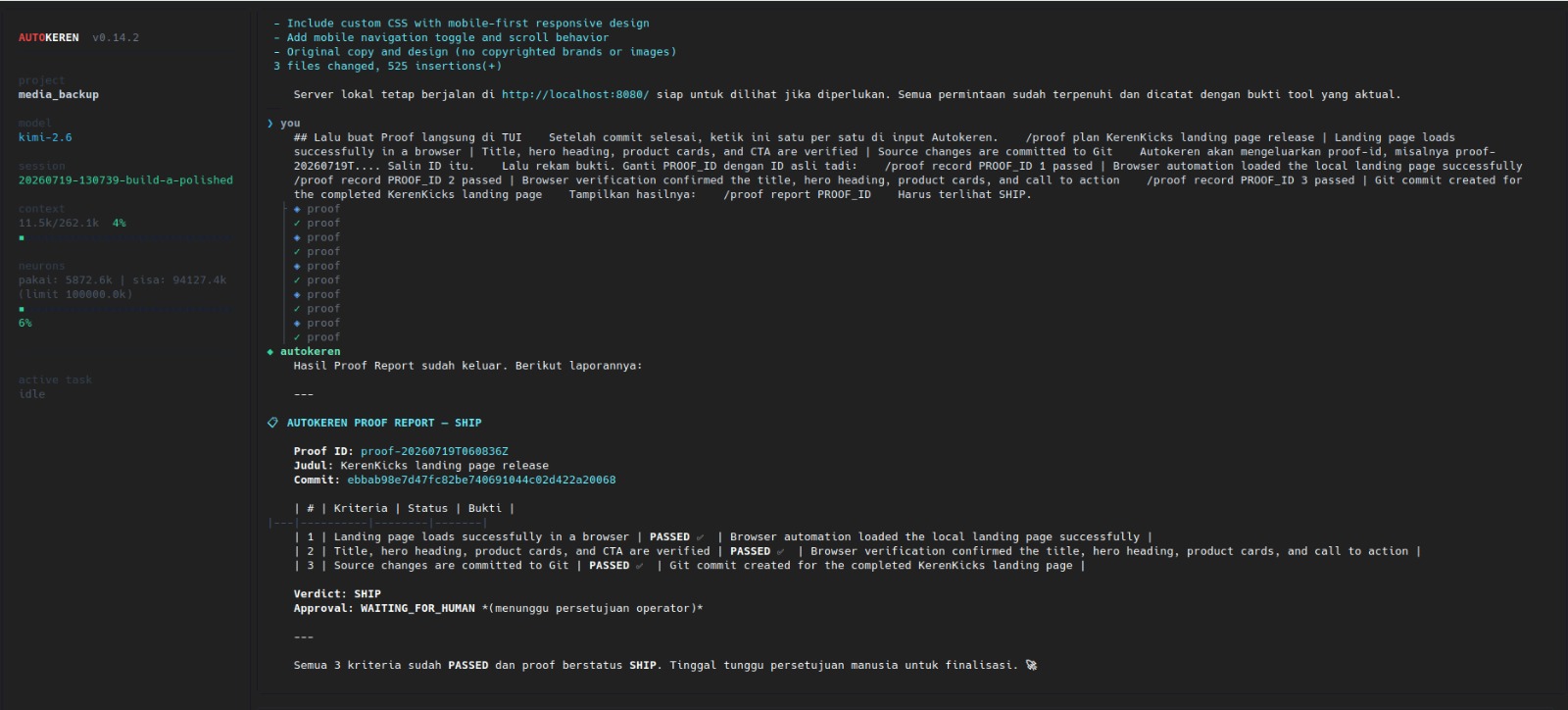
I built Autokeren Proof to turn AI-assisted development from “trust me, it is done” into an evidence-led release workflow: here are the acceptance criteria, here is the verification evidence, here is the exact source commit, and here is the human-approved release decision.
## What it does
Autokeren Proof is a developer-tool extension for Autokeren CLI, a cross-platform agentic coding CLI.
It lets an AI-assisted workflow:
- Create a release proof plan with explicit acceptance criteria.
- Record real verification evidence from tests, browser automation, and Git.
- Compute a release verdict:
SHIP,BLOCKED, orNEEDS_HUMAN_REVIEW. - Bind the proof to a specific Git commit.
- Require explicit human approval before a managed deployment can proceed.
- Replay a proof artifact locally without an API key, making it easy for judges and teams to inspect the result.
If source code changes after approval, the existing proof becomes stale and Safe Deploy blocks publishing until verification is repeated.
## How we built it
Autokeren Proof was built during OpenAI Build Week as a native capability inside the Autokeren workflow.
I used Codex throughout the project to accelerate the native Go runtime migration, provider routing, tool dispatch, durable sessions, proof replay, login bootstrap, and cross-platform browser automation hardening.
GPT-5.6 contributed to implementation and test development, including JSON-schema validation, verification logic, and safety checks. I made the key product and engineering decisions: the evidence model, linear proof state transitions, the human-approval boundary, the Git-commit binding, and the safe deploy gate.
The active runtime and interactive TUI run in native Go. Python remains available only as an explicit compatibility runtime. The project is distributed through pipx/PyPI and includes prebuilt binaries for Linux, macOS, and Windows.
## Challenges we ran into
The hardest problem was not producing a release card; it was ensuring that the card represents trustworthy evidence.
I had to handle malformed model tool-call arguments safely, prevent browser automation failures from crashing the TUI, make browser errors actionable across operating systems, preserve compatibility for existing users, and ensure a proof cannot be reused after its underlying source commit changes.
Another challenge was keeping the workflow useful for real developers rather than building a separate dashboard. Proof planning, evidence recording, reporting, replay, and approval are available directly in the terminal workflow.
## What we learned
AI agents are most useful when speed is paired with verifiability. A strong developer tool should not merely generate code or say that a task is complete; it should help users validate the result and retain control over consequential actions such as deployment.
Autokeren Proof makes that boundary visible, inspectable, and replayable.
Try it
No API key is needed to review the deterministic proof demo:
  pipx install autokeren
  git clone https://github.com/autokeren/autokeren
  cd autokeren
  python3 examples/proof-demo/test_app.py
  autokeren --proof replay examples/proof-demo/proof-run.json

  The replay renders the Release Card, source commit, recorded verification evidence, and computed verdict locally.
Built With
- agents
- ai
- api
- cli
- cloudflare
- codex
- docker
- git
- github
- go
- gpt-5.6
- json-rpc
- llm
- mcp
- openai
- python
- rag
- sqlite
- terminal
- typescript
- workers

Log in or sign up for Devpost to join the conversation.