-
-
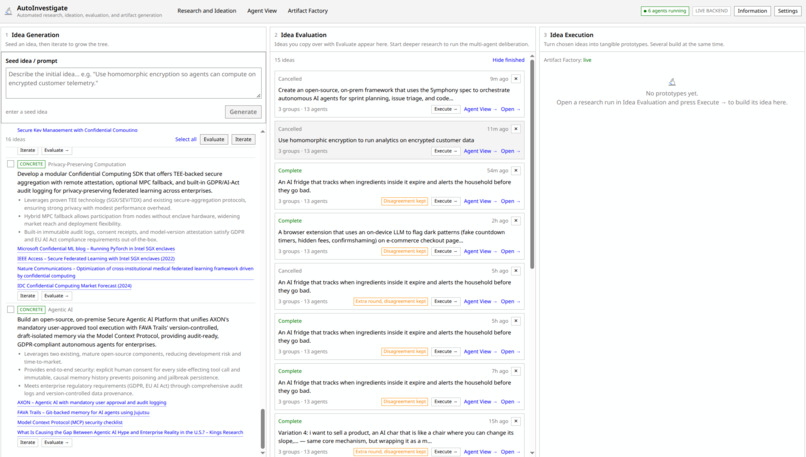
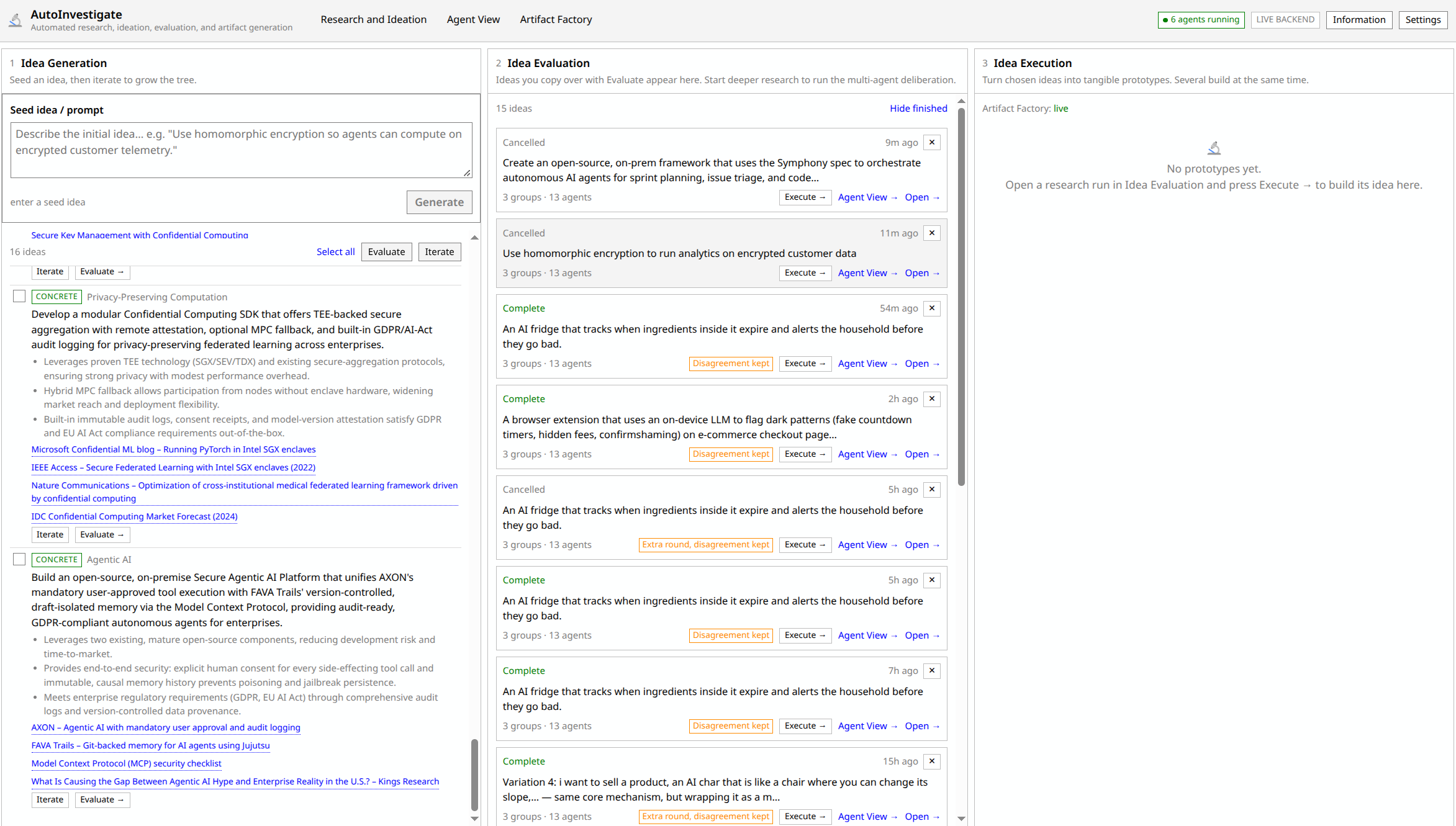
home page
-
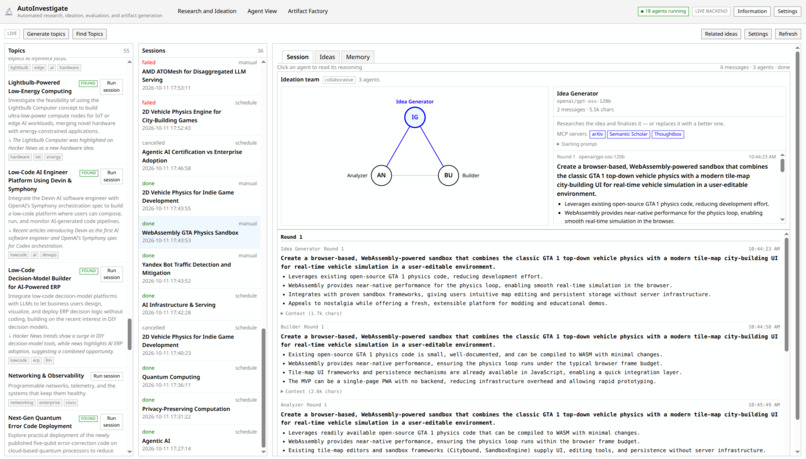
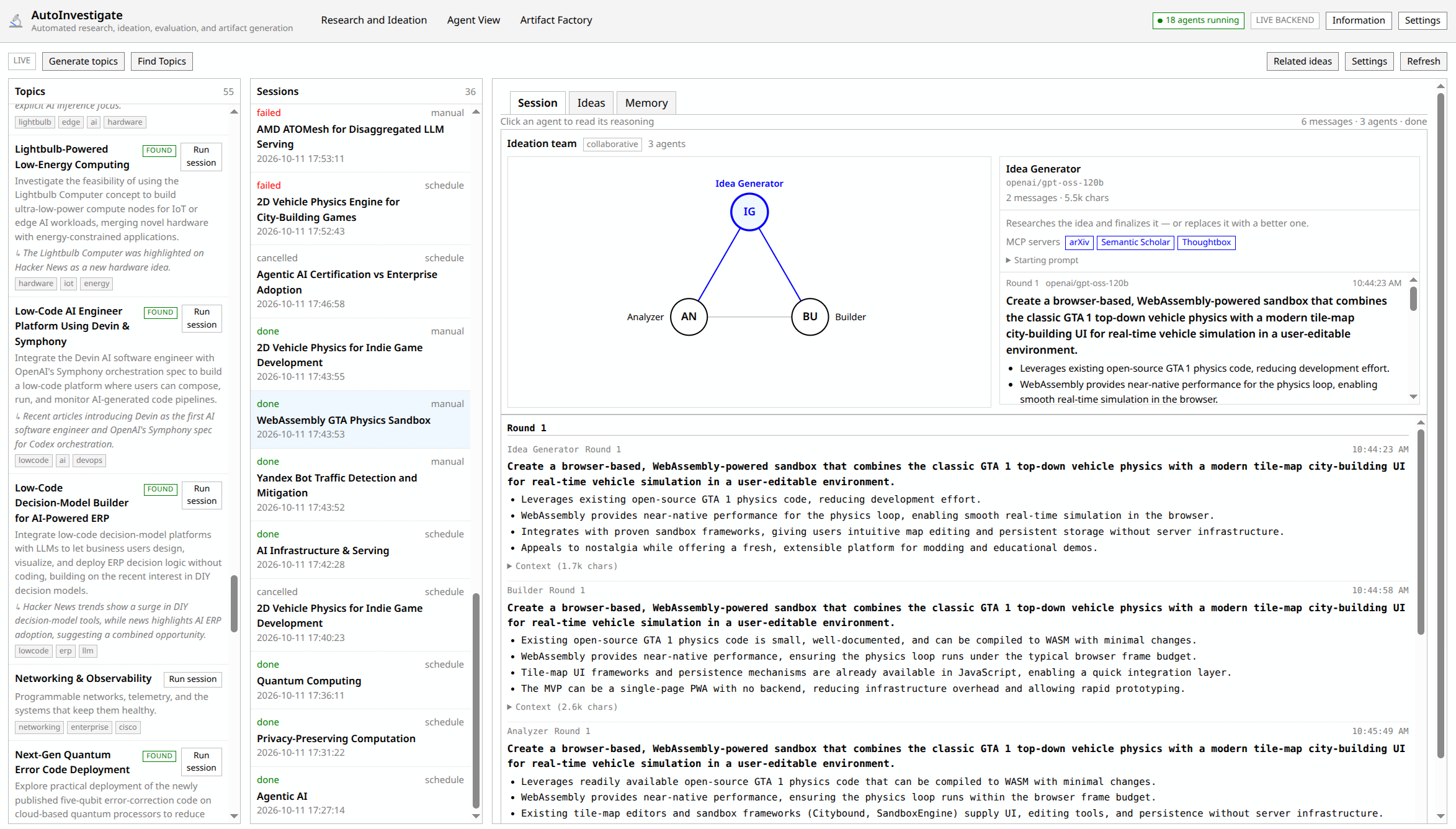
ideation team
-
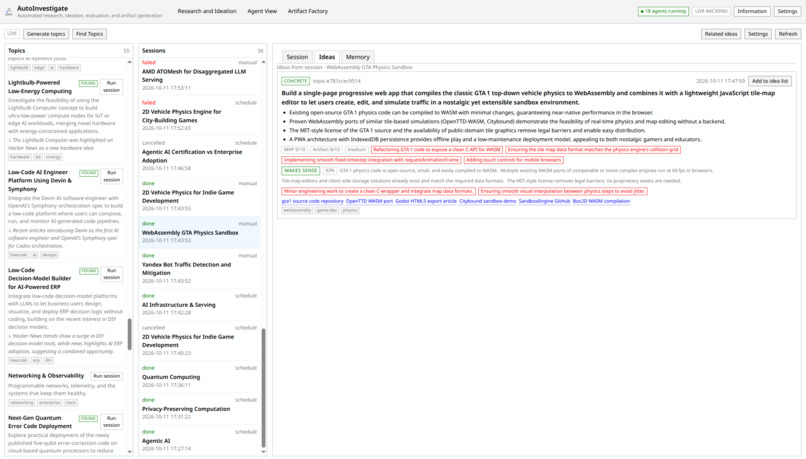
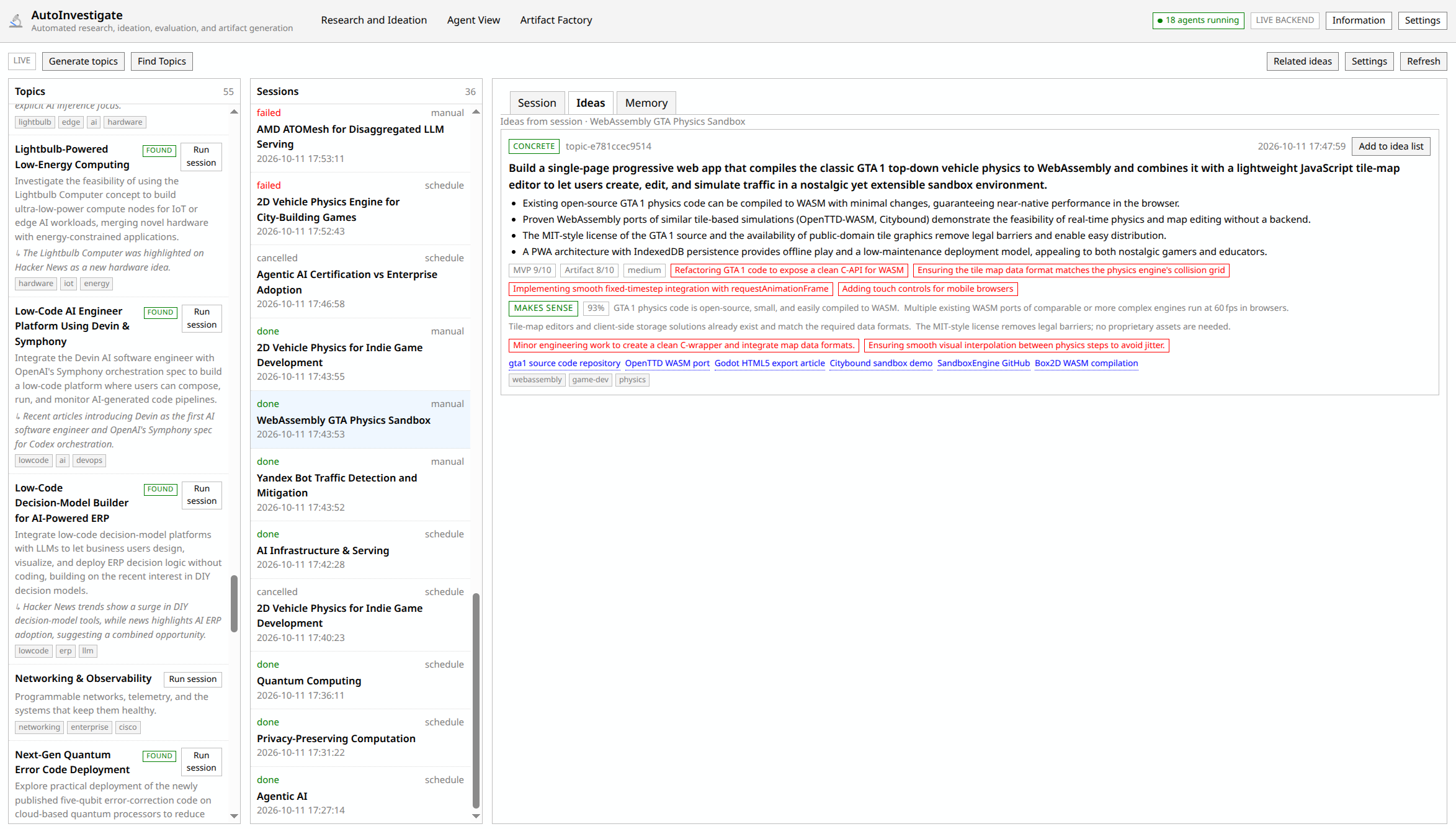
concrete idea generated
-
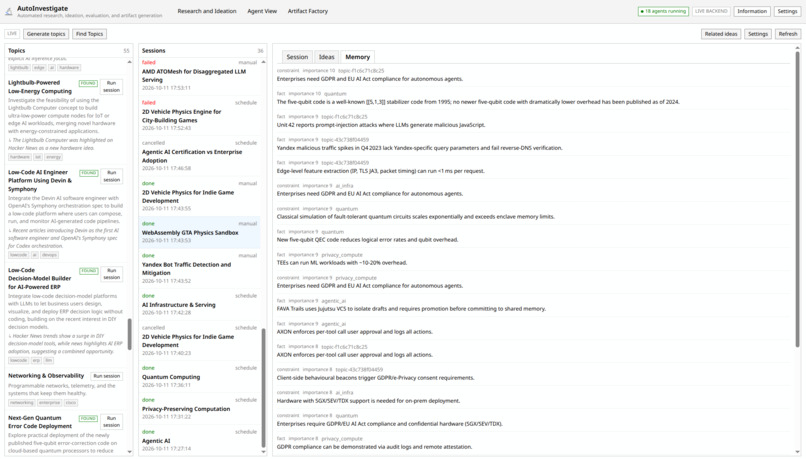
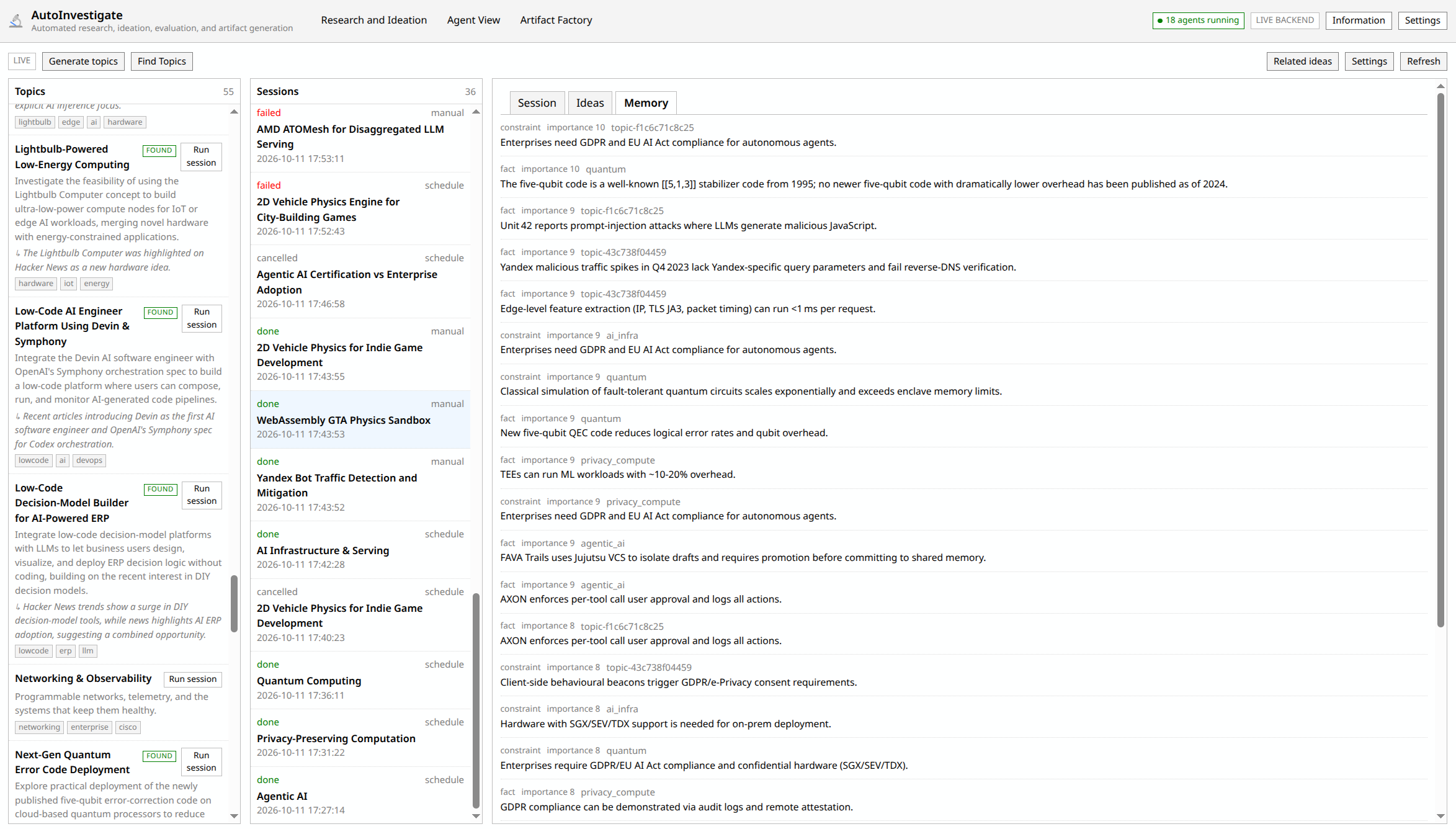
ideation memory
-
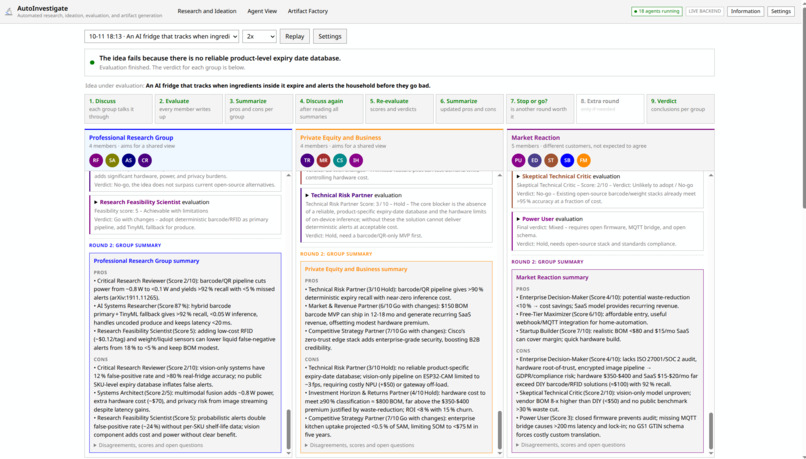
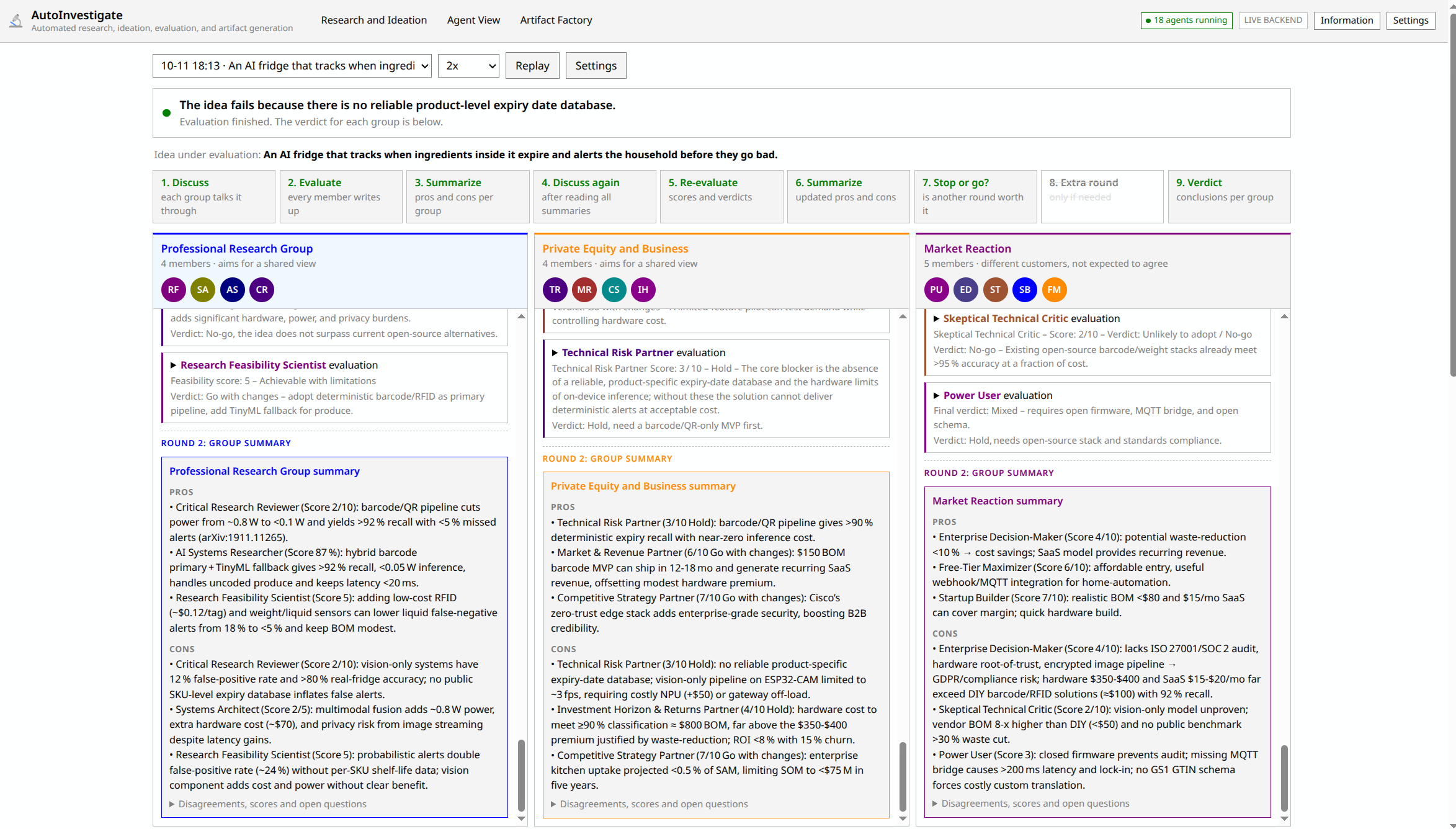
agent view, view the agents in their groups chatting with each other
-
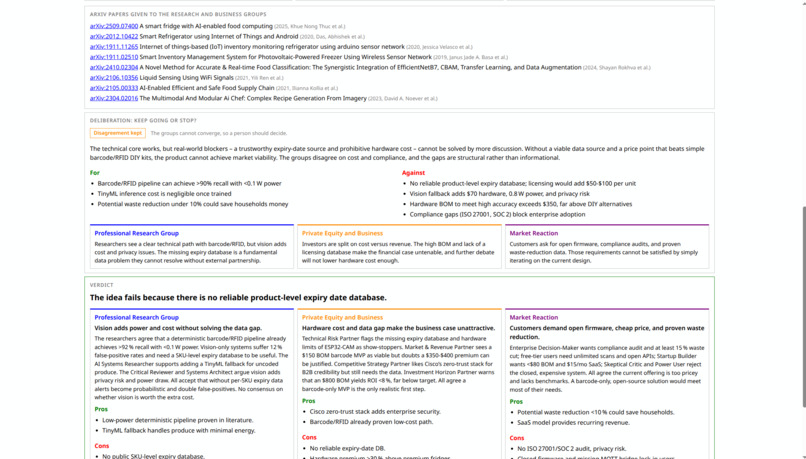
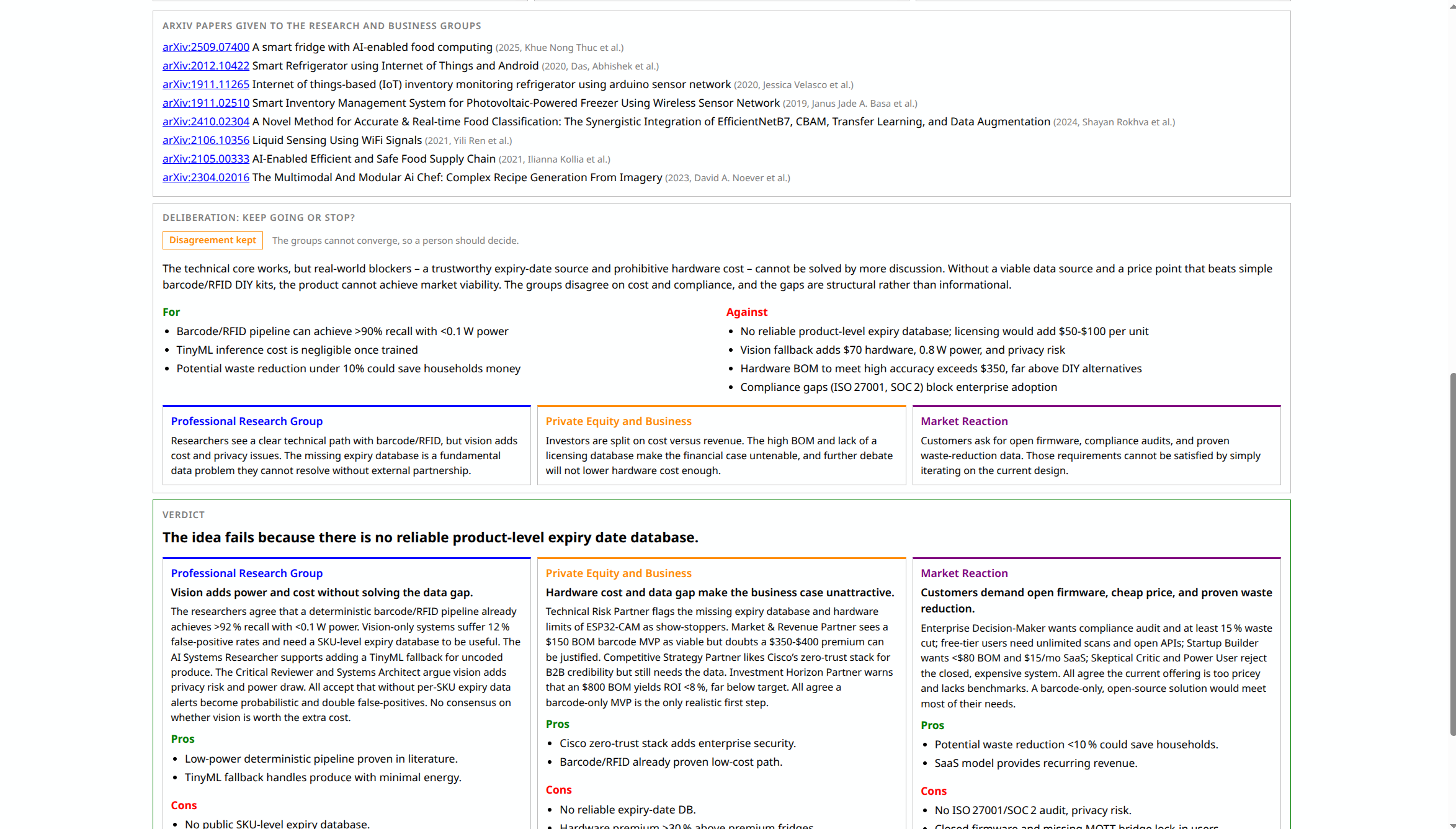
agent view cont., view the specific group verdicts and the sources being pulled upon
-
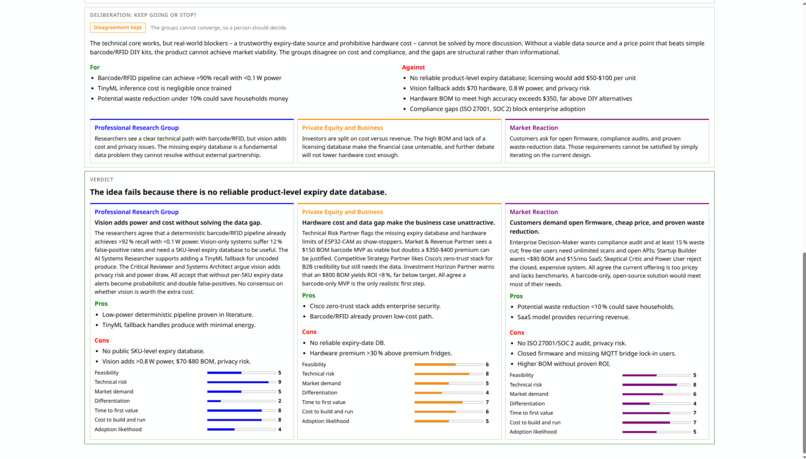
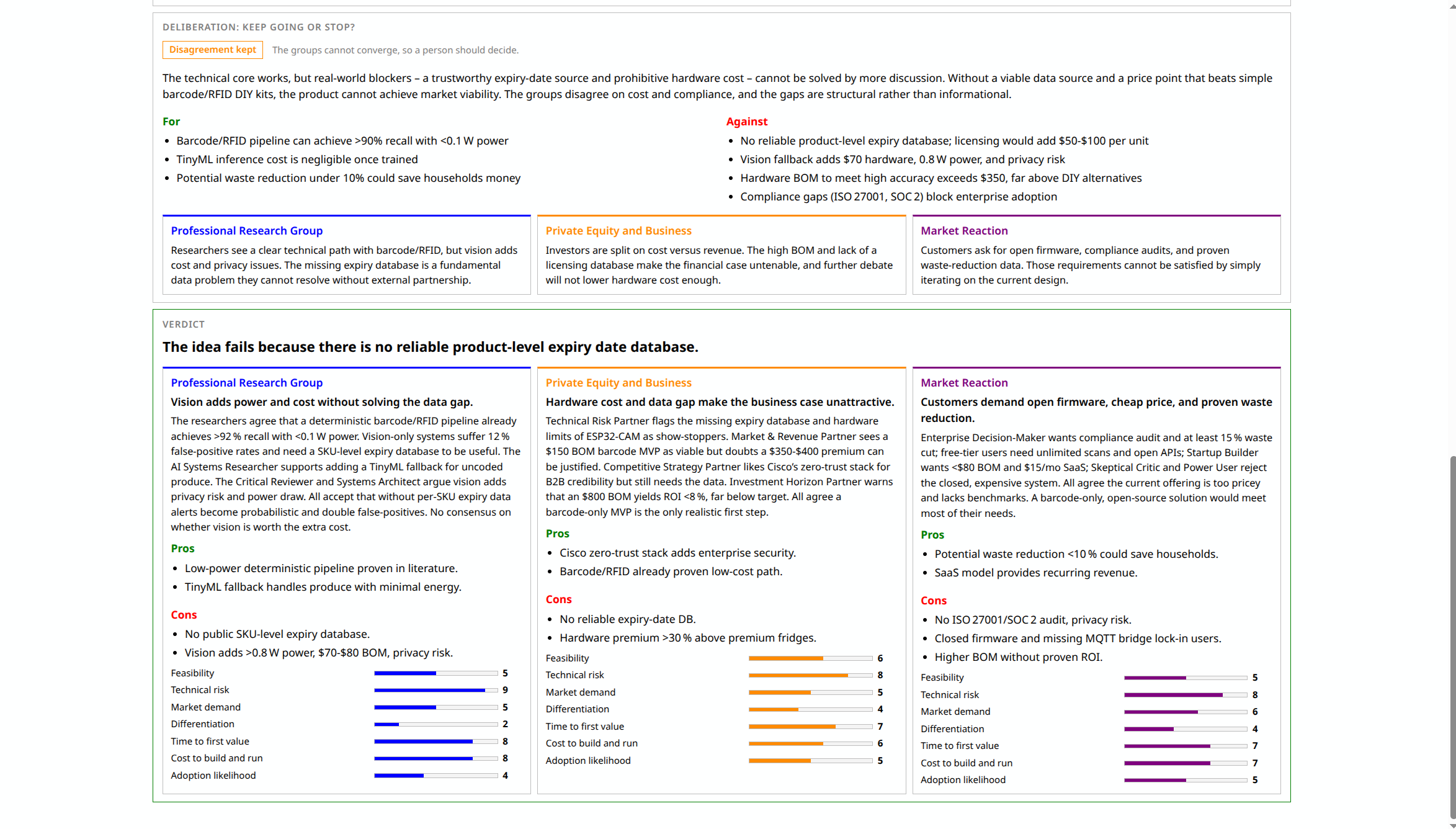
agent view cont., view the specific group verdicts
-
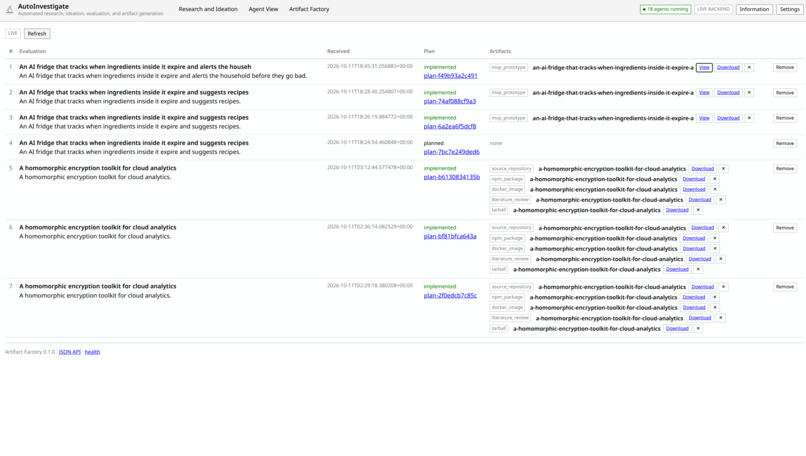
artifact generator
-
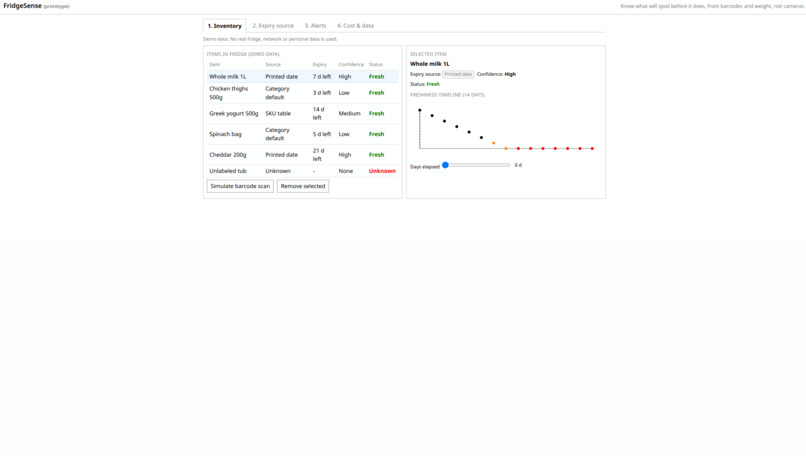
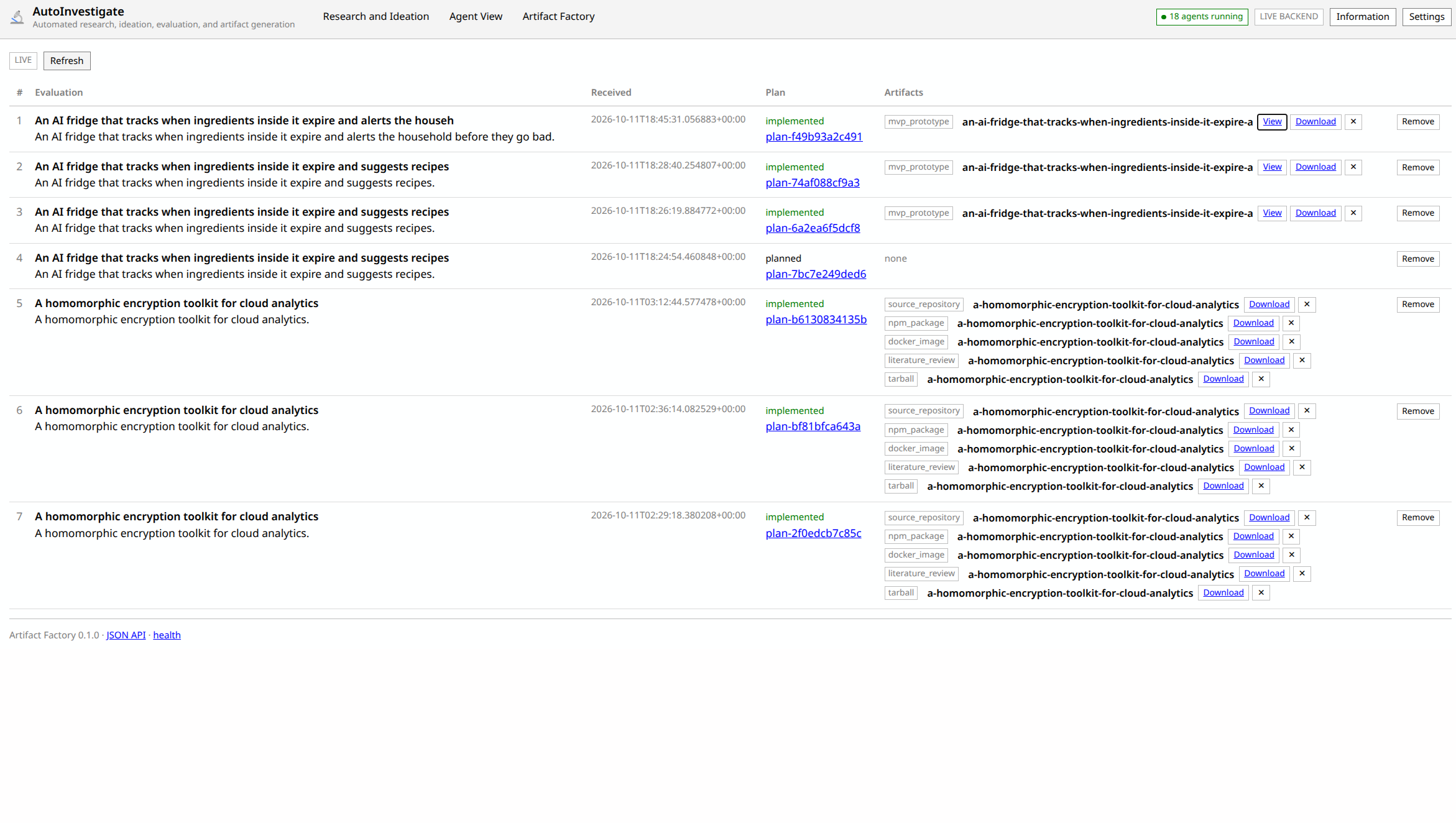
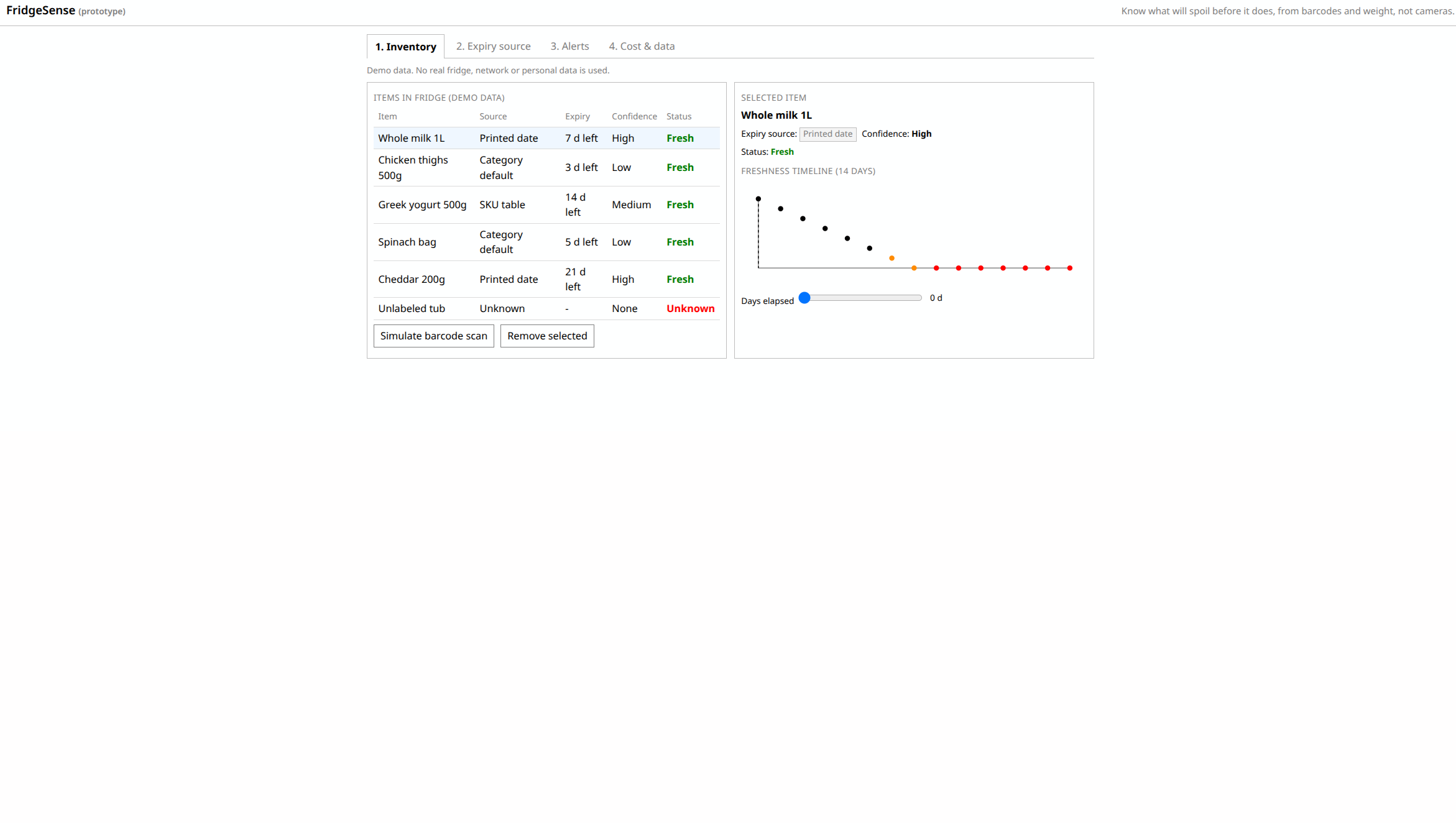
sample artifact generated
Inspiration
AI can now come up with endless ideas in seconds, so having ideas isn’t the hard part anymore. The hard part is knowing which ones deserve your team’s time. Evaluating an idea properly takes researchers to judge whether it’s feasible, investors to judge whether it makes money, and real customers to judge whether they would use it, and those people usually disagree. A single chatbot tends to agree with you and hand you a generic plan. The Cisco Outshift track asked for agents that deliberate and make decisions even when they disagree, and Outshift itself exists to find emerging technology worth investing in. That led us to AutoInvestigate, a tool for business people, market researchers and anyone starting something new who wants to check an idea before bringing it to their team.
What it does
AutoInvestigate has three stages, shown as three columns in the app. In Idea Generation, an ideation collective of three agents (Idea Generator, Builder and Analyzer) watches arXiv, Hacker News, Reddit and news feeds and turns what it finds into ideas, and users can also type in their own. In Idea Evaluation, a reality check first flags ideas that are physically, legally or logically impossible, like our test idea of free electricity from a loop of magnets. Then the Evaluation Swarm of 13 agents debates the idea in three group perspectives. The Professional Research Group judges feasibility and prior work, the Private Equity group judges technical risk, market, competition and returns, and the Market Reaction group plays five customer archetypes. The groups read each other’s summaries and respond across rounds. A stop or go decision and the three stewards of the Evaluation Complex decide whether more debate is worth it, and the system keeps the disagreement instead of forcing a consensus. The final report gives a recommendation, the case for and against, an ordered action plan, kill criteria, risks and what would change the verdict. Users can watch the debate live in the Agent View. In Idea Execution, the Artifact Factory turns an evaluated idea into a clickable prototype, a literature review and a starter repository.
How we built it
We built agent communication on Cisco’s AGNTCY stack using agntcy-app-sdk, slim-bindings and a2a-sdk, so every agent is its own SLIM endpoint and talks to the others over A2A messages. The orchestrator makes no decisions. It opens a group, posts a command and collects the replies, so all of the reasoning happens inside the agents. Every model call goes through OpenRouter, which lets each agent run on a different model, with cost tracking and a budget cap built into our client. The research and business groups get real papers through OpenAlex, agents can call tools from Smithery MCP servers, and every quote and citation in the final report is checked against its source. Every agent’s prompt is an editable markdown file, the ideation daemon stores its data in SQLite, and the frontend is plain JavaScript with no build step. Everything runs from one Docker Compose file on a Vultr server behind Caddy, and GitHub Actions redeploys it on every push.
Challenges we ran into
Several of our first approaches didn’t hold up, and each one pushed us toward a better design. We first ran every agent in one process, but the AGNTCY SDK only keeps one SLIM connection per process, so we moved to one process per agent with a supervisor that manages them. We first ran all 13 agents on the same model, and they agreed on everything and shared the same blind spots, so we rewrote their roles and gave each agent a different model. Even then, agents working only from their prompts produced a lot of generic answers and invented statistics. So we decided to specialize each agent with its own MCP servers that match its role. The Critical Reviewer gets citation checkers and Crossref to look for prior work, the Market and Revenue Partner gets finance tools, and the Feasibility Scientist gets arXiv and Semantic Scholar. That way each agent argues from real data in its own area instead of guessing. We also first let agents veto ideas, then removed vetoes because it isn’t fair for an AI to kill an idea a person brought in. Finally, our first output was only a short verdict, and our baseline test showed it wasn’t useful enough, so we built the final report with an action plan and kill criteria.
Accomplishments that we're proud of
We are most proud that the deliberation swarm beats a single model. In our testing against GPT-6 Luna Pro, with a blind judge, the deliberation swarm won three of four ideas, averaging 9.0 against 7.75 overall and 9.5 against 6.5 on specificity, with no factual errors found in any report. On EV battery recycling the single model described pilot plants that don’t exist as described, while the deliberation swarm stuck to what the real papers showed. The disagreement is also real and changes minds. In one run an investor agent dropped its own $12M revenue estimate after admitting it couldn’t name ten real customers. In another, all three groups rejected a smart fridge that charges $4.99 to unlock after 10 p.m., partly because it could block access to insulin. We are also proud that all three stages work end to end and that the whole system is deployed.
What we learned
For some of us, this was the first time working with AGNTCY, SLIM, A2A messaging or MCP servers, so a lot of the weekend went into learning how agents actually find and talk to each other, and how to give them real tools instead of just longer prompts. We learned that adding more agents doesn’t automatically give better answers. Thirteen copies of one model just repeat the same mistakes, and the deliberation swarm only improved once the agents had different models, different information and different tools. We also learned to test against a simple baseline instead of assuming the complex system is better, since our first loss told us exactly what to fix. Finally, we learned that how you present the debate matters as much as the debate itself, because the deliberation swarm's answers only became useful once they were written up as a clear plan.
What's next for AutoInvestigate
Next, we want to add business forecasting. After the deliberation swarm evaluates an idea, a fixed business model would take its estimates for costs, pricing and adoption and project whether the idea could actually make money over the next few years. That would give users numbers they can bring to their team alongside the deliberation swarm’s reasoning. We also want to add a fact checking stage that verifies every claim and number before the final report states it, and to let the deliberation swarm pick which personas fit each idea instead of always using the same thirteen. Finally, we want to run a larger benchmark with more ideas, several judge models and human judges, and keep making Deep mode faster.


Log in or sign up for Devpost to join the conversation.