-
-

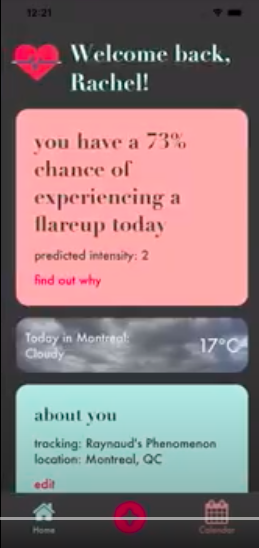
home screen
Inspiration
I’ve come to realize that the most frustrating thing about having an autoimmune disease is dealing with flare ups. It’s the anxiety of not always knowing when they’ll happen and the daunting task of understanding your triggers, which can be a very hard puzzle to solve as the triggers can be unique to the person, combinatorial and cumulative. On top of this, there is not much support from the medical field – because simply, they don’t have the means to decipher your triggers and offer the level of personalized medicine that is needed.
As well, autoimmune disease has seen an incredible increase over the past couple years. So much so that the harvard gazette and many others are calling it an epidemic. It is the 3rd most common category of disease in the US after cancer and heart disease. On top of all this, there is now evidence that covid19 infection causes autoimmune diseases - thus this viral epidemic is accelerating the already rising autoimmune epidemic, which is why tackling this issue is relevant now more than ever.
Too many people feel victimized by their conditions -and we don’t believe that should be the case. We want people to control their disease instead of their disease controlling them. We want them to feel empowered, supported and encouraged, and this was the motivation behind our app
What it does
takes in stress and exercise levels as well as weather inputs including humidity, pressure and temperature and predicts if you will have a flare up (and of what intensity that flare up will be) within the next 24 hours
How I built it
Data cleaning: due to the free-text nature of the diary app we used as starting dataset, we had to do a lot of data cleaning such as re-organization, making rankings for the different key words that we found, etc.
Once we decided on which potential inputs we could look into, we ensured that: 1) Each disease’s inputs correlated with that disease’s flare up intensities in order to not add noise to our model. 2) We also ensured that no inputs were dependent on each other (via heat maps and common sense) Based on the remaining inputs we narrowed down the diseases to Raynauds, Dysautonomia nad Lupus as they had the most viable inputs
Finally, the dataset had flare ups rated on a scale from 1-5. We generated and analyzed flare up distribution graphs (i.e. graphs made from our dataset that shows distribution of the different flare up intensities across a given input's values ex. temperature), and we re-grouped these flare-up categories to better represent their groupings in the graphs. This would lead to better model accuracy.
We also ensured that there was no bias in our dataset that could skew the outputs. We found that less than 10% of our data entries were male, so we dropped the male entries. As a side note: This would mean that currently our target population is only women. We also wanted to make sure there was equal representation of the outputs and we used up-sampling for the flare up categories with less entries.
Model: Our current model is a three-class classifier that uses information from the last few days to predict whether the user will experience no flare up, a medium flare up or an intense one on the next day. For this task, we tried different models, namely: Logistic regression, Decision Trees, Random Forest, and SGDClassifier.
For now, we obtained the best accuracy with the logistic regression model. With this model, our users only need to log in the app for 10 consecutive days before they can benefit from a prediction of flare up intensity whose accuracy is between 68 and 74%, depending on their disease.
We ensured that these models are explainable in order to use this insight to assist users in their understanding of their triggers.
Challenges I ran into
Data cleaning, knowing how to format the data so we can use it with the different models.
Accomplishments that I'm proud of
We made an ML product from scratch. It was our first time trying to do so and we learnt so much about best practices and tools to use to make such a product. Also very proud of our team work skills that allowed us to accelerate through the past 3 weeks and come up with an ethical AI model.
What I learned
How to implement an AI model from start to finish including data processing, researching ML models, learning about best practices and ethics in AI, testing ML models, etc.
What's next for Autoimmune disease flare up predictor
We would love to try more complex models including NN and LSTMs. We would also want to gather food data as this is a known trigger for many autoimmune diseases and would be a great addition to our inputs. Getting more male data would also be beneficial as we would then be able to make an app for both sexes.

Log in or sign up for Devpost to join the conversation.