-
-
Image
About the Project
Inspiration
In production environments, CI/CD pipelines are expected to accelerate delivery. In practice, they often become a bottleneck. A large percentage of failures are caused by predictable, low-level issues such as missing dependencies, minor syntax errors, or brittle test cases.
Despite this, developers still spend time manually inspecting logs and applying trivial fixes.
This is inefficient and does not scale.
The idea behind AutoHeal CI is simple:
$$ \text{If failures are repetitive and diagnosable, they should be fixable automatically.} $$
What It Does
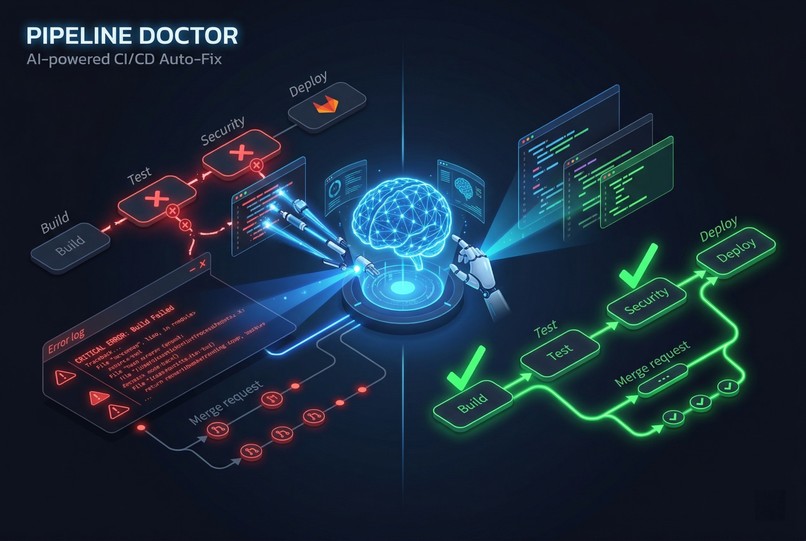
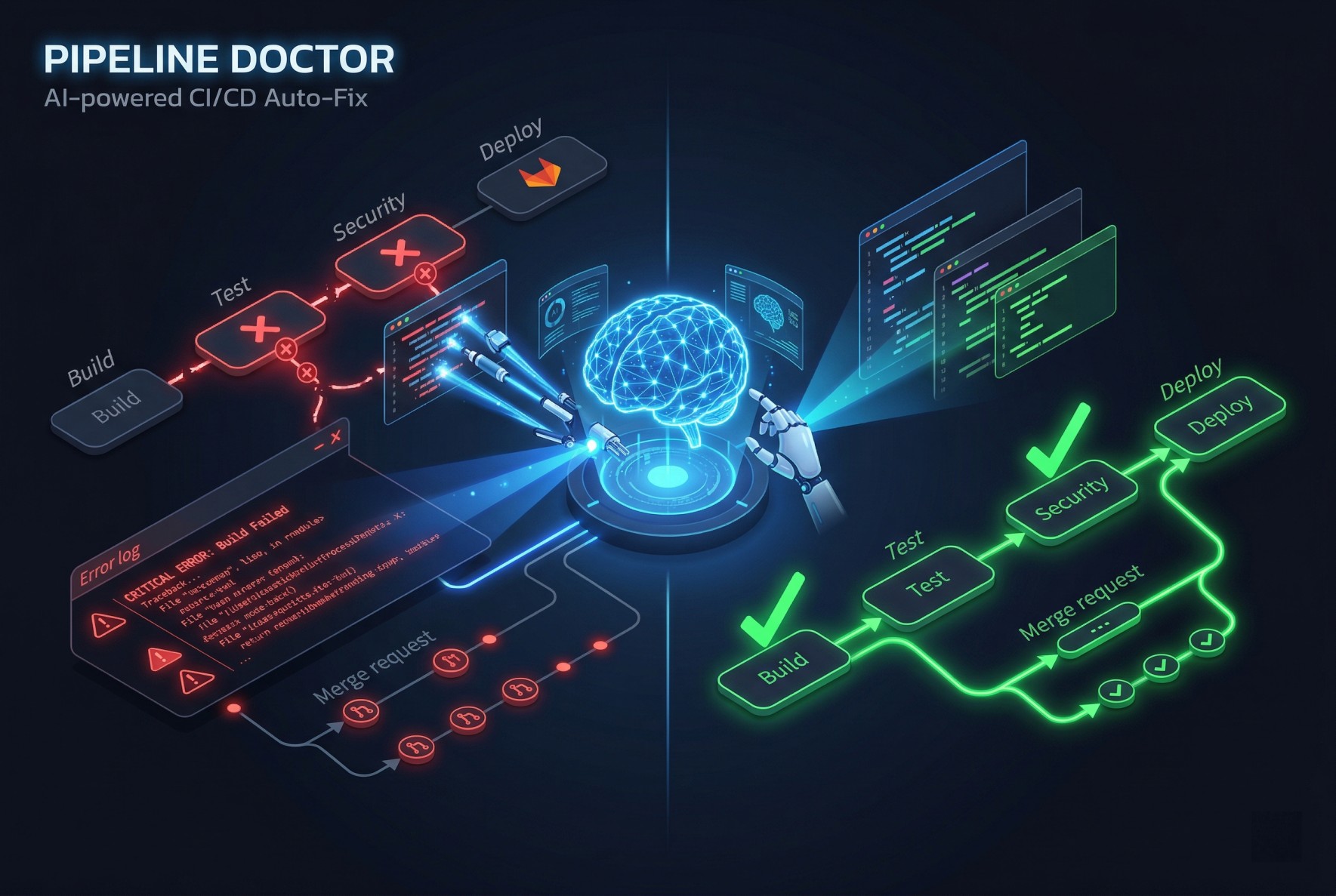
AutoHeal CI is an autonomous agent integrated with GitLab that actively resolves pipeline failures.
It performs the following actions:
- Detects failed pipelines in real time
- Extracts and analyzes failure logs
- Identifies the root cause of the failure
- Applies targeted fixes to the codebase or configuration
- Commits the changes and re-triggers the pipeline
This creates a closed feedback loop:
$$ \text{Failure} \rightarrow \text{Diagnosis} \rightarrow \text{Fix} \rightarrow \text{Validation} $$
How It Works
The system is designed as a deterministic workflow: Pipeline Failure ↓ Log Extraction (via GitLab API) ↓ Error Classification ↓ Automated Fix Application ↓ Commit & Push Changes ↓ Pipeline Re-run
Core Components
Failure Detection
Continuously monitors pipeline states and detects failed jobs.Log Extraction Layer
Retrieves raw job logs via GitLab APIs for analysis.Error Classification Engine
A rule-based classification system that maps failures into known categories:- Dependency errors (e.g., missing modules)
- Syntax/runtime errors
- Test assertion failures
- Dependency errors (e.g., missing modules)
Auto-Fix Engine
Applies scoped and high-confidence fixes:- Updates dependency manifests (e.g.,
requirements.txt) - Corrects syntax issues using LLM-assisted rewriting
- Adjusts failing test cases where applicable
- Updates dependency manifests (e.g.,
Version Control Integration
Automatically commits and pushes fixes with structured commit messages.Pipeline Orchestration
Re-triggers pipelines to validate fixes and confirm recovery.
Key Learnings
- A majority of CI/CD failures follow predictable patterns
- Deterministic approaches often outperform over-engineered AI systems in constrained domains
- The real value of AI in developer tooling lies in execution, not suggestion
- System integration and reliability are more challenging than model development
Challenges
Unstructured Log Parsing
Pipeline logs vary significantly, requiring flexible pattern recognitionSafe Auto-Remediation
Ensuring fixes are minimal and do not introduce regressionsAPI Integration Complexity
Handling authentication, job retrieval, and pipeline triggers reliablyScope Control
Avoiding over-generalization and focusing on high-impact failure cases
Future Work
- Extend support to infrastructure-level failures (Docker, environment configuration)
- Introduce validation layers before committing fixes
- Enable multi-agent orchestration for complex pipelines
- Integrate with security and compliance scanning workflows
Impact
AutoHeal CI transforms CI/CD pipelines from reactive systems into self-healing workflows.
$$ \text{Developer Effort} \downarrow \quad\quad \text{System Autonomy} \uparrow $$
Instead of developers fixing pipelines,
the pipeline fixes itself and continues execution.
Built With
- ci/cd
- gitcli
- gitlab
- gitlabapi
- openaiapi
- python
- regex
- restapi

Log in or sign up for Devpost to join the conversation.