
Inspiration
Color grading is inherently creative, but applying a creative direction consistently across many shots is still a repetitive and time-consuming process.
Modern multimodal models are increasingly capable of understanding the visual language of a scene — its lighting, mood, color palette, and cinematic intent. However, asking a generative model to independently grade every shot creates another problem: consistency. The same instruction can produce slightly different decisions from shot to shot, while professional post-production workflows require transformations that are predictable and reproducible.
That led us to the central idea behind AutoGrader:
Use agents for the decisions that require reasoning, and deterministic tools for the transformations that require consistency.
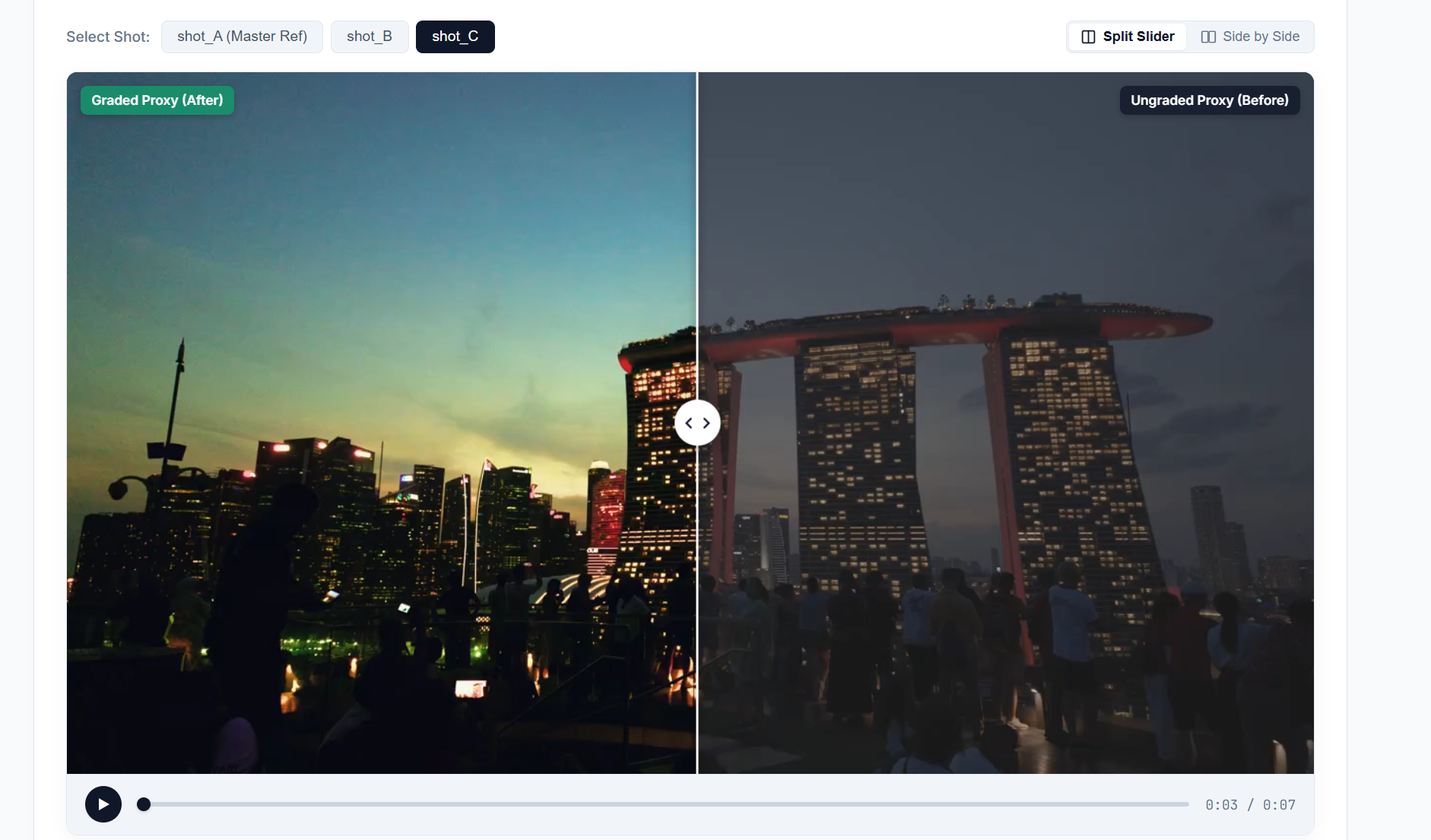
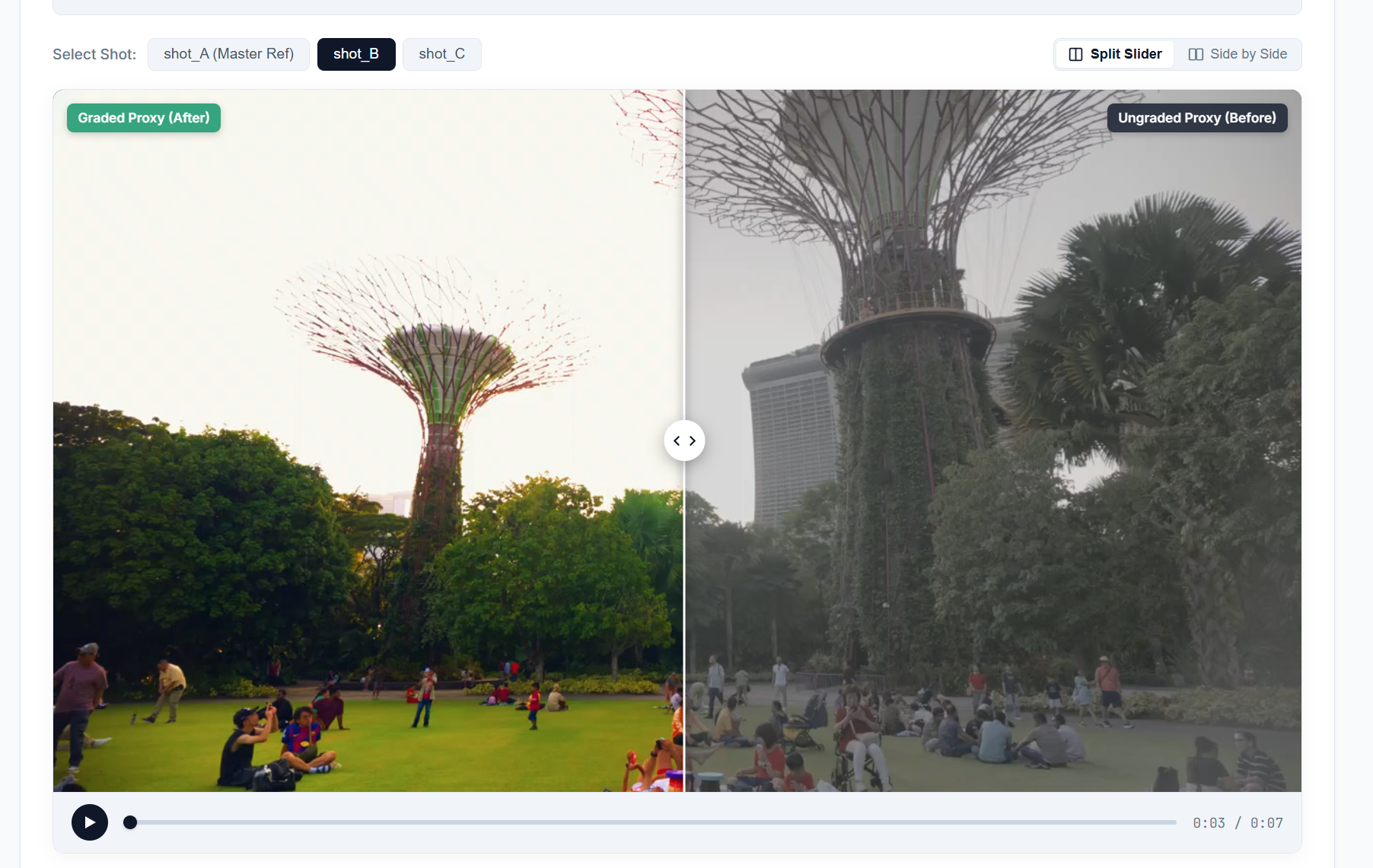
Rather than replacing the established color-grading pipeline, AutoGrader uses AI to reason about what a grade should be, then translates those decisions into deterministic LUT-based transformations that can be applied consistently across footage.
What it does
AutoGrader is an agentic video color-grading platform designed to grade multiple clips while maintaining a coherent visual identity between shots.
A user uploads footage and provides the creative direction they want. AutoGrader analyzes the material, reasons about the desired cinematic treatment, and coordinates the grading process across the uploaded clips.
Instead of allowing a generative model to manipulate every frame directly, the agentic system determines the appropriate grading strategy and produces structured parameters that feed into a deterministic color-processing pipeline.
This gives us the advantages of both approaches:
- Agentic reasoning for interpreting creative intent and adapting to different footage
- Deterministic LUT processing for repeatability and shot-to-shot consistency
- Automated analysis to reduce the amount of manual work required from the user
- A single workflow capable of handling multiple clips rather than treating each shot independently
The result is a system where AI acts more like a color-grading assistant and coordinator than an unpredictable image generator.
How we built it
AutoGrader is built around an agentic workflow using Gemini and Google Cloud.
The system separates the workflow into specialized stages rather than relying on one large prompt to perform the entire task. Agents analyze the footage and creative request, reason about an appropriate visual treatment, and convert that reasoning into structured grading decisions.
An orchestration layer coordinates these stages and ensures that relevant information is shared across the workflow so that clips are not graded in isolation.
We also integrated Parallel as an external research and contextualization capability within the agentic pipeline, allowing the system to retrieve additional information when the grading task benefits from external visual or cinematic context.
Crucially, the final pixel-level transformation is not performed generatively. The agentic output is converted into deterministic grading operations and LUTs. Once generated, the same transformation can be reproduced exactly and consistently.
The overall architecture can therefore be summarized as:
Footage + creative intent → agentic analysis and research → grading decisions → deterministic LUT generation/application → consistently graded output
This separation between reasoning and execution became one of the most important architectural decisions in the project.
Challenges we ran into
One of the largest challenges was determining where AI should stop.
It is tempting to make the entire pipeline generative, but doing so introduces variability precisely where a professional grading workflow needs predictability. We therefore had to design an interface between qualitative agent reasoning — concepts such as mood, warmth, contrast, or cinematic style — and quantitative parameters that a deterministic color pipeline can actually execute.
Another challenge was maintaining consistency across multiple shots with different starting conditions. A visually appropriate adjustment for one clip cannot simply be copied blindly onto every other clip. The system therefore needs to reason about both the individual footage and the broader creative direction.
Building the agentic workflow also required us to think carefully about orchestration: which tasks should be delegated, what context each agent requires, and which operations should remain ordinary deterministic software rather than becoming another agent.
Finally, video processing itself introduces practical engineering constraints including large files, processing time, asynchronous jobs, and presenting the results through a responsive web interface.
What we learned
The most important lesson from AutoGrader was that agentic AI does not need to replace deterministic software to be useful.
In fact, some of the most effective workflows emerge when the two are deliberately combined.
LLMs and multimodal models are strong at interpreting ambiguous human goals, reasoning across different sources of information, and deciding which actions should be taken. Traditional software remains substantially better at performing precisely specified numerical transformations reliably and repeatedly.
By assigning each part of the system to the technology best suited to it, we were able to build a workflow that is both adaptive and reproducible.
We also learned that designing a useful multi-agent system is less about maximizing the number of agents and more about giving each component a clear responsibility, a well-defined interface, and a reason to exist.
What's next for AutoGrader
The current project demonstrates the underlying agentic grading workflow, but the same architecture can extend much further into post-production.
Future versions could incorporate shot matching across entire sequences, reference-frame matching, automated scene grouping, persistent project-level creative direction, human-in-the-loop grade refinement, and tighter integration with professional editing and color-grading software.
Ultimately, we see AutoGrader not as a replacement for creative professionals, but as an agentic layer over the existing post-production toolchain — allowing filmmakers to express creative intent at a higher level while deterministic tools preserve the precision and consistency required for the final image.

Log in or sign up for Devpost to join the conversation.