-
-
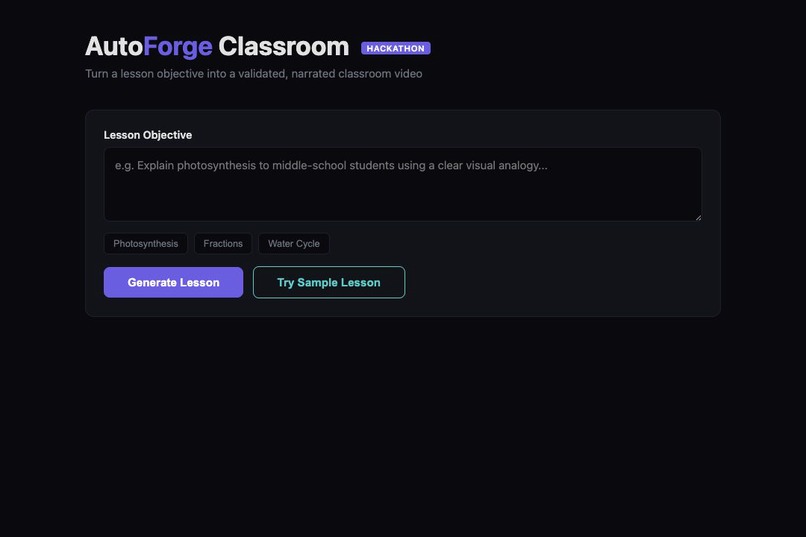
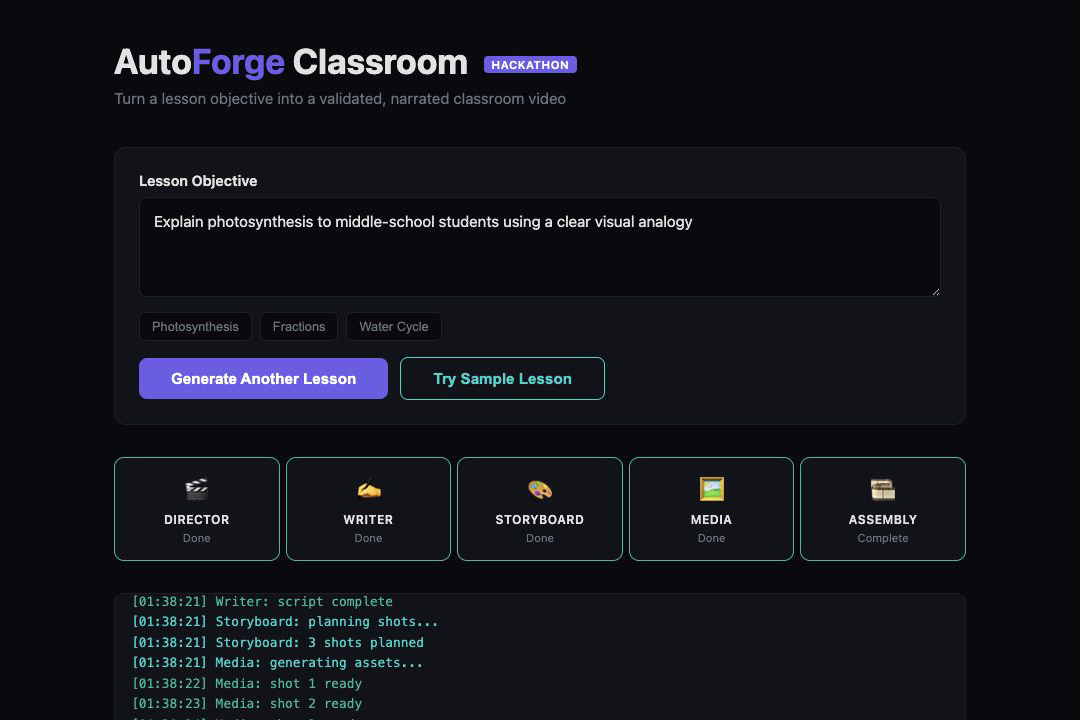
Teacher enters one clear lesson objective or runs the provider-free sample.
-
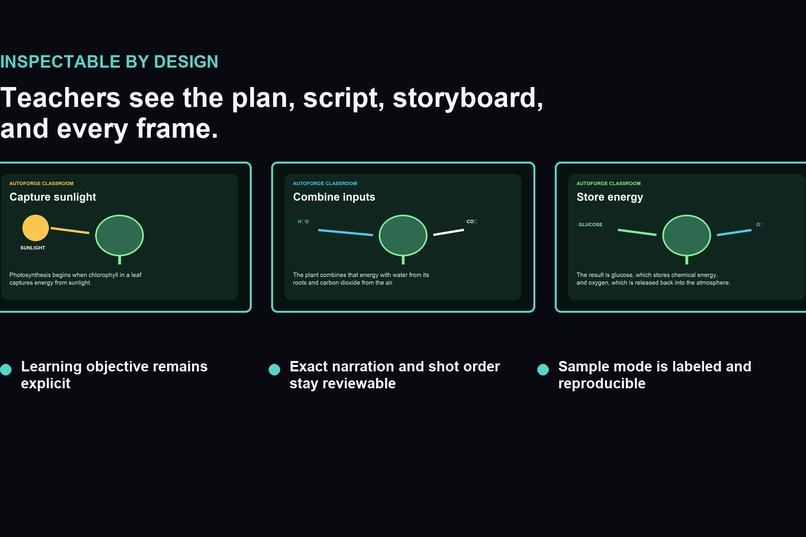
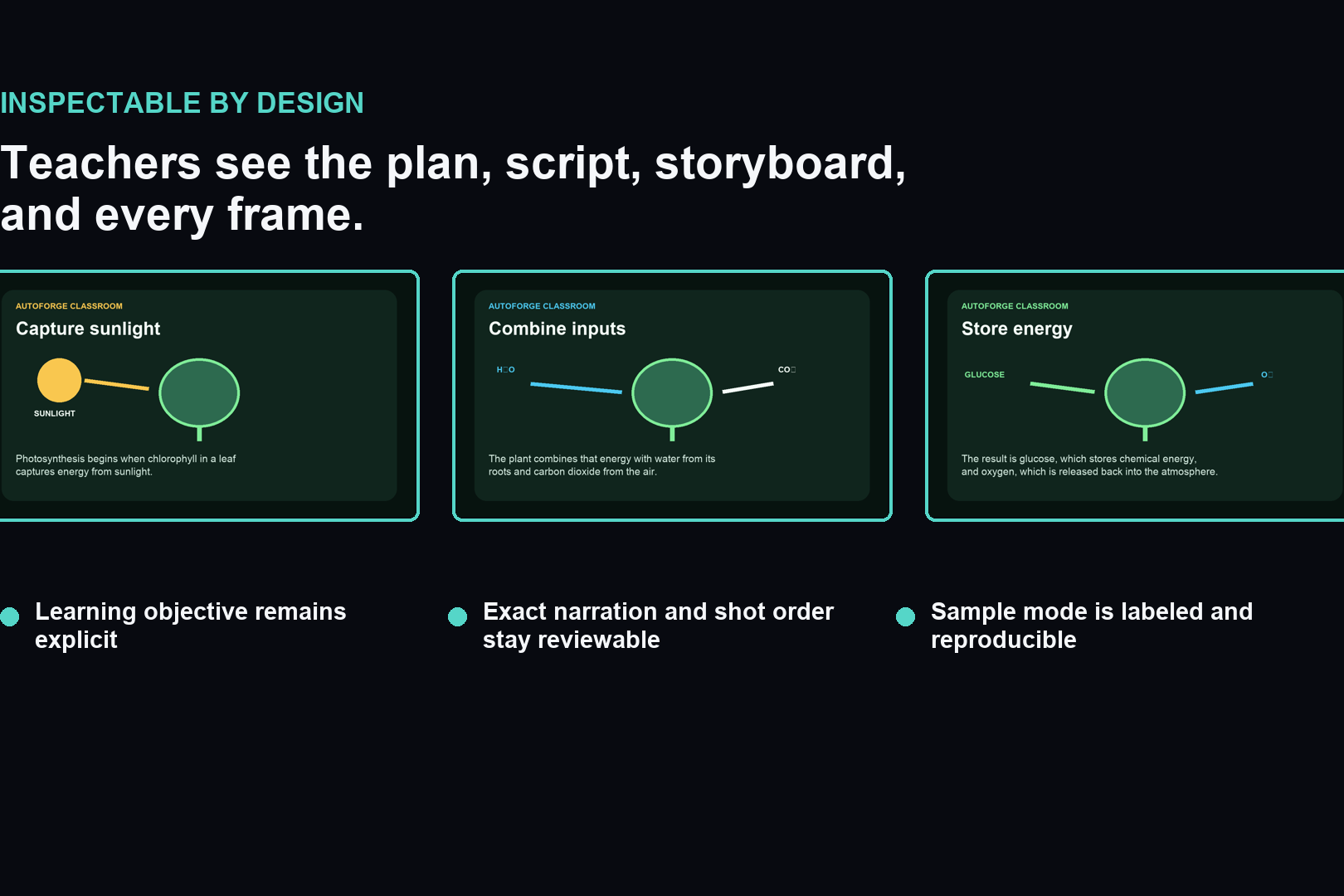
Inspectability by design: every planned teaching frame remains reviewable.
-
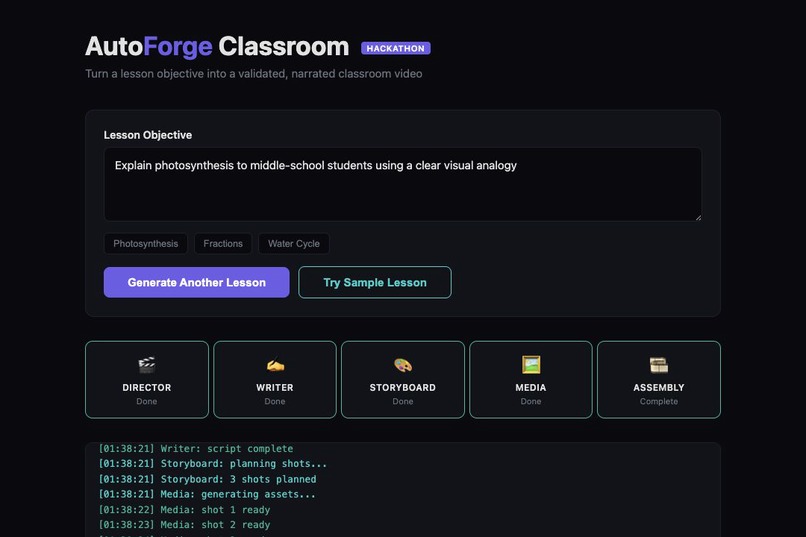
The complete five-stage lesson workflow with visible, reviewable progress.
What it does
Teachers often know exactly what they want students to understand but do not have hours to script, illustrate, narrate, edit, and quality-check a short lesson video. AutoForge Classroom turns one lesson objective into a complete classroom-ready MP4 through a visible multi-agent workflow.
GPT-5.6 Terra acts as the reasoning layer for three structured stages:
- The Director turns the objective into an audience-aware lesson plan.
- The Writer creates a concise teaching script.
- The Storyboard Agent converts the script into inspectable shots with exact narration and visual prompts.
OpenAI TTS and DALL-E 3 create narration and frames. A provider-neutral reliability layer then validates the storyboard and every generated artifact, derives scene timing from the real narration, assembles the video with FFmpeg, and verifies that the final MP4 contains valid audio and video streams.
The interface shows every stage, generated frame, failure, and final result. Judges can use the clearly labeled Sample Lesson path without a live provider credential; it exercises the same persistence, media-validation, progress, and FFmpeg assembly layers with deterministic classroom content.
Why it matters
The product is aimed at teachers, tutors, and instructional designers who need short explainers but lack video-production time or specialist tools. The core idea is not merely AI video generation. It is reliable educational generation: structured teaching artifacts remain inspectable, failures remain visible, and invalid or truncated media cannot silently become the final classroom asset.
That makes the workflow easier to trust, review, and adapt than a black-box "prompt to video" tool.
How we used GPT-5.6
GPT-5.6 Terra is the default runtime model for planning, writing, and storyboarding. It is responsible for turning an underspecified lesson objective into the structured educational decisions that downstream media generation needs: intended audience, learning objective, narrative structure, exact narration, visual composition, and shot sequence.
The integration is explicit in src/config.py and used by the Director, Writer,
and Storyboard agents. Other models are used only for modality-specific tasks
such as speech and image generation.
How we used Codex
Codex was the main engineering collaborator during Build Week. It was used to:
- audit the original prototype against the judging and eligibility rules;
- choose the Education positioning and define the public/private code boundary;
- turn reliability patterns into provider-neutral public modules;
- replace in-memory state with atomic, restart-aware project state;
- design shot and media contracts before paid generation begins;
- replace estimated clip timing with real narration duration;
- surface background failures through both WebSocket and polling paths;
- add a deterministic judge-testing path without exposing credentials;
- build and run regression, FFmpeg, path-safety, redaction, and lifecycle tests;
- prepare the submission narrative and demo-video workflow.
Key decisions were reviewed in Codex rather than accepted blindly: the judging build deliberately excludes SaaS infrastructure and private workstation integrations, prioritizing a coherent, testable classroom product.
What existed before Build Week
The pre-existing prototype contained a basic FastAPI application, a general idea-to-video multi-agent sequence, OpenAI agent wrappers, a simple WebSocket progress UI, and direct FFmpeg assembly.
What was added during Build Week
The Build Week work meaningfully extended that prototype with:
- the Education-focused AutoForge Classroom product experience;
- explicit GPT-5.6 Terra integration and documentation;
- storyboard contract validation before media generation;
- decoded-image, audio, intermediate-video, and final-video validation;
- atomic JSON and media publication with path-containment protections;
- durable project state and interrupted-run reconciliation;
- bounded parallel media generation;
- real narration-duration composition and checked FFmpeg diagnostics;
- redacted public errors and reliable WebSocket-to-polling fallback;
- a deterministic Sample Lesson path for judge testing;
- an expanded automated test suite and public-boundary audit.
The dated repository history and the submitted Codex Session ID provide evidence of these changes during the Submission Period.
Challenges
The hardest problem was reliability across asynchronous AI and media systems. A text model can return malformed shot data, a provider can return an HTML error page where an image was expected, FFmpeg can fail after several expensive calls, and a browser can lose its WebSocket while the job continues.
We addressed those failures as explicit contracts rather than UI edge cases: validate before paying for media, publish only validated artifacts, persist state atomically, expose bounded public errors, and never report completion until ffprobe confirms the final streams.
Accomplishments
- A complete lesson-objective-to-video experience rather than a backend-only proof of concept.
- Reproducible judge testing without private credentials.
- Real narration timing instead of model-estimated clip duration.
- Failure states that survive browser disconnects and process restarts.
- Provider-neutral safety code with no dependency on the private source project.
- Automated coverage spanning JSON recovery, path safety, state lifecycle, media validation, orchestration, and real FFmpeg output.
What we learned
For educational generation, inspectability matters as much as generation quality. A teacher needs to see the plan, script, storyboard, and frames—not only a final black-box video. We also learned that media validity must be treated as application data integrity: a file existing on disk is not evidence that it is safe to publish.
What's next
- curriculum-standard and age-level constraints;
- teacher editing and approval at every structured stage;
- citations and source-grounded lesson generation;
- accessibility controls for captions, reading speed, and visual contrast;
- reusable classroom templates and multilingual lesson variants;
- longitudinal educator feedback on preparation time and revision rate.
Built With
- fastapi
- ffmpeg
- gpt-5.6-terra
- multi-agent
- openai-api
- openai-codex
- pillow
- python
- websockets

Log in or sign up for Devpost to join the conversation.