-
-
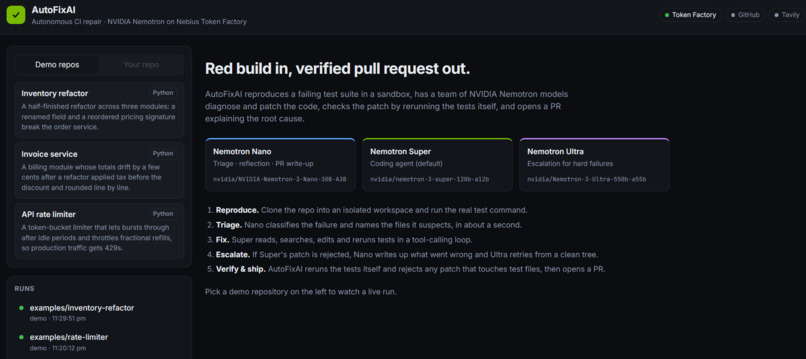
Demo Page
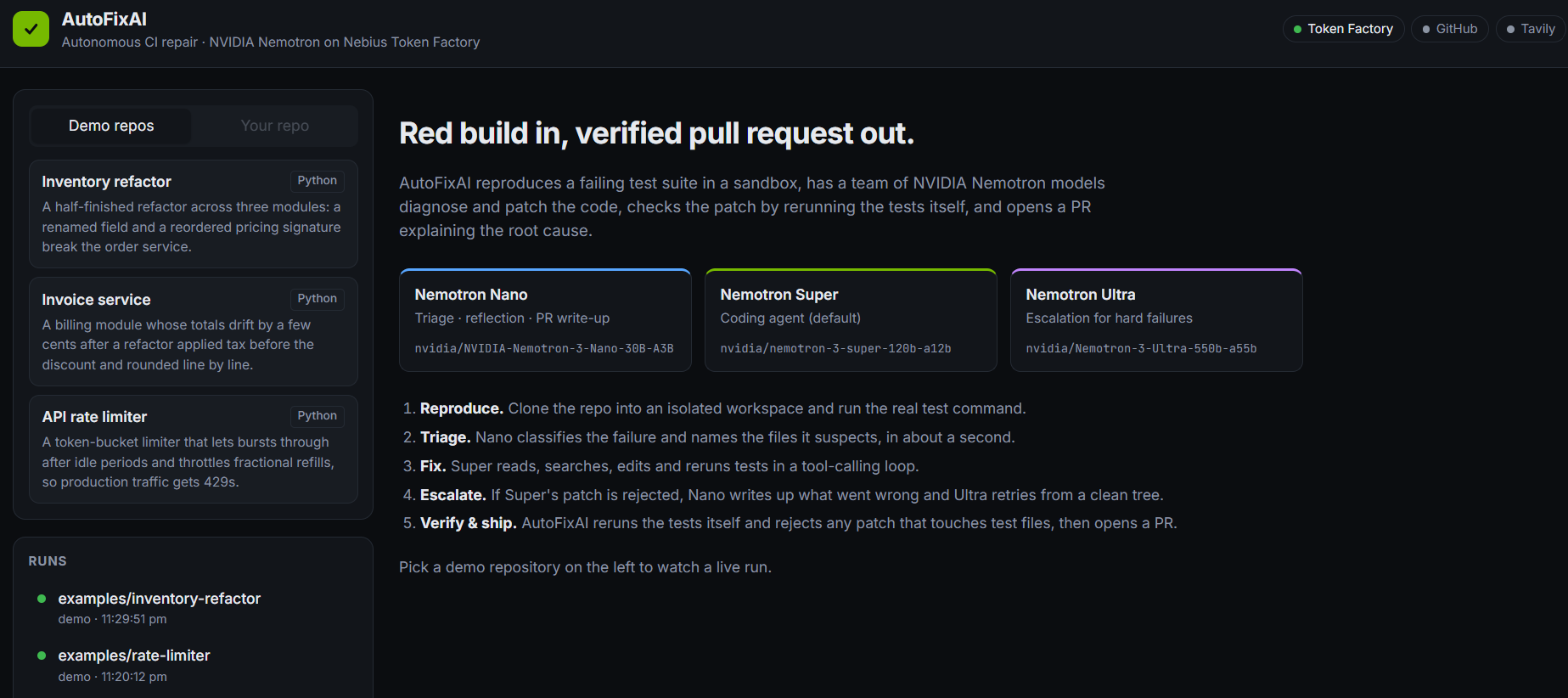
Inspiration
AutoFix AI was inspired by the universal frustration developers face when debugging code. Hours spent chasing runtime errors or fixing repetitive bugs often overshadow the creative joy of building. With Nebius Token Factory enabling safe code execution and NVIDIA’s Nemotron models offering advanced reasoning, we saw an opportunity to create a self‑healing coding agent — one that could detect, diagnose, and patch issues automatically, freeing developers to focus on innovation.
What it does
AutoFix AI is a coding agent that:
Writes, runs, and tests code in Nebius Token Factory.
Detects runtime errors and logic flaws.
Suggests or directly applies fixes using Nemotron models.
Provides explanations for each fix, helping developers learn from mistakes. In short, it’s a developer companion that reduces debugging time and accelerates shipping reliable software.
How we built it
Models: We used Nemotron 3 Ultra for deep reasoning about complex bugs and Nano for fast, everyday fixes.
Infrastructure: Code execution and testing were orchestrated through Nebius Token Factory, ensuring safe and isolated runs.
Workflow: The agent monitors execution logs, identifies anomalies, and generates patches. Fixes are validated by rerunning tests automatically.
Deployment: We leveraged Nebius Serverless Endpoints for responsive interactions and Serverless Jobs for background error analysis.
Challenges we ran into
Designing a robust error‑detection pipeline that works across multiple languages.
Balancing speed and accuracy: Nemotron Ultra is powerful but resource‑intensive, while Nano is fast but less nuanced.
Ensuring fixes didn’t introduce new bugs — requiring iterative validation loops.
Integrating explanations in a way that was both technically accurate and beginner‑friendly.
Accomplishments that we're proud of
Built a working prototype that successfully identifies and patches real runtime errors.
Demonstrated seamless integration of multiple NVIDIA models with Nebius Token Factory.
Created a user experience that feels like a true coding partner, not just a debugging tool.
Showcased the potential of self‑healing systems in software development.
What we learned
How to orchestrate multiple AI models for complementary tasks (reasoning vs speed).
The importance of clear explanations in developer tools — fixes are more valuable when they teach.
Practical lessons in deploying agents on Nebius infrastructure, balancing responsiveness with resource usage.
Debugging AI agents is just as challenging as debugging code — but incredibly rewarding.
What's next for Autofix AI
Expanding language support beyond Python and JavaScript to include Java, C++, and Rust.
Adding integration with popular IDEs (VS Code, JetBrains) for real‑time assistance.
Building a collaborative mode where AutoFix AI suggests fixes during pair programming sessions.
Exploring predictive debugging — catching potential bugs before they occur.
Open‑sourcing the project to invite contributions from the developer community.


Log in or sign up for Devpost to join the conversation.