🚀 Inspiration
Modern software systems generate massive volumes of logs and errors, yet debugging remains largely manual, time-consuming, and reactive.
While AI tools can suggest fixes, they still rely heavily on human intervention and lack reliability.
We were inspired to explore a shift from AI as an assistant → AI as an autonomous system, capable of not just suggesting but analyzing, fixing, and validating issues end-to-end.
AutoFix AI was built to move toward self-healing software systems.
⚙️ What it does
AutoFix AI is an autonomous debugging system that:
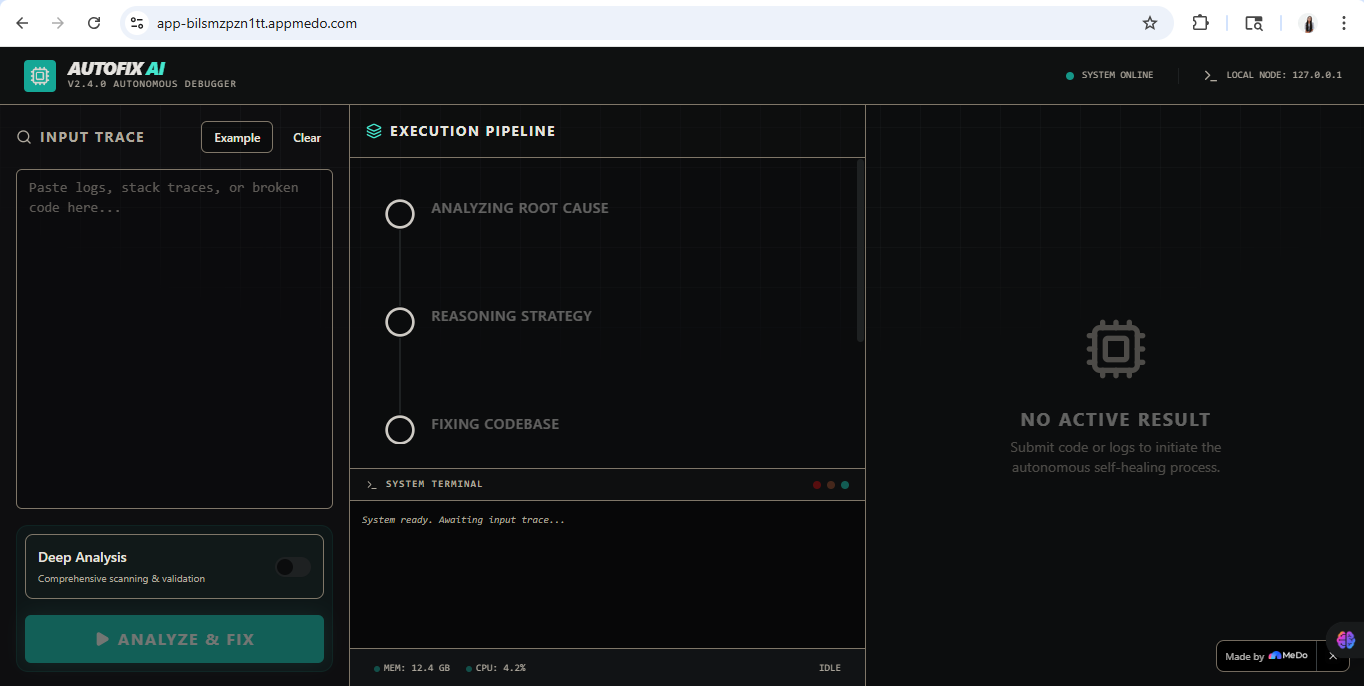
Ingests logs, error traces, or broken code Identifies root causes using LLM-based reasoning Generates context-aware fixes Validates fixes before output to improve reliability Iteratively improves using feedback loops
Unlike traditional tools, it focuses on execution-ready solutions, not just suggestions.
🏗️ How we built it Developed a backend using Python + FastAPI Designed a modular pipeline: analysis → reasoning → fix generation → validation Integrated LLMs using structured prompting and chaining Implemented a validation layer to verify generated fixes Built a feedback loop to improve system accuracy over time
The system was designed with a strong emphasis on architecture and reliability, not just prompt engineering.
⚠️ Challenges we ran into Ensuring reliability of LLM-generated fixes (hallucinations, incorrect outputs) Designing an effective validation mechanism for generated solutions Handling diverse and noisy log formats Balancing speed vs accuracy in multi-step pipelines
The biggest challenge was making the system trustworthy, not just functional.
🏆 Accomplishments that we're proud of Built a working prototype of a self-healing AI system Reduced debugging effort by ~40–70% in controlled scenarios Successfully implemented a validation layer, improving reliability Demonstrated a shift from AI assistants to autonomous problem-solving systems 🧠 What we learned Building with LLMs requires strong system design, not just prompts Reliability and edge-case handling are the hardest parts of AI systems Validation is critical for real-world AI adoption Combining backend engineering with AI unlocks practical, scalable solutions 🔮 What's next for AutoFix AI — Self-Healing Software System Integrate with real-world CI/CD pipelines (GitHub Actions, Jenkins) Enable automatic pull request generation and deployment Improve validation using test-case generation and execution Expand support for multiple programming languages and frameworks Move toward a fully autonomous software maintenance system 🔥 Why this will stand out Clear problem → solution → impact Shows engineering depth (not just AI hype) Emphasizes reliability (judges love this) Positions you as a systems thinker
Built With
- autonomous-agents-databases:-postgresql-/-mysql-cloud-&-apis:-google-cloud-(vertex-ai)
- docker-tools:-git
- java-backend:-fastapi
- languages:-python
- llm-apis-devops:-github-actions-(ci/cd)
- prompt-engineering
- rag-architecture:-modular-ai-pipelines
- rest-apis-ai/llm:-llm-orchestration

Log in or sign up for Devpost to join the conversation.