
🧠 Intelligent Anomaly Detection System using AI
🌟 Inspiration
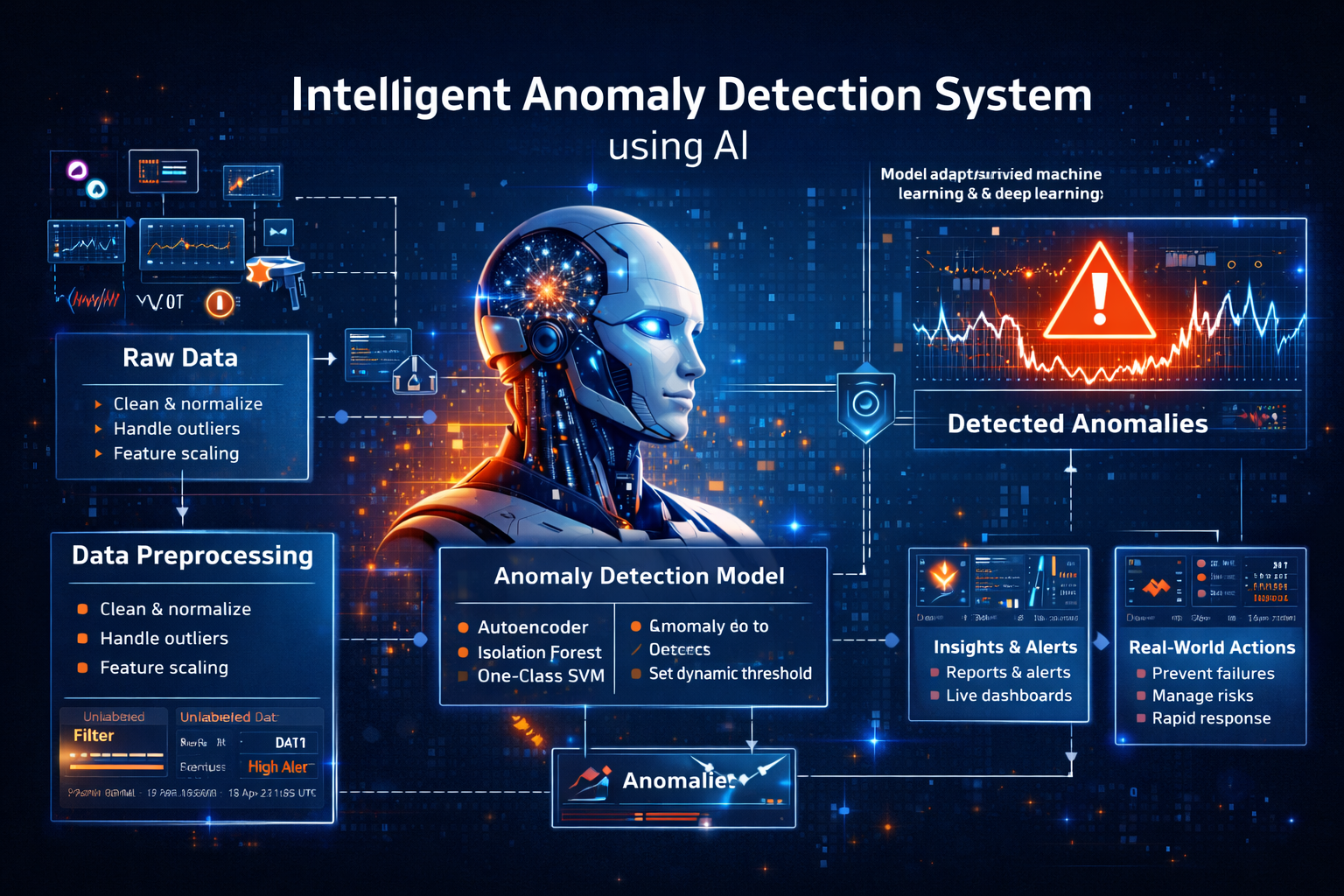
In many real-world systems, failures rarely happen due to known, well-defined rules. Instead, they occur because of unexpected patterns and subtle changes that go unnoticed until it’s too late. While studying machine learning, I realized that most traditional systems depend on fixed thresholds and manual monitoring, which are neither scalable nor adaptive.
This inspired me to build an AI-driven Anomaly Detection System that can learn what “normal” looks like from data and automatically identify unusual behavior without relying on predefined rules. The idea was to create a domain-independent solution that can be applied to healthcare, finance, public safety, or any data-driven environment.
📚 What I Learned
Through this project, I gained hands-on experience in:
- Understanding normal vs abnormal behavior in real-world datasets
- Working with unsupervised and semi-supervised learning techniques
- Feature scaling, dimensionality reduction, and handling noisy data
- Evaluating anomaly detection models using metrics like:
[ Precision = \frac{TP}{TP + FP}, \quad Recall = \frac{TP}{TP + FN} ]
- Interpreting model outputs and reducing false positives
- Translating complex AI concepts into clear, explainable insights
This project strengthened my understanding of how AI can move beyond prediction and into proactive risk prevention.
🛠️ How I Built the Project
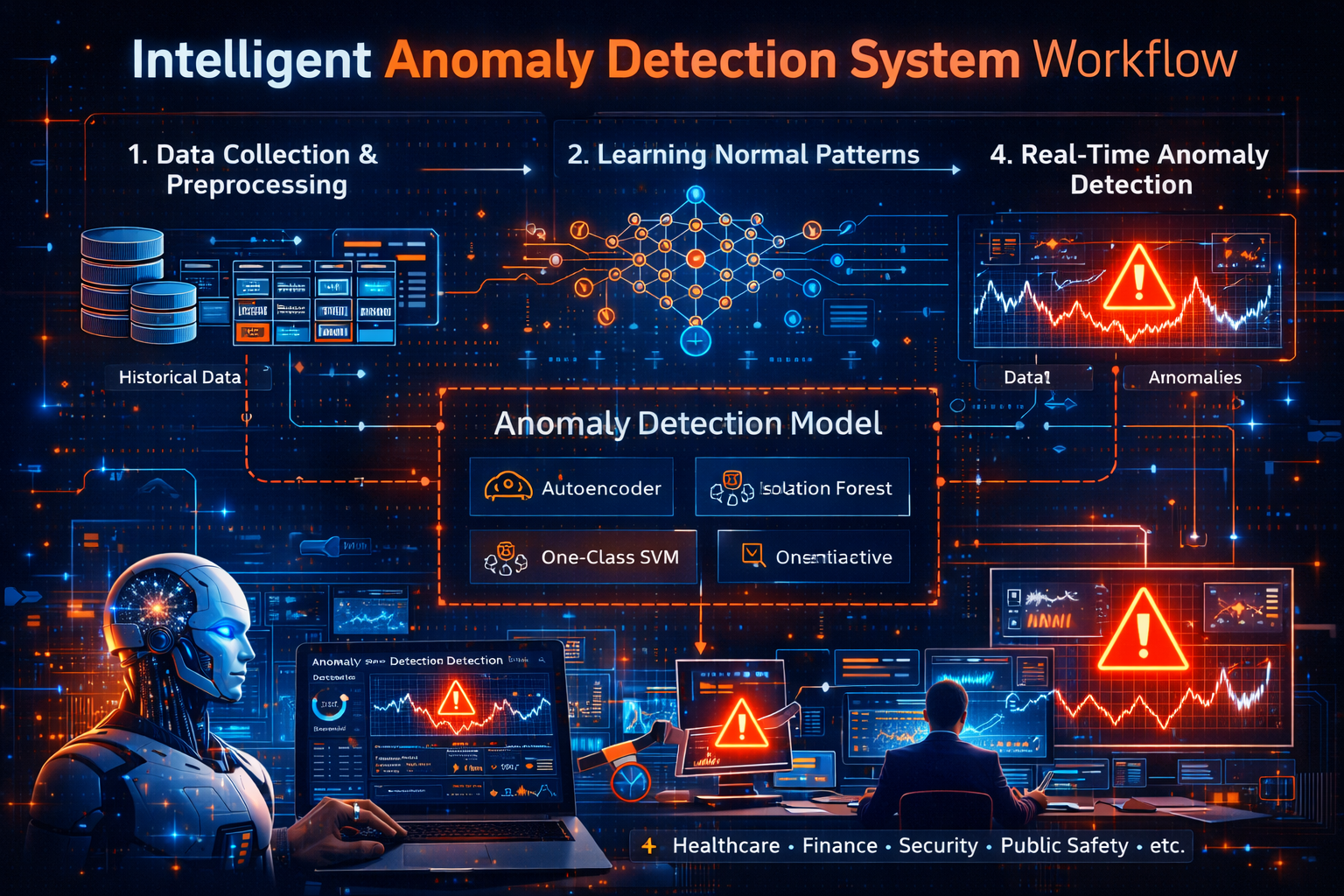
1️⃣ Data Collection & Preprocessing
- Used real-world or publicly available datasets containing time-series or tabular data
- Cleaned missing values, normalized features, and removed outliers that could bias training
2️⃣ Model Design
- Implemented unsupervised learning models such as:
- Autoencoders
- Isolation Forest
- One-Class SVM
- Trained models only on normal data so the system learns baseline behavior
3️⃣ Anomaly Detection Logic
- Reconstruction error or anomaly scores were calculated:
[ Error = \lVert X - \hat{X} \rVert^2 ]
- A dynamic threshold was used to classify data points as normal or anomalous
4️⃣ Evaluation & Visualization
- Visualized anomaly scores and detected deviations
- Validated the system using known abnormal samples
- Designed the system to be scalable and adaptable across domains
⚠️ Challenges Faced
- Lack of labeled anomaly data, making evaluation difficult
- Choosing the right threshold value to balance false positives and false negatives
- Handling noisy and imbalanced datasets
- Ensuring the system remains general-purpose and not overfitted to one domain
Overcoming these challenges required careful experimentation, model comparison, and iterative refinement.
🚀 Impact & Future Scope
This project demonstrates how AI can be used to detect risks early, reduce manual monitoring, and support faster decision-making.
Future improvements include:
- Real-time anomaly detection pipelines
- Explainable AI (XAI) for better interpretability
- Integration with alerting and decision-support systems
🎯 Conclusion
The Intelligent Anomaly Detection System showcases the power of AI in identifying hidden patterns that humans and rule-based systems often miss. By learning directly from data, the system provides a flexible, scalable, and proactive solution for real-world problem detection.
“AI doesn’t just predict the future — it protects it.”
Built With
- ai
- api
- data
- deploy
- flexibility
- google-cloud
- machine-learning
- model-building
- one-class-svm
- python
- storage
- while-matplotlib-and-seaborn-are-used-for-visualization.-the-models-are-developed-and-tested-in-jupyter-notebook-on-google-colab.-git-and-github-are-used-for-version-control
- with-scikit-learn-and-tensorflow-(keras)-for-building-machine-learning-and-deep-learning-models.-pandas-and-numpy-are-used-for-data-processing-and-analysis

Log in or sign up for Devpost to join the conversation.