Inspiration
💡 Inspiración
Every day, IT support teams around the world are overwhelmed by repetitive tickets: VPN failures, printer issues, BSOD errors, network problems. Each ticket costs companies an average of $856 to resolve manually, and 40% of them could be fixed automatically with the right script.
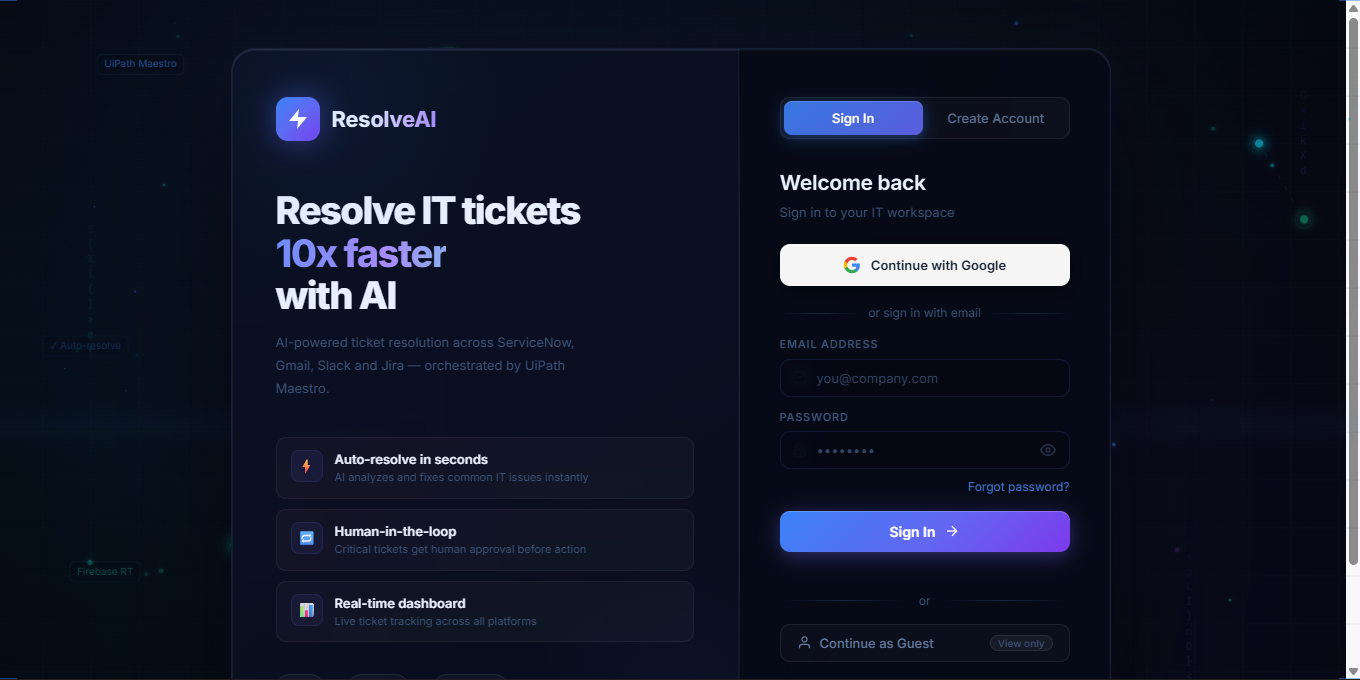
I wanted to build something that actually helps — not just a demo, but a real system that a company could deploy tomorrow. The idea was simple: what if an AI agent could read a ticket, understand the problem, generate the fix script, and coordinate across every platform the IT team uses?
That's how ResolveAI was born.
🔨 How I built it
The project is a full-stack agentic system built in under a week as a solo developer. Here's the stack:
Architecture
- UiPath Maestro — central orchestrator that governs the entire agent flow
- UiPath Agent Builder — defines agent behavior and human-in-the-loop logic
- UiPath API Workflows — connects all external systems
- Groq (Llama 3.3 70B) — the AI coding agent that analyzes tickets and generates fix scripts in real time
- Python / FastAPI — backend webhook server that receives tickets from ServiceNow and Gmail
- Supabase — real-time database with PostgreSQL that powers the live dashboard
- Slack — human-in-the-loop approvals for critical tickets
- Jira — automatic issue creation for escalated cases
- Vercel — frontend deployment
- Render — backend deployment
The flow
- A ticket arrives from ServiceNow or Gmail
- The FastAPI webhook server normalizes it and saves it to Supabase
- UiPath Maestro triggers the orchestration flow
- The Groq AI agent analyzes the ticket and generates a fix script
- If the ticket is critical → human-in-the-loop: Maestro pauses and sends an approval request to Slack with Approve / Reject buttons
- If not critical → auto-fix script is sent directly to the user via Slack
- A Jira issue is created automatically for all escalated tickets
- The real-time dashboard (built with vanilla JS + Supabase Realtime) updates instantly — no page refresh needed
Coding agent in action
The Groq LLM acts as a coding agent: given a natural language description of an IT problem, it returns structured JSON with:
- Root cause analysis
- Category and severity classification
- An executable PowerShell or Bash fix script
- Escalation decision with reasoning
- Estimated resolution time
This is the "coding agent" component that generates real, runnable code on demand — not pseudocode, not suggestions, but actual scripts an IT technician can run immediately.
🚧 Challenges I faced
1. Being a UiPath beginner
I had never used UiPath before this hackathon. Learning Maestro, Agent Builder, and API Workflows from scratch in less than a week while simultaneously building the full backend and frontend was the biggest challenge. I relied heavily on UiPath documentation and the community forum to understand how to configure the orchestration layer correctly.
2. Human-in-the-loop design
Getting the human approval flow right was tricky. The agent needs to pause, wait for a Slack response, and then resume — without losing the ticket context. I solved this by storing the full ticket state in Supabase and using the ticket ID as the correlation key across all systems.
3. Real-time dashboard without a framework
I deliberately built the frontend in vanilla HTML/CSS/JavaScript — no React, no Vue — to keep it simple and fast. Making Supabase Realtime work smoothly with live updates across tickets, analyses, and actions required careful state management in plain JS.
4. Prompt engineering for structured output
Getting the Groq LLM to always return valid, parseable JSON — even for edge
cases like hardware failures that need physical intervention — required
multiple iterations of the system prompt. The key was using
response_format: { type: "json_object" } and a very explicit schema
definition in the prompt.
📚 What I learned
- UiPath Maestro is genuinely powerful for orchestrating multi-agent flows — the human-in-the-loop capability built into the platform is something that would take weeks to build from scratch
- Groq is incredibly fast for real-time AI inference — the LLM responds in under 1 second, making it practical for live ticket processing
- Supabase Realtime makes building live dashboards dramatically simpler than traditional polling approaches
- The combination of low-code orchestration (UiPath) + AI coding agents (Groq) + traditional APIs is more powerful than any single approach alone
- Solo development in a hackathon forces you to prioritize ruthlessly — I focused on making the core flow bulletproof before adding integrations
🔮 What's next for ResolveAI
- Auto-execution: actually run the generated fix scripts on the user's machine via UiPath RPA
- Learning loop: store resolved tickets and use them to fine-tune the
AI agent's fix suggestions over time
- Multi-tenant: support multiple companies with isolated data per tenant
- Microsoft Teams integration: alongside Slack for human approvals
- ServiceNow full bidirectional sync: update ticket status back in ServiceNow automatically when resolved ## What it does
How we built it
Challenges we ran into
Accomplishments that we're proud of
What we learned
What's next for AutoDesk IT — Multiplatform Support Orchestrator
Built With
- 3.3
- 70b
- agent
- api
- automation
- builder
- cloud
- css3
- fastapi
- gmail
- groq
- html5
- javascript
- jira
- llama
- maestro
- postgresql
- python
- render
- rest
- servicenow
- slack
- supabase
- uipath
- vercel
- workflows


Log in or sign up for Devpost to join the conversation.