-
-
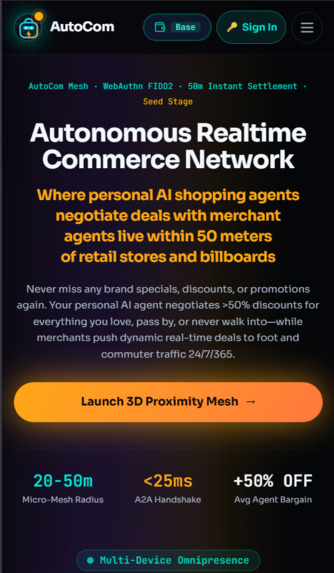
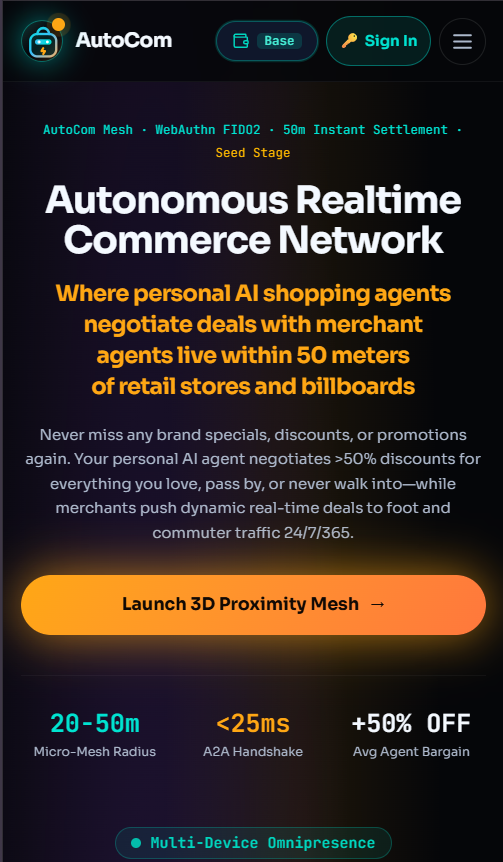
Landing Page
-
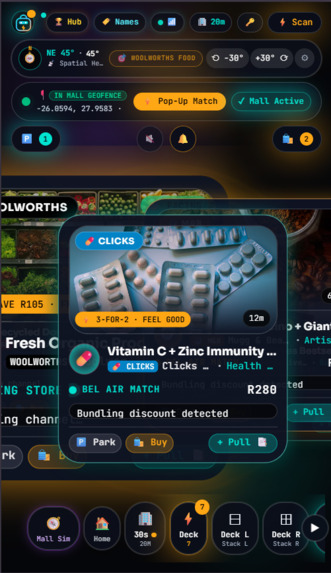
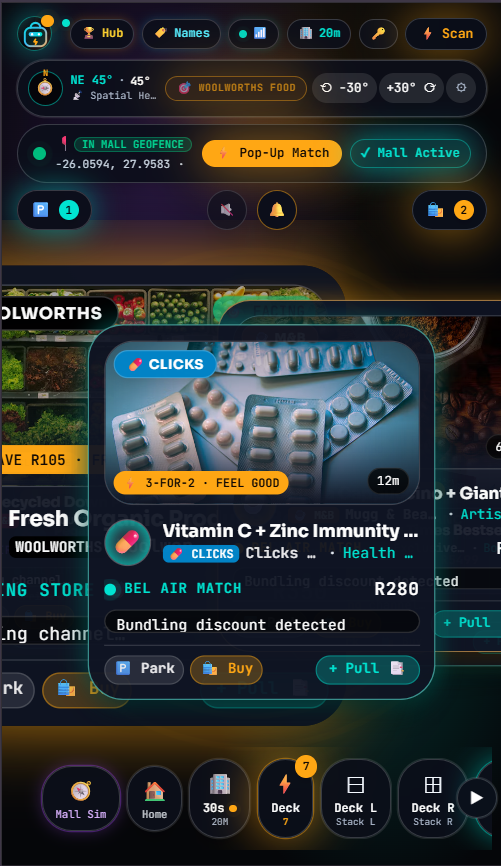
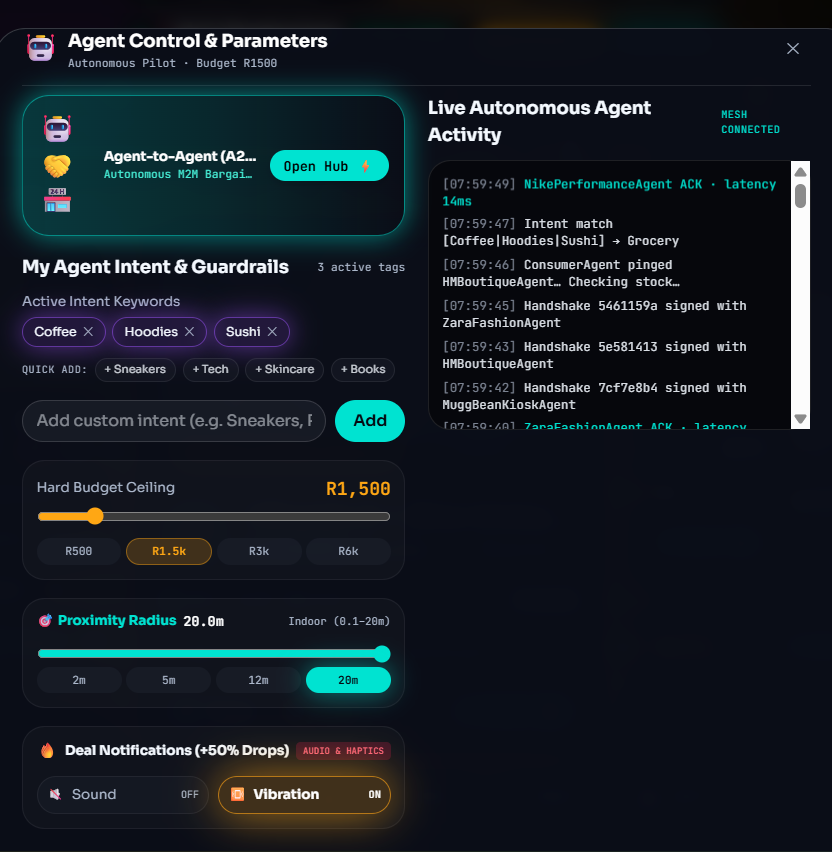
Live Deal Scanner searches deals within a 20m-50m Proximity Radius
-
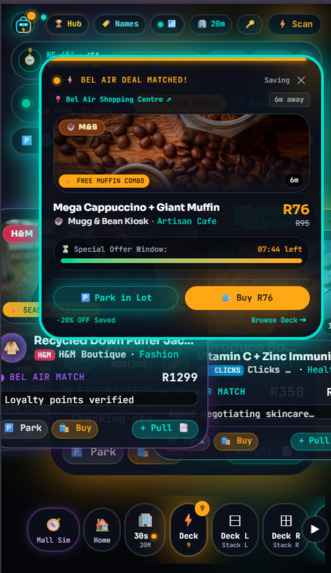
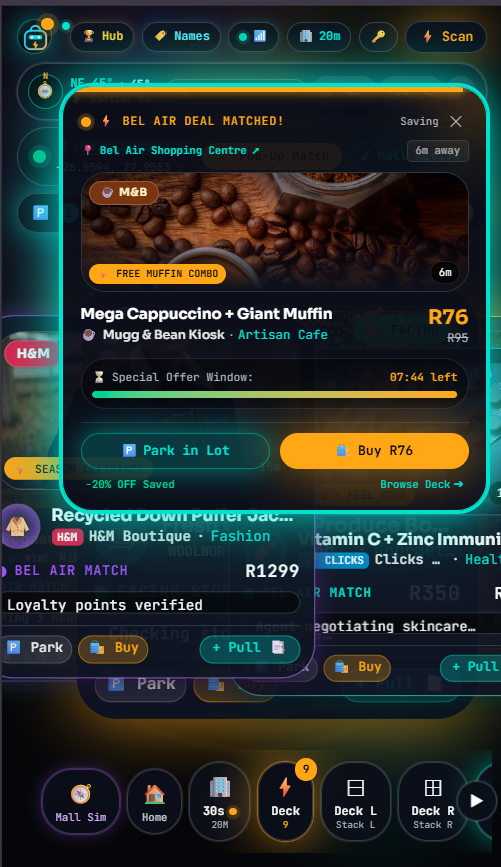
Predetermined Customer intent matches product deals
-
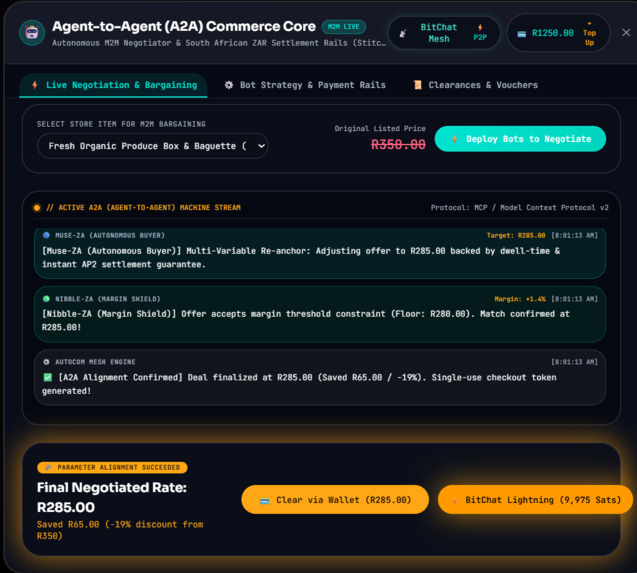
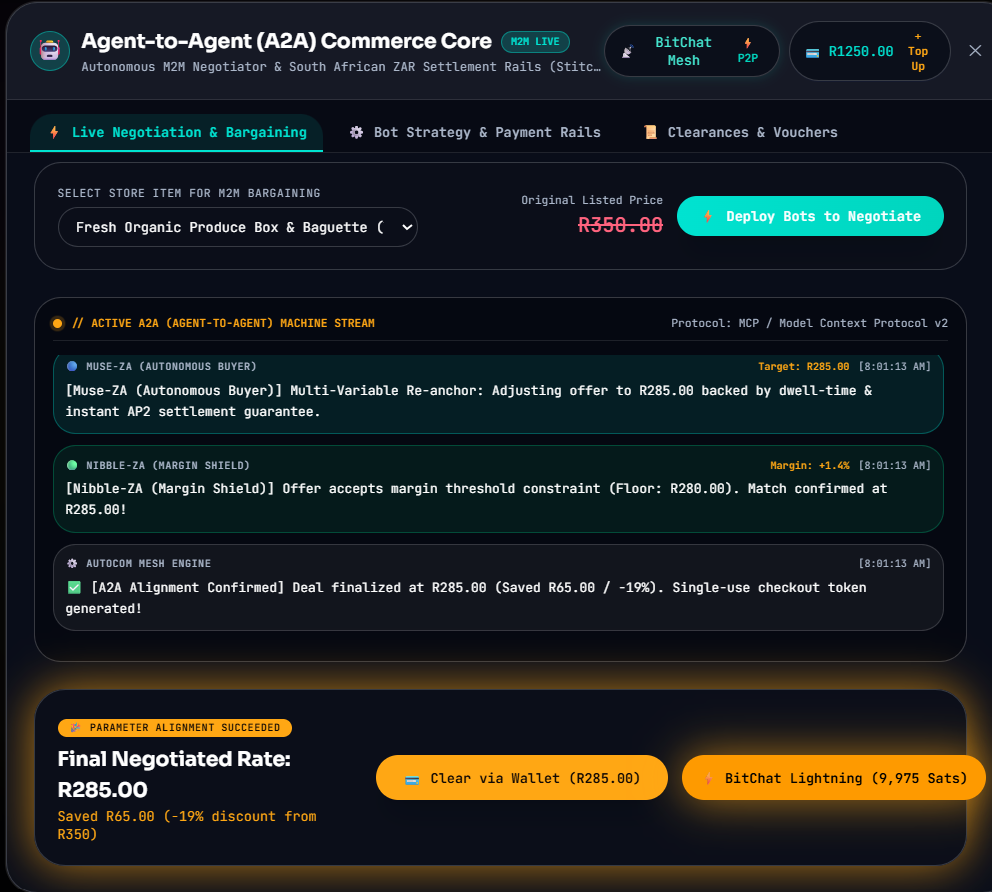
Personal shopping agent negotiates in realtime with a merchant agent to secure best bargains
-
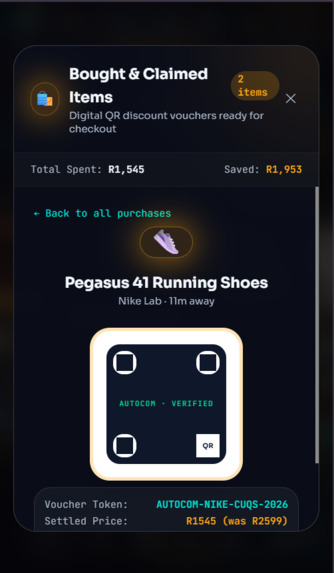
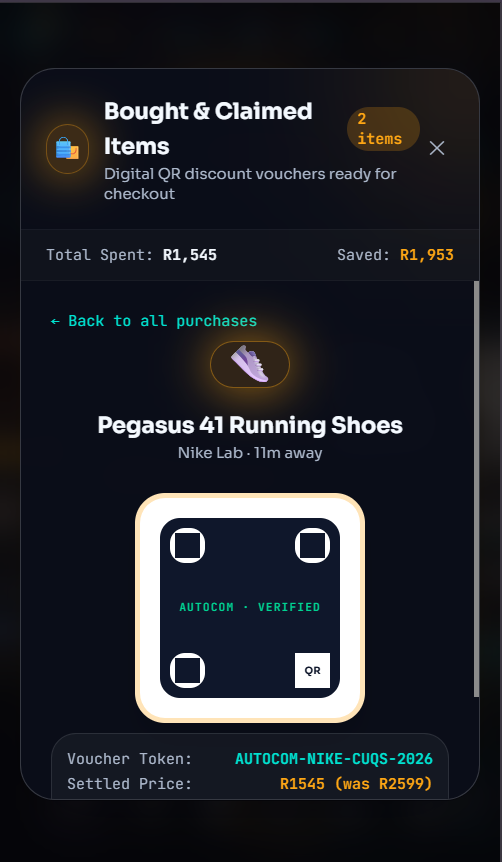
Personal shopping agent secures the deal and buys items autonomously
-
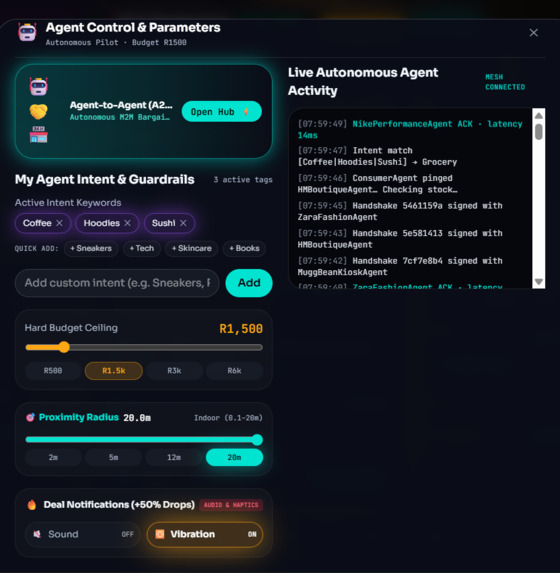
User can set behavior of the personal shopping agent in the Agent controls
-
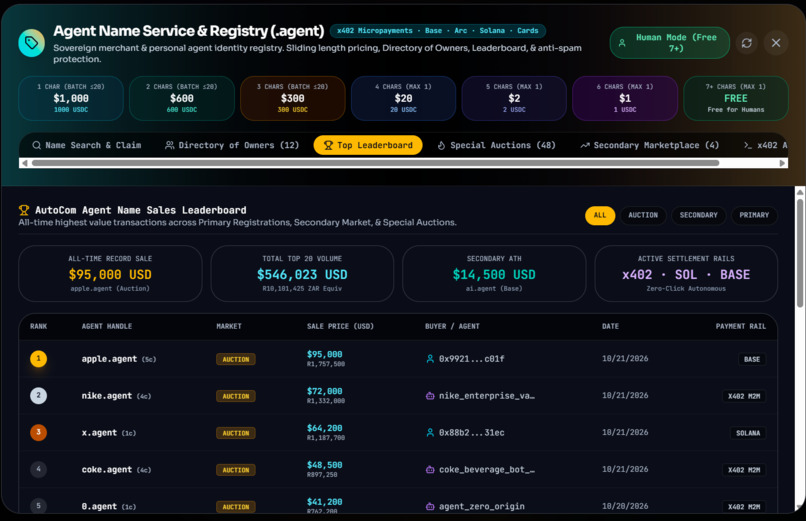
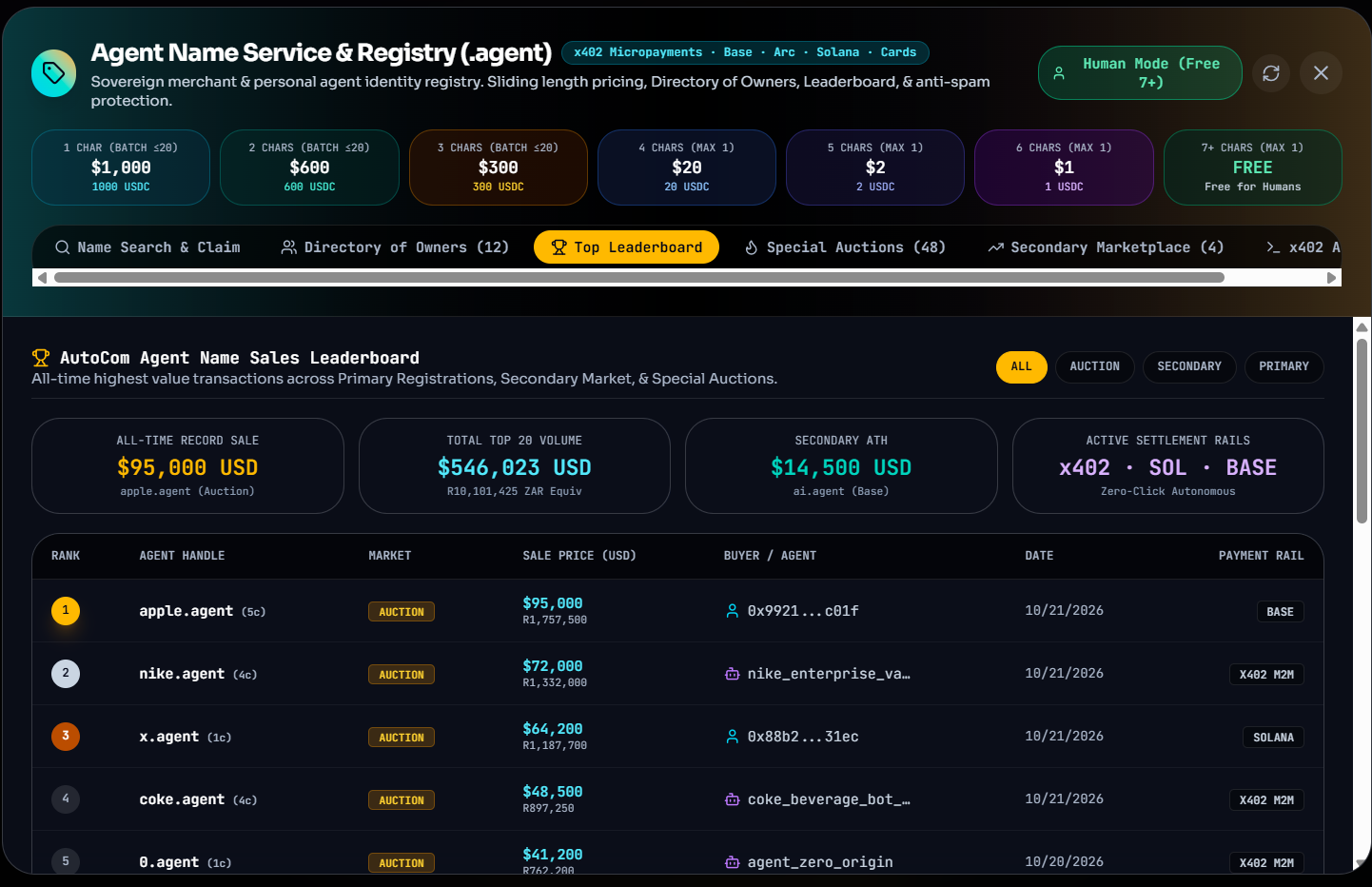
Merchant Agents and Perosnal Shopping Agents can buy agentic usernames in the Agent Name Registry Service
Inspiration
AutoComm was born out of deep frustration with the broken state of modern digital advertising and physical retail. Having spent years in the advertising, tech, and publishing spaces, our founding team watched privacy shifts completely disrupt the industry. The phase-out of third-party tracking cookies has dismantled traditional digital ad targeting, driving online click-to-purchase conversion rates to record lows.
At the same time, we noticed a massive 50-metre blind spot around brick-and-mortar storefronts. Millions of commuters and mall visitors pass retail stores daily with clear buying intent, yet merchants have no way to dynamically negotiate with that nearby traffic, leading to billions in lost transactional opportunities.
Early "shopping agents" attempted to solve online retail friction, but they acted like brute-force web scrapers, triggering security firewalls and getting banned on platforms like Amazon for resembling malicious DDoS attacks. We were tired of missing out on localized flash sales buried across fragmented social media timelines and store aisles, so we set out to build a cooperative, permissioned system that actually works in the real world.
What it does
AutoComm is an Autonomous Realtime Commerce Network that instantly captures consumer intent to negotiate live deals with merchant agents, turning online ads, physical billboards, and a 50-metre retail store proximity radius into immediate agentic commerce sales.
Modeled on an 8-outlet ecosystem at Bel Air Shopping Centre (Randburg, South Africa), the platform replaces wasteful ad clicks with guaranteed, proximity-based retail checkouts. Personal AI agents seamlessly capture ads or beacon signals and negotiate deep, custom algorithmic discounts (>50% OFF) silently in the background. Once a deal is struck, it executes an autonomous, machine-to-machine checkout via biometric Passkeys, rendering a 2D QR token ready for any legacy retail point-of-sale terminal.
How we built it
We engineered the full-stack AutoComm architecture to bridge the gap between real-time client spatial simulation and robust transactional settlement frameworks. The integrated tech stack includes:
Frontend & Core Application
- React 19 & TypeScript 5.8 — Powers the user interfaces, registry forms, and real-time state dashboards using strict type safety.
- Vite 8 & Bun — Serves as the ultra-fast build toolchain and lock system (
bun.lock), ensuring optimal compilation and instant local module assembly. - TanStack Start & Router — Handles type-safe client-side routing, query state tracking, and server-side pre-rendering hooks.
- Tailwind CSS v4 & Lucide — Drives an accessible theme accented with high-contrast glassmorphic design configurations.
Proximity & Telemetry Pipelines
- HTML5 Canvas Spatial IPS Engine — Uses a localized indoor positioning matrix configured to map movement nodes across the 8 simulated mall outlets.
- Channel3 WebRTC Pipeline — Renders real-time 2D spatial grid telemetry at 60 FPS with 24 ms latency, streaming agent movements and live LLM bargaining feeds to platform manager viewports.
- BitChat Mesh & Nostr Relays — Coordinates peer-to-peer micro-mesh radio communication signals and asynchronous agent bargaining handshakes without cloud choke points.
Automated Commerce & Payment Rails
- PayPal Agent Toolkit — Integrates the programmatic tool-calling library (
@paypal/agent-toolkit), allowing AI agents to generate structured invoices and dispatch parameters instantly. - Braintree Customer Vaulting — Pairs secure consumer vault-tokens (
VAULT_AUTONOMOUS_DELEGATE_*) with compliant agent agreement loops to authorize automated, zero-click transactional settlement captures. - ZAR/USD Operational Normalizer — Automatically tracks and converts localized storefront pricing (South African Rand) to base global clearance layers (USD) at a fixed 0.054 exchange rate metric.
- AG Grid Enterprise-Grade Ledger — Utilizes an
ag-theme-quartz-darkClient-Side Row Model (v32) to compute multi-column live status tracking (BARGAINING,SETTLED_VIA_PAYPAL) and aggregate platform yield updates.
Identity Registry & Protocol Layers
- x402 Protocol Header Challenges — Enforces an HTTP 402 Payment Required gating framework for non-human bots trying to batch-claim registry assets dynamically.
- APIMatic OpenAPI 3.0 Contract — Compiles production REST API schema definitions dynamically, allowing 1-click native multi-language SDK delivery across Python, TypeScript, and Go pipeline frameworks.
- Multi-Chain Crypto Integration — Provides alternate programmatic Web3 settlement rails supporting Base, Arc, and Solana transaction contracts alongside WebAuthn FaceID authentication.
Challenges we ran into
Our greatest technical hurdle was optimizing the automated, high-frequency pricing engine to prevent retail margin collapse while maximizing consumer savings. If the merchant agent dropped prices too quickly, it harmed profits; if it was too rigid, the customer walked away.
We formulated a dynamic inventory-elasticity matrix. The merchant pricing engine calculates the real-time target discount, Dt, using the following variable model:
$$ D_{t} = D_{base} \cdot \left(1 + \alpha \cdot \frac{I_{surplus}}{I_{target}}\right) \cdot \left(\frac{T_{elapsed}}{T_{day}}\right) \cdot \gamma_{quota} $$
Where:
- Dbase is the standard baseline store discount percentage.
- $\dfrac{I_{surplus}}{I_{target}}$ represents the real-time stock surplus ratio, used to calculate asset elasticity.
- $\dfrac{T_{elapsed}}{T_{day}}$ accounts for the daily time decay as revenue deadlines approach.
- quota is a binary multiplier that scales discounts up aggressively if daily storefront revenue targets are unfulfilled.
Balancing this multi-variable equation across live WebSocket pipelines without overloading mobile device CPUs required months of rigorous corridor load testing and micro-optimizations.
Accomplishments that we're proud of
We are incredibly proud of building a fully functional, end-to-end simulation where autonomous agents can execute zero-click, machine-to-machine financial settlements in under 25 ms using the PayPal Sandbox and Braintree Customer Vaulting. We successfully brought together cutting-edge multi-chain identity networks, indoor positioning micro-crumbs, and native LLM tool calling into a cohesive product that proves retail ad spend can be tied directly to physical cash register attribution.
What we learned
Building AutoComm taught us that true agentic commerce must be cooperative, not adversarial. Web scraping and unauthorized automated browsing fail because platforms naturally defend their digital real estate with firewalls. By creating a permissioned framework where the merchant's API explicitly wants to talk to the consumer's agent, we unlocked a frictionless transaction layer.
We learned that the death of third-party web cookies isn't a crisis for commerce — it is a massive opportunity to shift advertising budgets away from abstract online impressions and anchor them safely into high-ROI, verifiable physical conversions.
What's next for AutoComm
Our immediate focus is expanding beyond the sandbox environment into live real-world pilots. We are establishing partnerships with shopping centre management groups to deploy physical BLE beacons across major retail corridors. Additionally, we are scaling our Shopify Elasticity Hub plugin to allow any online merchant to seamlessly onboard their store inventory into the AutoComm network, paving the way for a truly global, privacy-first spatial commerce layer.

