
Inspiration
The inspiration for AutoCartOS stems from the persistent "outcome gap" found in modern professional procurement. While contemporary AI can generate complex code or write essays, the process of setting up a high-performance workstation still requires hours of manual research into port compatibility, power requirements, and hidden hardware dependencies. We sought to shift the paradigm from "search" to "solution" by creating a system where AI doesn't just suggest products, but explicitly architects technically sound, ready-to-use hardware ecosystems.
What it does
AutoCartOS is a multi-agent orchestration platform that transforms high-level user goals into complete, technically validated product bundles. By utilizing a deterministic pipeline of six specialized agents, the system moves beyond simple recommendations to architect functional ecosystems where every hardware dependency and compatibility requirement is automatically resolved.
The system combines the reasoning power of LLMs for initial planning with a rigorous, rule-based logic engine. Deployed on the Aedify.AI cloud infrastructure, it provides a traceable and explainable "outcome experience," delivering a fully engineered JSON cart that is ready for immediate professional or industrial use.
How we built it
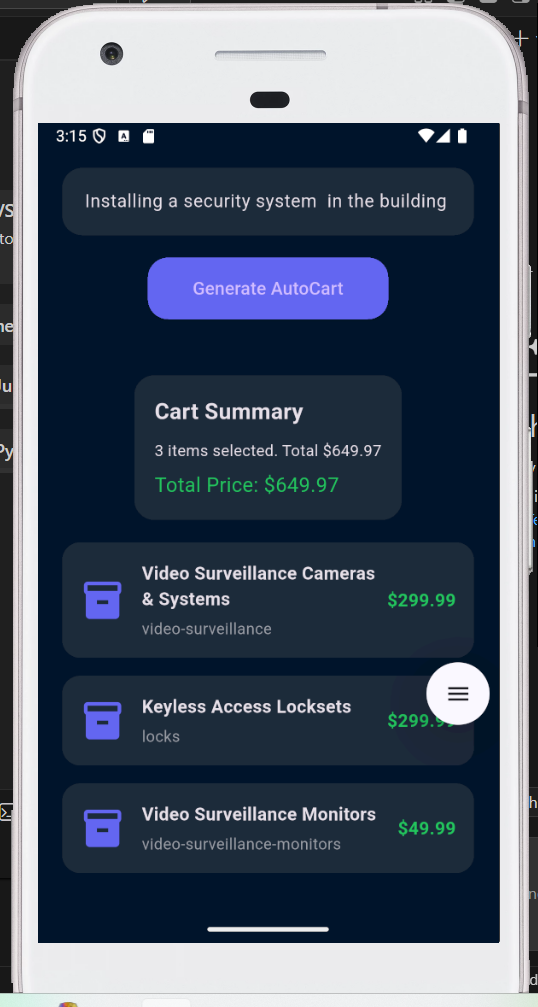
We built the system using a robust stack featuring Python and FastAPI for the backend, utilizing LangGraph for multi-agent state management and LangChain for LLM orchestration. To eliminate the risk of LLM hallucinations, we developed a custom deterministic rule system to verify hardware compatibility and resolve component dependencies. The interactive user experience is powered by a modern Flutter dashboard, allowing users to visualize engineered bundles and completeness scores in real-time, all while being hosted on the high-performance Aedify.AI cloud infrastructure.
Challenges we ran into
During development, we navigated significant technical hurdles, primarily coordinating shared state across six distinct agents while preventing context drift throughout the pipeline. Mapping the intricate nuances of competing hardware ecosystems into a deterministic rule set required extensive scenario planning to ensure accuracy. Additionally, integrating the Flutter frontend posed initial challenges regarding rendering latency and complex state synchronization with the FastAPI backend, which we optimized to deliver a responsive and seamless "outcome experience."
Accomplishments that we're proud of
We are particularly proud of achieving zero-hallucination compatibility by successfully decoupling creative LLM planning from technical hardware validation. Delivering a full-stack, cloud-deployed platform on Aedify.AI within a high-pressure hackathon timeframe stands as a major milestone for the team. This architecture proves that agentic workflows can be both intelligent and industrially reliable.
What we learned
This project taught us that LLMs are most effective when utilized as "translators" for high-level human intent, while hardcoded rules remain essential as technical guardrails for specialized tasks. We also discovered that breaking complex problems into specialized agents with isolated responsibilities significantly reduces "role confusion" and improves overall output quality. Finally, deploying on a high-performance infrastructure like Aedify.AI highlighted the importance of selecting the right cloud environment for asynchronous agentic tasks.
What's next for AutoCartOS
Looking ahead, we plan to integrate real-time inventory APIs to provide live pricing and availability for all selected products. We aim to expand our deterministic rule engine to support complex enterprise configurations, such as industrial IoT and server-room setups. Most importantly, we are working to evolve AutoCartOS into a multimodal AI system, allowing users to initiate procurement through images and voice commands for a truly frictionless experience.


Log in or sign up for Devpost to join the conversation.