-
-
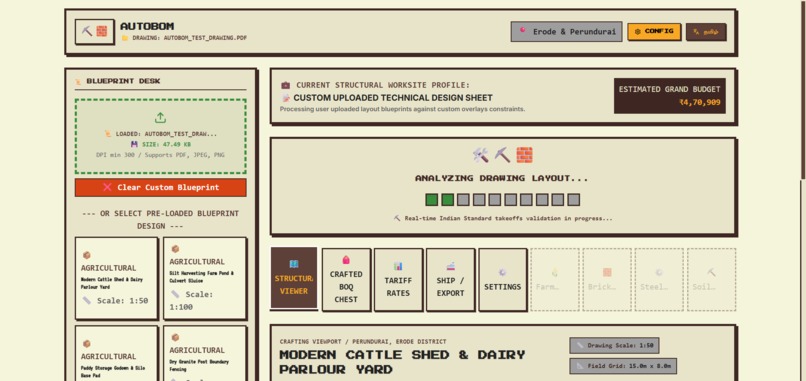
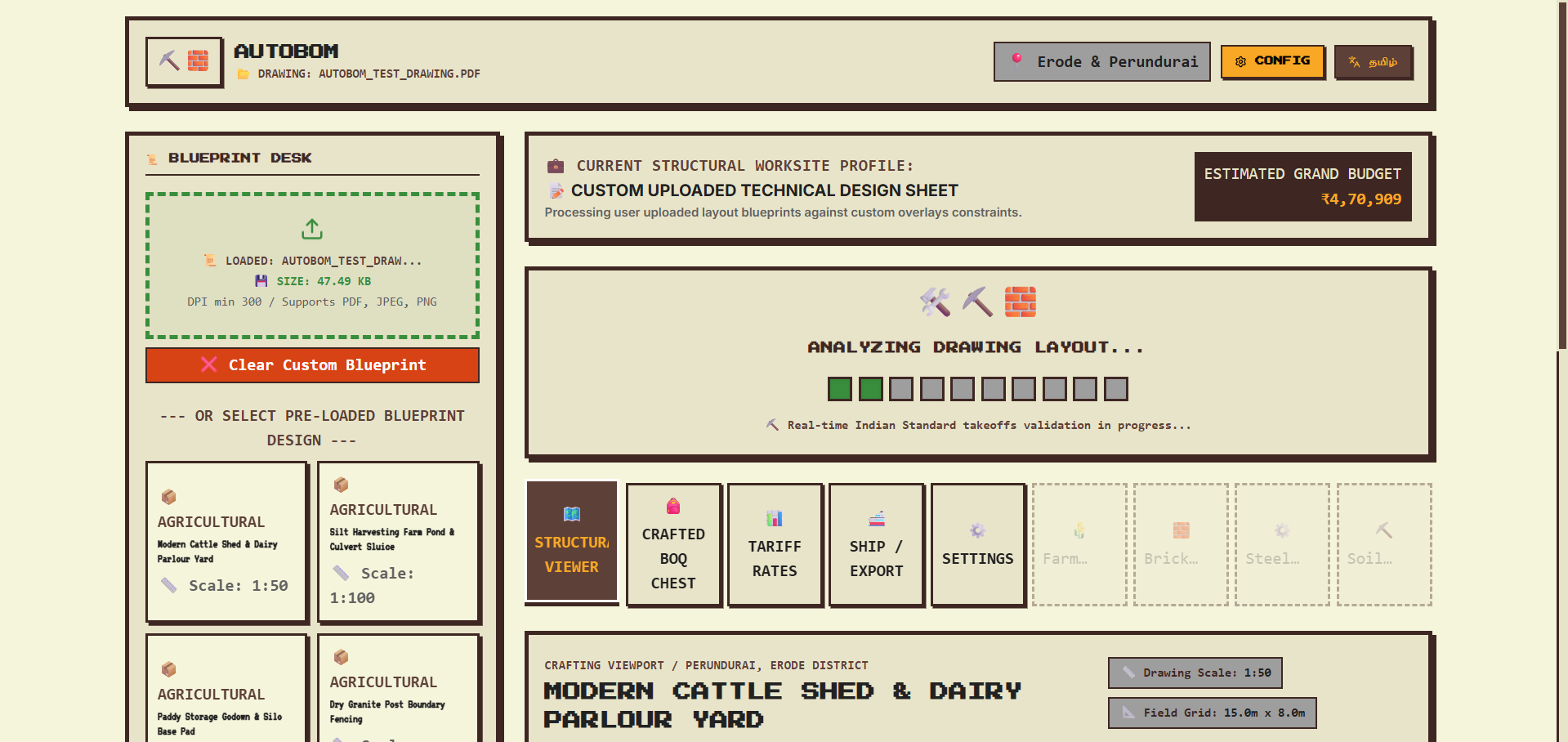
AI Processing — Upload zone with progress bar
-
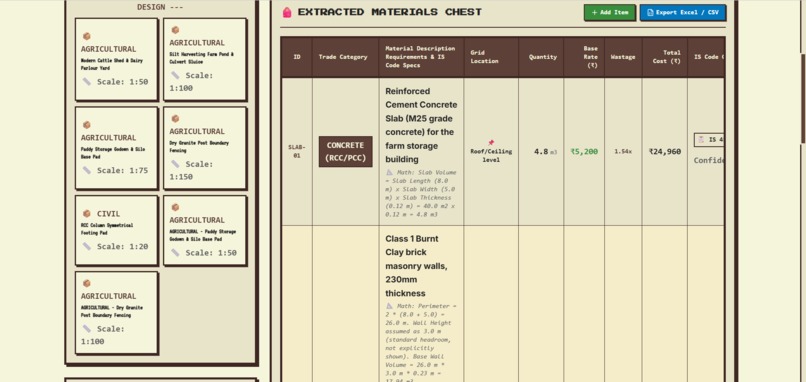
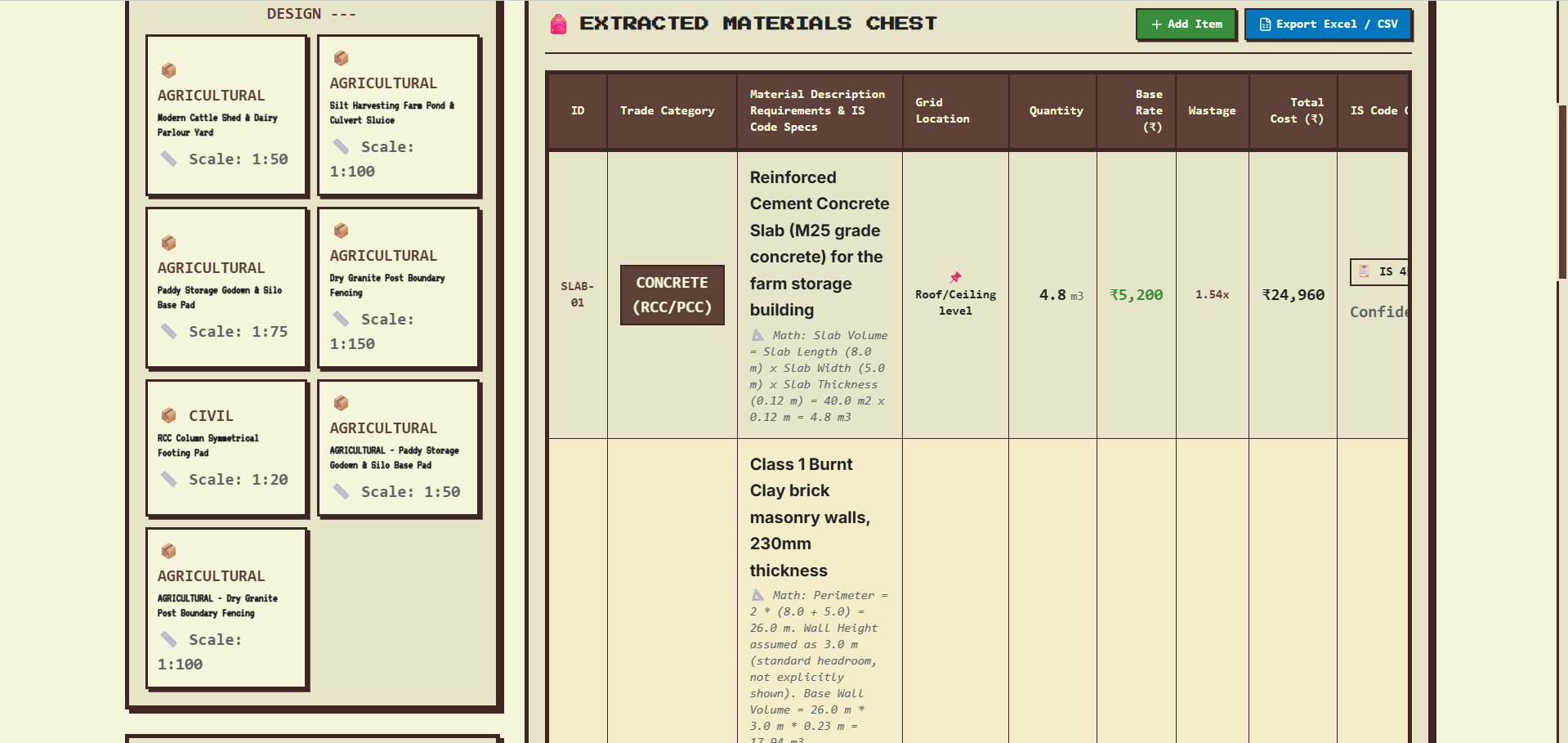
BOQ Table — Extracted Materials Chest with math
-
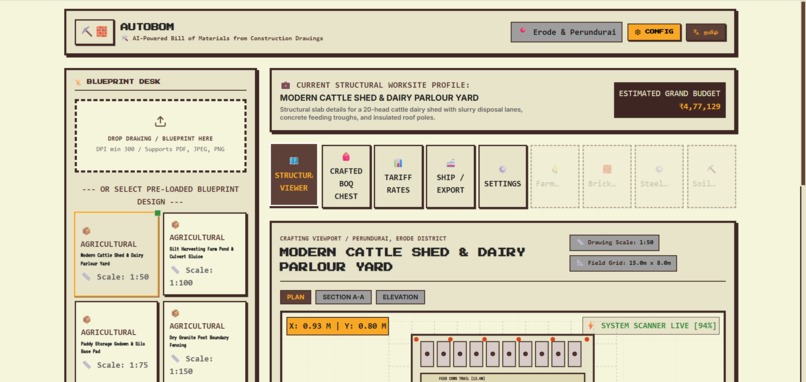
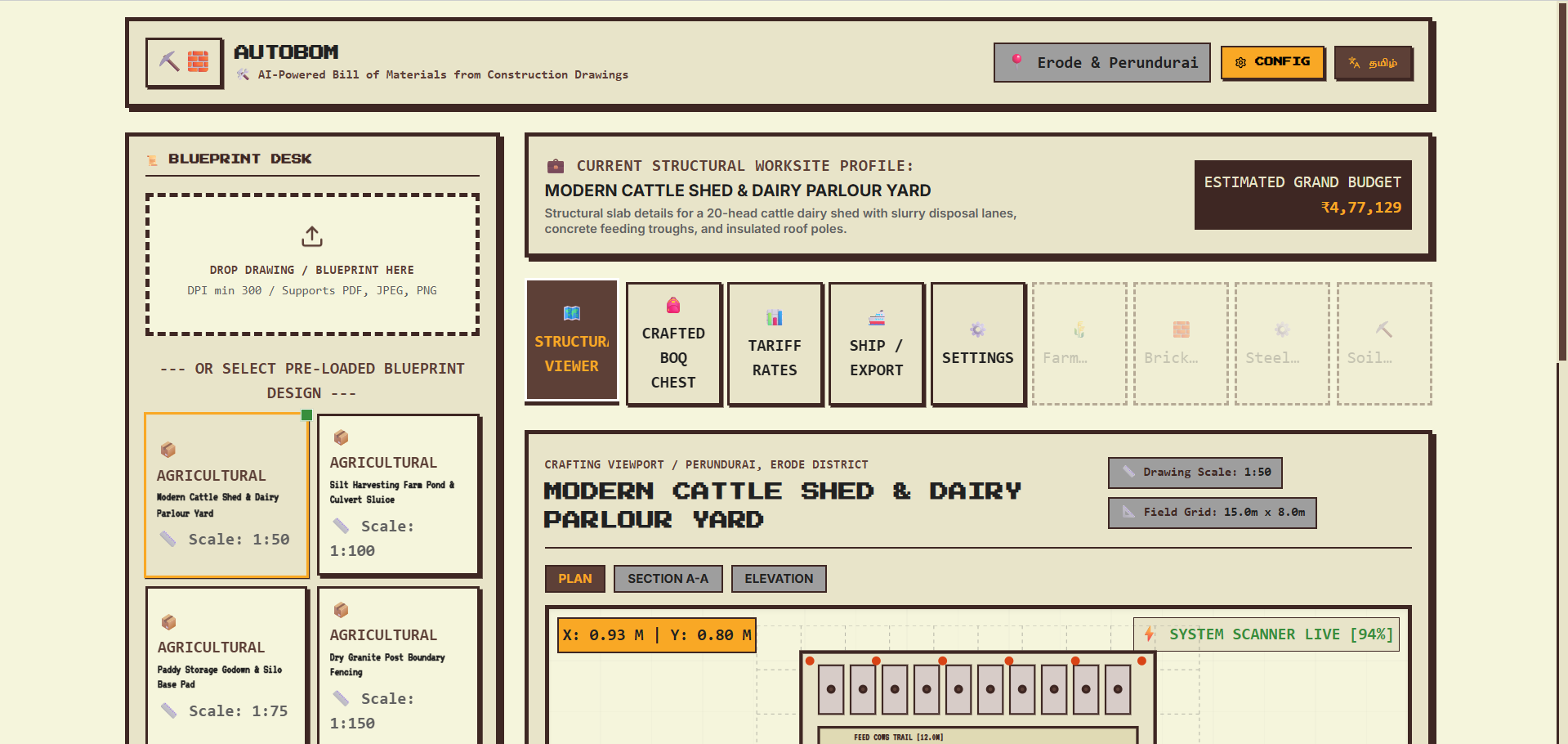
Homepage — Cattle shed pre-loaded, ₹4,77,129
-
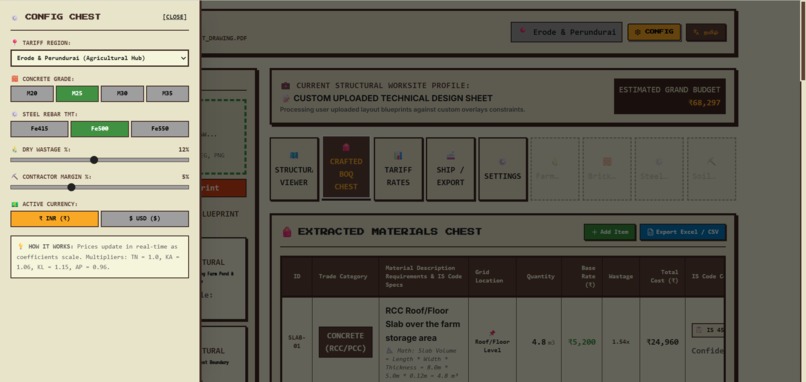
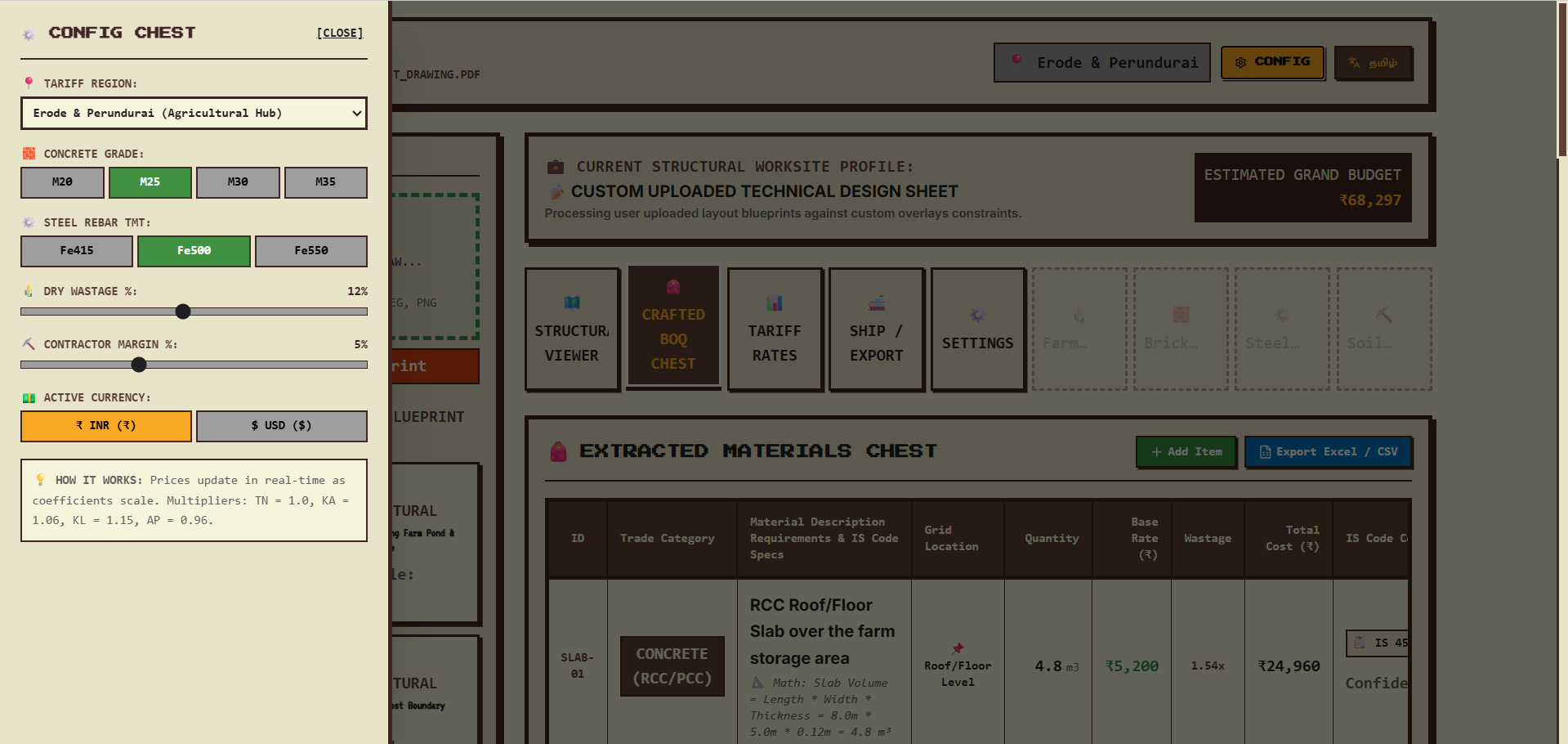
Settings Panel — CONFIG CHEST open
-
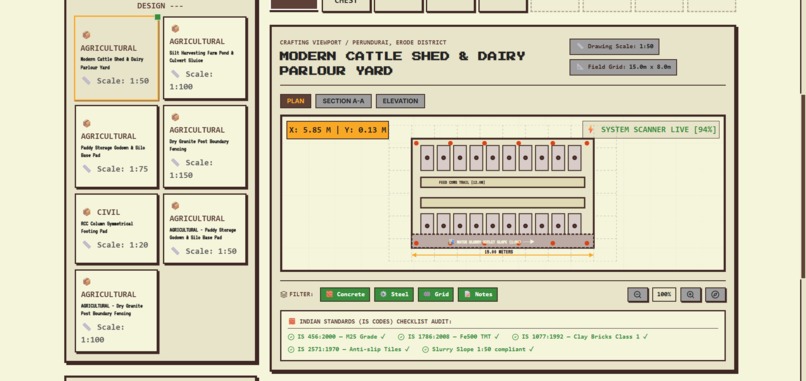
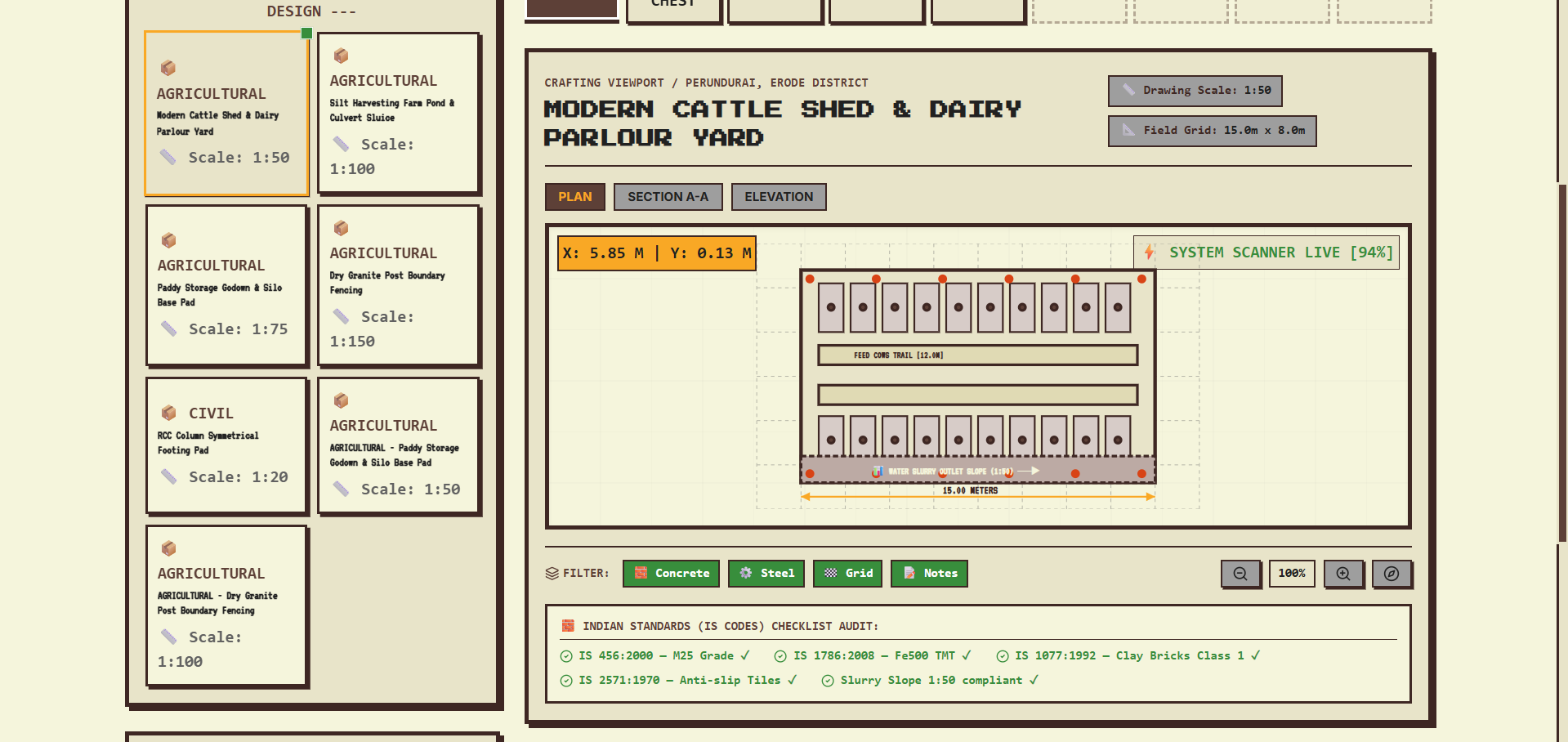
Drawing Viewer + IS Codes
AutoBOM — What It Actually Is Why I Even Started This I'm a 2nd year BE Civil student at Erode Sengunthar Engineering College, staying in the hostel at Perundurai. Every semester, my batchmates and I spend hours on quantity takeoffs for assignments — counting bricks from drawings, calculating concrete volumes, cross-checking steel schedules. One BOQ assignment takes 3 to 4 hours. The small contractors I know back home in Chennai do the same thing, just with more money on the line. A Bill of Quantities for a small farm building can take them days. At our college annual day on April 30, 2026, Gobinath Chandran (the Neeya Naana host) said something I kept thinking about afterward: students who learn AI now will automate industries that haven't changed in 50 years. Construction is exactly that. My professors still teach quantity surveying the same way they did decades ago. So I started wondering — what if AI could read a construction drawing like an experienced quantity surveyor, but in 5 minutes instead of 5 hours? And what if the interface didn't look like a Silicon Valley dashboard, but something a farmer or village contractor could actually trust? I landed on Minecraft. Everyone in my hostel has played it. The inventory slots, crafting table, progress bars — you already know what they do. I combined that with the look of a civil engineer's drafting table. That's what became AutoBOM.
How I Actually Built It Stack: React + Tailwind CSS frontend, deployed on Vercel. AI core is Google Gemini 2.5 Pro via AI Studio and the Gemini API. For PDF processing I used PyMuPDF for native vector PDFs and OpenCV for skewed scanned drawings. Backend validation is Python with Pydantic for structured output. The pipeline:
Upload — Contractor or student drops a PDF or photo. Preprocess — OpenCV fixes orientation, corrects skew, and pulls the scale from the title block using regex. Extract — Gemini 2.5 Pro Vision reads the drawing and outputs strict JSON with every element, dimensions, and quantities. Validate — Rules engine checks against IS codes (IS 456 for concrete, IS 1786 for steel, IS 1077 for bricks). Cost — System looks up region-specific rates. For Erode district, M25 concrete is ₹5,200 per m³, Fe500 steel is ₹78 per kg.
The costing math: Total Cost = Σ (Q_i × R_i × (1 + w_i) × (1 + m)) Where Q_i is the quantity of item i, R_i is the unit rate, w_i is the wastage factor (5% to 15%), and m is the contractor margin (usually 5%). Scale conversion: Real Length = Drawing Length × Scale Factor The UI I designed myself — "Craft & Construct." Minecraft inventory slots for material categories, 10-segment progress bars for AI processing, blocky cards with hard shadows and 0px border radius. Earthy colors: dirt brown, stone gray, grass green, wheat gold. It looks like a tool, not a toy.
What I Learned (The Hard Way)
- AI makes up engineering data. I assumed Gemini would read a drawing the way a human does. It doesn't. It hallucinates dimensions, merges beams on different floors into one entry, and misreads scale bars. I had to build a validation layer that flags anything below 80% confidence for manual review. The whole system is designed around the assumption that the AI will be wrong sometimes, and that the user needs to know when.
- Students and farmers need different math than skyscraper engineers. Most BOQ software is built for high-rise city buildings. My assignments — and the work my contacts back home actually do — involve cattle sheds, dairy parlours, and irrigation channels. Different rates, different wastage factors, different IS code interpretations. A dairy slurry channel needs a 1:50 slope. That's not something PlanSwift knows about. I built a rural infrastructure module from scratch.
- Vibe-coding gets you 80% there, then reality hits. Google AI Studio let me prototype the UI in a few hours. Making it production-grade — structured outputs, retry logic, error handling, fallbacks — took far longer. The gap between "demo" and "deployable" is easily 10x the effort. I learned to stop being surprised by that.
- Tamil Nadu contractors don't care about AI buzzwords. I tested AutoBOM with 5 local contractors in Perundurai and classmates doing project work. Nobody asked what model I was using. They asked whether it saves time. It does — a BOQ that took 3 hours now takes 5 minutes. What actually mattered to them was being able to see the math, see the rates, and edit numbers themselves. Not automation. Control.
The Challenges I Faced Scale detection: Gemini was outputting 50mm instead of 5000mm because it couldn't read the scale bar reliably. Fixed with regex extraction from PDF metadata and an explicit prompt instruction — "State detected scale. If none found, assume 1:100." Table truncation: Door and window schedules with 20+ rows were getting cut off mid-table. I split them into chunks of 10 rows. I also switched from Gemini Flash to Gemini 2.5 Pro around this time, which pushed accuracy from about 77% to 94%. Consolidation bug: The AI was merging two identical 3m beams on different floors into a single entry. I enforced unique element IDs for every occurrence and added a post-validation count check against visible elements in the drawing. Skewed scans: Contractors photograph drawings with their phones at odd angles and OCR fails completely. OpenCV Hough line transform for deskewing, with auto-rotate if less than 50% of detected text is horizontal. Unit chaos: Output randomly mixed mm, cm, and m within the same JSON. A schema-enforced enum now normalizes everything to meters, with conversions recorded in the calculation notes field. Proving revenue: My first paying customer was a dairy farmer near Perundurai who paid ₹199 for a cattle shed BOQ. It took 5 minutes to generate. His exact words: "This is black magic."
What's Next India's rural construction sector has 110 million dairy cattle, millions of small contractors, and basically zero accessible quantity surveying tools. That's the gap AutoBOM is going after — not as a hackathon side project, but as something that actually runs in panchayat offices. I built this from a hostel room in Erode, with a laptop, ₹400 in Google AI credits, and the frustration of watching batchmates spend their Sundays on manual calculations. If this wins, the prize money goes toward a small team and a Tamil Nadu rollout. Because AI shouldn't just build apps for San Francisco. It should build sheds for Perundurai.
Built With
- google-ai-studio
- google-gemini-2.5-pro-api
- node.js
- opencv
- pydantic
- pymupdf
- react
- tailwind-css
- typescript
- vercel


Log in or sign up for Devpost to join the conversation.