-
-
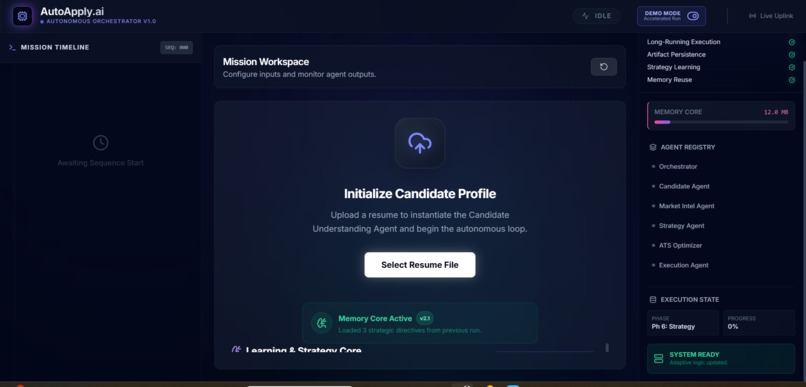
agent asks to upload the resume
-
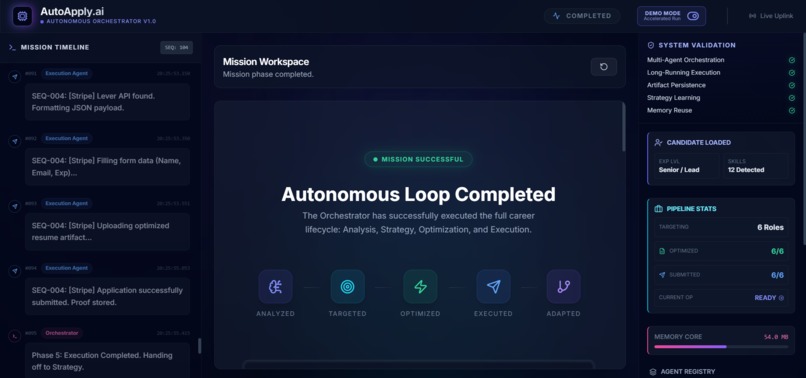
agents execute their tasks and show this
-
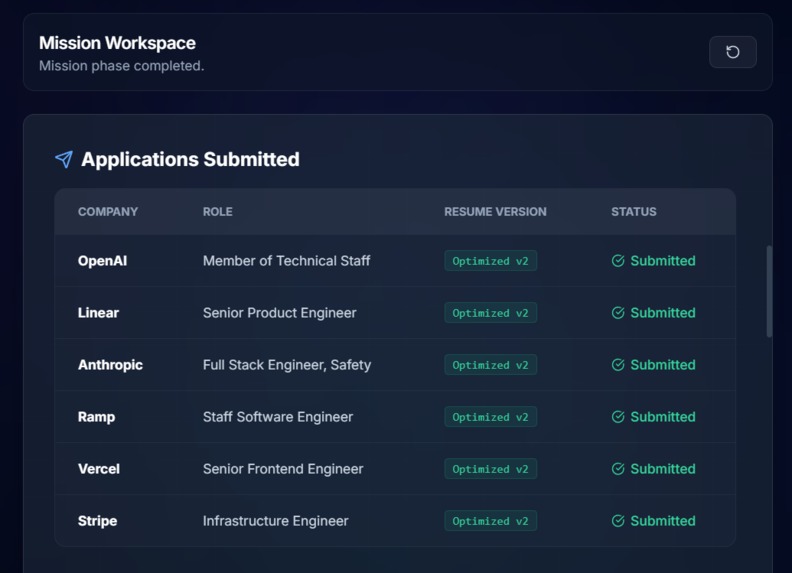
it shows companies it applied for as per your resume
-
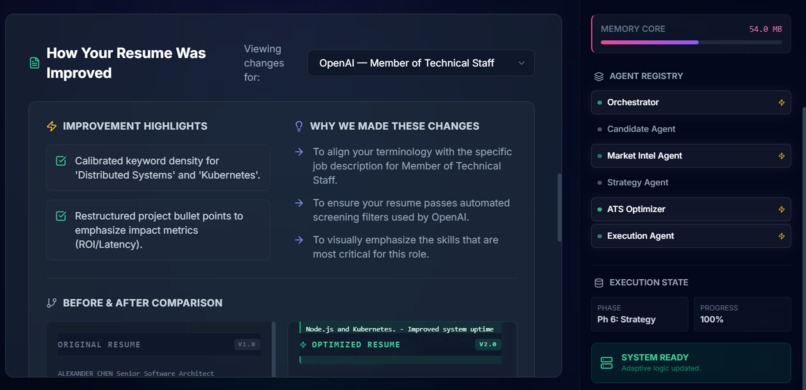
shows what corrections it made in your resume to pass the ats score
-
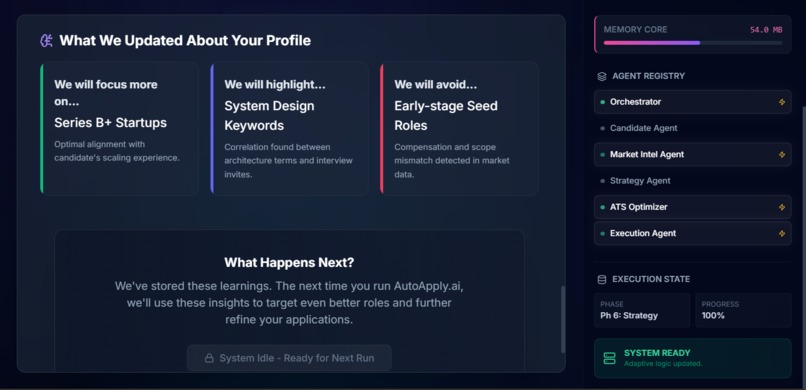
shows all updates together


Inspiration
Job searching today is exhausting and repetitive. Candidates spend hours searching across multiple platforms, rewriting resumes, and filling the same application forms—often with little feedback or results. We were inspired by a simple question: why is the burden of execution still entirely on the user?
With the launch of Gemini 3 and the shift toward the Action Era—where AI systems can plan, act, and learn—we wanted to explore what job searching would look like if AI didn’t just assist, but actually executed. AutoApply.ai was inspired by the idea of building a true autonomous agent that could take responsibility for the end-to-end career application workflow and improve itself over time.
What it does
AutoApply.ai is an autonomous career execution system.
A user uploads a resume, and the system:
Understands the candidate’s skills, experience, and preferences
Identifies high-quality, relevant job opportunities
Optimizes the resume separately for each role to pass automated screening systems
Executes job applications (safely simulated or real where allowed)
Learns from outcomes and adapts its strategy for future runs
The system completes the entire loop—analysis → targeting → optimization → execution → learning—with minimal user intervention, and becomes more effective every time it runs.
How we built it
We built AutoApply.ai entirely using Google AI Studio (Build tab) with Gemini 3 Pro as the primary reasoning engine.
The system is structured as a multi-agent architecture, orchestrated by a central controller:
Candidate Understanding Agent extracts structured candidate intelligence from resumes
Market Intelligence Agent reasons over job opportunities and selects high-probability roles
ATS Optimization Agent iteratively improves resumes using a generate → verify → refine loop (Vibe Engineering)
Execution Agent performs safe application execution and captures artifacts
Learning & Strategy Agent reflects on outcomes and updates long-term strategy memory
Gemini 3’s long-context reasoning enables agents to reason across documents, execution history, and memory, allowing the system to operate as a long-running autonomous workflow rather than a single prompt or chatbot. A premium mission-control-style UI makes the autonomy and learning behavior transparent to users.
Challenges we ran into
One of the biggest challenges was avoiding the trap of building a “prompt-only” wrapper. Designing agents that could coordinate, maintain state, and learn across runs required careful orchestration and clear phase boundaries.
Another challenge was balancing transparency with usability—exposing meaningful outcomes (applications submitted, resume changes, strategy updates) without overwhelming non-technical users with internal logs or AI jargon. We also had to design safe execution semantics to demonstrate action without violating platform or ethical constraints.
Accomplishments that we're proud of
Building a true autonomous loop that plans, executes, learns, and adapts
Demonstrating Vibe Engineering through iterative ATS optimization
Implementing long-term memory that changes future behavior across runs
Creating a clean, premium UI that makes autonomy understandable to non-technical users
Delivering a complete end-to-end system, not just a chatbot or demo
What we learned
We learned that autonomy is not about larger prompts—it’s about system design. Long-running AI systems need memory, verification loops, clear execution boundaries, and thoughtful user-facing explanations.
Working with Gemini 3 reinforced how powerful multimodal, long-context reasoning can be when used as part of an orchestrated system rather than a single interaction. We also learned the importance of building trust through transparency—users care deeply about what changed and why, not just outcomes.
What's next for AutoApply.ai
Next, we plan to:
Add follow-up tracking and response analysis
Integrate interview scheduling and preparation
Expand learning signals based on recruiter responses
Support multi-candidate and team-based workflows
AutoApply.ai is a step toward a future where AI systems don’t just advise humans—but take responsibility for execution and improvement over time.

