-
-
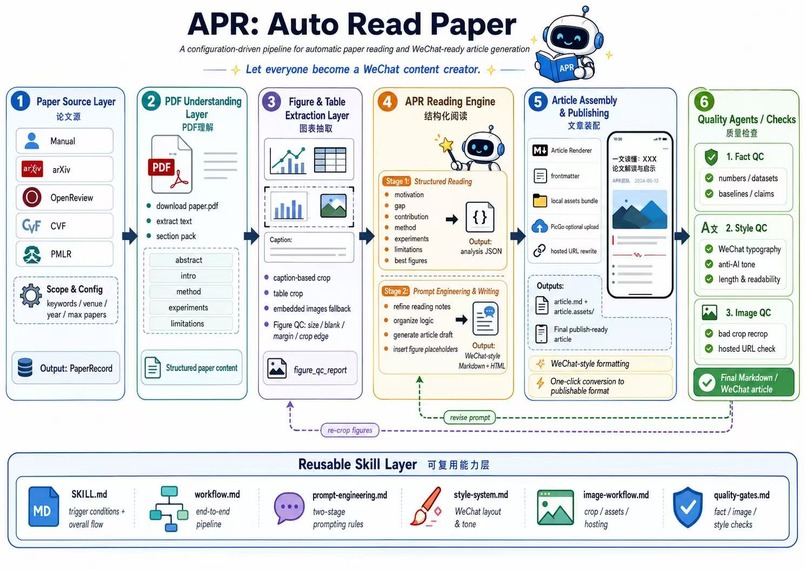
framework
:::writing{variant="standard" id="41827"}
Inspiration
Reading research papers is powerful, but it is also slow, repetitive, and easy to postpone. We wanted to build a system that turns dense academic papers into clear, publish-ready reading notes, so more people can follow frontier research and share what they learn.
What it does
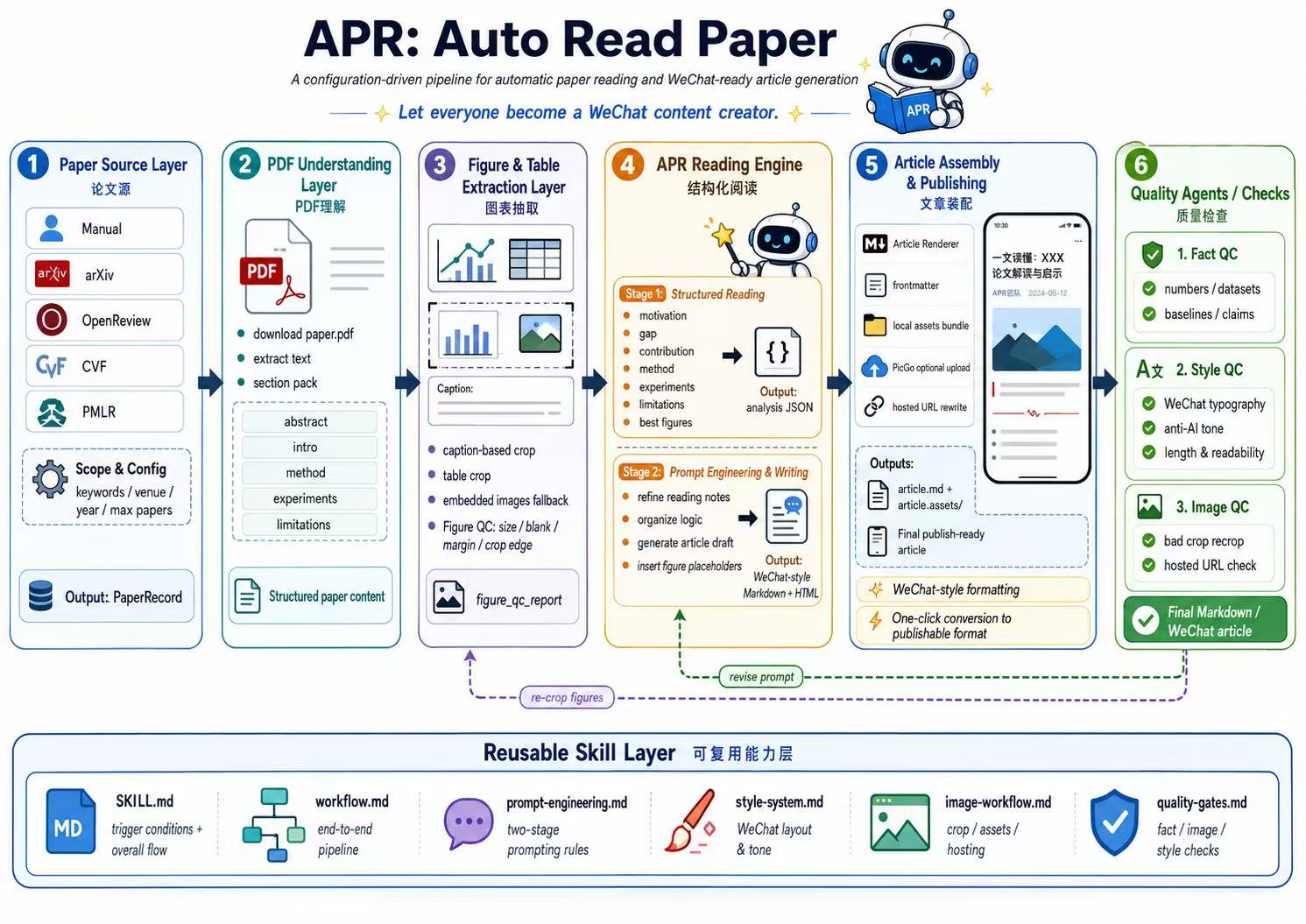
auto-read-paper automatically fetches papers, reads and analyzes the PDF, extracts key figures, summarizes the motivation, method, contributions, experiments, and limitations, then generates a polished Markdown article with images, formulas, and structured explanations.
How we built it
We combined paper fetching, PDF parsing, figure extraction, prompt engineering, image hosting, Markdown rendering, and quality checks into a reusable workflow. The system is designed around modular skills, so each step can be improved independently.
Challenges we ran into
The hardest parts were extracting useful figures reliably, reducing the “AI-written” tone, and keeping technical explanations accurate while still readable. We also had to balance automation with manual-quality article formatting.
Accomplishments that we're proud of
We built an end-to-end pipeline that can turn a research paper into a detailed article in minutes. It supports local assets, hosted images, reusable prompts, style templates, and review loops for both content quality and visual quality.
What we learned
A good paper-reading system is not only about summarization. It needs structure, citation awareness, figure understanding, writing style control, and repeated self-checking. Prompt engineering becomes much more effective when it is treated as part of the system design.
What's next for auto-read-paper
Next, we want to support more conferences and domains, improve figure detection, add stronger multi-agent review, provide richer article style presets, and make the whole workflow easier for creators, researchers, and students to use. :::

Log in or sign up for Devpost to join the conversation.