-
-
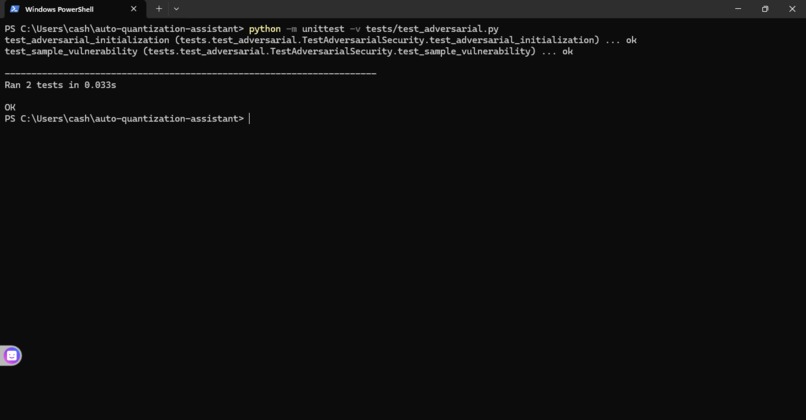
Running adversarial unit test suite successfully in PowerShell.
Inspiration Modern machine learning models deliver incredible performance but deploying them to resource-constrained edge devices creates massive bottlenecks. Model weight overhead and inefficient memory usage limit scalability. Inspired by the goals of OpenAI Build Week, this project was built to solve this exact friction point by automating precision reduction workflows safely and efficiently.
What it does The Auto-Quantization Assistant is an automated pipeline and toolset designed to streamline model quantization workflows. It features comprehensive, built-in support for multiple optimization strategies including symmetric, asymmetric, and clipping optimization methods, ensuring that models maintain robustness and performance integrity even under extreme adversarial conditions.
How we built it Core Logic & Architecture: Developed using Python and PyTorch modules housed within dedicated source directories (src/quantization and src/validation) to handle metrics tracking and compression calculations cleanly.
AI Integration: Utilized OpenAI's Codex coding agent within the development environment to write, review, and refine code architecture and secure optimization routines.
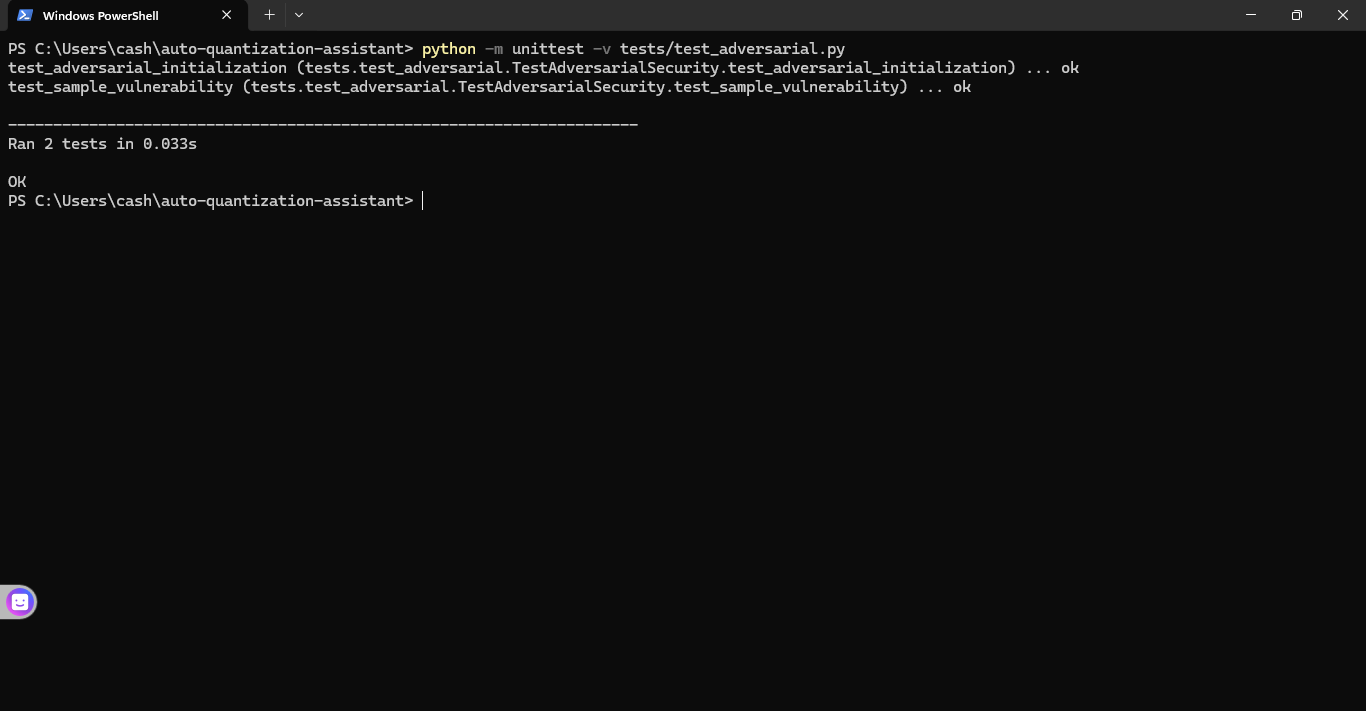
Testing & Robustness: Implemented a rigorous unit testing framework (tests/test_adversarial.py) running adversarial checks to validate quantization bounds and gradient stability.
CI/CD & Cloud Workflows: Integrated automated validation pipelines via GitHub Actions to ensure reliable builds and continuous delivery.
Challenges we ran into Balancing aggressive memory compression with numerical stability was a significant hurdle. Extreme outlier weights often caused severe degradation when quantized. This was resolved by implementing robust clipping logic and asymmetric quantization boundaries backed by automated test suites to catch vulnerabilities early.
Accomplishments that we're proud of Successfully integrating OpenAI's Codex agent to accelerate architecture design and code review workflows.
Building a reliable test suite that passes adversarial validation checks for edge cases and outlier weights in just seconds.
Establishing a fully automated CI/CD pipeline using GitHub Actions to guarantee continuous code quality and stable builds.
What we learned We gained deep insights into low-level tensor manipulation, precision scaling limits, and how AI-assisted coding agents like Codex can accelerate the development and debugging lifecycle of complex machine learning infrastructure.
What's next for Auto-Quantization Assistant Expanding support for additional quantization algorithms and hardware targets.
Integrating advanced automated performance benchmarking directly into the dashboard interface.
Scaling community adoption and gathering feedback through further open-source enhancements.

Log in or sign up for Devpost to join the conversation.