-
-
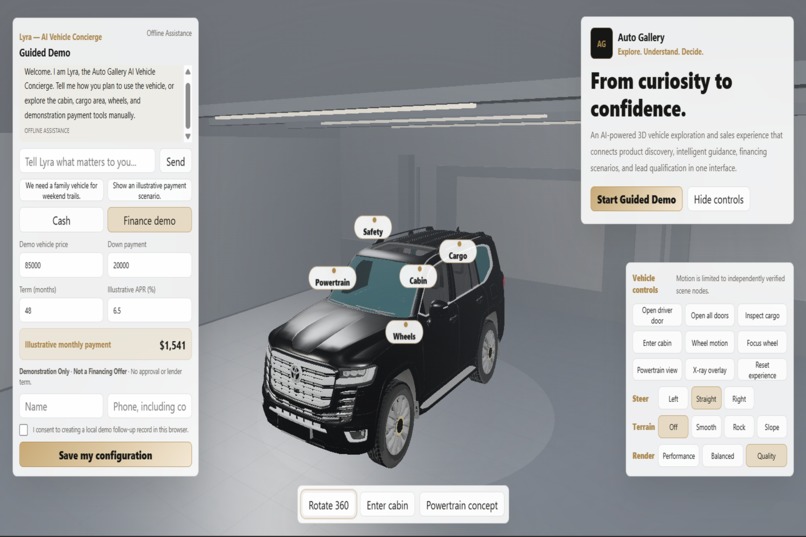
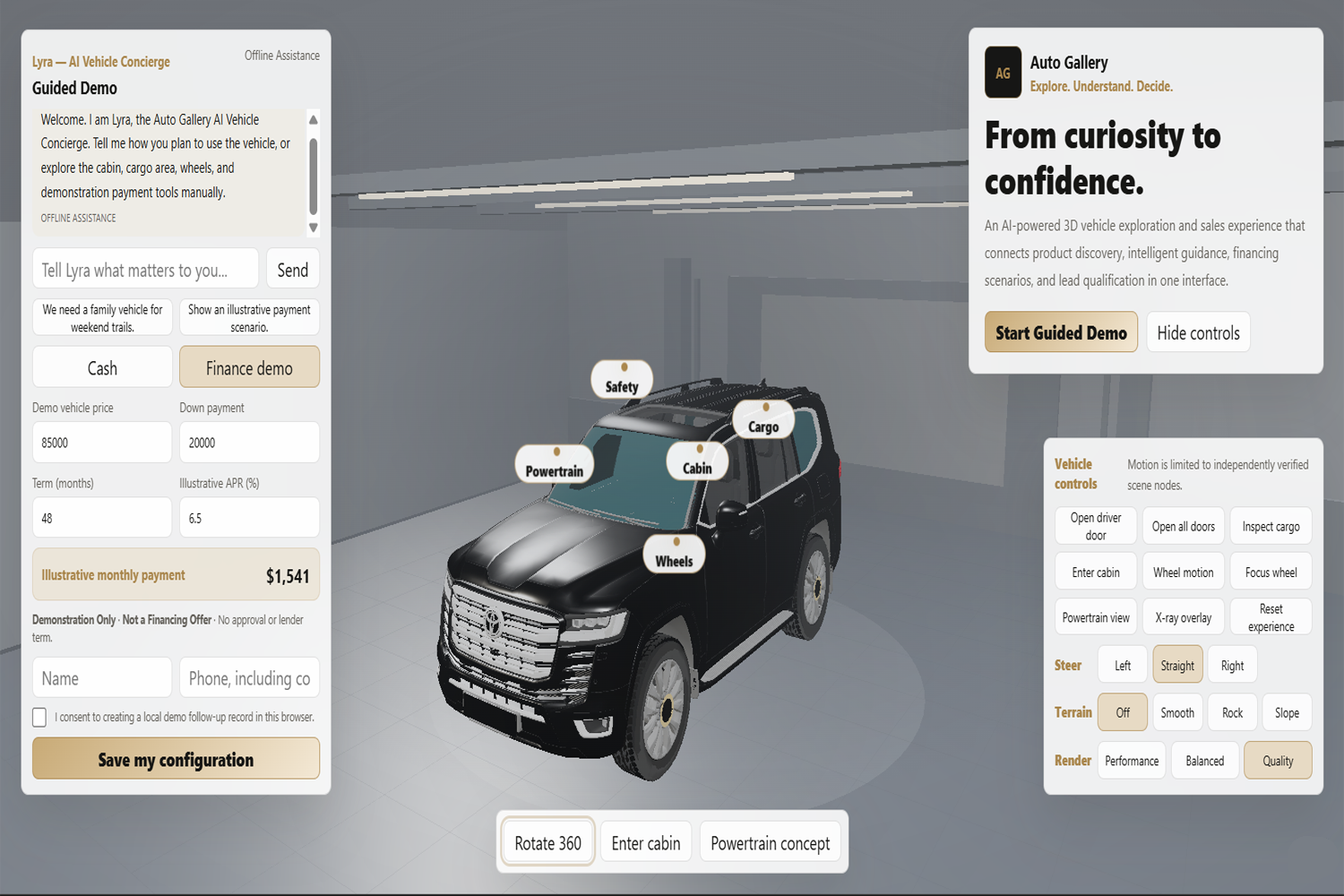
Auto Gallery’s interactive 3D showroom with Lyra, financing tools, hotspots, and complete vehicle controls.
-
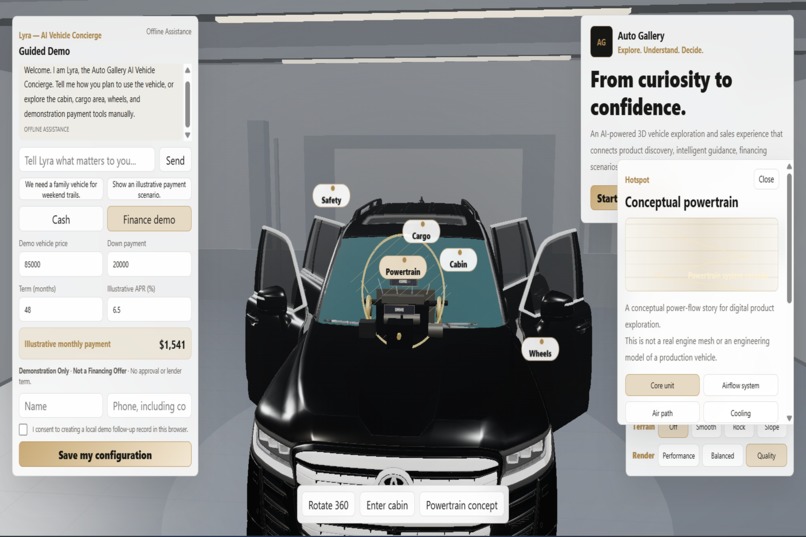
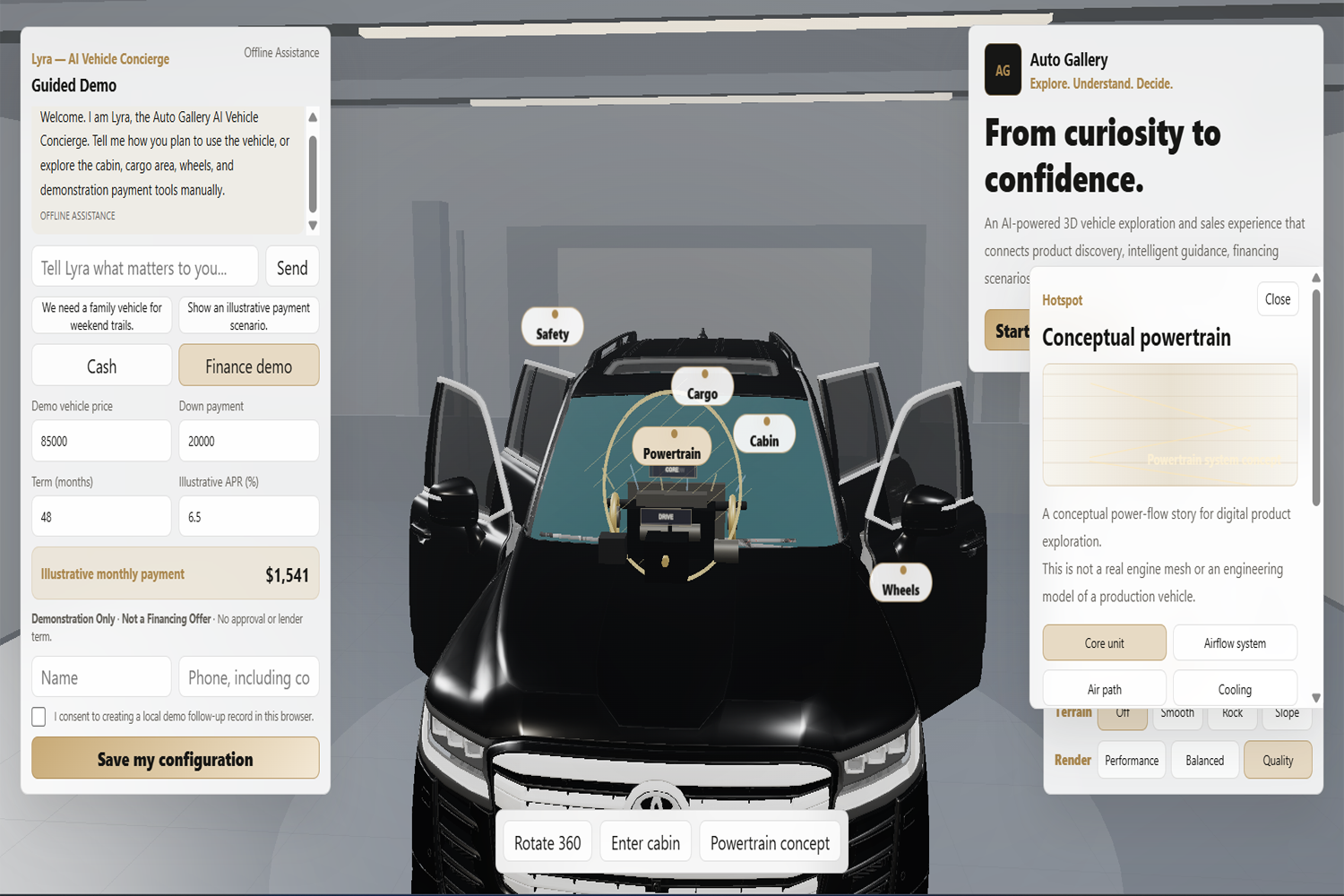
Conceptual powertrain exploration with interactive hotspots, open doors, and transparent educational guidance.
-
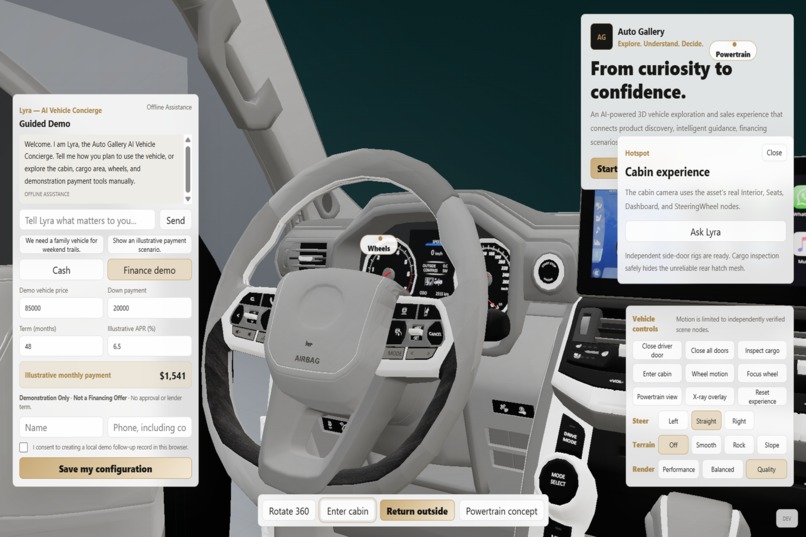
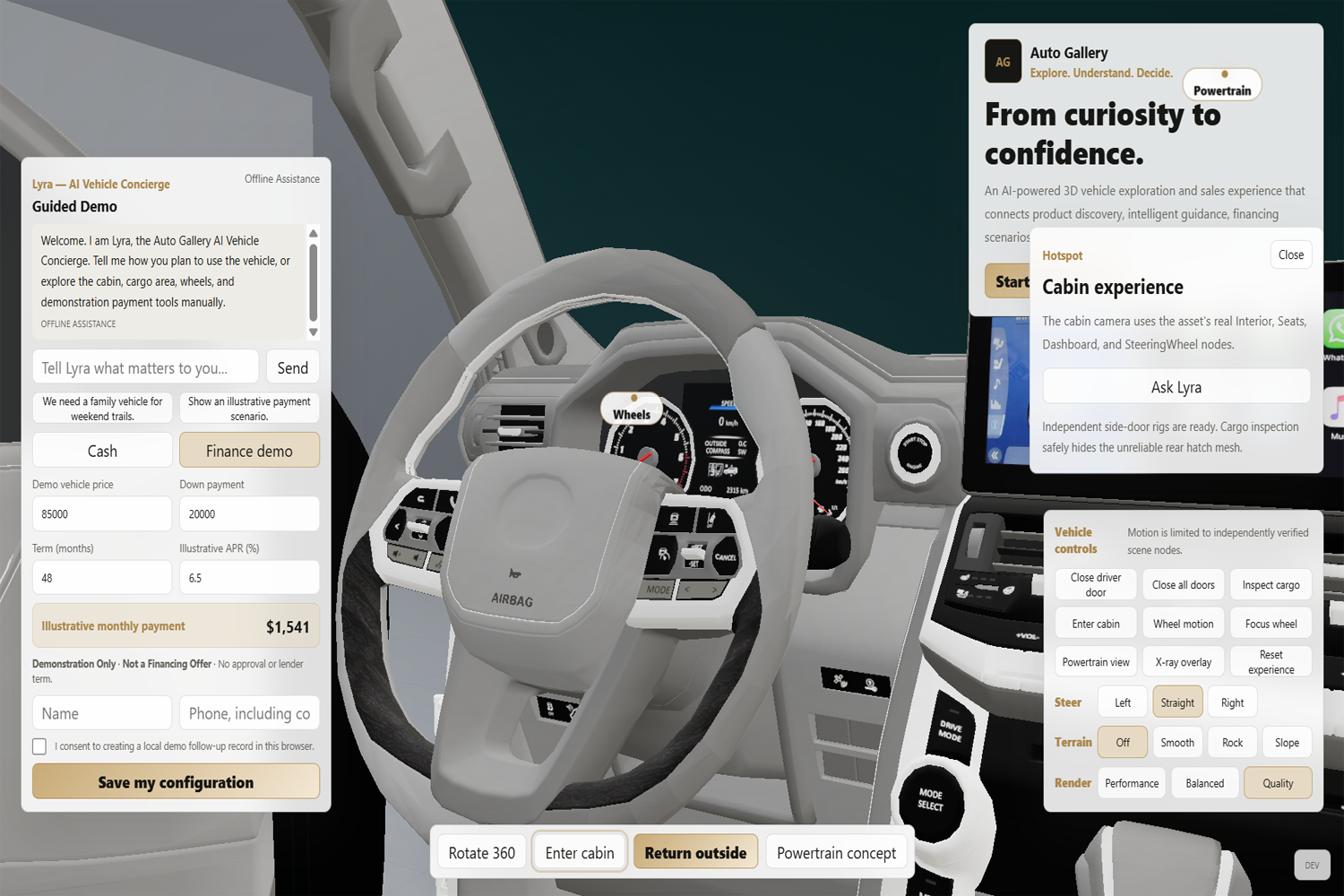
Immersive cabin view using the vehicle’s real dashboard, steering wheel, seats, and interior geometry.
-
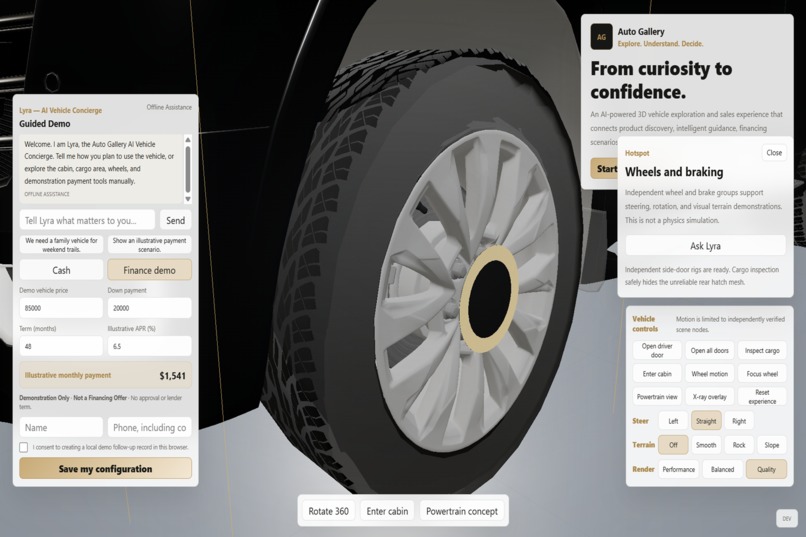
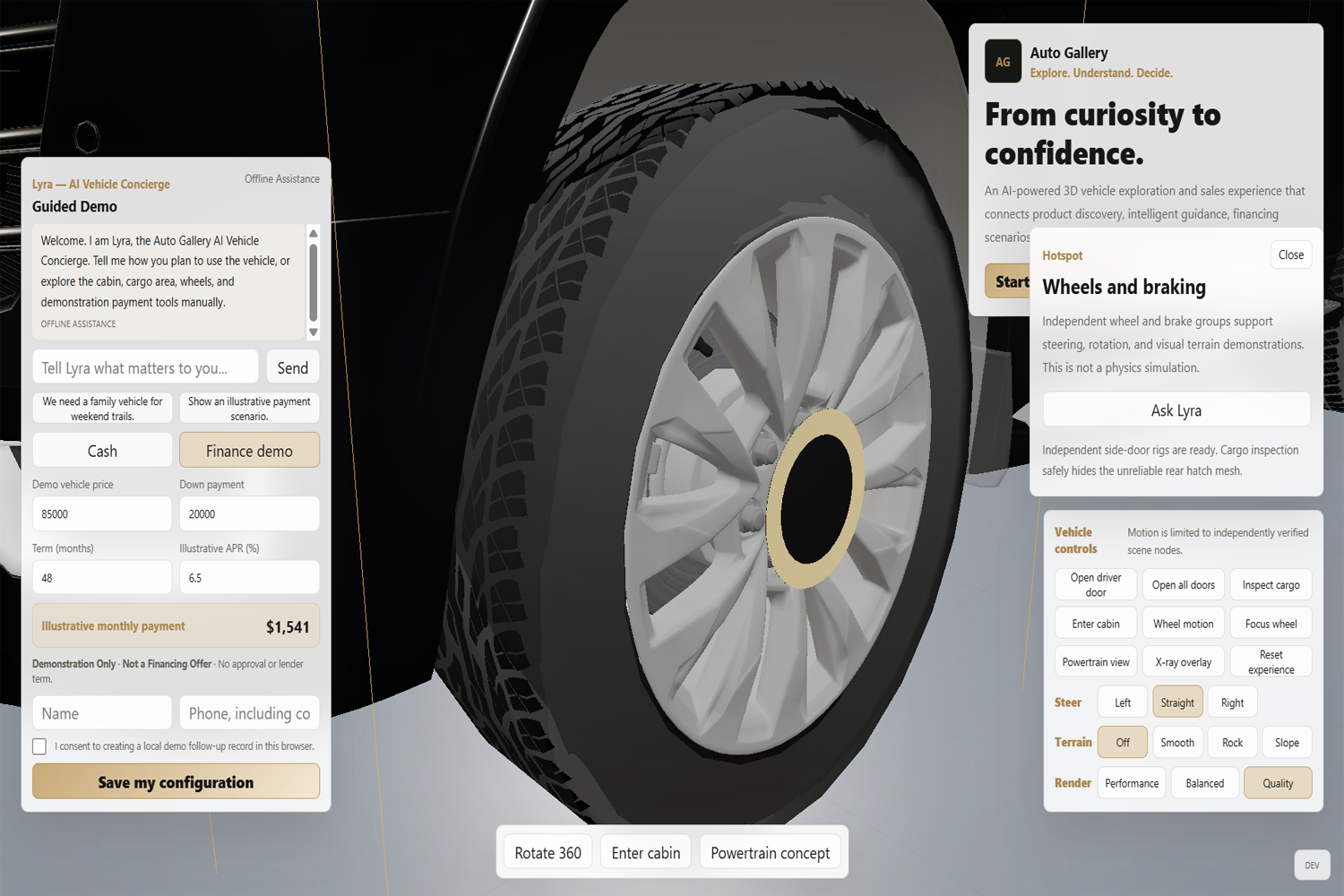
Detailed wheel and braking exploration with steering, rotation, terrain modes, and Lyra-guided explanations.
Inspiration
Online vehicle shopping still feels like browsing a digital brochure. Customers move between static images, specification tables, separate finance calculators, and generic contact forms.
I wanted to build an experience where the vehicle itself becomes the interface: customers can explore it, understand its features, evaluate affordability, and express interest without leaving the showroom experience.
Auto Gallery started as a simple idea: What if an online vehicle listing could guide a customer like a real showroom consultant?
Codex and GPT-5.6 helped transform that idea into a working, testable, and deployable 3D product experience in a matter of hours.
What it does
Auto Gallery is an interactive 3D vehicle discovery and sales-assistance experience led by Lyra, an AI Vehicle Concierge concept.
Customers can:
- Explore and rotate an optimized 3D vehicle.
- Open and close independent side doors.
- Enter and inspect the real cabin mesh.
- Observe steering and wheel demonstrations.
- Explore an illustrative off-road mode.
- Inspect the cargo area.
- View a clearly labeled conceptual powertrain.
- Calculate an illustrative monthly payment.
- Save a consent-based browser-local demo configuration.
- Run a complete and repeatable Guided Demo.
- Receive rule-based Offline Assistance without depending on an external API.
Unlike a conventional product gallery, Auto Gallery connects vehicle discovery, product education, affordability, and sales follow-up inside one unified experience.
How we built it
Auto Gallery was built with React, Vite, Three.js, JavaScript, glTF assets, Meshopt optimization, and static web deployment.
The original local vehicle asset package was approximately 1.89 GB. It was processed and reduced to an optimized public model package of approximately 14.4 MB while retaining the visual quality and interactive scene groups required for the demonstration.
Codex powered by GPT-5.6 supported:
- Three.js scene and camera architecture.
- Vehicle interaction groups and validated pivots.
- Door, steering, wheel, cabin, cargo, and hotspot controls.
- Guided Demo orchestration.
- Rendering-quality and performance modes.
- Material targeting and visual corrections.
- Offline Assistance logic.
- Illustrative financing calculations.
- Browser-local consent-based lead handling.
- Automated tests and security scans.
- Static deployment packaging.
- Competition documentation and release preparation.
GPT-5.6 helped reason about the architecture, user journey, fallback behavior, testing strategy, performance decisions, and competition positioning.
Human decisions defined the product concept, visual style, automotive sales focus, branding, feature priorities, and the decision to prioritize reliability and truthful product behavior.
Challenges
Optimizing a complex 3D asset
The original vehicle package was too large for practical browser delivery. The model and textures required optimization, material correction, and careful scene inspection before the vehicle could be deployed as a performant web experience.
Working with incomplete interaction groups
Not every visible vehicle component existed as a reliable independent mesh. Instead of presenting misleading animations, unsupported features were handled honestly.
For example, the source model does not contain a complete real engine mesh, so the powertrain experience is clearly labeled as conceptual. The rear hatch was also not reliable as a complete independent animation, so cargo inspection uses a transparent fallback rather than pretending to provide a real hatch animation.
Live AI reliability
Live tool-calling was tested separately, but the tested third-party gateway did not provide reliable enough latency for a public judging experience.
The submitted build therefore uses a deterministic Guided Demo and rule-based Offline Assistance. This ensures every judge can experience the complete product journey consistently without an external service failure.
Static deployment and security
The project was converted into a self-contained static deployment. Environment files, API credentials, development logs, temporary files, and private assets were excluded from the public build and repository.
Accomplishments
- Converted a static vehicle listing into a complete guided 3D sales experience.
- Reduced the vehicle asset package from approximately 1.89 GB to approximately 14.4 MB.
- Implemented vehicle doors, cabin, wheels, steering, cargo, hotspots, and camera interactions.
- Created a reliable and repeatable Guided Demo led by Lyra.
- Integrated illustrative financing and consent-based local follow-up.
- Passed 22 automated tests.
- Passed secret and globalization scans.
- Produced a successful production build.
- Moved from an initial concept to a public working product with Codex and GPT-5.6.
What we learned
AI-assisted engineering is not simply asking a model to generate code.
The strongest results came from combining human product judgment with Codex iteration: defining a clear objective, inspecting generated work, testing each change, rejecting unreliable approaches, and choosing honest fallbacks when a source asset or external service could not support a feature correctly.
We also learned that a deterministic AI-guided experience can sometimes provide greater real-world value than an impressive but unreliable live integration.
What’s next
The next version of Auto Gallery can connect to:
- Verified vehicle inventory and official specifications.
- Production CRM systems.
- Lender and financing data.
- Customer analytics.
- Multiple vehicle models.
- Saved customer accounts and comparisons.
- Multilingual vehicle guidance.
- Reliable production-grade live tool-calling.
Auto Gallery demonstrates how Codex and GPT-5.6 can dramatically shorten the distance between imagination and a working product.
Imagine it. Prompt it. Build it.
Auto Gallery — Explore. Understand. Decide.
Built With
- 3d
- ai
- cloudflare
- codex
- css3
- gltf
- gpt-5.6
- html5
- javascript
- meshopt
- node.js
- pages
- react
- three.js
- vite
- webgl

Log in or sign up for Devpost to join the conversation.