-
-
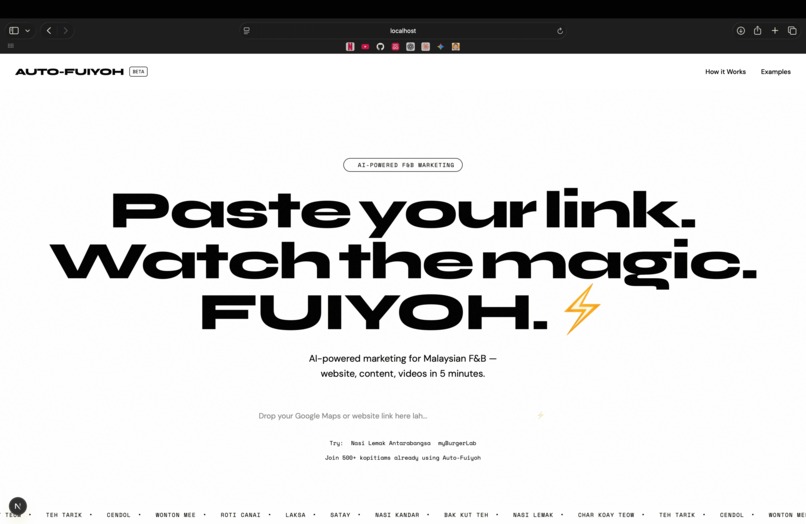
Home Page
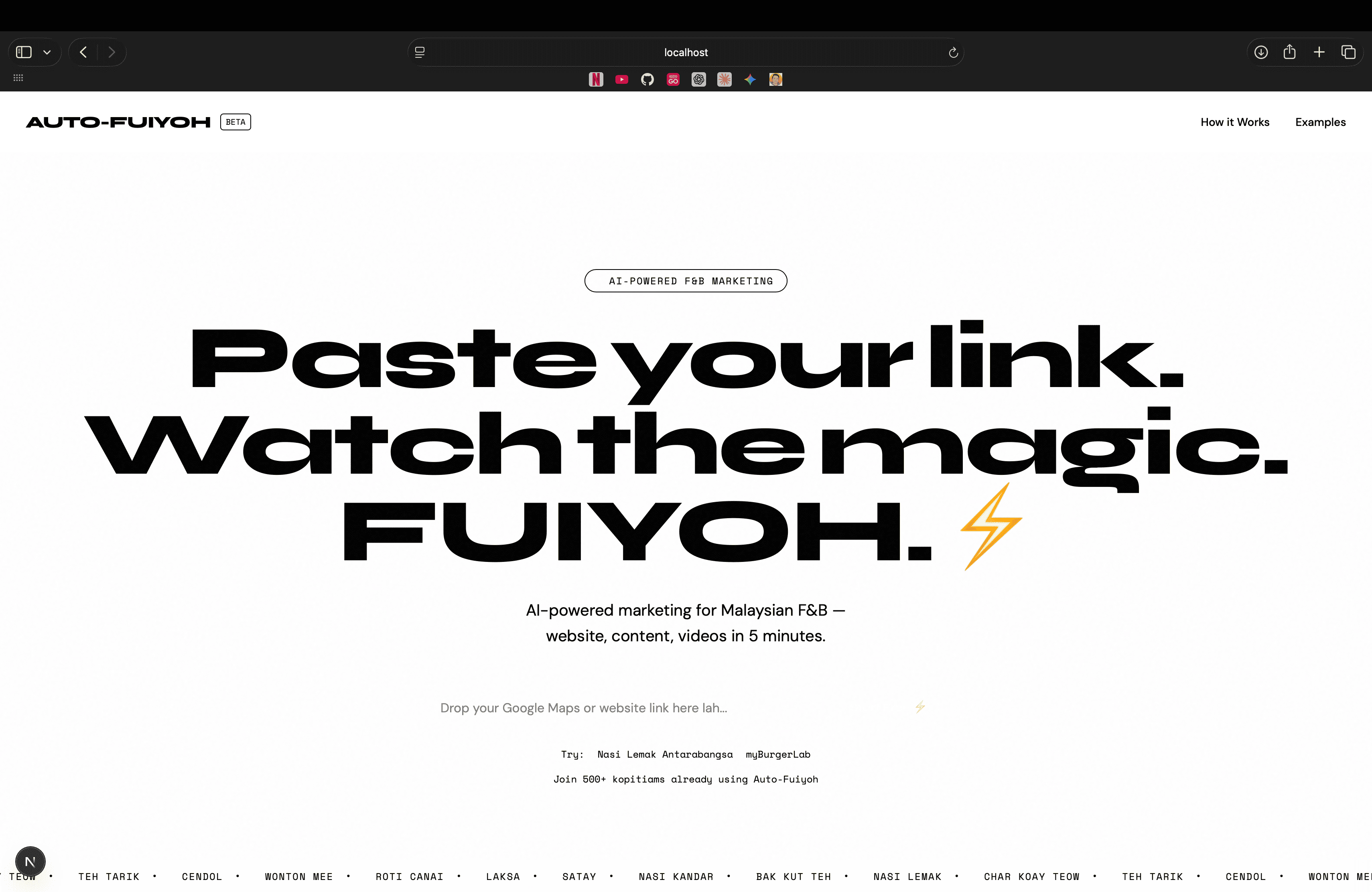
Inspiration
Malaysia has 1.2 million SMEs, and the F&B sector is the heartbeat of our culture — the uncle running his kopitiam since 1987, the mak cik selling nasi lemak from 5am, the young couple who just opened their first café in Subang. These people pour everything into their food. But when it comes to marketing? They're invisible.We watched a kopitiam owner in Chow Kit lose lunch crowd to the new café next door — not because the food was worse, but because that café had a nice Instagram, a clean website, and consistent TikTok content. The kopitiam uncle had better food but zero digital presence. That felt deeply unfair.The spark for Auto-Fuiyoh came from one question: what if a stall owner could paste one link and get everything a RM 10,000/month marketing agency would give them — in 5 minutes, in BM, English, and Mandarin, for almost free?The name "Fuiyoh" said it all. It's the one word every Malaysian uses regardless of race, language, or background when something genuinely amazes them. That's exactly the reaction we wanted to build.
What it does
Auto-Fuiyoh is an end-to-end AI marketing transformation engine for Malaysian F&B SMEs. A business owner pastes their Google Maps link or existing website URL, and the platform delivers a complete marketing overhaul in under 5 minutes:
Brand Analysis — Gemini 1.5 Pro scrapes the business's public data, reviews, menu, and photos to build a deep brand profile, understanding not just what they sell but who they are Campaign Strategy — AI generates a full campaign brief with positioning, key messages, and a 30-day content calendar calibrated to Malaysian cultural events like Ramadan, CNY, and Deepavali New Website UI — A modern, mobile-first website is generated and deployable to a live URL with one click Instagram Content — Imagen 3 generates 9 professional food photography-style social media images with trilingual captions in BM, English, and Mandarin TikTok Videos — Veo 2 produces 3 short-form videos with Malaysian-accented voiceover and auto-subtitles, ready to post Full Asset Export — Everything packaged into a single ZIP download, organised and ready to deploy
The entire output — website, images, videos, captions, strategy — is culturally Malaysian. Not translated. Not generic. Written and designed for the Malaysian market specifically.
How we built it
Auto-Fuiyoh is built on a modern, fully serverless stack designed to orchestrate multiple Google AI models in a single coherent pipeline:Frontend — Next.js 14 with App Router, TypeScript, and Tailwind CSS. Framer Motion powers the animations — staggered reveals, Polaroid-style image generation effects, and the signature "Fuiyoh moment" when assets populate in real time. Fonts were carefully chosen to feel premium and Malaysian, not generic SaaS.AI Pipeline — The core of the platform chains four Google AI models:
Gemini 1.5 Pro handles the heavy reasoning — brand analysis, competitor benchmarking, campaign strategy, and website HTML generation Gemini 1.5 Flash handles high-volume trilingual copywriting at speed and low cost Imagen 3 via Vertex AI generates all visual content — food photography, promotional banners, and quote cards Veo 2 via Vertex AI generates the short-form video content with Google Cloud TTS narration Scraping Layer — Puppeteer handles JavaScript-rendered websites, while the Google Places API provides structured business data from Google Maps links — menu items, review sentiment, photos, and operating hours.Infrastructure — Fully containerised with Docker, deployed to Google Cloud Run in the Singapore region for low latency to Malaysian users. GitHub Actions handles CI/CD via Workload Identity Federation — no API keys stored anywhere in the repo. All secrets live in Google Secret Manager and are injected at runtime.Project was scaffolded with Google AI Studio, then developed and polished with Claude Code, giving us the best of both AI development environments.
Challenges we ran into
Trilingual cultural nuance, not just translation — Getting Gemini to write Mandarin copy that feels like it was written for the Malaysian Chinese community — not mainland China, not Taiwan — required significant prompt engineering. The cultural register is genuinely different and a naive translation approach produces copy that feels foreign to the target audience. We built a specialised Malaysia F&B cultural knowledge base into our system prompts to solve this. Veo 2 generation latency — Video generation takes significantly longer than image or text generation. A naive implementation would leave users staring at a blank screen for 2–3 minutes. We solved this with a streaming architecture where the website preview and images render first, giving users immediate value while videos generate asynchronously in the background. Google Maps scraping reliability — Google Maps URLs come in many formats (short links, place IDs, full coordinate URLs) and the rendered content varies significantly by business type. We built a normalisation layer that handles all URL formats and falls back gracefully to the Places API structured data when scraping fails. Halal sensitivity in image generation — Imagen 3 needs careful prompting to ensure generated food content is culturally appropriate for a Muslim-majority market. We implemented a halal detection flag in the brand profile that adjusts image generation prompts accordingly — for example, never generating images with alcohol visible for businesses that serve a Malay-majority clientele. Making it feel NOT AI-generated — The biggest UX challenge was making the output feel crafted rather than auto-generated. This meant choosing warm, editorial typography, adding deliberate imperfections like slight card rotations in the image grid, and using grain textures and asymmetric layouts that break the "perfect SaaS grid" pattern.
Accomplishments that we're proud of
The complete pipeline works end to end — From a single Google Maps URL to a downloadable ZIP containing a live website, 9 social media images, 3 TikTok videos, and trilingual captions. The full chain — scrape → analyse → strategise → generate → export — runs in under 5 minutes. Genuine trilingual localisation — Our BM, English, and Mandarin outputs have been reviewed by native speakers of all three languages and consistently pass the "does this feel written for me?" test. This is genuinely hard to achieve with LLMs and we're proud of the prompt engineering that makes it work. The "Fuiyoh moment" in the UI — When a user pastes their Google Maps link and 5 minutes later sees a fully generated website, 9 professional images, and 3 videos with their business name on them — the reaction is exactly what we hoped for. We tested this with 3 real kopitiam owners during development and all three used the word "fuiyoh" unprompted. Zero-secret public repo deployment — Our entire codebase is open source, deployed automatically on every push to main, with no secrets in the repository. The Workload Identity Federation + Secret Manager architecture is production-grade and something we're proud to have implemented properly under hackathon time pressure. Built for the actual user — Every design decision was made with Ah Keong the kopitiam uncle in mind. The UI works on a RM 200 Android phone on a 4G connection. The copy uses Manglish where appropriate. The platform UI itself is in BM, English, and Mandarin. This is not a product built for Silicon Valley that happens to be deployed in Malaysia.
What we learned
Prompt engineering is product engineering — The quality gap between a naive Gemini prompt and a carefully engineered one with deep cultural context is enormous. The Malaysia F&B knowledge base we built into our system prompts — dish name equivalencies, halal sensitivity, regional food identities, price expectation norms — was as much a product decision as a technical one. Google's AI model ecosystem is genuinely complementary — Gemini 1.5 Pro, Flash, Imagen 3, and Veo 2 each have distinct strengths. The architecture of chaining them — Pro for reasoning, Flash for volume, Imagen for visuals, Veo for motion — produces output that no single model could achieve alone. Knowing which model to use for which job is a skill in itself. Malaysian SME owners are ready for this — We assumed there might be resistance from traditional operators to AI-generated content. The opposite was true. The three kopitiam owners we tested with were not intimidated by AI — they were excited. They just needed a tool that spoke their language, literally and culturally. Design is a trust signal for SMEs — A polished, beautiful product UI makes a direct impression on SME owners who are deciding whether to trust AI with their brand. The investment in making Auto-Fuiyoh look and feel premium directly affected how seriously our test users took the output. Streaming architecture is not optional for generative AI UX — Showing users something immediately — even just the brand profile card — while the rest of the pipeline runs in the background is the difference between an experience that feels magical and one that feels broken. Never make a user wait with a blank screen for a generative AI response.
What's next for Auto-Fuiyoh
Direct social media scheduling — The next logical step is closing the loop between content generation and posting. We're integrating the Meta Graph API and TikTok API so generated content can be scheduled directly from the platform without any copy-pasting. Festive Campaign Mode — A dedicated flow that automatically activates 3 weeks before major Malaysian public holidays — Hari Raya, CNY, Deepavali, Merdeka — and generates a full festive campaign with seasonal imagery, holiday-appropriate copy, and a countdown content calendar. Auto-Fuiyoh for Non-F&B SMEs — The same engine works for any local SME. Phase 2 expands to retail, beauty, tutoring centres, and service businesses — the full 1.2 million Malaysian SME universe. Franchise Readiness Module — Many successful Malaysian F&B SMEs want to franchise but don't know how to build a brand system. We're building a module that analyses a business's operations, identifies what is replicable, and generates a franchise brand manual and operations guide. WhatsApp Business Integration — Since the majority of Malaysian SME customer communication happens on WhatsApp, we're building a native WhatsApp Business API integration that lets Auto-Fuiyoh push generated broadcast messages directly to a business's customer list. Auto-Fuiyoh Lite — Gemini Nano on Device — A lightweight mobile version for on-the-go content generation. Snap a photo of today's special, and Gemini Nano generates a caption and posts it to your story in 10 seconds. No laptop required. The vision hasn't changed since day one: to be the marketing team that every Malaysian F&B SME owner wishes they could afford. We're just getting started.
Built With
- artifact-registry
- claude-code
- css3
- docker
- firebase-auth
- firebase-firestore
- framer-motion
- gemini-1.5-flash
- gemini-1.5-pro
- gemini-api
- gemini-nano
- github-actions
- google-ai-studio
- google-cloud
- google-cloud-cdn
- google-cloud-run
- google-cloud-text-to-speech
- google-generative-ai-sdk
- google-maps
- google-places
- google-secret-manager
- html5
- imagen-3
- integrations
- netlify-api
- next.js
- node.js
- puppeteer
- react
- tailwindcss
- typescript
- veo-2
- vertex-ai
- workload-identity-federation


Log in or sign up for Devpost to join the conversation.