Inspiration
The inspiration behind LoopPilot Secure came from a simple question:
"If AI agents can become autonomous, how do we make sure they can act safely and responsibly?"
Modern AI systems are becoming increasingly capable. They can write code, analyze problems, and complete complex tasks, but true autonomy introduces a new challenge: giving AI enough freedom to be useful while maintaining security, transparency, and control.
We wanted to explore what the next generation of software engineering could look like: not an AI that simply answers questions, but an AI system that can manage an entire engineering workflow while respecting security boundaries.
What We Built
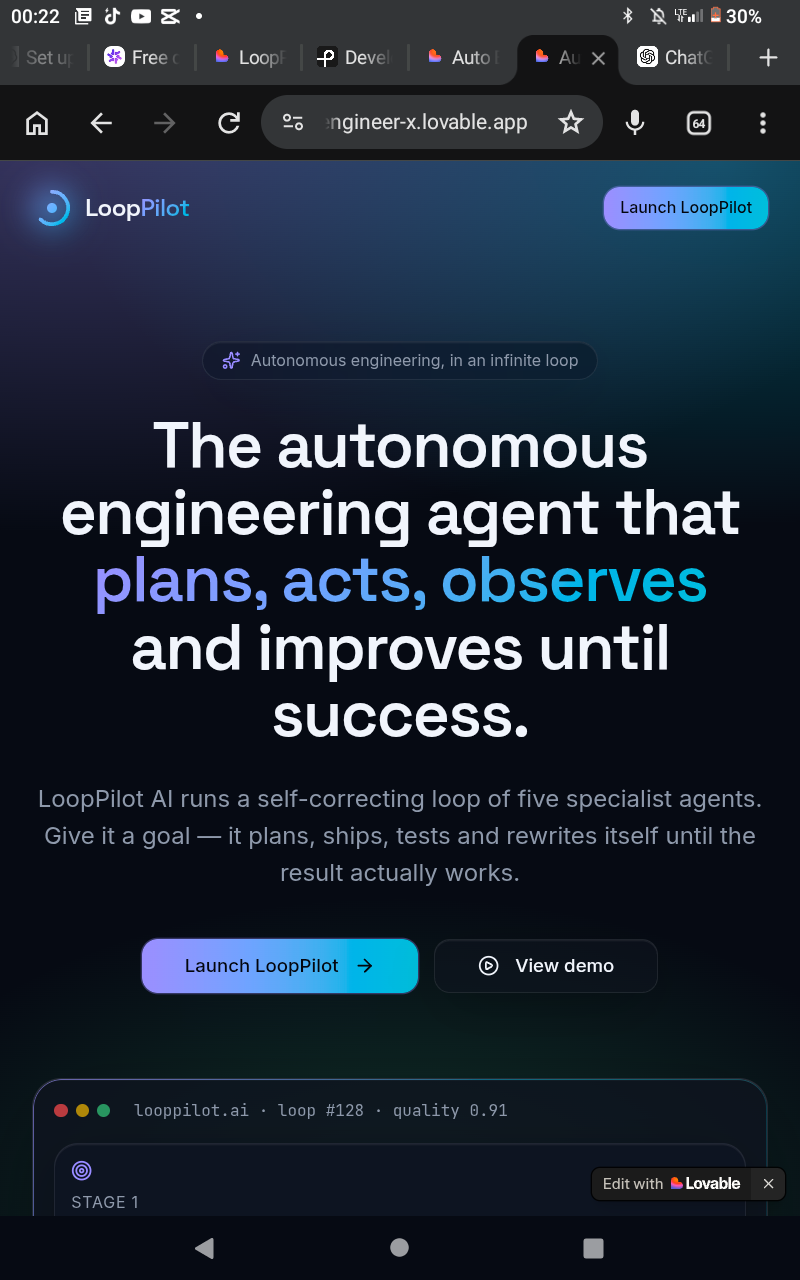
LoopPilot Secure is an autonomous AI engineering platform that uses multiple specialized agents working together in a continuous improvement loop.
A user provides a goal, and the system coordinates:
- 🧠 Planning: Understanding the objective and creating an execution strategy.
- 💻 Building: Performing development tasks based on the plan.
- 🧪 Testing: Evaluating results and identifying issues.
- 🔍 Reviewing: Analyzing quality and suggesting improvements.
- 📈 Optimizing: Deciding the next action to improve outcomes.
The key innovation is the integration of a security-first approach. Every autonomous action is evaluated through a zero-trust authorization layer, ensuring that AI agents can operate independently while still following controlled permissions.
How We Built It
We designed LoopPilot Secure around an agent-based architecture.
The workflow consists of:
- A user submits a high-level engineering goal.
- The Planner Agent converts the goal into actionable steps.
- Other agents execute, evaluate, and improve the solution.
- Security checks validate whether actions are allowed.
- The Reflection Journal records decisions, iterations, and improvements.
The interface was built to make the autonomous process understandable through dashboards, timelines, agent status cards, and execution reports.
Challenges We Faced
Building an autonomous AI workflow introduced several challenges:
Creating a Realistic Agent Loop
One challenge was designing a system where agents do more than produce outputs. The workflow needed to demonstrate planning, execution, feedback, and improvement as a continuous process.
Balancing Autonomy and Control
A major challenge was answering the question:
«"How much freedom should an AI agent have?"»
Too many restrictions reduce usefulness, while unlimited access creates security risks. This led us to focus on zero-trust authorization as a core part of the design.
Making Complex AI Understandable
Another challenge was presenting autonomous behavior clearly. AI decision-making can feel like a black box, so we created transparent logs, timelines, and reflection records to show how the system progresses.
What We Learned
Through building LoopPilot Secure, we learned that the future of AI is not only about making systems more powerful. It is also about making them more trustworthy.
We learned the importance of:
- Designing AI systems with security from the beginning.
- Creating transparent workflows that users can understand.
- Building focused solutions instead of adding unnecessary complexity.
- Treating AI agents as systems that need governance, not just intelligence.
Future Vision
LoopPilot Secure represents our vision of a future where autonomous AI agents can become reliable engineering partners.
The goal is not to replace human creativity, but to amplify it by allowing AI systems to handle repetitive engineering processes while humans focus on higher-level decisions, innovation, and direction.
Autonomous intelligence should not only be capable. It should be trustworthy.# Inspiration
What it does
How we built it
Challenges we ran into
Accomplishments that we're proud of
What we learned
What's next for Auto Engineer XLoopPilot
Built With
- chatgpt
- deepseek
- lovable


Log in or sign up for Devpost to join the conversation.