

Inspiration
Children with autism often struggle with recognizing and interpreting emotional cues from others, which can make social interaction confusing and stressful. While many therapy solutions exist, they are often inaccessible, non-interactive, or emotionally overwhelming. We wanted to create a gentle, intuitive tool that helps autistic children practice emotional recognition and response in a safe, playful, and personalized environment — a space where learning emotions feels like building in a sandbox.
What it does
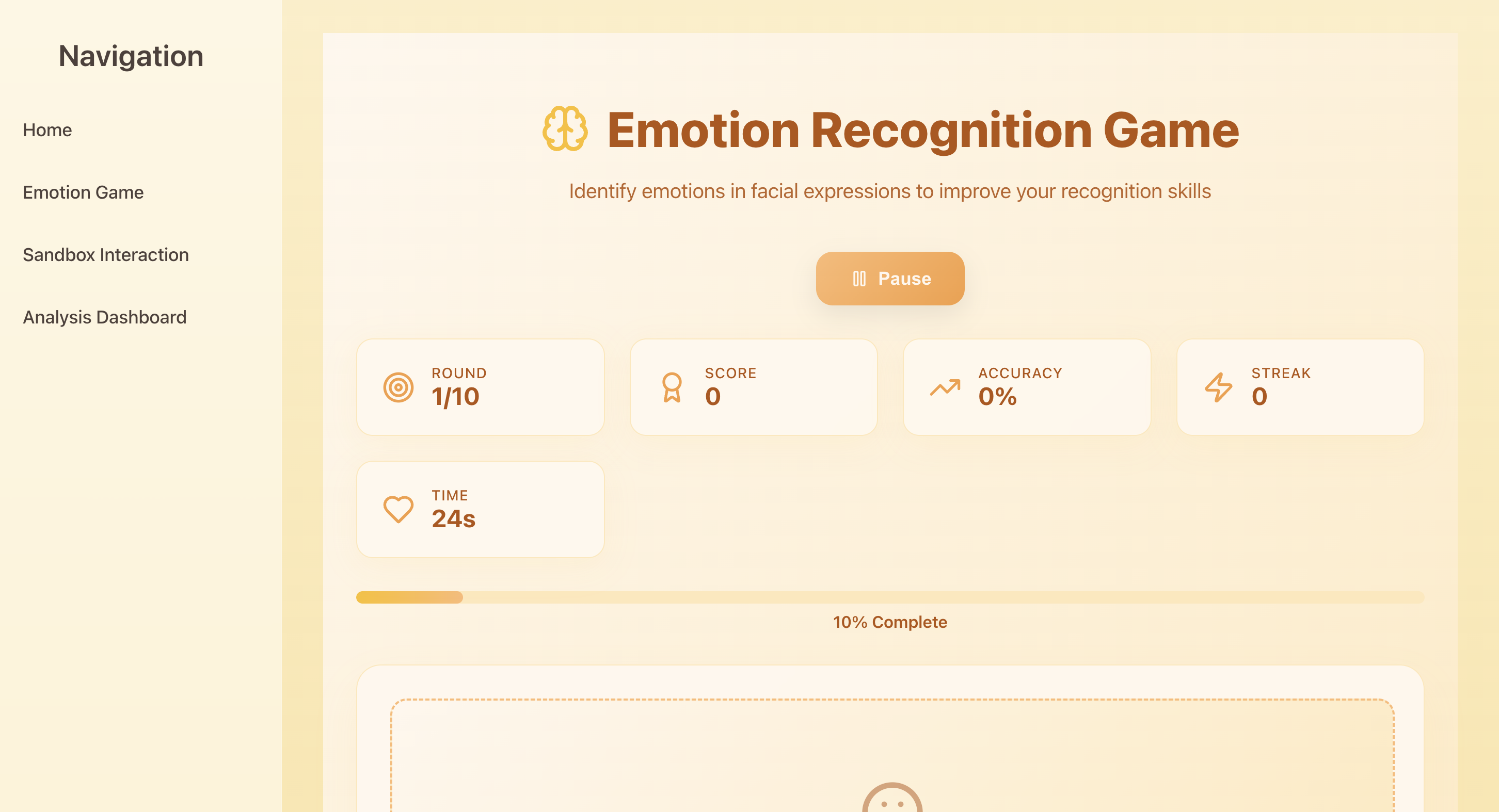
AutiPal is an interactive AI-powered platform designed to support autistic children in understanding and responding to emotions. It combines:
🧩 Visual multiple-choice emotion quizzes featuring expressive real human faces, powered by emotion-aware generative AI.
🏖️ Digital sandbox interface, where children can place characters, objects, and symbols to express or respond to different emotional scenarios.
📊 Personalized feedback dashboard from professional AI agent for parents and educators, comparing the child’s responses to typical developmental models and tracking improvement over time.
How we built it
We leveraged starGAN (https://arxiv.org/abs/1711.09020) to generate human faces with different facial expressions, and LLM agent to provide personalized professional feedback and analysis.
Challenges we ran into
Designing an interface that is both engaging and non-overstimulating for neurodiverse users.
Creating a feedback mechanism that is informative without being judgmental or discouraging.
Balancing real-time AI processing (emotion recognition) with lightweight frontend performance for mobile devices.
Lack of diverse training data for children's emotional expressions — especially across cultural backgrounds.
Accomplishments that we're proud of
Built a fully functional prototype in 24 hours integrating vision AI, frontend quiz logic, and backend analytics.
Created a unique radar-based visualization to analyze users’ emotional recognition patterns.
What we learned
- How to integrate multimodal AI in a real-time educational setting.
- The importance of accessibility and emotional sensitivity in UX design, especially for neurodiverse populations.
- That emotion AI is not just a tech novelty — it can truly empower learning and empathy.
What's next for AutiPal - AI for Autistic Children
We aim to expand the toolbox within this application.
Built With
- cursor
- flask
- stargan

Log in or sign up for Devpost to join the conversation.