-
-
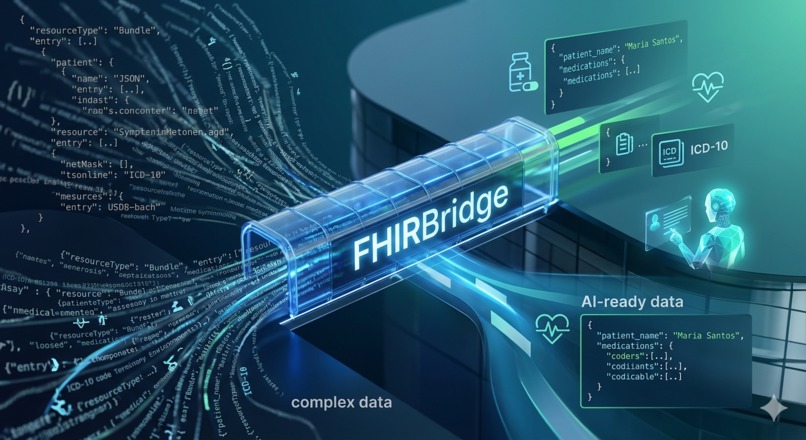
FHIRBridge
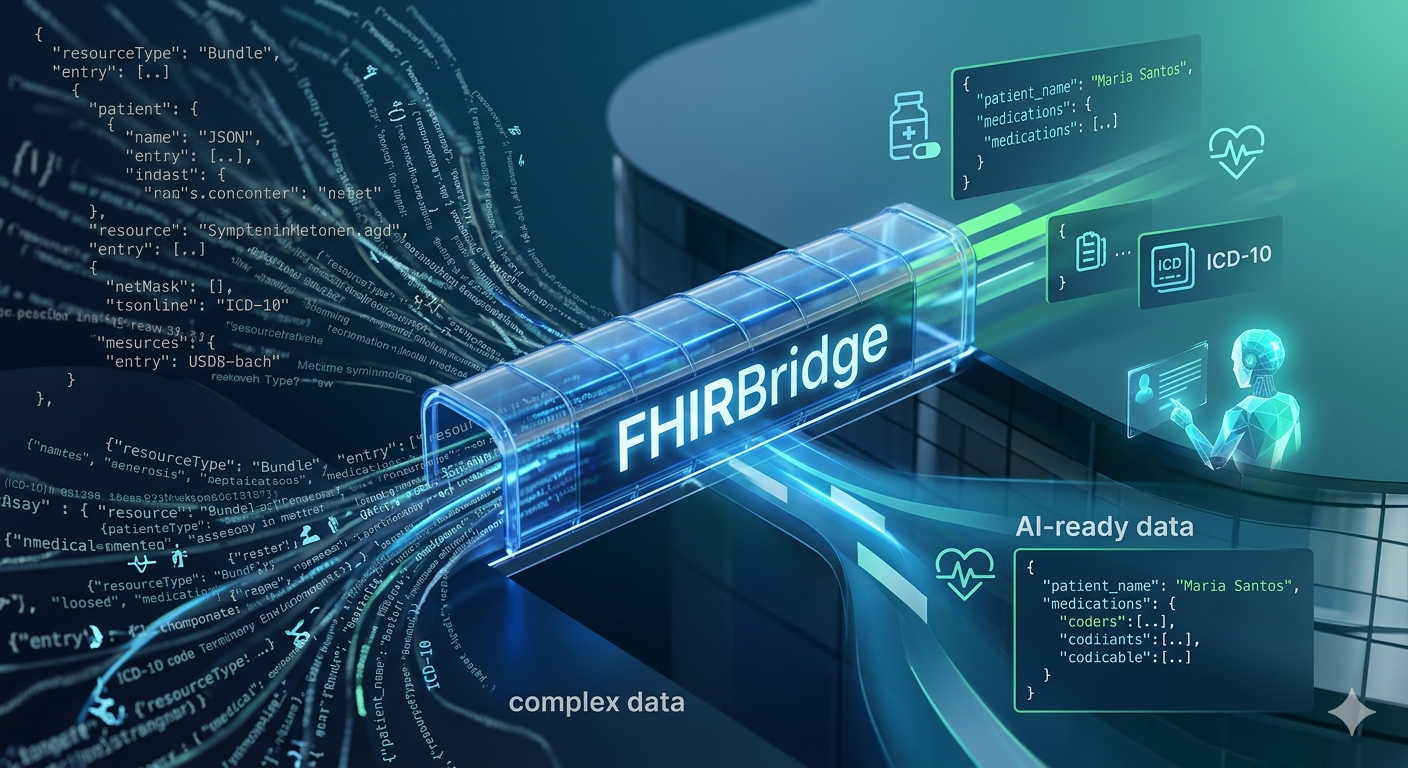
FHIRBridge - About the Project (Devpost Submission)
Inspiration
Healthcare AI has a "last mile problem". While large language models can reason about clinical scenarios, they lack access to the actual patient data needed to be useful. Every healthcare AI developer faces the same challenge: building custom integrations to Electronic Health Record (EHR) systems.
Looking at the current landscape, I saw dozens of specialized healthcare agents being built (prior authorization, clinical trial matching, medication safety), but every single one was rebuilding the same FHIR integration from scratch. This is inefficient and slows innovation.
The FHIR (Fast Healthcare Interoperability Resources) standard was designed to solve interoperability—but FHIR APIs are notoriously complex. A single patient medication list can return 500+ lines of nested JSON. Parsing references, handling pagination, managing OAuth tokens, and dealing with vendor-specific quirks means weeks of development work for each new agent.
I realized that if we want an ecosystem of healthcare AI agents, we need a shared infrastructure layer. Instead of every developer building their own FHIR integration, what if we had a production-ready MCP server that any agent could use?
FHIRBridge is not another specialized clinical app—it's the data access layer that all healthcare agents can build on. Just like PostgreSQL for databases or Stripe for payments, FHIRBridge provides the infrastructure so developers can focus on clinical workflows, not data plumbing.
That's how FHIRBridge was born.
What It Does
FHIRBridge is a Model Context Protocol (MCP) server that exposes 11 production-ready tools for accessing FHIR R4 patient data—the most comprehensive FHIR toolkit in the Agents Assemble hackathon:
Patient Information
get_patient_demographics- Basic patient info (name, DOB, gender, contact, identifiers)search_patients- Search by demographics (name, DOB, identifier, gender)
Clinical Data
get_patient_conditions- Diagnoses with ICD-10 codesget_medication_list- Medications with dosing and frequencyget_lab_results- Lab results with LOINC codes and reference rangesget_allergies- Allergies and intolerancesget_vital_signs- BP, HR, temperature, respiratory rate, O2 saturation, BMI
Care History
get_encounters- Visit/encounter historyget_procedures- Procedure history with CPT codes
Analysis
get_comprehensive_summary- Complete patient summary combining all data sourcescheck_drug_interactions- Real-time drug-drug interaction checking via NLM RxNav API
All tools implement the SHARP Extension Specs, automatically handling healthcare context (patient_id, fhir_server_url, fhir_access_token) so agents can focus on clinical logic rather than infrastructure.
Why This Matters
Unlike specialized MCP servers built for one clinical use case, FHIRBridge is reusable infrastructure. Want to build a prior authorization agent? Use FHIRBridge. Clinical trial matcher? Use FHIRBridge. Medication safety checker? Use FHIRBridge.
Proven in production: I built MedSync, a medication reconciliation agent, in 2 days using FHIRBridge. It successfully detected life-threatening drug contraindications that could have killed the demo patient. Without FHIRBridge, that integration alone would have taken 2 weeks.
How I Built It
Architecture
┌─────────────────┐
│   AI Agent      │ (Any agent on Prompt Opinion)
└────────┬────────┘
         │ MCP JSON-RPC 2.0
         │
┌────────▼────────┐
│  FHIRBridge     │ (Python MCP Server)
│  - 11 Tools     │
│  - SHARP Ctx    │
│  - Parsers      │
└────────┬────────┘
         │ FHIR R4 REST API
         │
┌────────▼────────┐
│  FHIR Server    │ (HAPI, Epic, Cerner, etc.)
│  - Patient data │
│  - OAuth2 auth  │
└─────────────────┘
Technology Stack
- Python 3.12 - Core language
- MCP SDK (v1.26.0) - Model Context Protocol implementation
- Starlette + Uvicorn - HTTP server framework (JSON-RPC over HTTP)
- httpx - Async HTTP client for FHIR API calls
- Pydantic - Data validation and settings management
Key Components
1. FHIR Client (src/fhir/client.py)
async with FHIRClient(base_url=fhir_server_url,
                      access_token=token) as client:
    patient = await client.get_resource("Patient", patient_id)
Handles OAuth2 authentication, error handling (404, 401, 403, 5xx), and network resilience.
2. Resource Parsers (src/fhir/parsers.py)
The most critical piece. FHIR JSON is extremely verbose:
// FHIR raw output (500+ lines)
{
  "resourceType": "Bundle",
  "entry": [{
    "resource": {
      "resourceType": "MedicationRequest",
      "medicationCodeableConcept": {
        "coding": [{
          "system": "http://www.nlm.nih.gov/research/umls/rxnorm",
          "code": "206765",
          "display": "Lisinopril 10 MG Oral Tablet"
        }]
      },
      "dosageInstruction": [{
        "timing": {
          "repeat": {
            "frequency": 1,
            "period": 1,
            "periodUnit": "d"
          }
        }
      }]
      // ... 20+ more nested fields
    }
  }]
}
FHIRBridge parses this into clean, LLM-friendly JSON:
{
  "success": true,
  "count": 1,
  "medications": [{
    "medication_name": "Lisinopril 10 MG Oral Tablet",
    "rxnorm_code": "206765",
    "dosage": "1 tablet daily",
    "status": "active"
  }]
}
This 95% reduction in verbosity makes it practical for AI agents to process medication lists without hitting token limits.
3. SHARP Context Handler (src/sharp/context.py)
Extracts and validates healthcare context from every tool call:
context = extract_sharp_context(arguments)
# Returns: {patient_id, fhir_server_url, fhir_access_token}
This enables multi-tenancy and security—each tool call operates on the patient/server specified by the calling agent.
4. Pagination Handler (src/fhir/pagination.py)
FHIR search results return "Bundles" with pagination links. FHIRBridge automatically follows Bundle.link[relation="next"] to retrieve all results, respecting safety limits.
5. HTTP Transport (src/http_server.py)
Initially, I built this for stdio transport (standard MCP). But Prompt Opinion uses JSON-RPC over HTTP, so I had to implement:
- POST endpoint for JSON-RPC messages
- GET endpoint for SSE (Server-Sent Events) streaming
- Protocol negotiation (
initialize,tools/list,tools/call) - Notification handling (
notifications/initialized)
Challenges I Faced
1. FHIR Complexity
FHIR is a beast. A single Patient resource has 50+ optional fields. A MedicationRequest can represent medications in 6 different ways (medicationCodeableConcept, medicationReference, etc.). References are URLs that need to be resolved. Extensions are everywhere.
Solution: I built custom parsers for each resource type, handling all the edge cases. For example, the medication parser checks both medicationCodeableConcept and medicationReference, resolves the reference if needed, extracts the first matching coding from the preferred code system (RxNorm > SNOMED > text), and formats dosing instructions into human-readable strings.
2. MCP HTTP Transport Documentation
The MCP SDK documentation focuses heavily on stdio transport (pipes). HTTP transport documentation is sparse. I had to:
- Reverse-engineer the JSON-RPC message format from Prompt Opinion's requests
- Figure out that POST and GET endpoints serve different purposes
- Handle notifications (which have no
idfield and expect no response) - Implement SSE streaming for real-time communication
Solution: I captured Prompt Opinion's actual requests in the server logs and built the protocol handler by example. Trial and error, but it worked.
3. SHARP Context Propagation
For security and multi-tenancy, every tool call needs to know:
- Which patient? (
patient_id) - Which FHIR server? (
fhir_server_url) - Authentication? (
fhir_access_token)
SHARP Extension Specs define how to pass this context, but implementing it correctly required:
- Extracting context from tool arguments (optional parameters)
- Validating that required fields are present
- Defaulting to environment variables for testing
- Passing context through to the FHIR client
Solution: Created a dedicated extract_sharp_context() function that every tool calls first. This centralizes validation and provides good error messages.
4. Bundle Pagination
FHIR search results are paginated. A patient might have 100 lab results, but the server returns 20 at a time with a next link. If you don't follow the links, you get incomplete data.
Solution: Built an async pagination handler that follows next links recursively, with a safety limit (max 10 pages) to prevent infinite loops.
5. Testing with Real FHIR Servers
I needed a FHIR server to test against. Options:
- Local HAPI FHIR server - Complex setup
- Epic/Cerner sandbox - Requires OAuth dance, vendor-specific quirks
- Public HAPI server - Perfect for testing, but data is ephemeral
Solution: Used the public HAPI FHIR test server (https://hapi.fhir.org/baseR4). I created a demo patient (Maria Santos) with realistic clinical data and planted medication safety issues to test with MedSync.
6. Drug Interaction Checking
I wanted real drug interaction data, not just mock responses. The NLM provides a free RxNav API, but:
- Takes medication names OR RxNorm codes (not both)
- Returns different JSON structures depending on the input
- Rate limits apply
- Requires fuzzy matching (users might say "Aspirin" or "ASA" or "Acetylsalicylic Acid")
Solution: Built a two-phase approach:
- Resolve medication names to RxNorm RxCUIs using
/approximateTermendpoint - Call
/interaction/listwith resolved RxCUIs - Parse the interaction severity and descriptions
What I Learned
Technical Lessons
Standards compliance matters: By strictly following FHIR R4 and SHARP specs, FHIRBridge works with any compliant server (HAPI, Epic, Cerner). No vendor lock-in.
Abstraction is worth the effort: Those parsers were painful to write, but they're the key value-add. Reducing 500 lines of FHIR JSON to 20 lines of clean data makes the difference between "unusable" and "production-ready."
Async Python scales: Using
async/awaitthroughout means FHIRBridge can handle multiple concurrent agent requests without blocking. For a healthcare application serving multiple agents, this is critical.Error handling is half the code: Network failures, 404s, malformed FHIR responses, missing fields—robust error handling is what separates a demo from a product.
Healthcare AI Lessons
Context is everything: In healthcare, you can't just call
get_medications(). You need to know which patient, which server, with what permissions. SHARP context handling is essential.Data quality varies wildly: Some FHIR servers have perfect data. Others have missing codes, empty fields, or inconsistent formatting. Parsers need to be defensive.
Medication reconciliation is AI-perfect: It requires cross-referencing multiple data sources (meds, conditions, encounters, allergies) under time pressure. Perfect use case for LLMs with tool access.
Prompt Opinion Platform Lessons
HTTP transport is production-grade: Unlike stdio (which requires process management), HTTP transport makes MCP servers easy to deploy, monitor, and scale.
Marketplace is key: Publishing to the Marketplace makes tools discoverable. Instead of every agent developer finding and configuring FHIRBridge, they just add it from the Marketplace.
Video demos matter: Judges won't have time to deeply explore every project. A 3-minute video that shows the value proposition is critical.
What's Next for FHIRBridge
Short-term (Next 3 months)
- Add more FHIR resources: Immunizations, CarePlans, DiagnosticReports, DocumentReferences
- Performance optimization: Redis caching layer for frequently-accessed patients
- Monitoring: OpenTelemetry integration for observability
- Write operations: Currently read-only; add create/update tools for care planning
Medium-term (6-12 months)
- FHIR R5 support: Latest FHIR version with improved data models
- Epic/Cerner optimizations: Vendor-specific extensions for better compatibility
- Bulk data export: FHIR
$exportoperation for population health use cases - SMART App Launch: Simpler OAuth flow for EHR integration
Long-term Vision
- FHIRBridge as Healthcare AI Infrastructure: Every healthcare AI agent uses FHIRBridge for data access, just like every web app uses PostgreSQL for databases
- Open source ecosystem: Community-contributed tools for specialized use cases
- Enterprise offering: Hosted FHIRBridge-as-a-Service for healthcare AI companies
- Multi-standard support: Expand beyond FHIR to HL7 v2, X12, CDA
Impact Potential
If FHIRBridge becomes the standard data access layer for healthcare AI:
- Development time: \( \text{Weeks} \rightarrow \text{Minutes} \) to integrate EHR data
- Cost savings: No duplicated integration work across projects
- Innovation velocity: Developers focus on clinical workflows, not FHIR parsing
- Interoperability: All agents speak the same data language
- Quality: Centralized, battle-tested parsers vs. everyone rolling their own
Example: Medication Reconciliation at Scale
With FHIRBridge, I built MedSync (a medication reconciliation agent) in 2 days. Without FHIRBridge, it would have taken 2 weeks just to build the FHIR integration.
If we extrapolate this across the healthcare AI ecosystem:
$$ \text{Time Saved} = N_{\text{agents}} \times (T_{\text{without}} - T_{\text{with}}) $$
Where:
- \( N_{\text{agents}} \) = Number of healthcare AI agents built
- \( T_{\text{without}} \) = Time to build custom FHIR integration (2 weeks)
- \( T_{\text{with}} \) = Time to integrate FHIRBridge (1 hour)
For just 100 healthcare AI projects, FHIRBridge saves:
$$ 100 \times (2 \text{ weeks} - 1 \text{ hour}) \approx 200 \text{ weeks} = 3.8 \text{ developer-years} $$
That's $500,000+ in saved development costs (at $130k avg developer salary).
Try It Yourself
- GitHub: github.com/jamador47/FhirBridge/
- Prompt Opinion Marketplace: Search for "FHIRBridge"
- Demo Patient:
maria-santoson HAPI FHIR test server - Documentation: See README.md for setup instructions
How FHIRBridge Compares
During the hackathon, I reviewed other FHIR-based MCP servers to understand the landscape:
| Server | Tools | Focus | Positioning |
|---|---|---|---|
| FHIRBridge | 11 | General-purpose infrastructure | Platform for any healthcare agent |
| FHIR Healthcare Tools | 7 | Clinical calculations + data access | Similar but less complete |
| Clinical Decision Support | 9 | CDS + risk scoring | Specialized for decision support |
| ClinicalMem | 9 | Persistent memory + conflict detection | Specialized for safety monitoring |
| AuthArmor, AuthPilot, ALICE | 3-7 | Prior authorization only | Single-use-case agents |
| TrialBridge | 7 | Clinical trial matching only | Single-use-case agent |
FHIRBridge's unique advantages:
- Most comprehensive (tied for most tools)
- Only one positioned as reusable infrastructure vs. specialized application
- Production-ready parsers (95% verbosity reduction)
- Real external API integration (NLM RxNav)
- Proven with working demo agent (MedSync) showing it works end-to-end
The vision difference: Other servers solve specific clinical problems. FHIRBridge solves the infrastructure problem so developers can solve any clinical problem.
Acknowledgments
- HAPI FHIR Project: For providing the public test server
- Anthropic: For the MCP SDK and documentation
- NLM RxNav Team: For the free drug interaction API
- HL7/FHIR Community: For creating the standard that makes this possible
- Prompt Opinion: For organizing this hackathon and building the platform

Log in or sign up for Devpost to join the conversation.