-
-
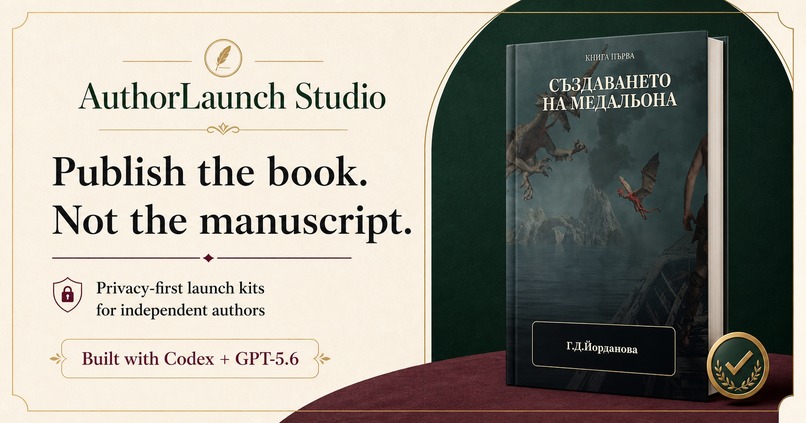
AuthorLaunch Studio — privacy-first book-launch workflow.
Inspiration
Independent authors often have to be their own publisher, web designer, SEO specialist, translator, and social-media manager. The work is repetitive, details such as price and order contact can drift between channels, and generic AI tools may confidently invent an ISBN, publisher, review, or award that the author never supplied. Uploading an unpublished manuscript to solve a marketing problem is also an unnecessary privacy risk.
We wanted to build a practical assistant for the author who does everything alone: useful enough to remove launch work, strict enough to protect the truth, and portable enough that the result does not disappear with an AI subscription.
What it does
AuthorLaunch Studio is a privacy-first Codex workflow that turns one author-approved cover and seven verified facts — title, author, genre, short description, price, currency, and order contact — into a coherent launch kit. It never requests or processes the manuscript.
The portable pack contains:
- a responsive catalog page;
- SEO title and description;
- Schema.org
BookandOfferJSON-LD; - accessible cover alt text;
- Facebook and Instagram drafts;
- an author review checklist; and
- a manifest with a stable fact ledger, deliberate omissions, warnings, and SHA-256 hashes for the input and generated files.
The Codex skill can also draft channel-specific copy and review-labelled translations under the same grounding rules. Missing details are omitted or requested instead of guessed, and nothing is published without author approval.
In the working demo, judges can edit the seven facts and inspect the affected Catalog, SEO, Social, and Manifest views. The exported page and launch files remain usable without Codex or an AI subscription; only new AI-assisted drafting or translation requires Codex access.
How we built it
We used Codex with GPT-5.6 to design and implement three connected layers:
- A reusable Codex plugin and skill. Its closed-world policy preserves title, author, price, currency, and order contact exactly; forbids unsupported publishing and sales claims; labels translations for human review; and requires explicit approval before publishing.
- A dependency-free Python validation and export layer. The input gate rejects manuscript fields, unconfirmed cover rights, malformed prices and locales, and unsafe order links. The renderer escapes content and creates eight portable launch artifacts. The pack validator recomputes hashes, checks required files, and confirms that core supplied facts remain present.
- A polished TypeScript/React prototype. Built with vinext and deployed on OpenAI Sites, it makes the source-of-truth model visible instead of hiding it behind a chat box.
Automated tests cover manuscript rejection, unsafe URL rejection, deterministic render-and-hash validation, and server-rendered product output.
Challenges we ran into
The hardest problem was allowing useful creative drafting without turning fluent prose into a source of fictional facts. We solved this by separating author-supplied facts from generated wording, assigning stable IDs to the facts, preserving critical values verbatim, and making omissions visible. The deterministic layer verifies structure, required facts, safe links, files, and hashes; human review remains explicit for creative wording and translations.
The second challenge was portability. Rather than making the author dependent on a permanent AI session, we designed the final catalog and launch materials as ordinary files that can be hosted, inspected, and reused anywhere.
Accomplishments that we're proud of
- The manuscript is not merely optional: manuscript-named fields are rejected at the input gate.
- A single fact sheet keeps the affected catalog, SEO, structured-data, social, and traceability views consistent.
- Unsupported ISBN, publisher, page-count, availability, ratings, and sales claims are omitted when they are not supplied.
- Unsafe URL schemes are rejected and generated HTML is escaped.
- The offline renderer and validators require no paid API and no third-party Python packages.
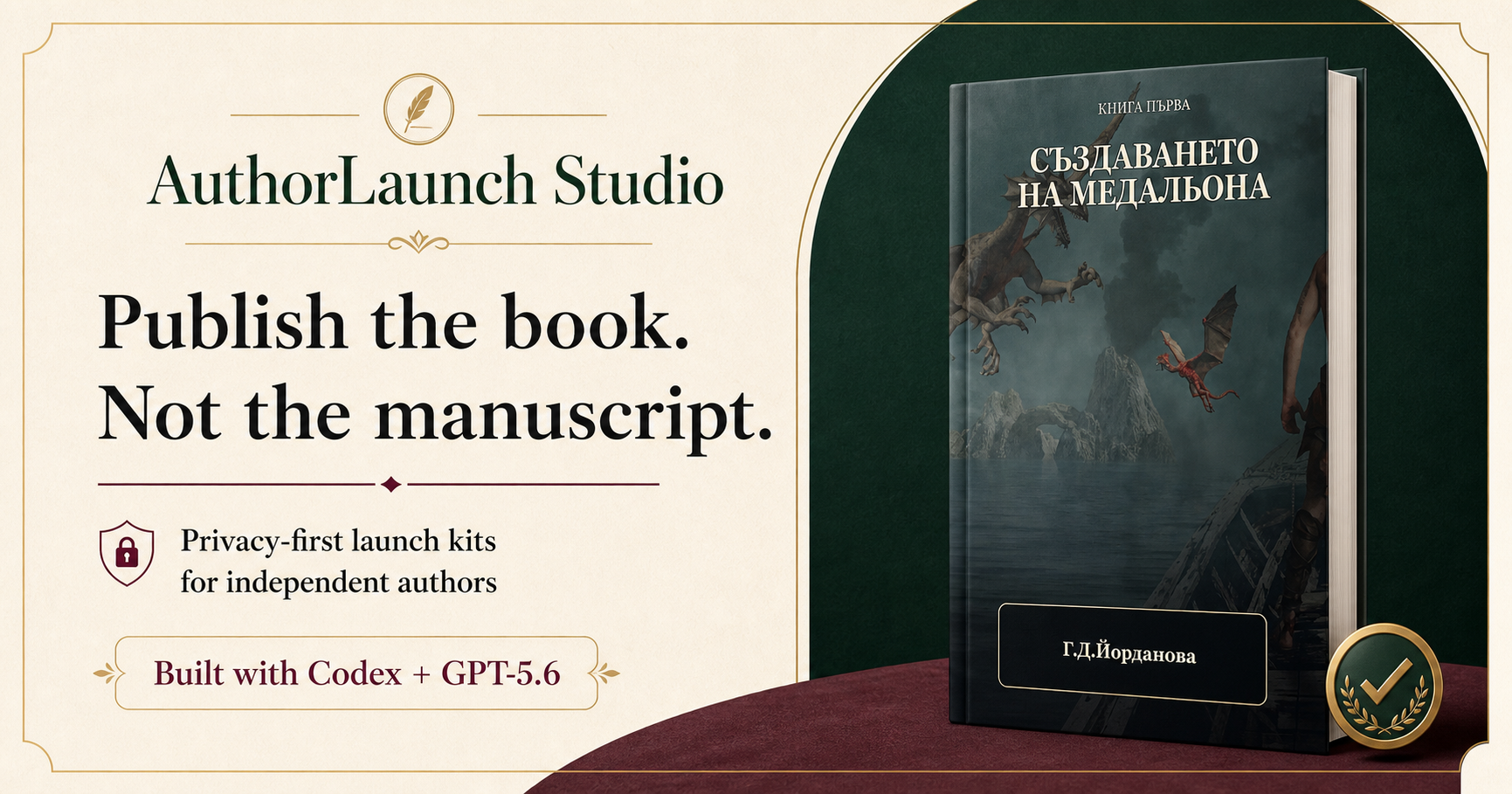
- The public prototype uses a real, author-owned Bulgarian book cover and metadata as its sample while keeping the software reusable for any author.
Why it matters
For an under-resourced author, the bottleneck after writing is often dozens of small launch tasks rather than one large task. AuthorLaunch Studio replaces that fragmented workflow with one auditable source of truth while minimizing exposure of unpublished work.
The core idea is not another unlimited copy generator. It is a useful AI assistant inside a deterministic trust boundary: creative where it helps, strict where facts and author control matter.
What we learned
Trust improves when an AI product shows its source of truth, omissions, and limits. Independent authors do not only need more content; they need consistency, ownership, and a safe path from draft to approval.
What's next
- locale-specific export packs and more human-review workflows;
- author-controlled tone presets;
- ZIP export and adapters for additional catalog platforms;
- deeper accessibility and SEO checks; and
- collaboration and approval flows for small publishers.
Built With
- codex
- gpt-5.6
- json-ld
- next.js
- openai-sites
- python
- react
- schema.org
- typescript
- vinext

Log in or sign up for Devpost to join the conversation.