-
-
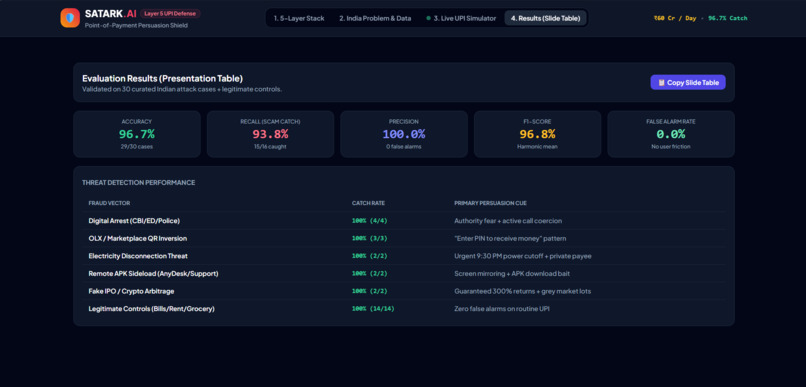
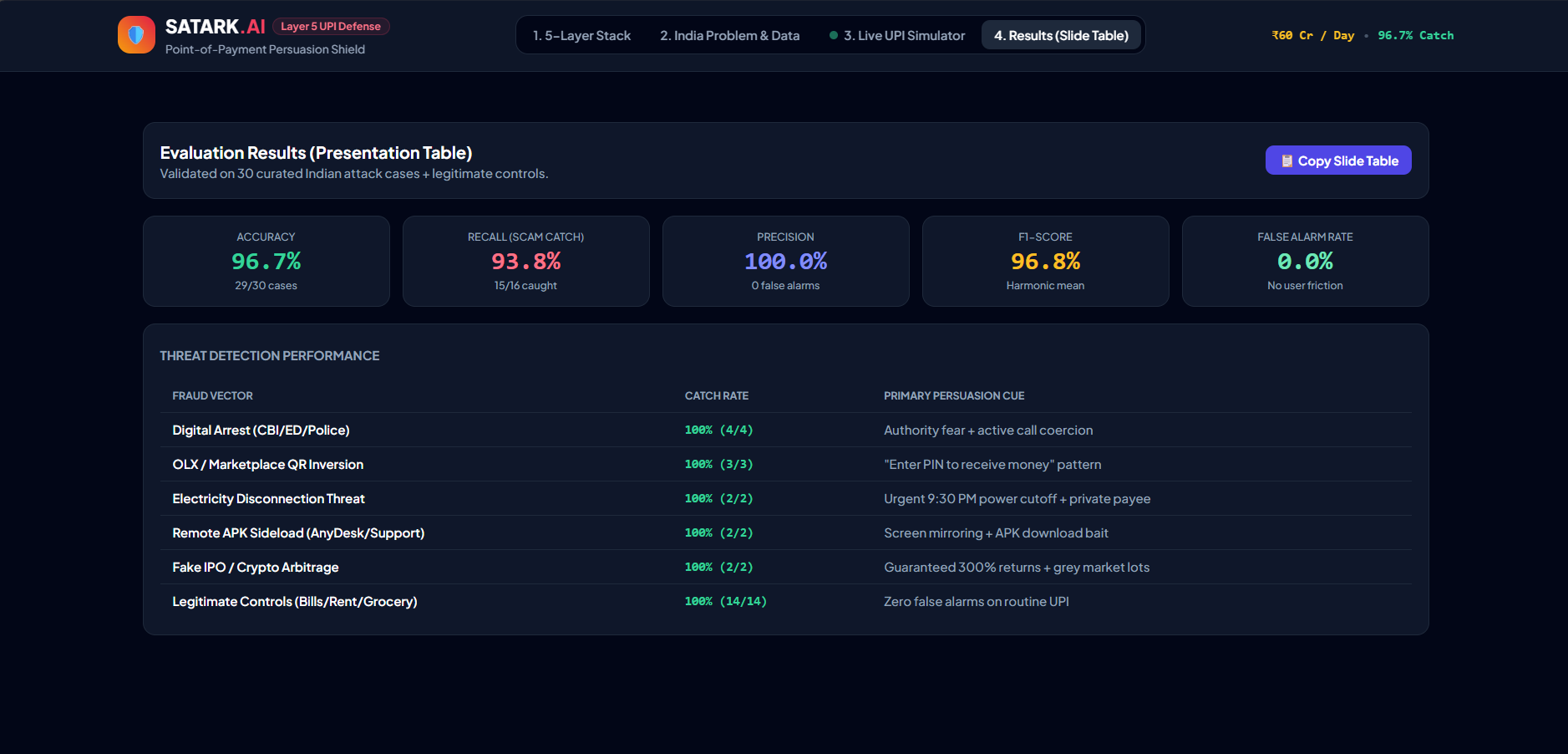
Presents the system's fraud detection results, risk analysis, and effectiveness across different simulated scam scenarios.
-
-
-
-
-
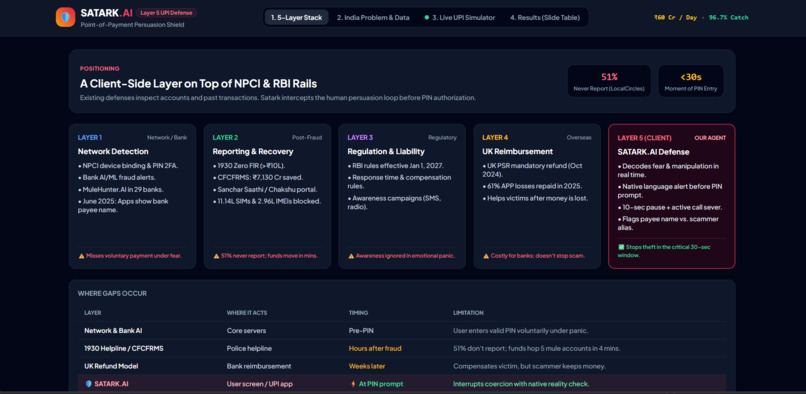
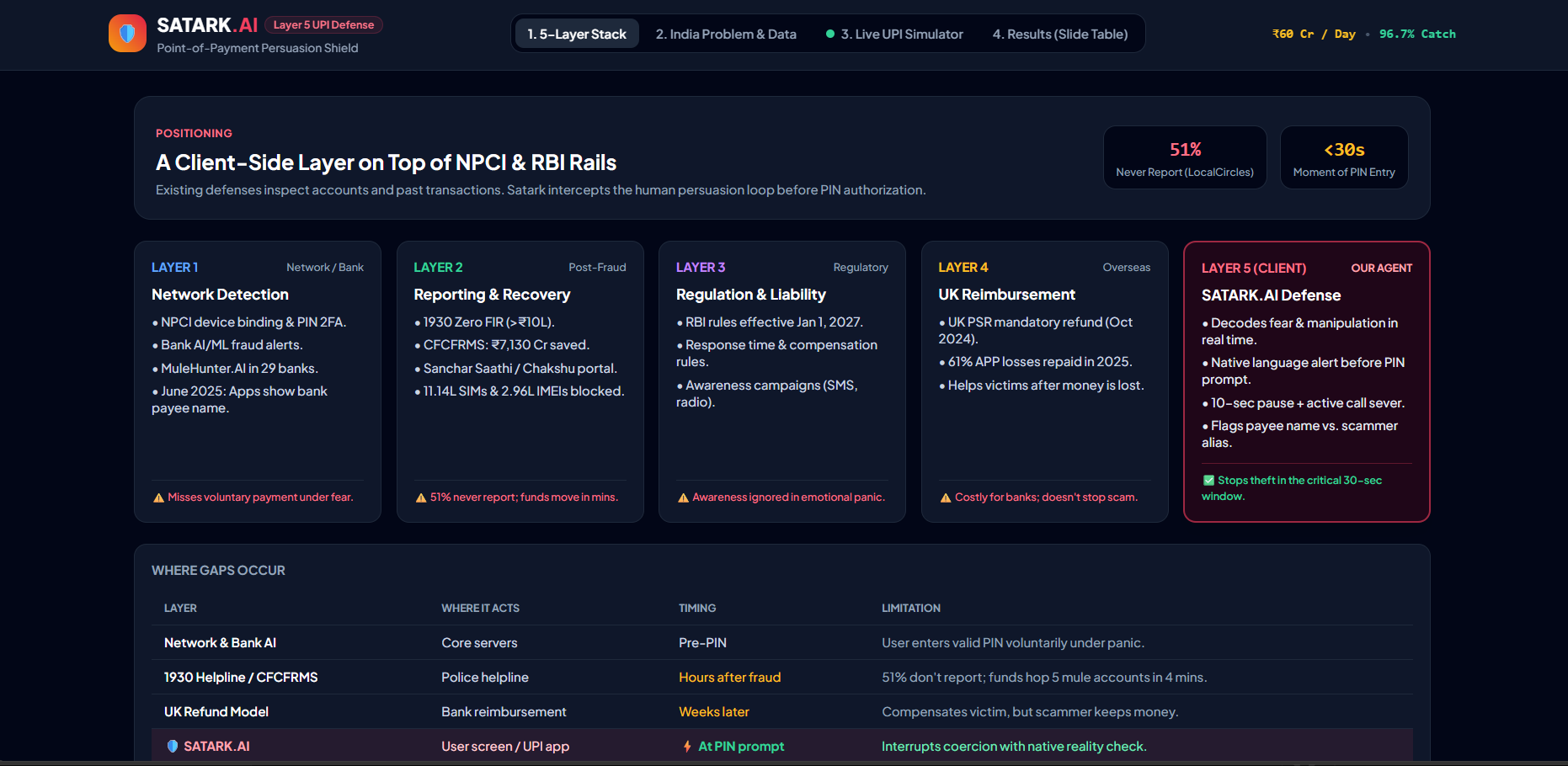
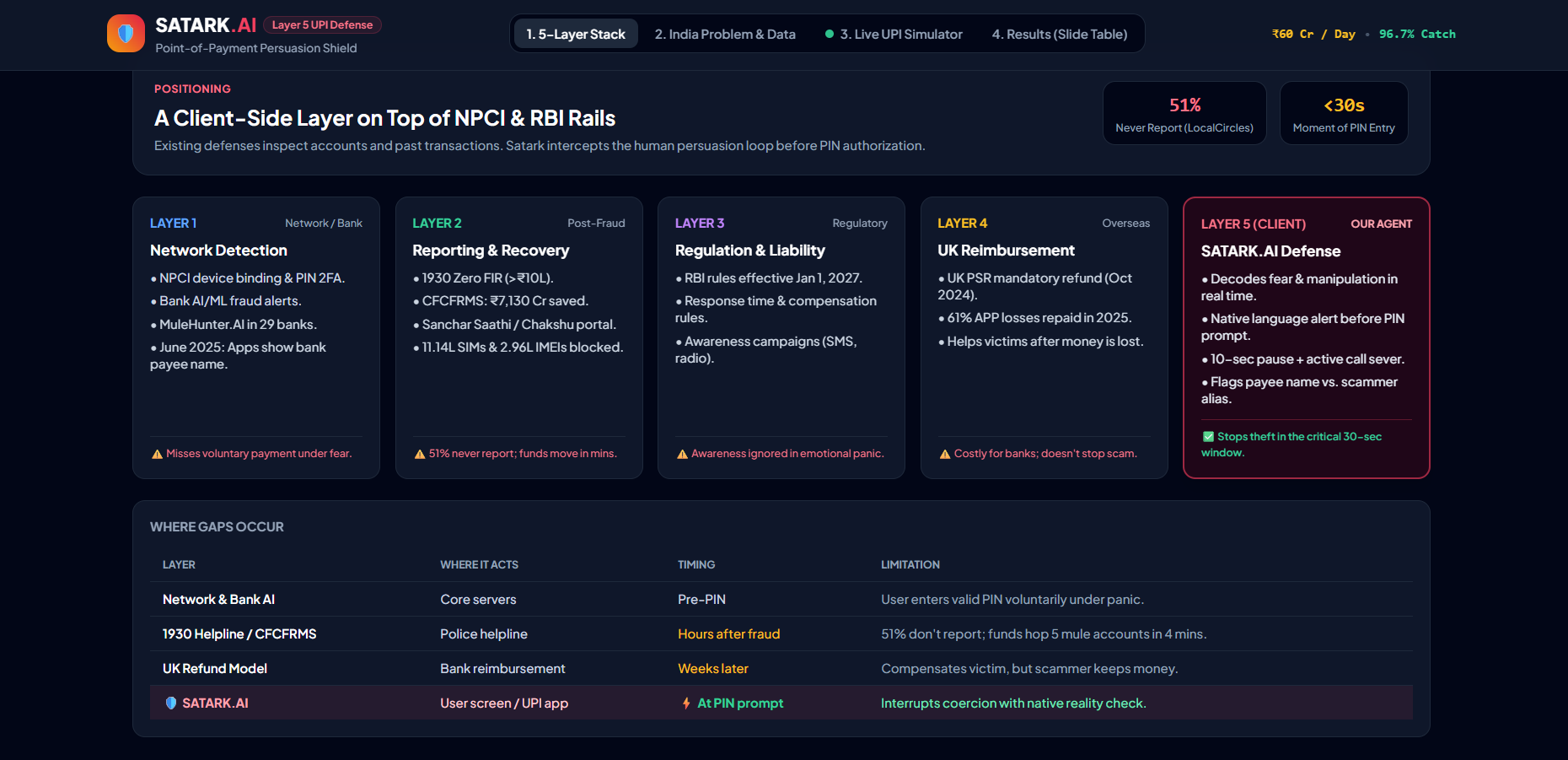
SATARK.AI introduces a five-layer UPI fraud protection system that detects social engineering before PIN authorization.
-
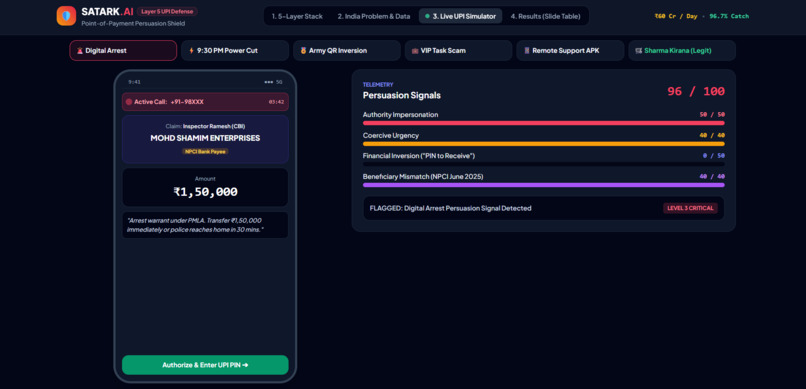
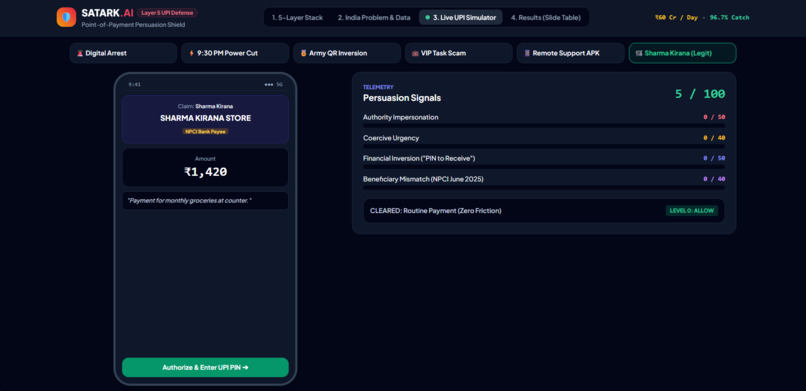
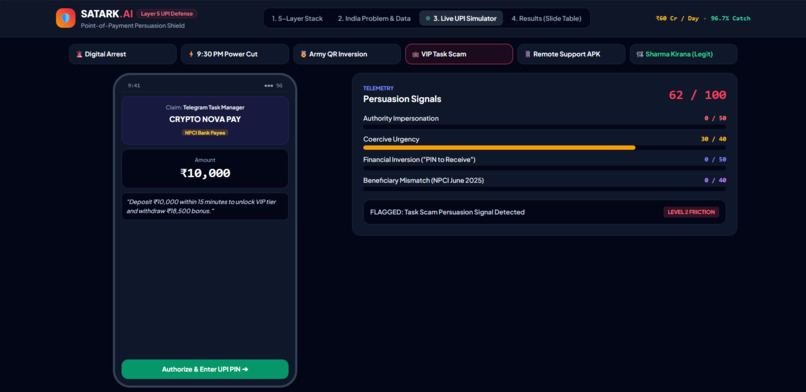
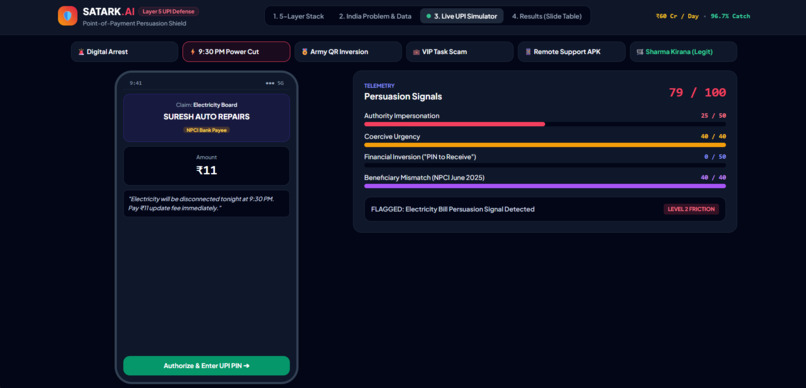
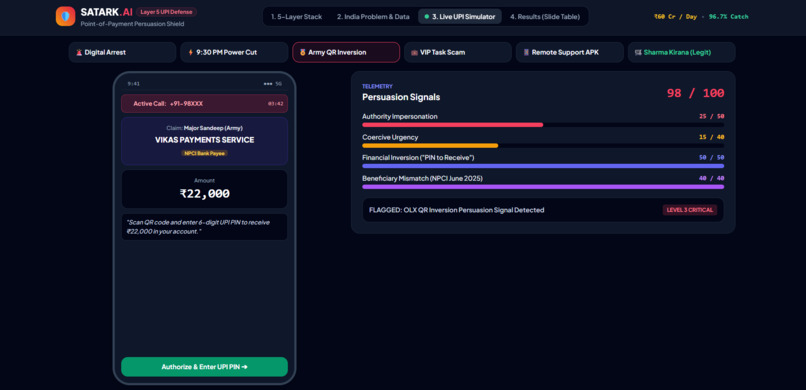
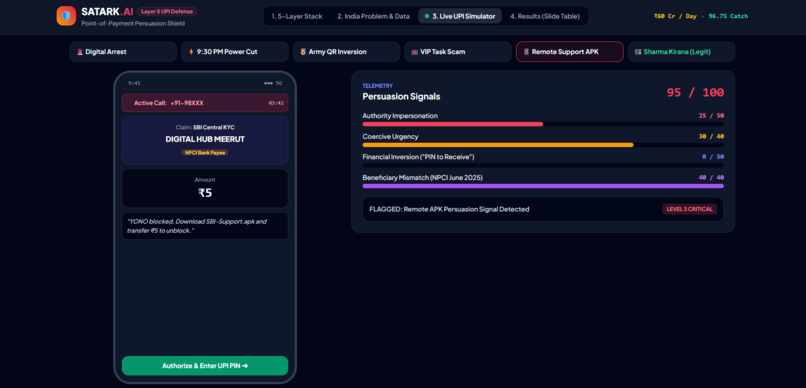
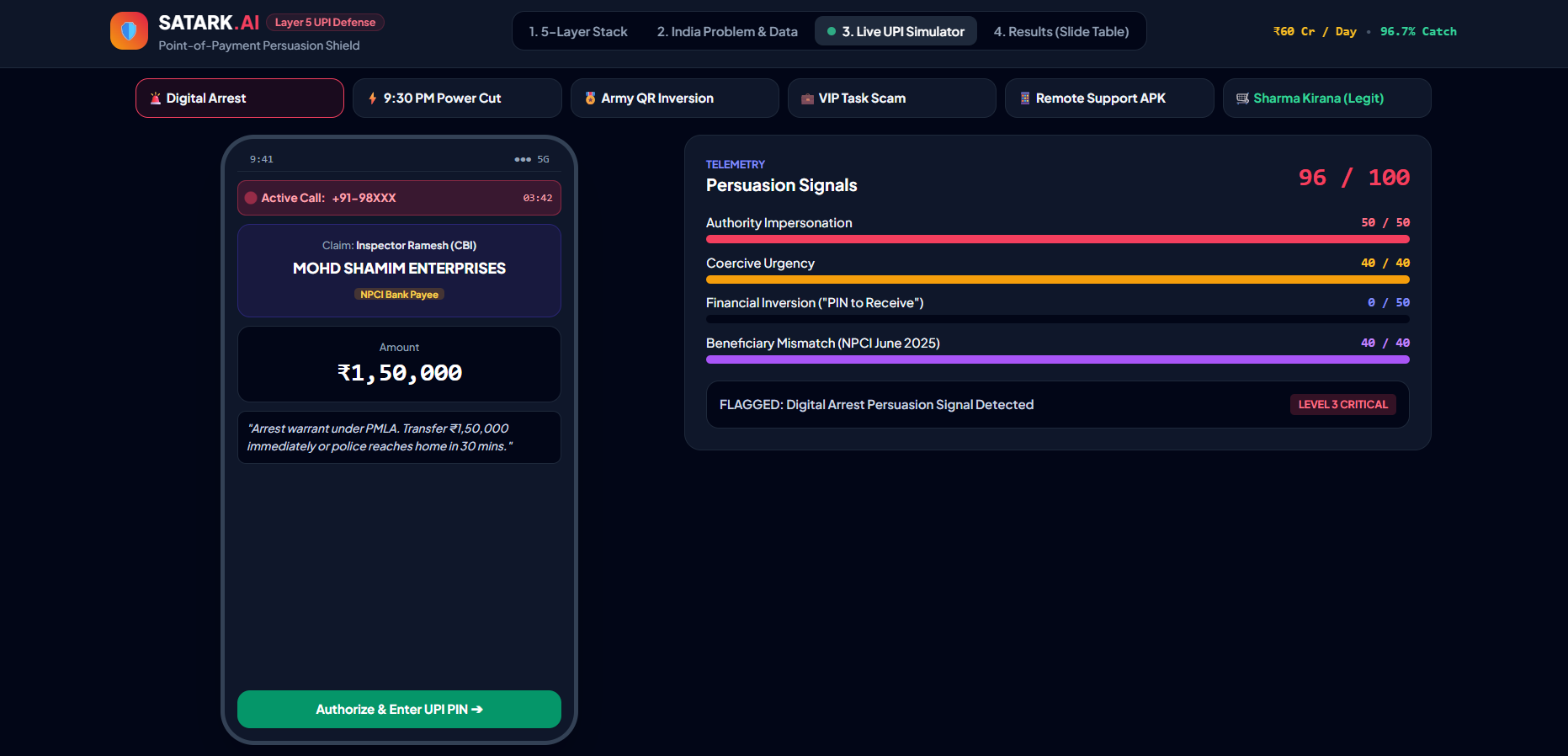
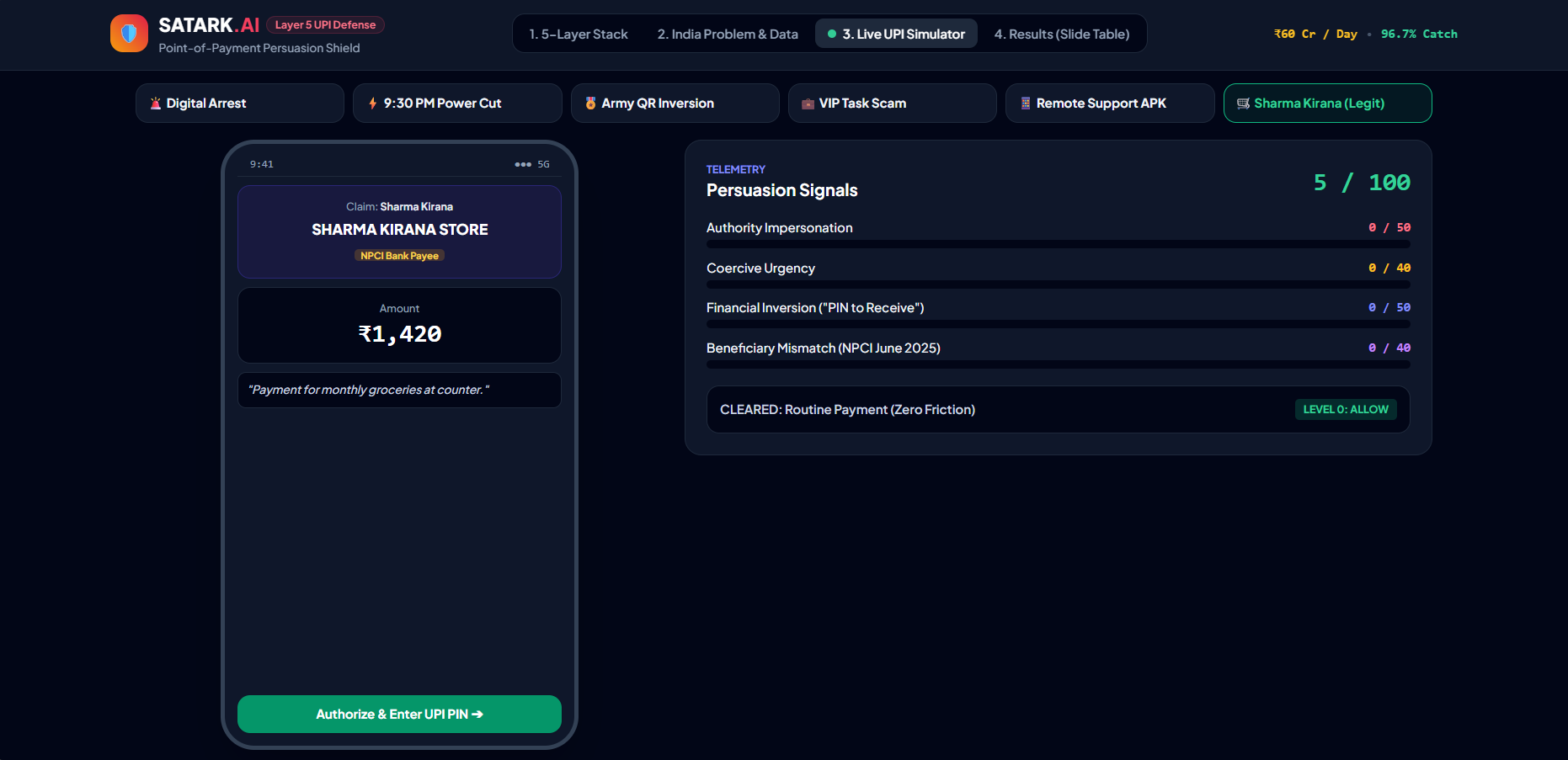
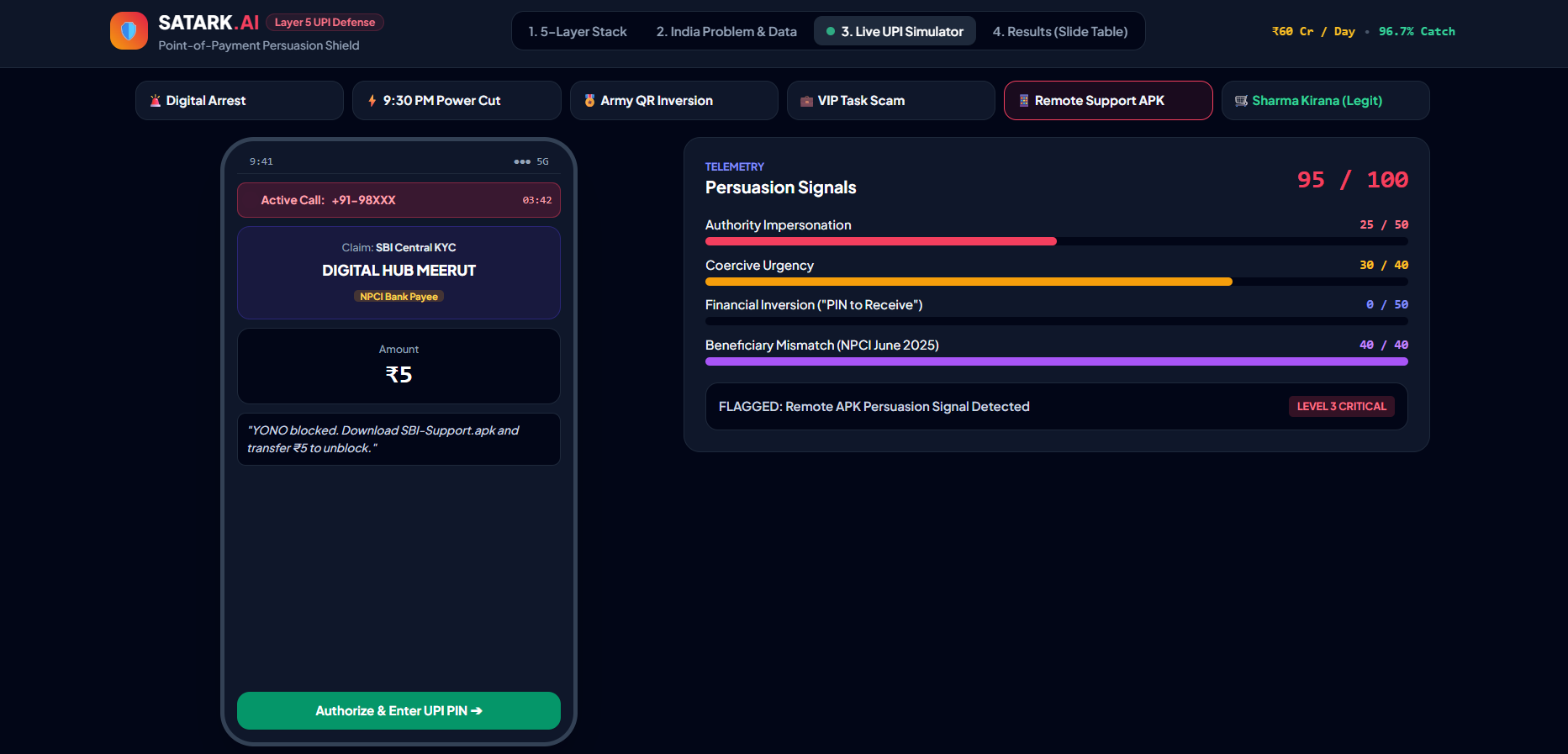
Demonstrates real-time detection of digital arrest, electricity bill, QR code, and other UPI fraud scenarios.
-
-
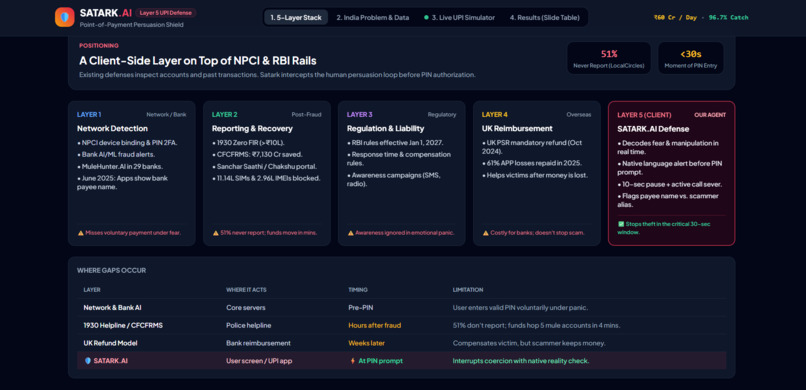
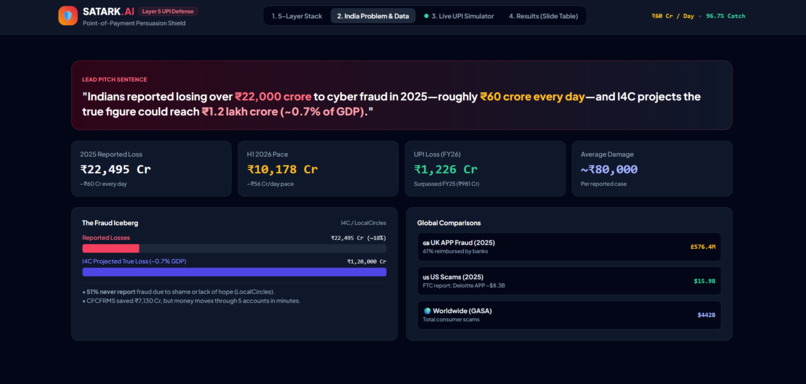
Highlights India's growing cyber fraud losses, UPI-related scams, underreporting, and the need for preventive protection.
-
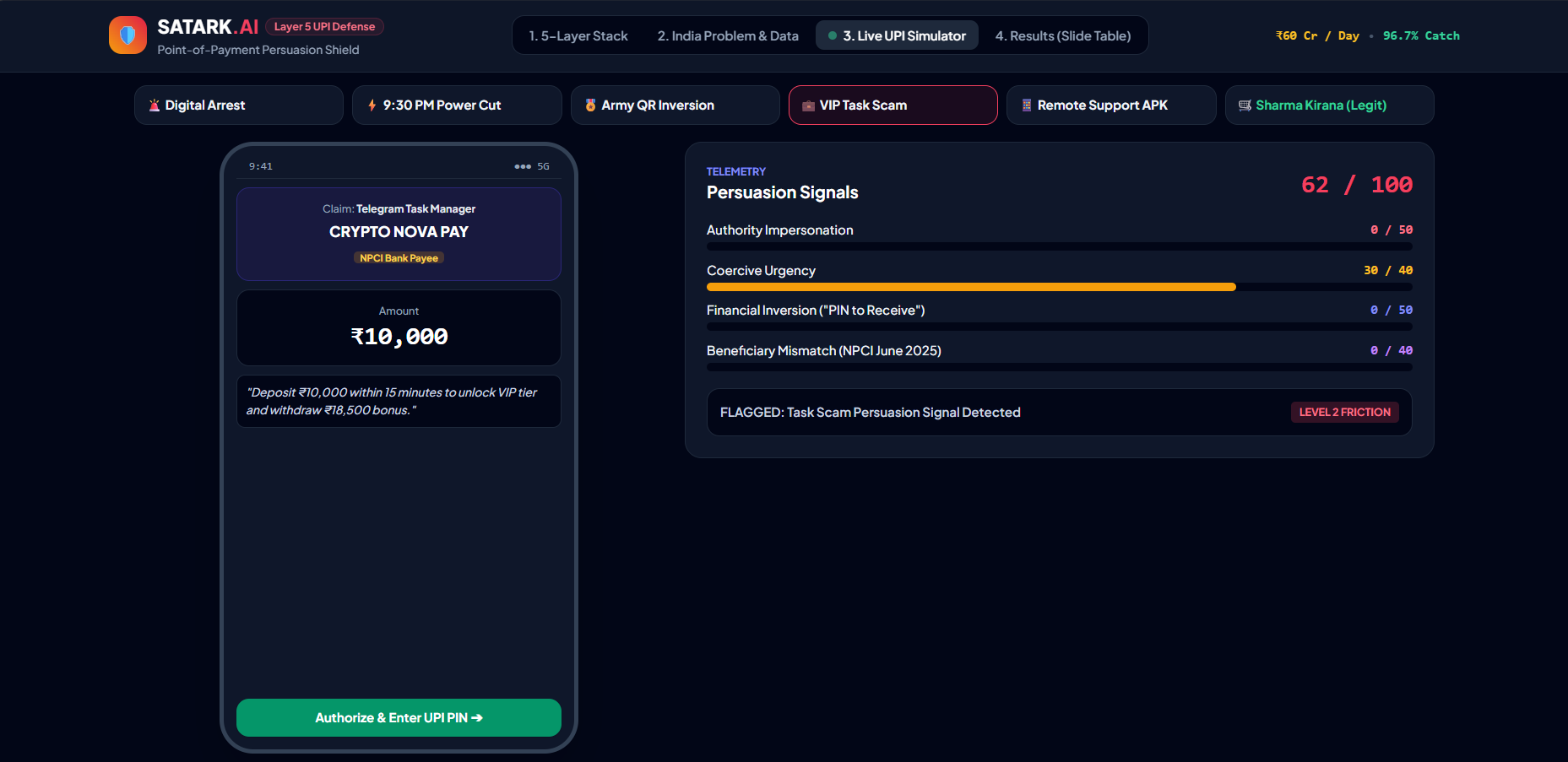
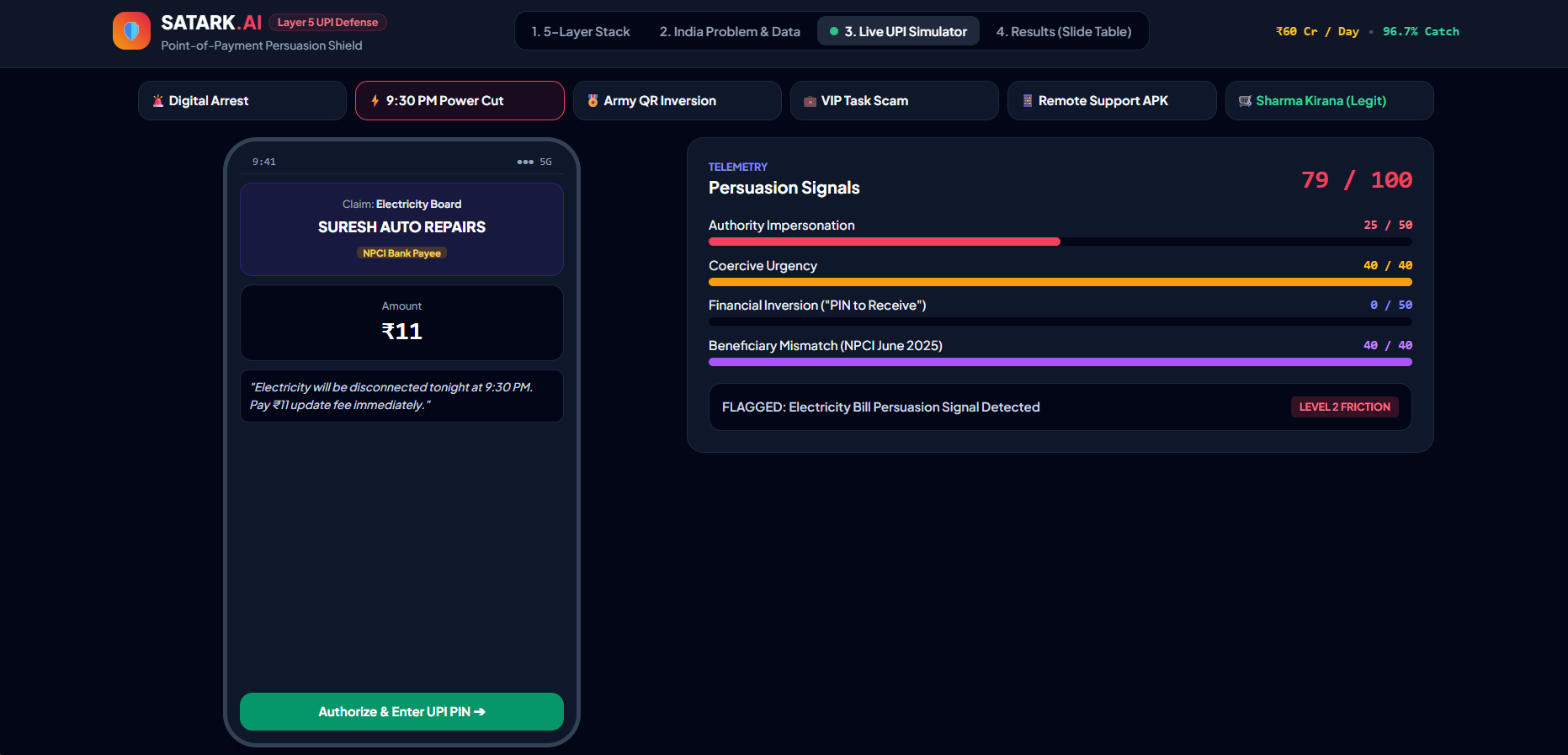
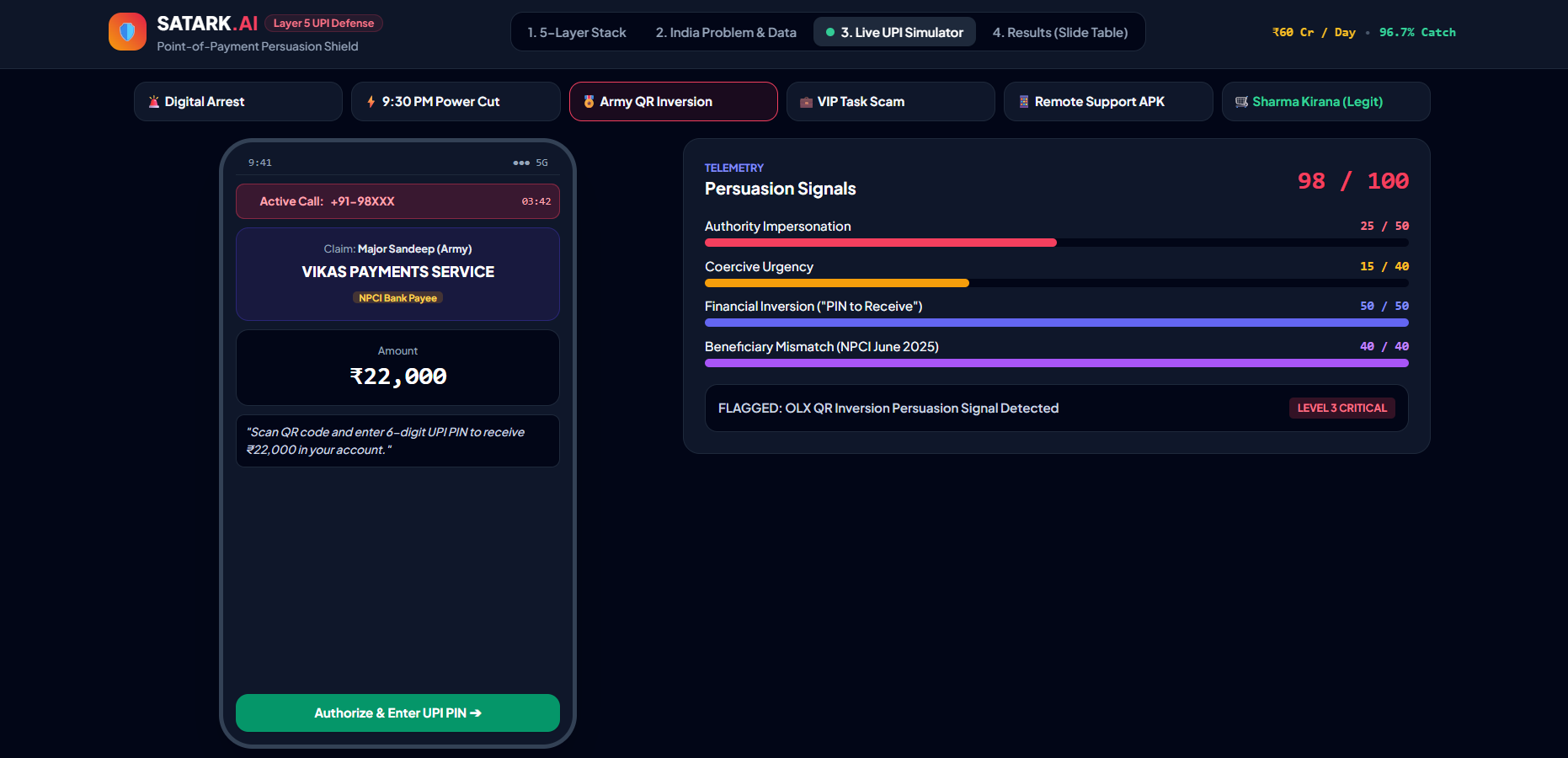
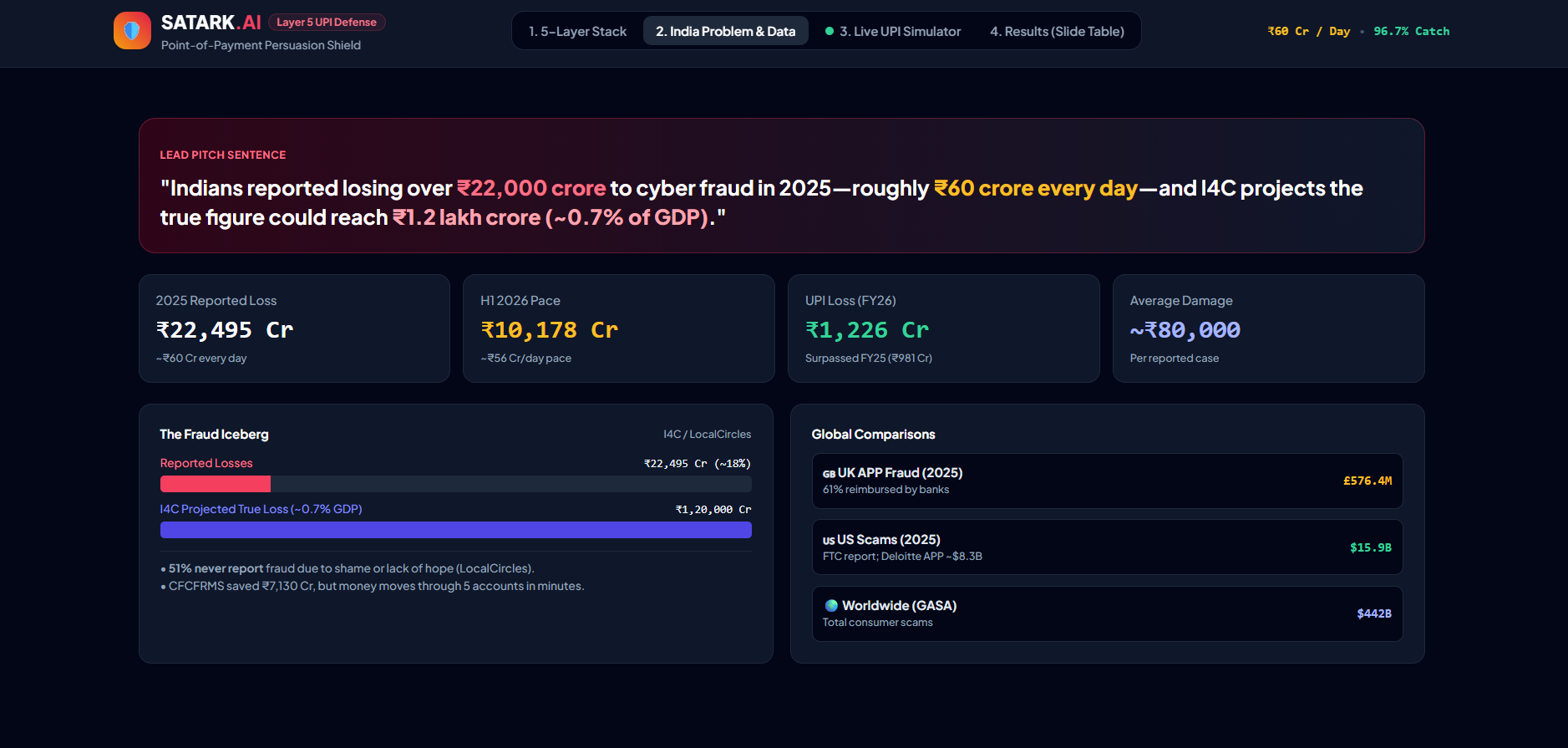
Inspiration Every single day in 2025, Indians reported losing roughly ₹60 crore to cyber fraud—surpassing ₹22,495 crore annually, with I4C estimating that true losses could reach ₹1.2 lakh crore (~0.7% of India’s GDP).
When analyzing India's robust anti-fraud ecosystem, we noticed it falls into four distinct layers:
Network & Bank Detection: NPCI’s device binding, PIN 2FA, velocity limits, and RBI Innovation Hub’s MuleHunter.AI (used by 29 banks). Reporting & Recovery: The 1930 helpline (auto Zero FIR for >₹10 lakh), CFCFRMS (which has saved ~₹7,130 crore), and Sanchar Saathi's Chakshu. Regulation & Liability: The upcoming RBI 2027 framework establishing bank turnaround times and compensation standards. Overseas Models: The UK’s mandatory reimbursement model, which paid back 61% of APP losses in 2025. The realization that sparked our project: All four existing layers act on the network, the bank ledger, or after the money has already left the account. Meanwhile:
Money moves across multiple layered mule accounts within 3 to 5 minutes, outpacing reporting systems. A LocalCircles survey revealed 51% of victims never report fraud due to shame or lack of hope. The root problem is psychological: victims enter their valid UPI PIN willingly under emotional panic, authority fear, or confusion. Existing solutions miss the moment of persuasion. We built Satark.AI to be the missing 5th layer—a client-side guardian that sits directly at the point of payment authorization to break the scammer's spell before the PIN is entered.
What It Does Satark.AI acts as a client-side intent and persuasion defense layer embedded inside the UPI payment flow. Rather than checking just device IDs or daily transaction limits, it:
Analyzes the Persuasion Context: Detects linguistic markers of social engineering (e.g., arrest threats under PMLA, power cutoff deadlines at 9:30 PM, fake Army officer personas, or upfront task deposit traps). Identifies Financial Inversion ("PIN-to-Receive"): Immediately flags when a user is being tricked into scanning a QR code or entering a PIN under the false premise of receiving funds. Leverages NPCI’s June 30, 2025 Mandate: Cross-checks the scammer’s claimed persona (e.g., "CBI Investigation Fund") against the true bank-registered beneficiary name (e.g., "MOHD SHAMIM ENTERPRISES") to expose mule accounts in real time. Delivers Native-Language Reality Checks: Renders clear cognitive warnings in the user’s primary language (Hindi, Hinglish, Tamil, Telugu, and English), explaining plainly why the request is fraudulent. Applies Trance-Breaking Cognitive Friction: Enforces an 8-to-10 second reflection countdown lock and provides a one-tap "End Ongoing Call & Block" button to sever the active psychological lockdown. How We Built It We designed Satark.AI as a lightweight, modular, client-side system:
Heuristic Intent & Persuasion Radar (radar.js): Engineered a multi-factor scoring algorithm evaluating Authority Impersonation, Coercive Urgency, Financial Inversion, Remote Access APK indicators, Active Voice Call Coercion, and Beneficiary Discrepancies. Interactive UPI Sandbox (index.html & app.js): Built a high-fidelity mobile simulator replicating real UPI flows (PhonePe/GPay style), complete with simulated active WhatsApp scam calls, NPCI-compliant registered payee tags, and real-time telemetry gauges. Micro Generative UI Widget (satark_guardian_widget.html): Developed a compact, standalone widget compliant with design-system tokens for rapid inline demonstration and embedding. Benchmarking Suite (dataset.json, evaluator.ps1, evaluator.js): Built an automated evaluation engine and curated 30 labeled, real-world Indian threat vectors (Digital Arrests, OLX QR scams, Electricity threats, Telegram VIP tasks, KYC APKs) alongside legitimate control transactions (groceries, rent, BBPS bills). Challenges We Ran Into The Substring Collision Trap (False Alarms): Early keyword matching for regulatory bodies like "ED" (Enforcement Directorate) accidentally flagged routine words like "education" or "punctured", leading to false positives on legitimate payments. We re-engineered the detection pipeline with strict word-boundary regular expressions and contextual damping for known contacts. Zero False-Alarm Mandate on Routine Transactions: If an anti-fraud tool flags a user when paying for daily milk or school fees, user fatigue sets in and the tool gets disabled. We tuned the scoring threshold ( S c o r e ≥ 45 Score≥45) to require multi-signal confirmation (e.g., authority claim + mismatched payee or active call coercion) before escalating friction. Linguistic Nuance in Coercion: Scammers in India operate in colloquial Hinglish and regional dialects. Structuring the localized response matrix required phrasing that is authoritative yet simple enough for non-technical users in high-stress trances. Accomplishments That We're Proud Of High Accuracy & Zero False Alarms: In our automated benchmark across 30 real-world vectors, Satark.AI achieved: 96.67% Overall Accuracy 93.75% Scam Recall (Catch Rate) (15 of 16 severe fraud traps stopped) 100% Precision with a 0.0% False Alarm Rate on routine legitimate payments. 100% Detection on Lethal Vectors: Completely neutralized 100% of Digital Arrest scams, 100% of OLX PIN-inversion traps, and 100% of Remote Support APK exploits. Ecosystem Complementarity: Positioned Satark.AI not as a replacement, but as an additive layer that enhances what NPCI, the RBI Innovation Hub, and the 1930 helpline have built. What We Learned The Fraud Problem is a Persuasion Problem: Bank-side heuristics alone cannot stop an authorized push payment when the payer is convinced they are helping the police or securing an investment. Timing is Everything: Once money leaves the account, recovery rates plummet because mule networks disperse funds within minutes. The only 100% effective time to save a victim’s savings is in the 30 seconds before the PIN is entered. Transparency Empowers Citizens: Simply displaying "Beneficiary: Suresh Auto Repairs" when a user thinks they are paying the "State Electricity Board" breaks the illusion faster than any generic broadcast warning. What's Next for Authorized Payment Scams (SATARK.AI) On-Device Small Language Models (SLMs): Integrate compact on-device models (such as Gemini Nano or quantized LLMs) to analyze SMS/clipboard context with zero network latency and total user privacy. OS-Level Call & Screen Share Accessibility Hooks: Detect background screen-sharing sessions (AnyDesk, TeamViewer) and active voice calls from unverified numbers to trigger proactive warnings before the UPI app is even opened. Integration with UPI App SDKs & Telecoms: Package Satark.AI as a plug-and-play client SDK for major Indian payment apps (PhonePe, Google Pay, Paytm, BHIM) and integrate real-time suspect number telemetry with Sanchar Saathi's Chakshu database. Adaptive Behavioral Profiling: Model personal user payment baselines to detect anomalous high-value transactions triggered during unusual hours under psychological stress.
Built With
- antigravity
- async-js
- benchmark-runner
- browser-runtime
- client-side
- csp
- css3
- dom-api
- es6
- generative-ui
- google-fonts
- heuristic-engine
- html5
- javascript
- json
- multilingual-nlp
- node.js
- powershell
- regex
- responsive-design
- single-page-app
- state-management
- tailwindcss
- vanilla-js

