-
-
Authorized DevOps Agent_1
-
Authorized DevOps Agent_2
-
Authorized DevOps Agent_3
-
Authorized DevOps Agent_4
-
Authorized DevOps Agent_5
-
Authorized DevOps Agent_6
-
AI_agents
-
architecture
-
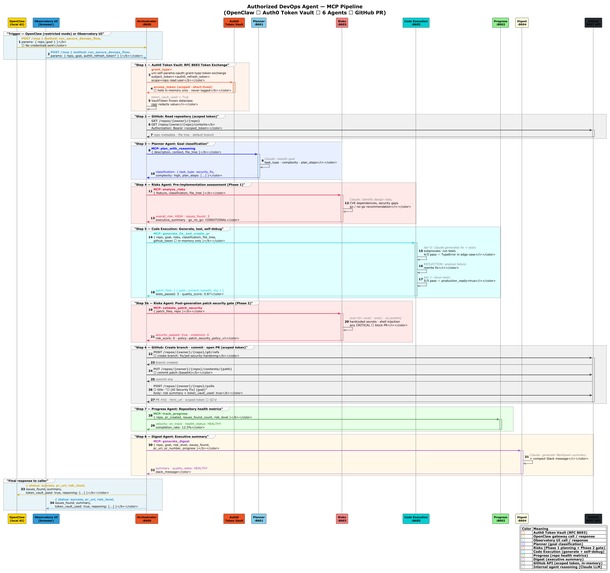
sequence
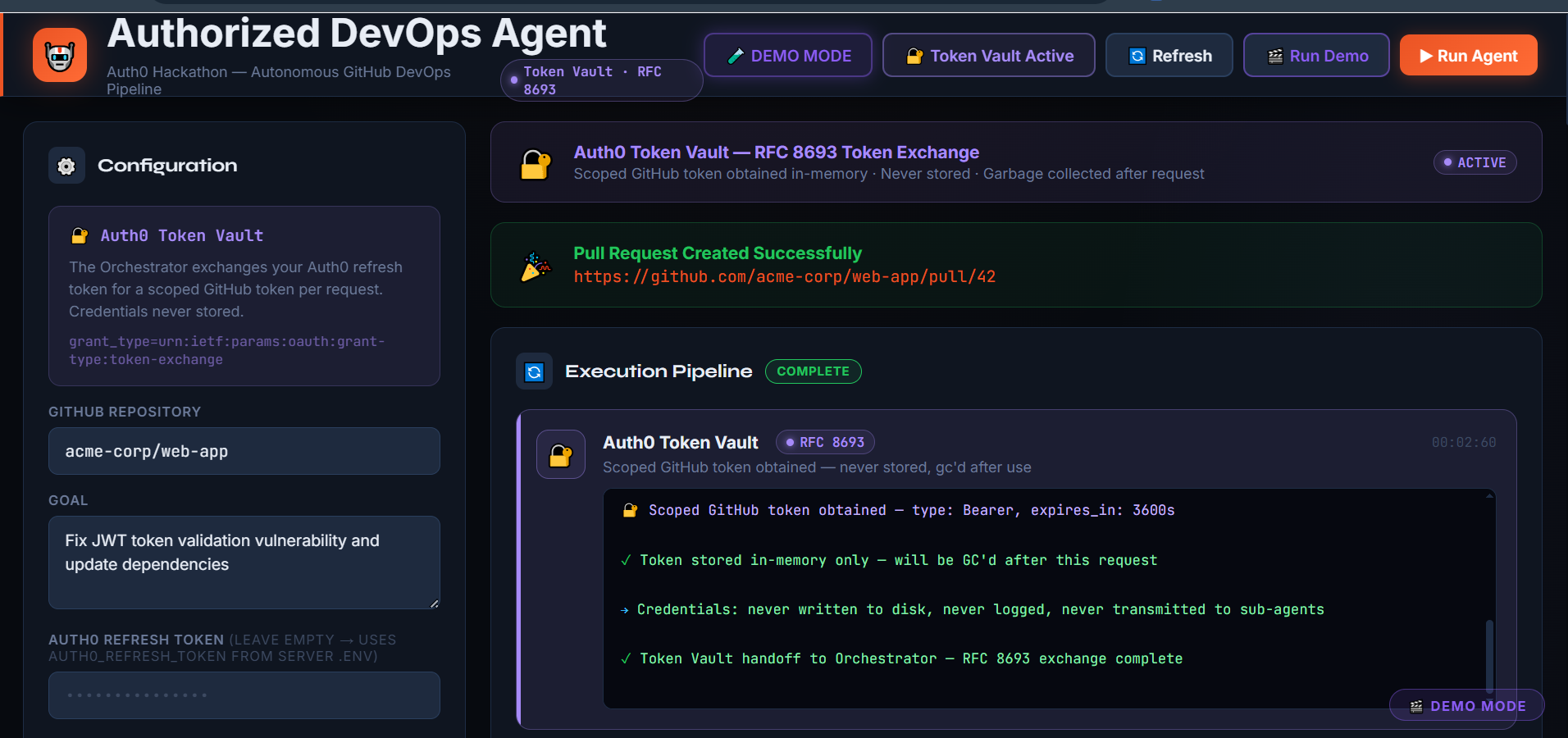
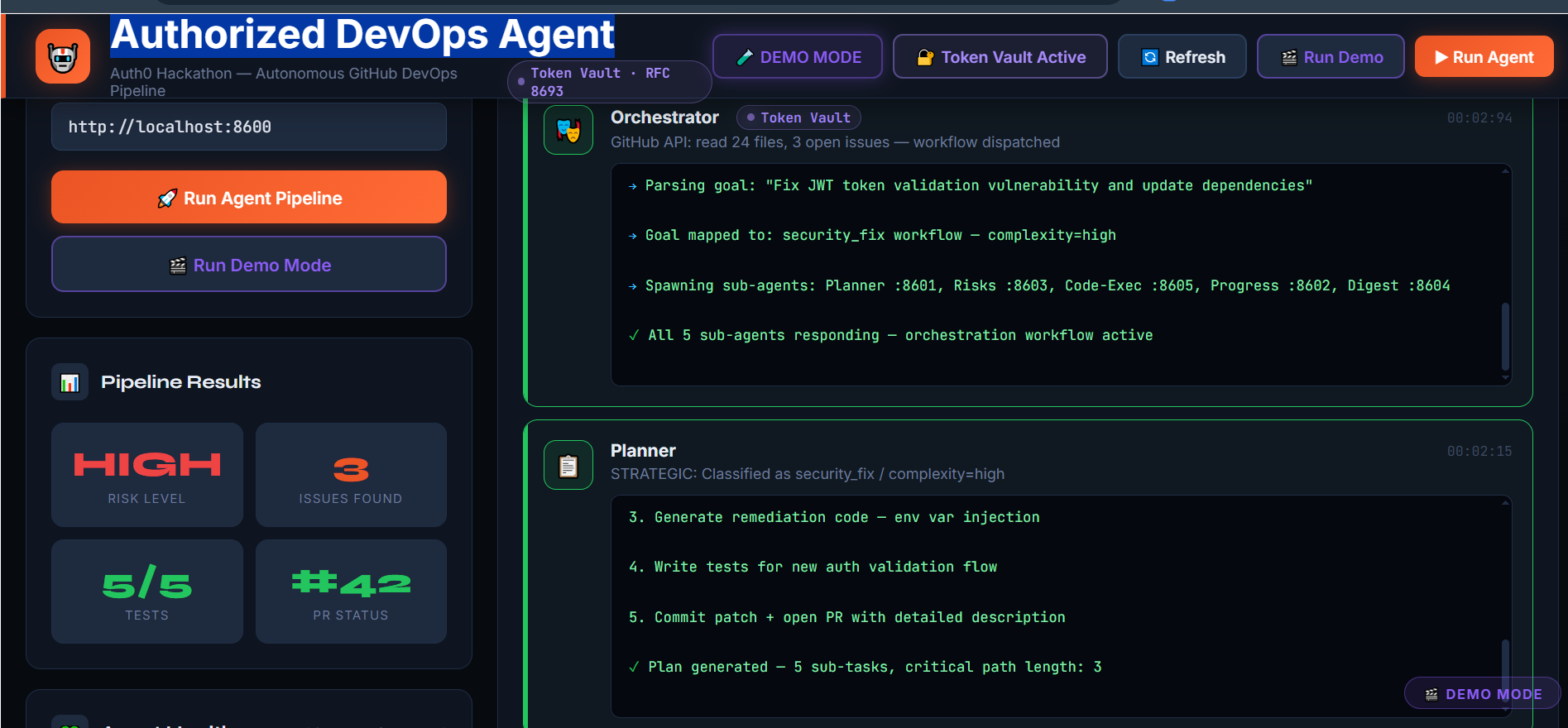
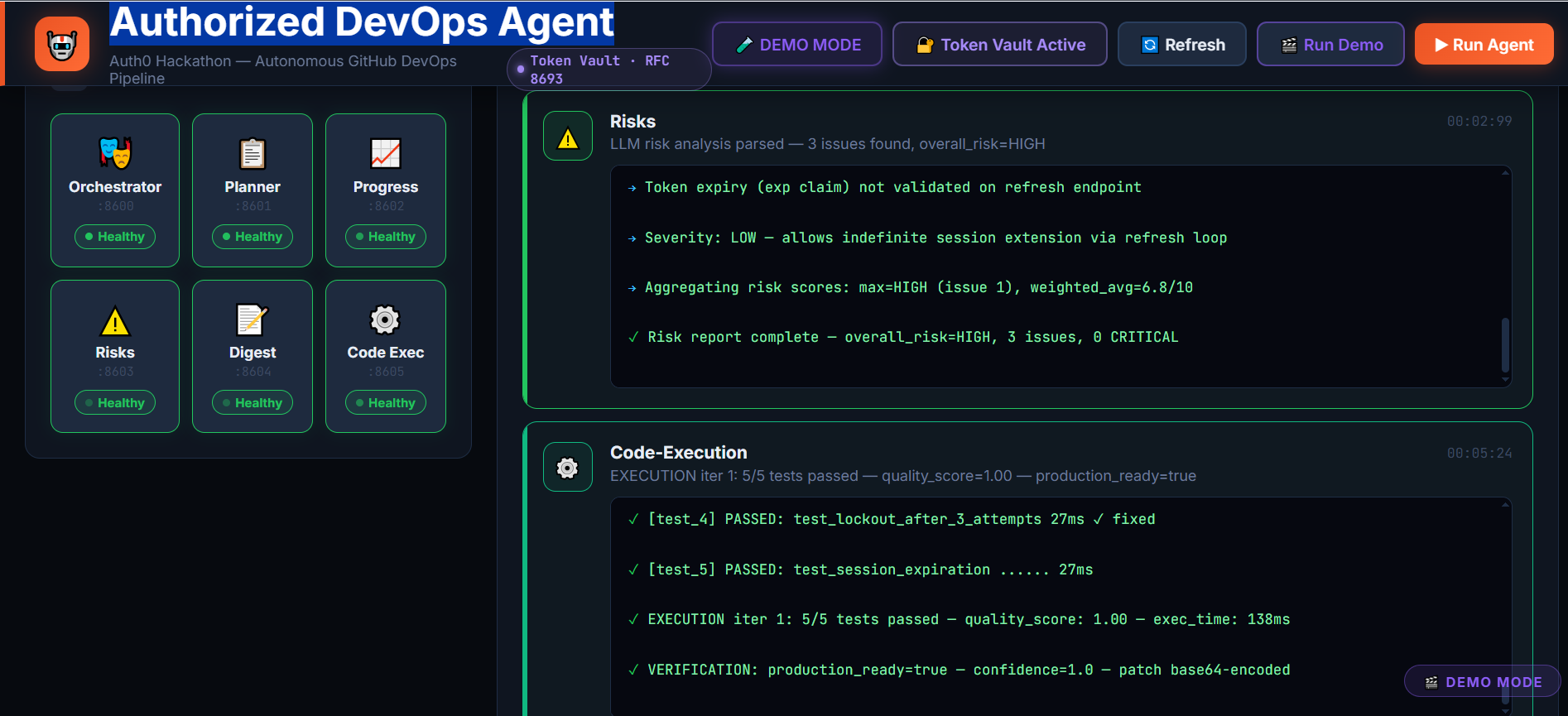
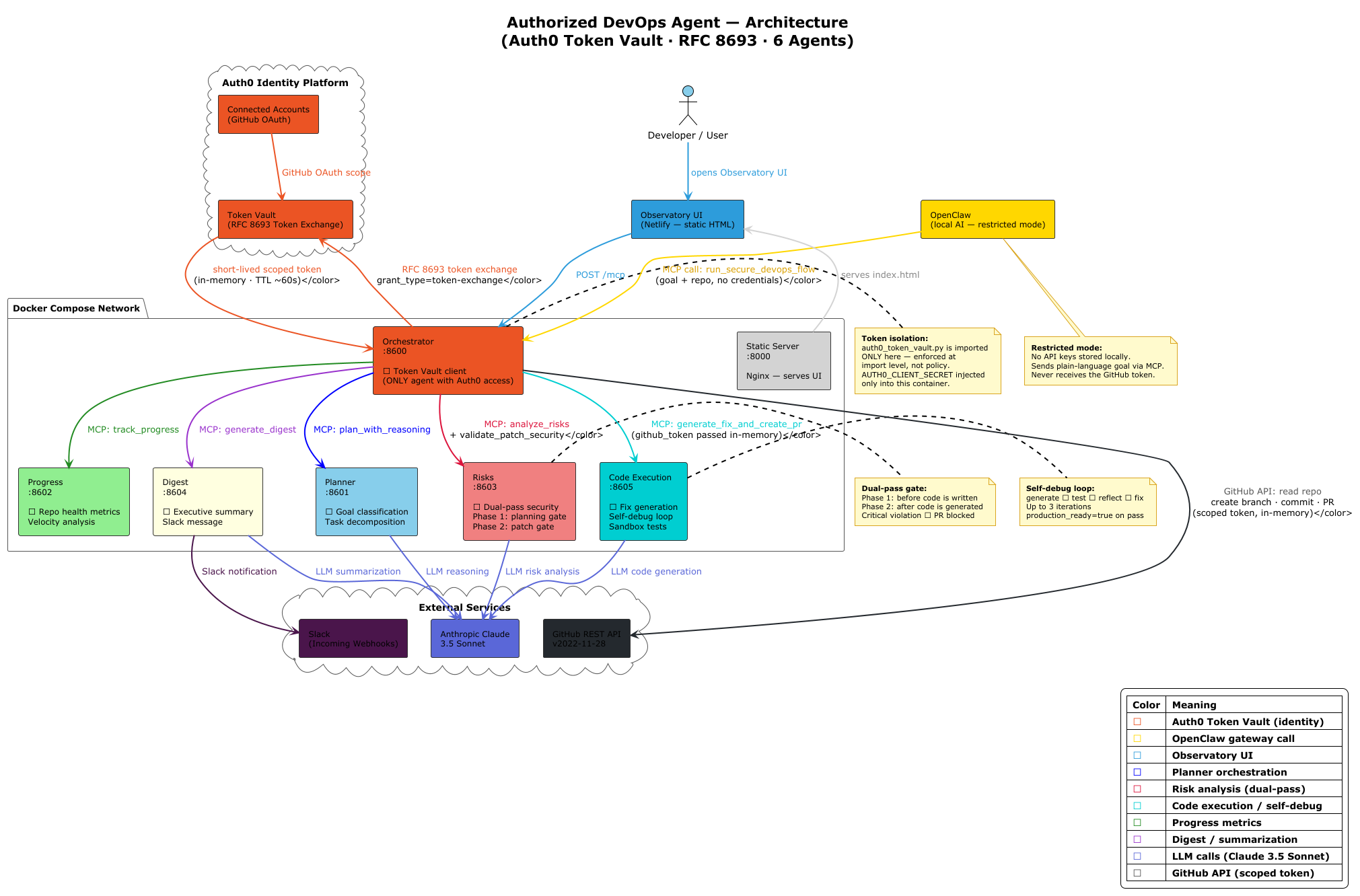
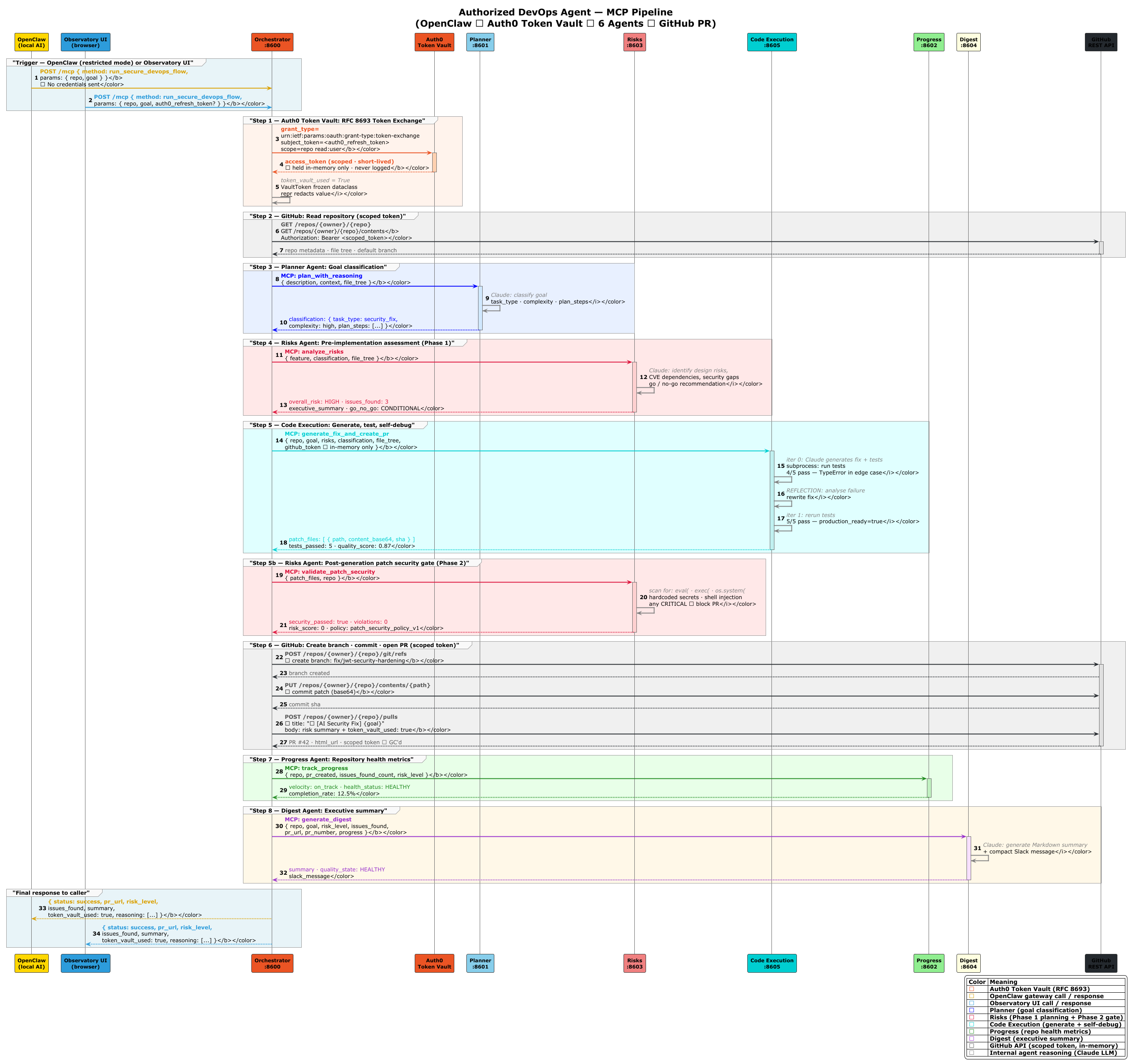
Authorized DevOps Agent: A secure RFC 8693-powered gateway that grants local AI (OpenClaw) "Right to Act" without exposing long-lived credentials.
🔮 Inspiration
The hackathon brief said it best:
“Keep OpenClaw in restricted mode and let it communicate with your apps through an intermediary agent.”
That single line became the blueprint for this project.
As on-device AI grows - OpenClaw on a Mac Mini, browser-based models, phone-level assistants - one limitation keeps appearing: a local model can reason, but it cannot safely hold real credentials.
The missing piece was a secure authorization layer that lets an AI act without ever touching long-lived secrets.
Auth0 Token Vault and the RFC 8693 Token Exchange flow provided exactly that infrastructure.
🔨 What It Does
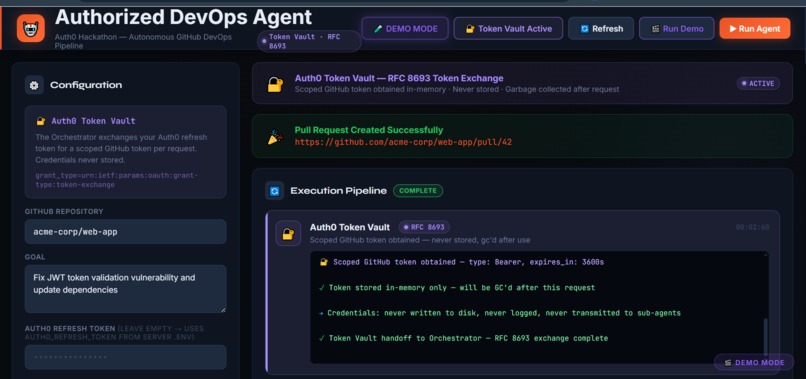
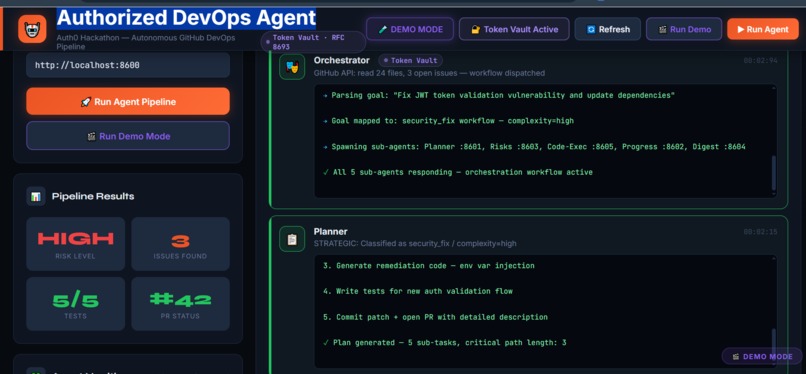
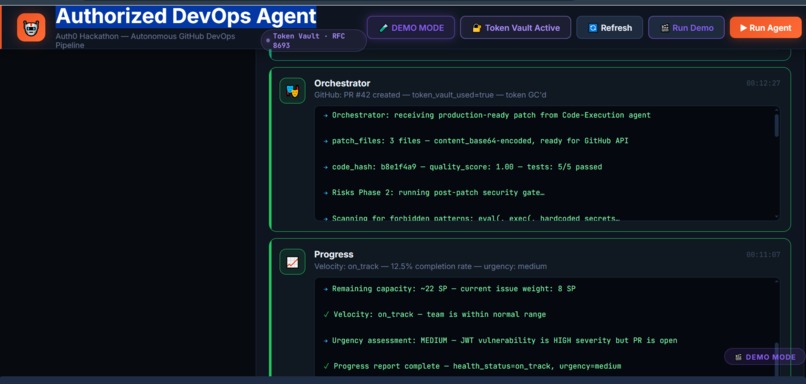
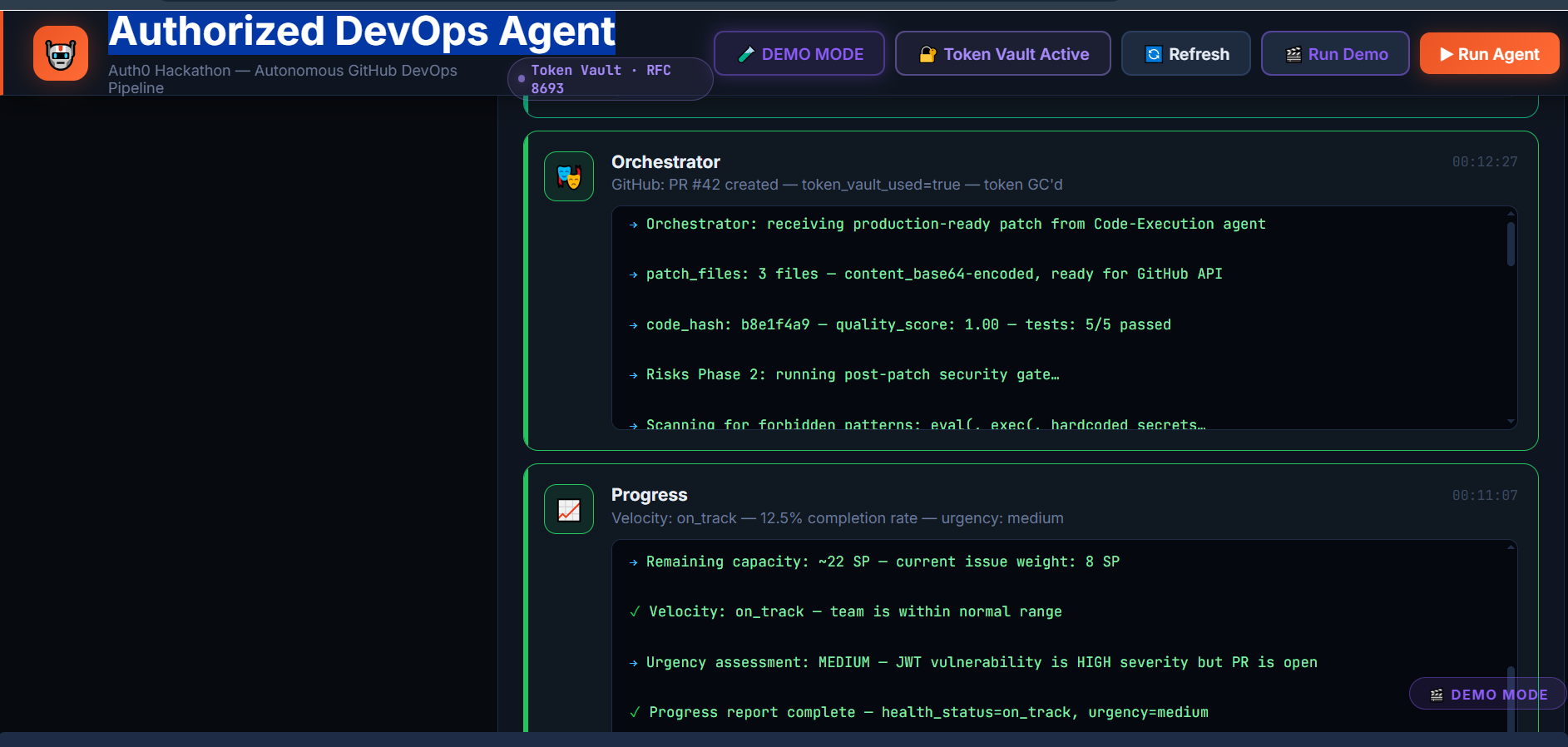
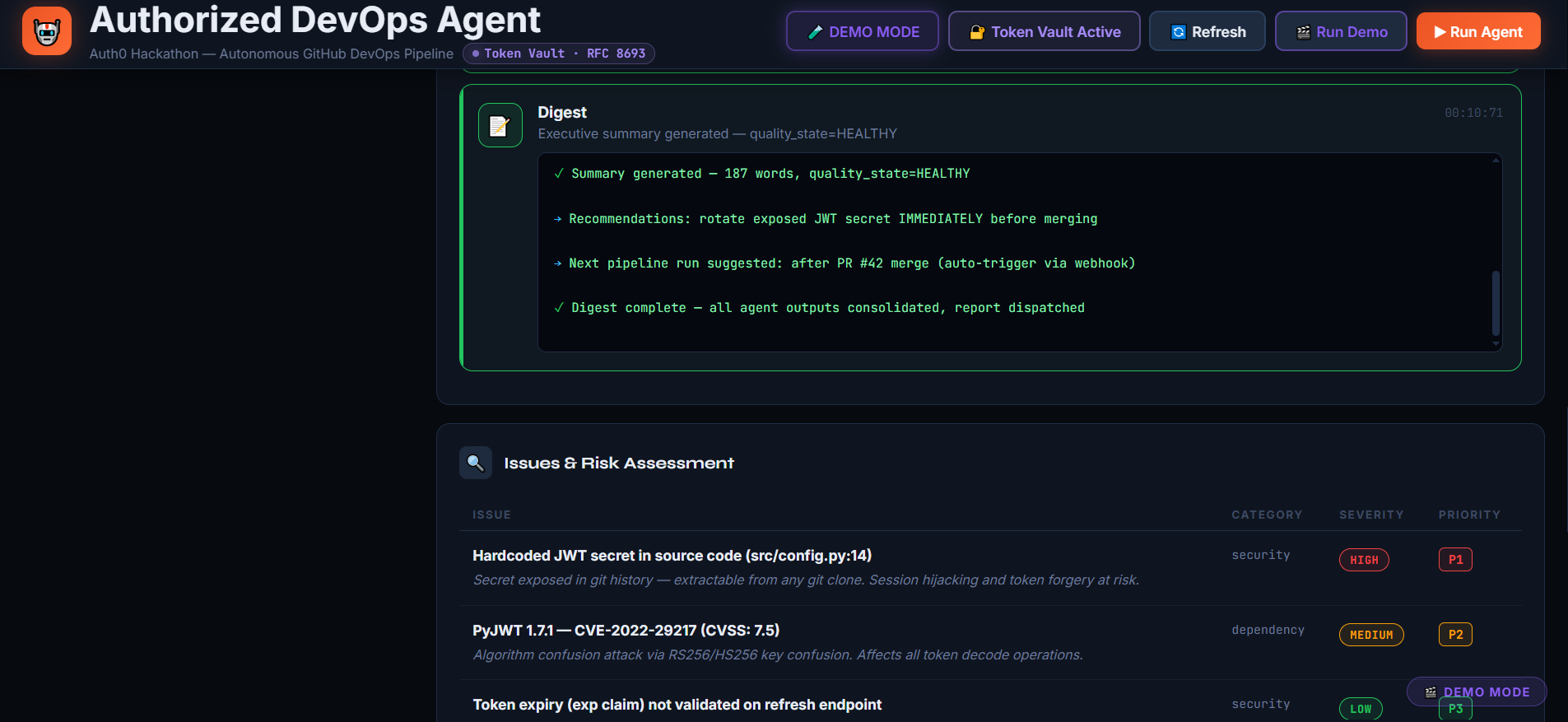
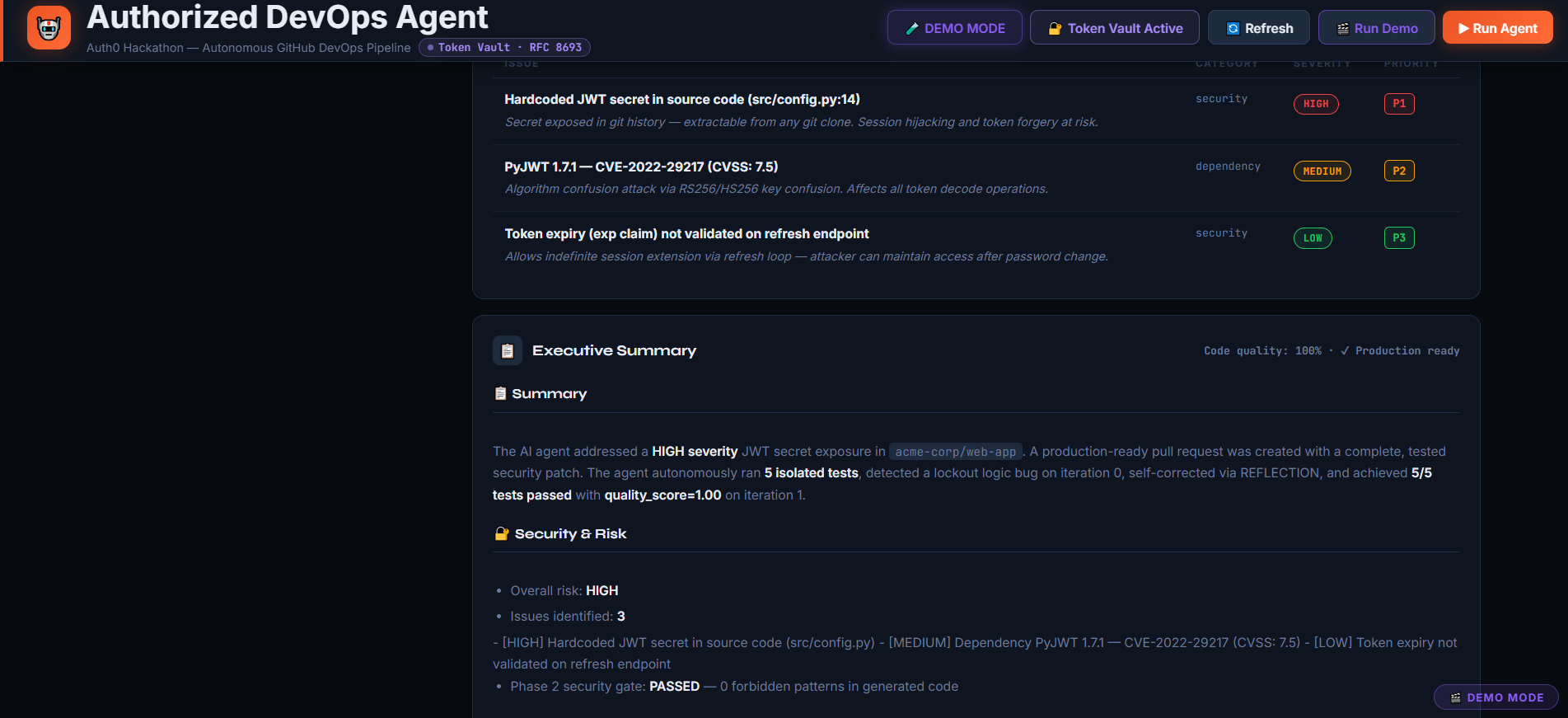
Authorized DevOps Agent is a secure authorization gateway that allows a restricted local model (OpenClaw) to run a full GitHub DevOps workflow — analyze a repo, generate a fix, run tests, and open a Pull Request — without ever receiving a long-lived credential.
OpenClaw (restricted mode)
        │
        ▼
Authorized DevOps Agent
        │
        ├── Auth0 Token Vault (RFC 8693)
        │   → short-lived, scoped GitHub token (memory only)
        │
        ├── Planner & Risks
        ├── Code Execution
        ├── Progress & Digest
        ▼
   GitHub REST API
A user or upstream AI only provides:
- Repository:
acme-corp/web-app - Goal: "Fix the JWT token validation vulnerability"
The system handles everything else.
🏗️ How We Built It
Architecture
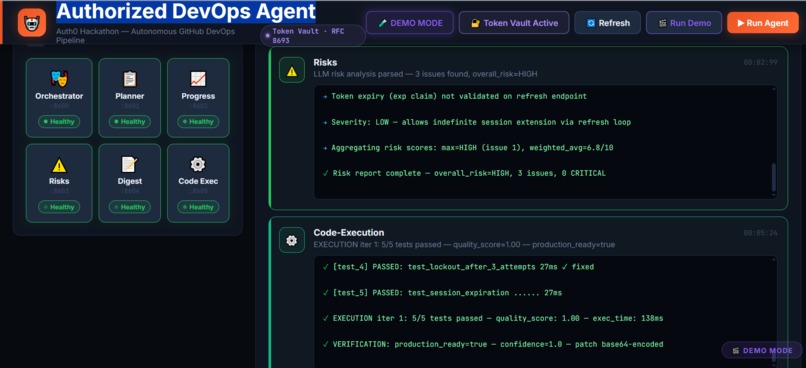
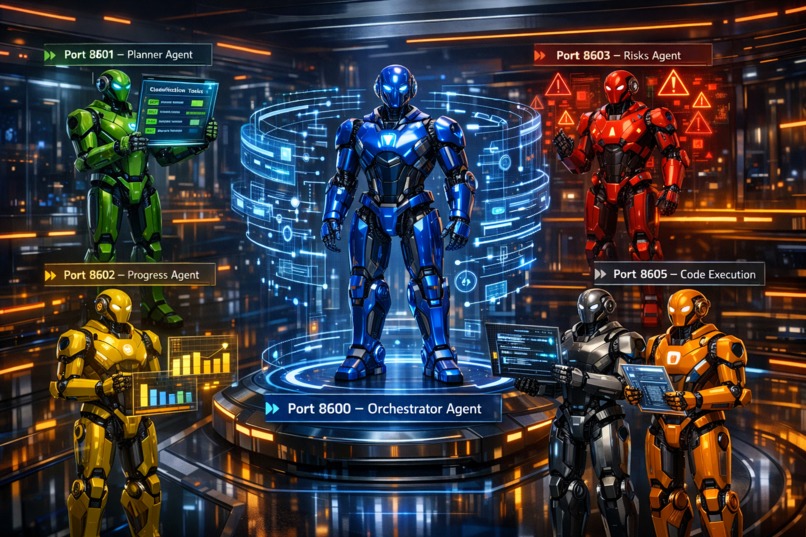
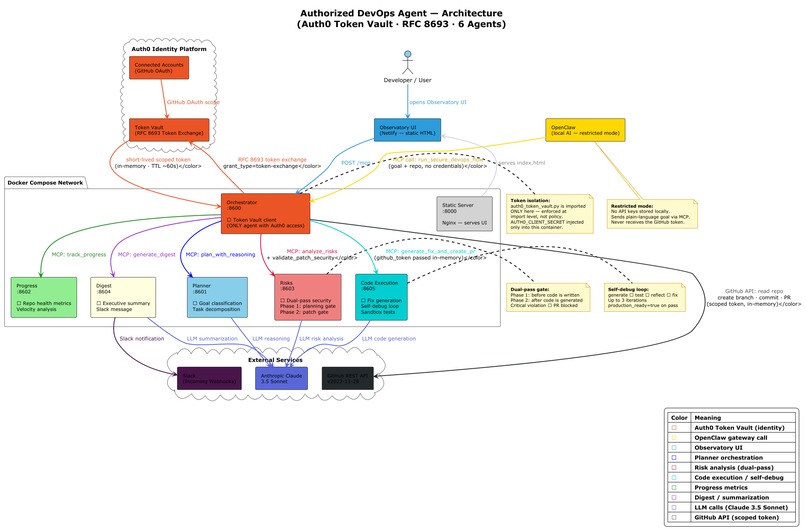
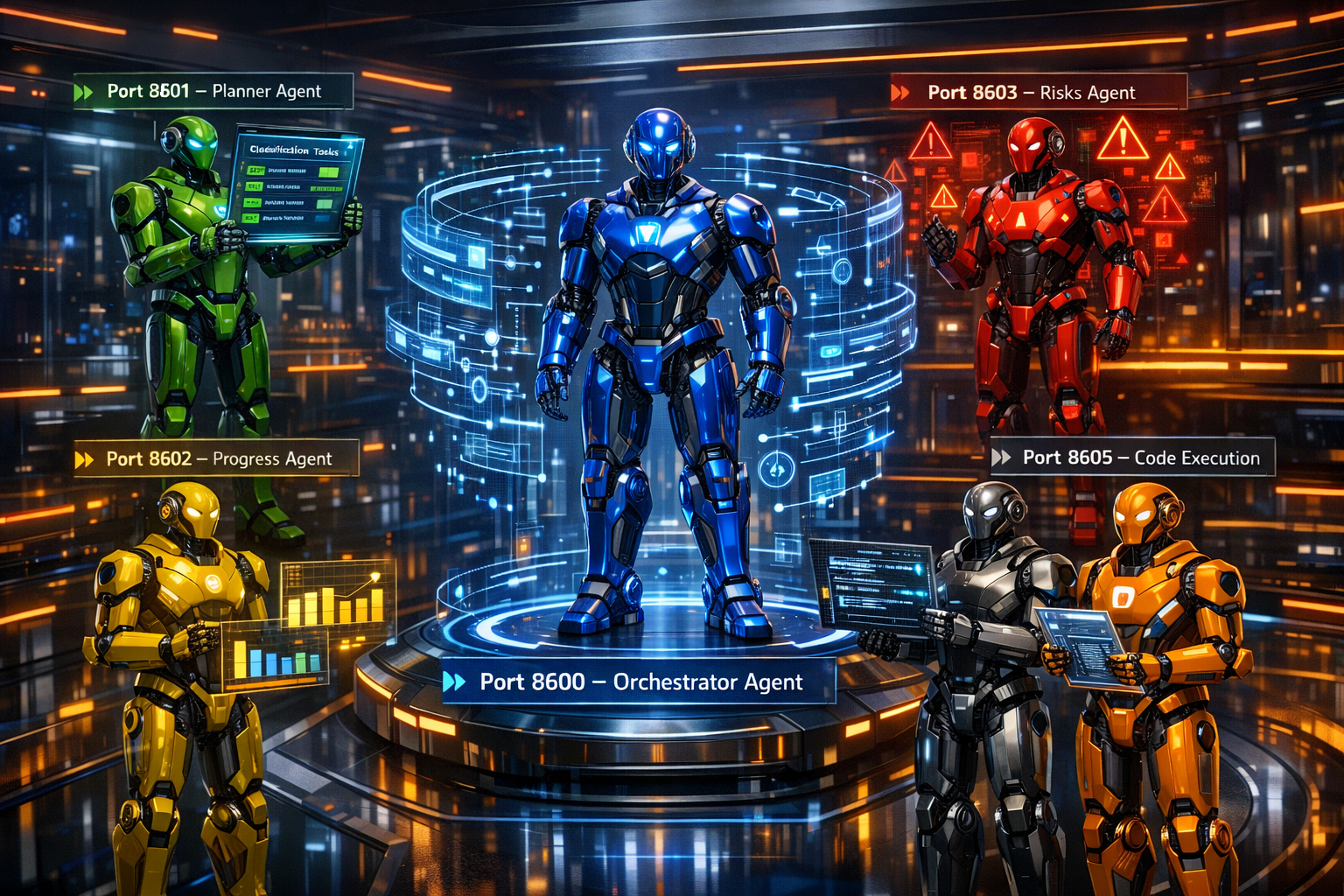
We built a six-agent system, each running as an independent FastAPI service inside its own Docker container. Agents communicate through a lightweight JSON-RPC protocol (MCP).
Only the Orchestrator is allowed to access the Auth0 Token Vault - this is the trust boundary.
Security Model - The Trust Boundary
- The user links GitHub to Auth0 via Connected Accounts.
- The Orchestrator requests a token using RFC 8693 Token Exchange.
- Auth0 returns a scoped, short-lived GitHub token.
- The token lives only in memory inside a frozen dataclass — never logged, never printed.
- All GitHub API calls use this token.
- When the task ends, the token disappears with the process — no disk writes, no persistence.
Sub-agents are structurally isolated from AUTH0_CLIENT_SECRET.
The GitHub token never crosses the trust boundary.
Zero Trust Agent Execution
OpenClaw (or any local model):
- Never receives the GitHub token
- Cannot escalate beyond
repo+read:user - Cannot persist state
- Is fully audited through the Observatory UI
🏆 Accomplishments We’re Proud Of
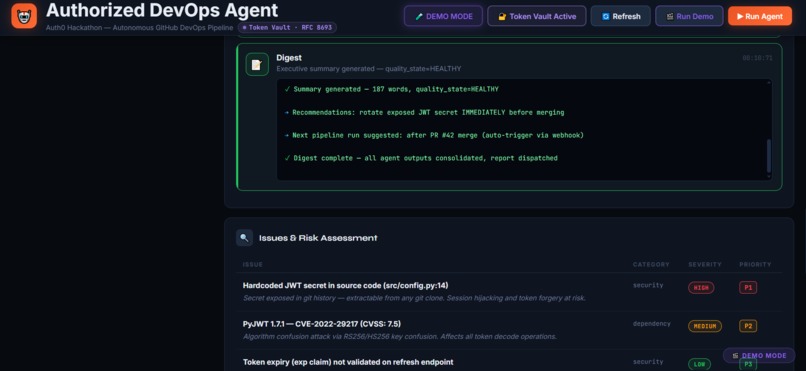
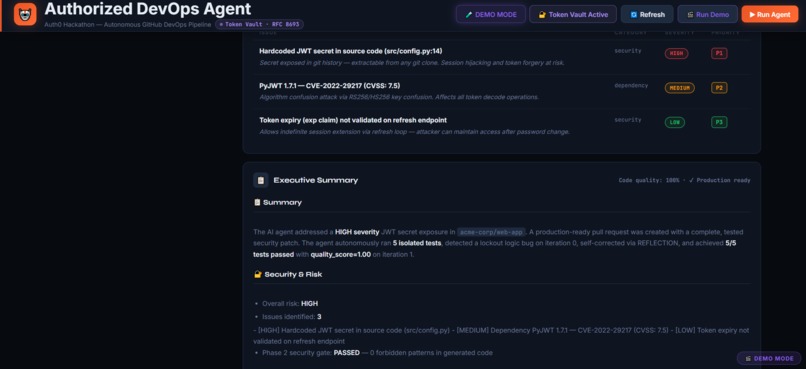
- End-to-end autonomous pipeline - from Token Exchange to GitHub PR in a single MCP call
- Perfect reliability - achieved a 1.0 Quality Score in autonomous debugging tests
- Sub-60s TTL - GitHub tokens exist only for the duration of the task
- Dual-pass security gate - design-time + patch-time risk analysis
- Zero credential storage - enforced by architecture, not policy
- Full observability - every agent decision visible in real time
🏃 Challenges We Ran Into
Enforcing the Trust Boundary
Required architectural isolation at the import and container level.Deterministic Security Outputs
LLMs are probabilistic. We redesigned the parsing layer for stable, auditable decisions.Multi-Agent Cross-Origin Security
UI on Netlify, agents in Docker, OpenClaw on device - custom CORS and environment detection needed.Autonomous Debugging Reliability
Building a self-healing test runner required careful sandboxing and strict execution limits.
Bonus Blog Post
The AI Identity Crisis: How I Built a Gateway That Trusts No One
Building the Authorized DevOps Agent turned out to be less about wiring APIs and more about confronting what I now call the AI Identity Crisis. As a backend engineer, I’ve spent years securing systems for humans - but securing a system for an LLM is an entirely different challenge.
At first, the task looked deceptively simple: let a local AI (OpenClaw) interact with GitHub. But the moment I started designing the flow, the core problem became obvious. Any long‑lived token I handed to the agent was a liability. A prompt injection, a logging slip, or even a malformed response could leak the keys to the kingdom. Hardening the agent wasn’t enough - I needed to remove anything worth stealing.
The breakthrough came when I integrated Auth0 Token Vault. Using RFC 8693 Token Exchange, I pushed all credentials out of the agent layer entirely. The Orchestrator became the sole Vault Keeper. Sub‑agents never touch secrets; they don’t even import the modules capable of doing so. The GitHub token lives only in memory, scoped to a single request, and disappears after ~60 seconds.
One of the hardest engineering challenges was enforcing this isolation structurally. I didn’t want “best practices.” I wanted architectural guarantees. By restricting imports, isolating containers, and implementing a dual‑pass security gate that scans generated patches before they ever reach GitHub, the system evolved from a DevOps helper into a blueprint for Zero‑Trust AI execution.
This journey taught me something fundamental: in the age of autonomous agents, security isn’t a feature - it is the architecture. And the only trustworthy AI is the one that’s designed to trust no one.
👨🎓 What We Learned
The key insight: identity delegation is the missing layer in AI agent architecture.
LLMs can reason and generate code, but without delegated, scoped identity they either have too much power or none at all.
Auth0 Token Vault + RFC 8693 is the exact mechanism needed for safe, real-world agent actions.
We also learned that observability is essential - without the reasoning trail, trust is impossible.
⏭ What’s Next
- OpenClaw plugin - native MCP tool for direct integration
- Sandbox PR verification - Bandit + Semgrep before committing
- GitHub Actions integration - trigger CI pipelines automatically
- Expanded language support - TypeScript, Go, Java
- Enterprise audit log - structured record of every Token Exchange and agent action
Proud of building a truly secure autonomous DevOps agent.
Built With
- asyncio
- auth-0
- css3
- docker
- fastapi
- html5
- httpx
- javascript
- poetry
- pydantic
- python
- python-dotenv
- uvicorn

Log in or sign up for Devpost to join the conversation.