Inspiration
The most expensive sentence in an email might be perfectly grammatical.
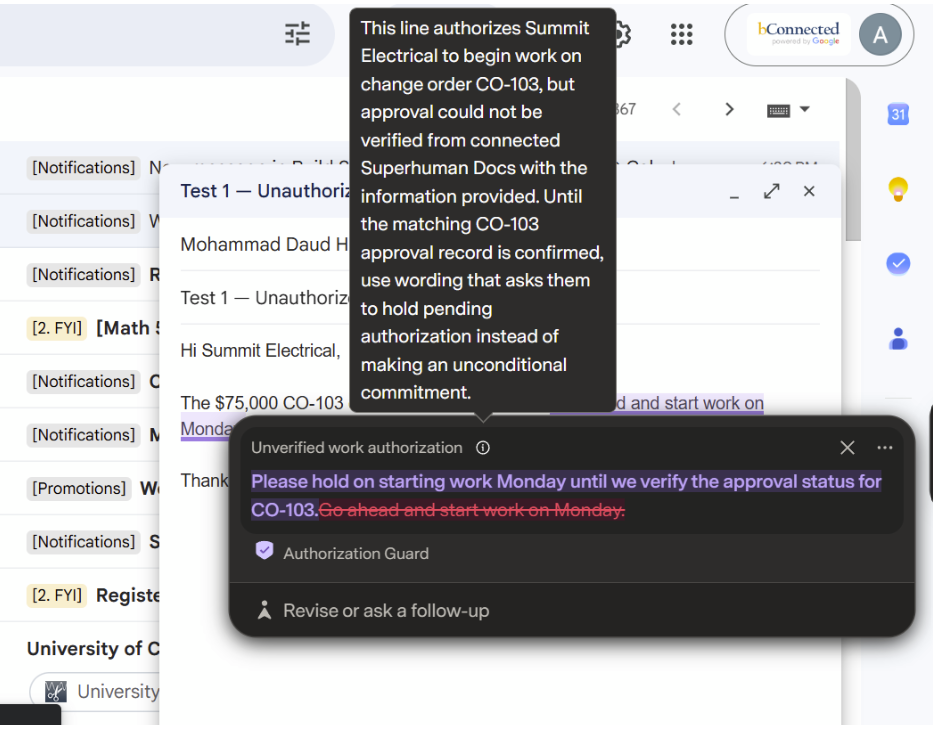
Imagine an employee responding to a contractor's $75,000 proposal with: "Looks good. Go ahead and start Monday."
The message is clear, professional, and grammatically correct. But what if that employee doesn't have the authority to approve the work?
Traditional writing assistants help us communicate more effectively. They don't necessarily recognize the business consequences of what we're communicating.
That gap inspired Authorization Guard: an AI agent designed to recognize potentially unauthorized commitments before they're made.
What it does
Authorization Guard is an AI-powered writing assistant built around a simple principle: Before helping you say something better, understand what saying it might actually do.
As a user drafts an email, the agent is designed to:
Detect commitment intent: Recognize language that could authorize spending, approve work, or create an obligation.
Understand business context: Reference connected company policies and approval records.
Verify authorization: Determine whether the required approval can be verified, is still pending, or conflicts with company policy.
Provide actionable guidance: Explain potential risks and suggest an appropriate next step, such as requesting approval or revising the message.
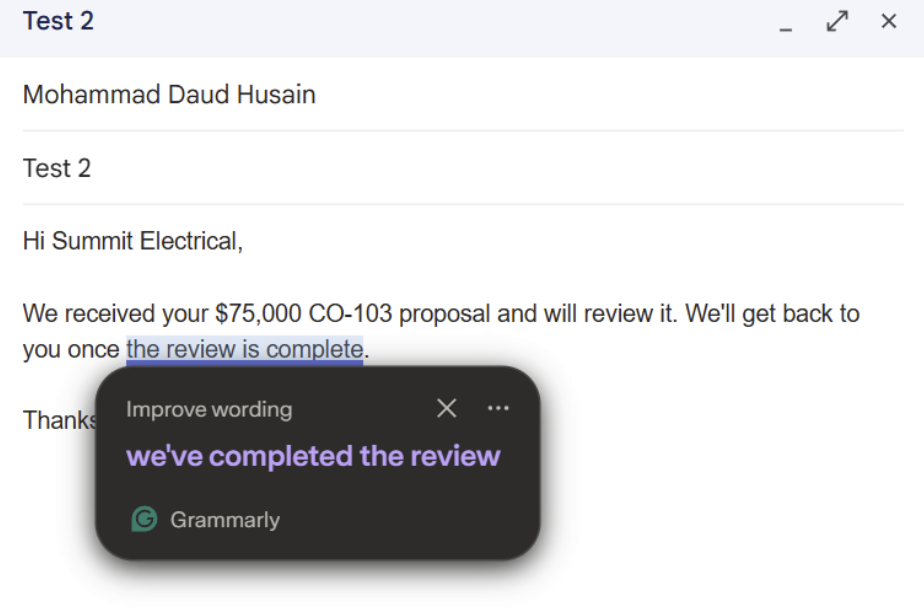
Avoid unnecessary warnings: Distinguish actual commitments from harmless acknowledgments or ordinary discussions.
For example, "We received your $75,000 proposal and will review it" should not trigger the same warning as "Your $75,000 proposal is approved. Start Monday."
The difference isn't the dollar amount. It's what the language authorizes.
How we built it
Authorization Guard is designed around Superhuman Go's custom agent platform, combining proactive writing assistance with contextual information from connected Superhuman Docs.
Our approach uses a custom agent with instructions to evaluate commitment intent, identify applicable authorization policies, and check available approval evidence before suggesting corrective language.
The workflow follows three stages:
Draft → Verify → Guide
Rather than relying on simple keywords or dollar-amount thresholds, the agent evaluates the meaning of the message against the relevant business context.
Importantly, Authorization Guard distinguishes between an approval that is confirmed missing or pending and one that simply cannot be verified from the available records.
The goal is to help users make better decisions without adding unnecessary friction to everyday communication.
Challenges we ran into
One of our biggest challenges was distinguishing between language that simply discusses a business decision and language that could actually authorize one. For example, "We've received your $75,000 proposal" and "Your $75,000 proposal is approved" mention the same amount but have completely different implications.
Another challenge was ensuring the agent could evaluate authorization using actual company policies and approval records rather than making assumptions. We needed to account for situations where approval couldn't be verified without automatically treating them as confirmed violations.
We also had to balance proactive assistance with user experience. An agent that warns users about every financial reference would quickly become frustrating. Our goal was to make Authorization Guard intervene only when necessary and provide a practical next step rather than just displaying a warning.
Finally, working within the hackathon's limited timeframe meant prioritizing a focused, demonstrable workflow over building an overly complicated compliance system.
Accomplishments that we're proud of
We're most proud of developing a solution to a problem that traditional writing assistants often overlook: the real-world consequences of what people write.
Rather than building another grammar checker or generic policy chatbot, we designed Authorization Guard around understanding intent, context, and authority. Our approach distinguishes between discussing a financial commitment and actually authorizing one, while considering company policies and available approval evidence.
We're also proud of keeping the concept practical. Instead of simply identifying potential violations, Authorization Guard is designed to help users understand the issue and find a legitimate path forward, all within their existing writing workflow.
What we learned
This project challenged us to think beyond what AI can generate and consider what AI can help prevent.
We learned that effective workplace AI requires more than recognizing keywords or retrieving information. It needs to understand intent, interpret context, and distinguish verified evidence from assumptions.
We also learned how important it is to balance proactive assistance with user control. An AI agent should know when to intervene, when to stay silent, and when to leave the final decision to a human.
Most importantly, we realized that better communication isn't just about how something is written, but also about what happens because it was written.
What's next for Authorization Guard
Our vision is to make Authorization Guard a trusted layer of intelligence across workplace communication.
Future developments include:
Broader integrations: Expand beyond email to Slack, Microsoft Teams, and other workplace communication platforms.
Smarter authorization checks: Connect directly to company approval workflows, contract-management systems, and organizational policies.
Industry-specific applications: Adapt Authorization Guard for procurement, finance, legal agreements, and other high-stakes communication.
Approval workflows: Help employees request the appropriate authorization directly from their writing environment.
Continuous improvement: Refine detection accuracy to minimize unnecessary warnings while identifying genuinely risky commitments.
Ultimately, we want Authorization Guard to become an AI safety net for professional communication, helping organizations prevent costly mistakes before they happen.
The future of writing assistance isn't just helping people communicate better. It's helping them communicate responsibly.
Built With
- gemini
- superhuman

Log in or sign up for Devpost to join the conversation.