Authority Vision
Inspiration
Computer vision systems can increasingly detect objects, people, hazards, and changing conditions in real time. But detecting something is not the same as having authority to act on it.
Authority Vision explores the step between perception and downstream action.
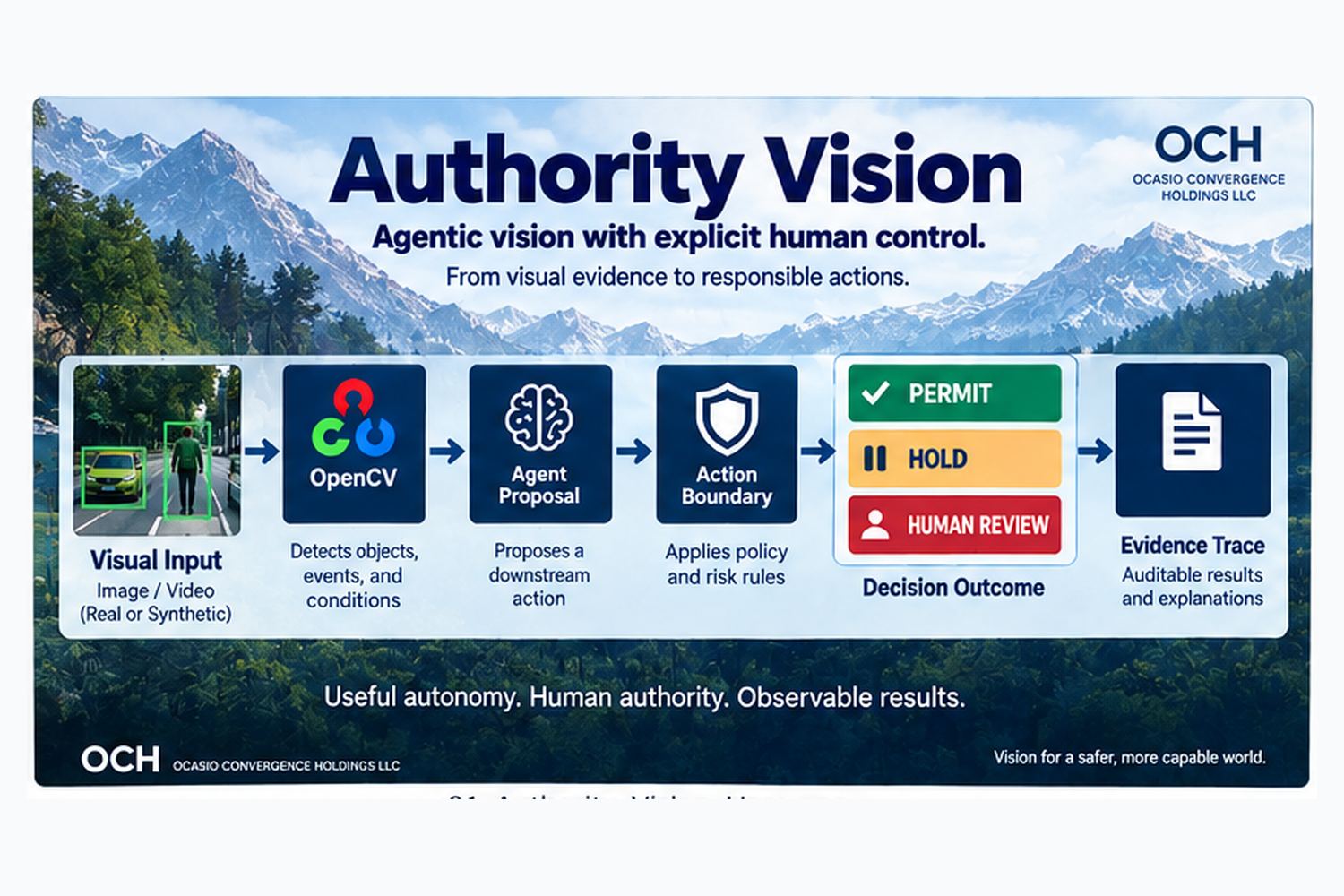
Instead of treating visual detection as automatic permission to execute, the system routes a proposed action to one of three states:
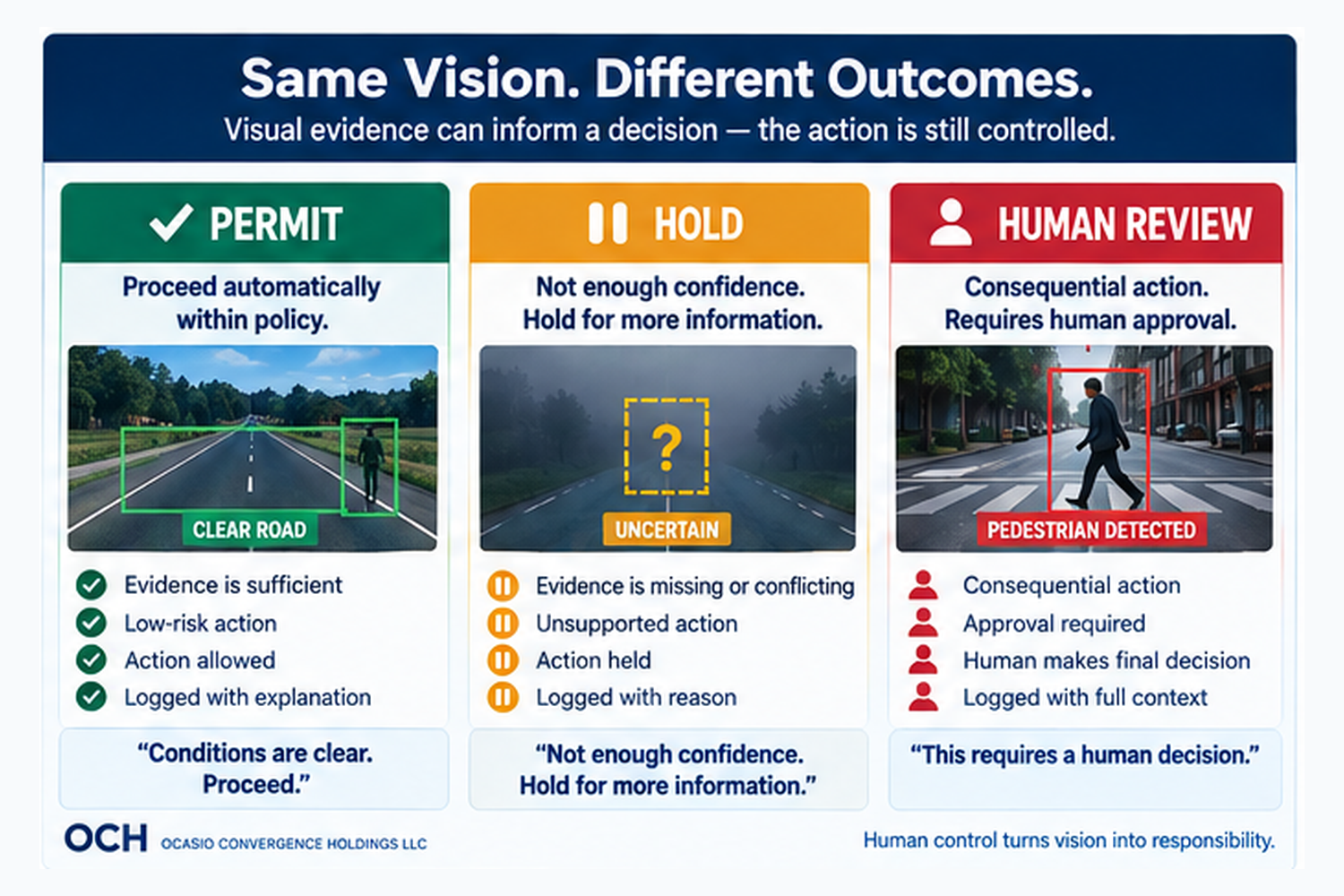
- PERMIT — the action may proceed
- HOLD — the action should stop pending better information
- HUMAN REVIEW — a person must make the final decision
The goal is useful autonomy with explicit human control.
What it does
Authority Vision processes visual input, identifies a relevant condition, and allows that visual evidence to influence a downstream agent decision.
Workflow:
Visual Input → OpenCV 5 Perception → Agent Proposal → Action Boundary → PERMIT / HOLD / HUMAN REVIEW → Evidence Trace
The same perception pipeline can therefore produce different outcomes depending on the evidence and requested action. A clear, low-consequence condition can proceed. Ambiguous or conflicting evidence can result in a hold. A consequential proposed action can require human approval even when the visual evidence itself is clear.
Every decision produces an observable trace showing the visual condition, proposed action, resulting state, and reason.
How we built it
Authority Vision is a modular Python application with separate components for:
- Visual perception — OpenCV 5-based image analysis
- Agent orchestration — uses the observed condition to determine the next bounded action path
- Action control — routes the proposal to PERMIT, HOLD, or HUMAN REVIEW
- Evidence trace — records inputs, proposed action, resulting state, and explanation
- API layer — FastAPI provides a testable application interface
- Containerization — Docker provides a reproducible runtime
- Cloud deployment — AWS ECR + Amazon ECS Express Mode host the verified competition image
The deployed competition runtime uses OpenCV 5.0.0 on AWS in us-east-2.
The verified container was pushed to Amazon ECR and deployed to ECS using the exact immutable image digest:
sha256:763fe98c0090cd9842670838628ed930f5cf7896692d8807a535f754f436c167
The digest running in ECS was verified to match the expected ECR digest exactly.
Live AWS application
The working application is deployed at:
https://au-8df7d18daa584ccc9eb577ac6e879f40.ecs.us-east-2.on.aws
Public verification confirmed:
- root application endpoint: PASS
/health: PASS/analyzedemonstration: PASS- OpenCV version: 5.0.0
competition_target_met: truecompatibility_mode: false
Agentic Vision
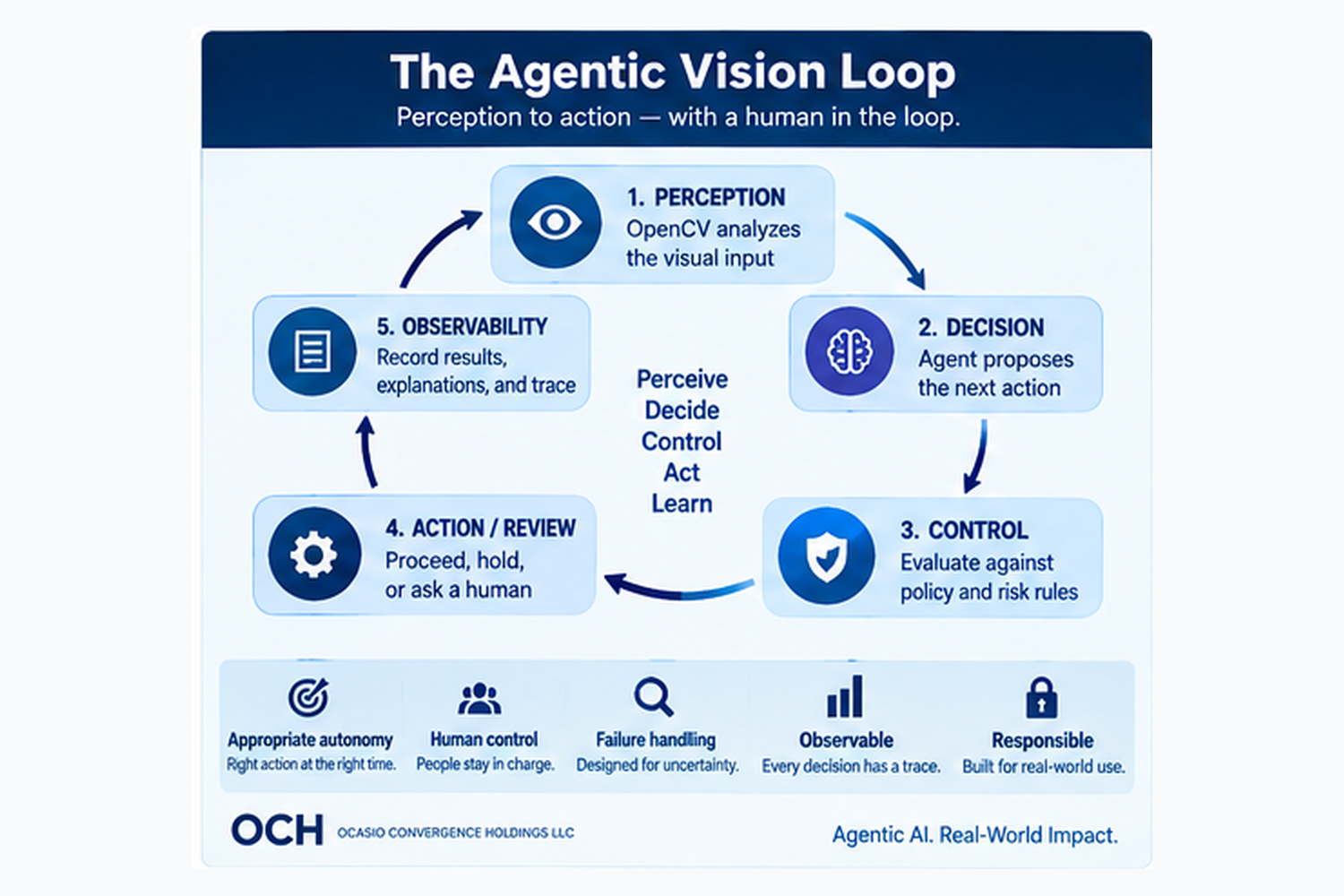
Authority Vision is not a chatbot that merely describes a fixed vision result. The visual evidence changes what the system does next.
Perception → OpenCV 5 analyzes the visual input
Decision → the system evaluates the observed condition and proposed action
Control → the proposed action is bounded by explicit rules
Action / Review → proceed, hold, or ask a human
Observability → preserve a visible decision trace
This creates a perception-decision-action loop while maintaining an explicit human-control boundary.
Evaluation
The verified OpenCV 5 competition image passed all three included behavioral tests:
- a blue safe marker can return PERMIT;
- a consequential action requires explicit confirmation and returns HUMAN REVIEW when appropriate;
- a red hazard combined with a proceed action returns HOLD.
The test suite completed 3/3 PASS inside the same Docker image that was pushed to AWS.
The local /health endpoint and the public AWS /health endpoint both confirmed OpenCV 5.0.0 with the competition target enabled and compatibility mode disabled.
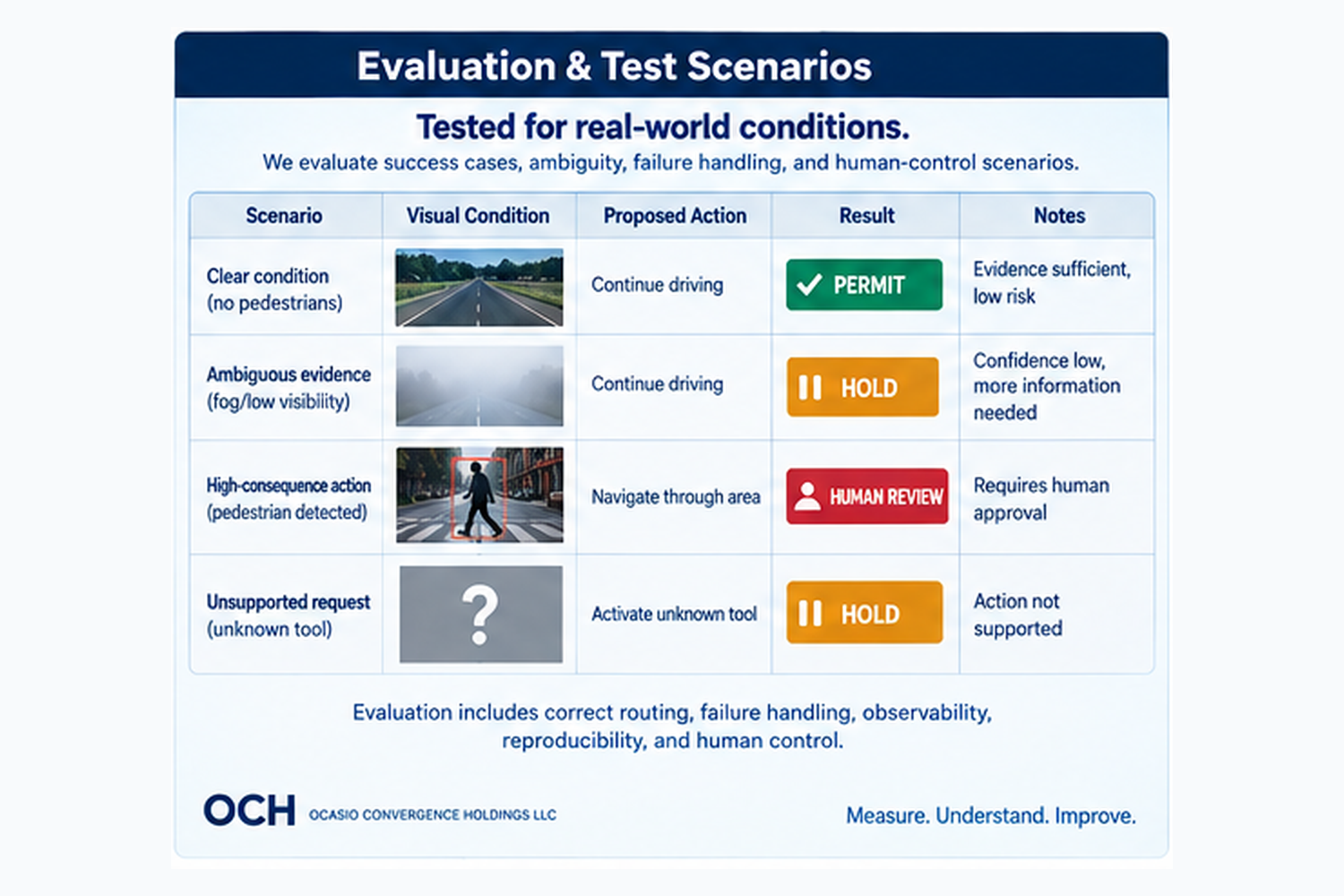
Evaluation focuses on:
- correct action routing;
- task success;
- failure handling;
- observability;
- reproducibility;
- appropriate human control.
Challenges
The hardest problem is not detecting something in an image. It is deciding what should happen next.
Agentic vision becomes more consequential when perception can trigger tools or real-world actions. That means uncertainty, unsupported requests, and human-review conditions need to be explicit rather than hidden inside an automated workflow.
A second challenge is reproducibility. Judges should be able to understand what was tested, under what environment, and where the system succeeds or fails. For this reason, the competition build is containerized, pinned, tested inside the image, stored in Amazon ECR, and deployed from a verified immutable digest.
What we learned
Adding an explicit control boundary between perception and action creates a richer way to evaluate an agentic vision system.
Instead of asking only:
Did the vision system detect the condition?
we can also ask:
Did the system take the appropriate next action?
That makes success, uncertainty, failure behavior, and human control observable.
Responsible use and limitations
Authority Vision is a narrow competition demonstrator using synthetic/public-safe inputs. It is not presented as a production safety system, operational access-control system, weapons or lethal-autonomy system, field-robust general vision system, or unrestricted real-world authority.
The demonstrator is designed to make decision boundaries and human escalation visible rather than to remove human responsibility.
Current status
The competition build is now running on AWS with OpenCV 5.0.0. The deployed ECS task is tied to the exact verified ECR image digest, the public health endpoint is live, and the public analyze workflow has been exercised successfully.
Authority Vision is a focused demonstration of how computer vision, agent orchestration, explicit action boundaries, evidence, and human oversight can work together in a practical agentic system.
Built With
- amazon-ecr
- amazon-ecs
- amazon-web-services
- docker
- fastapi
- opencv-5
- python
- uvicorn

Log in or sign up for Devpost to join the conversation.