-
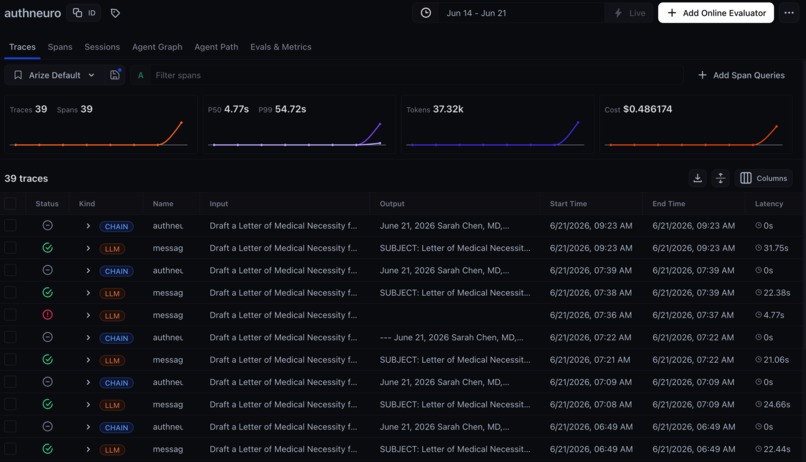
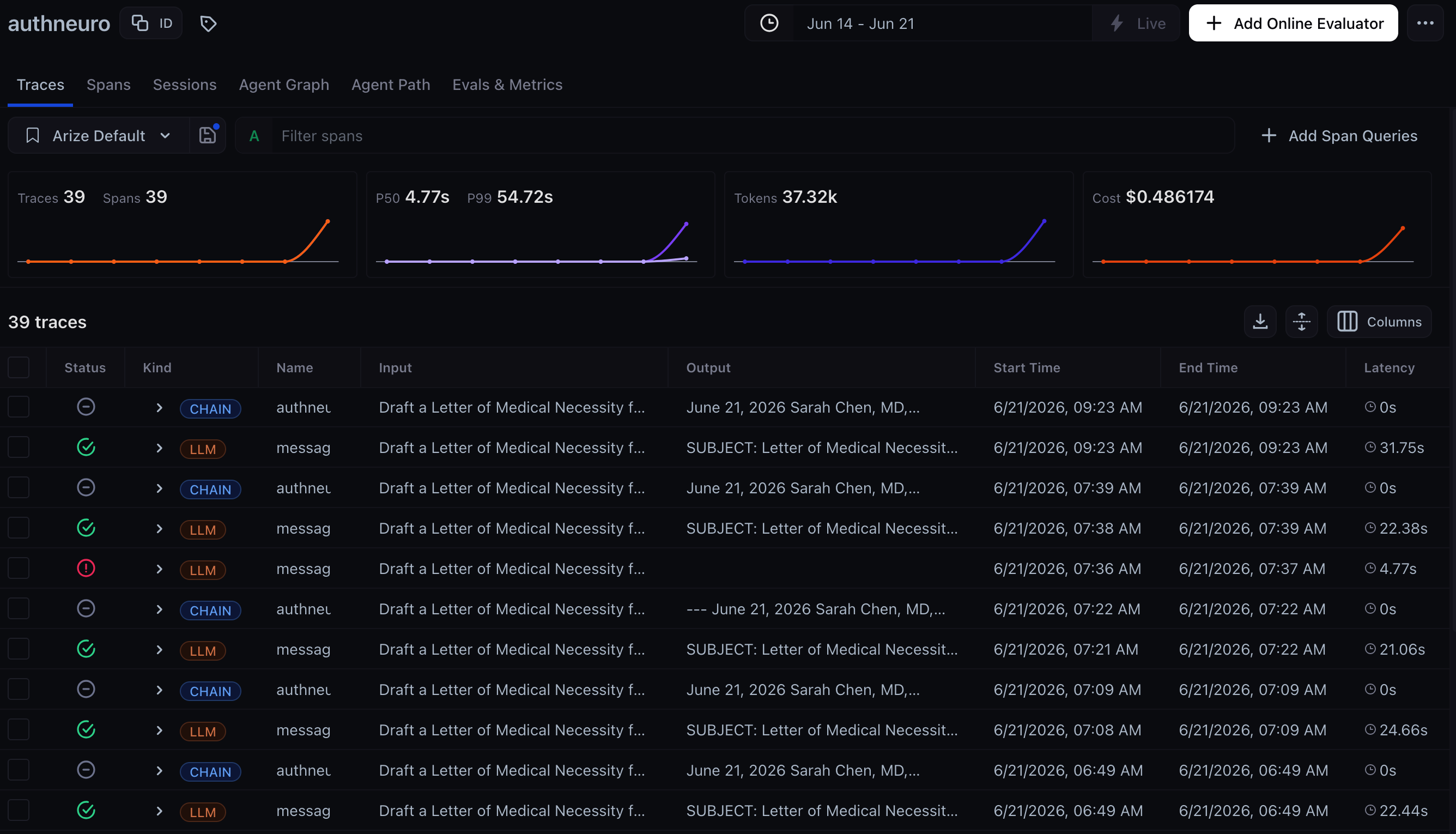
Clinical pipeline observability in action. AuthNeuro uses live Arize AX tracing to track reasoning lifecycle of every authorization request
-
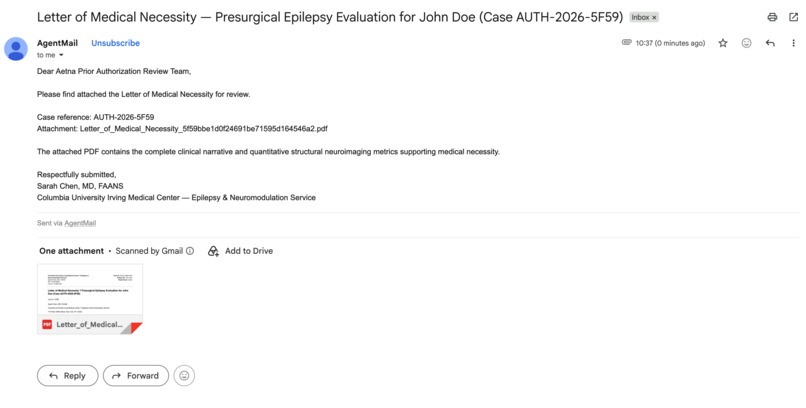
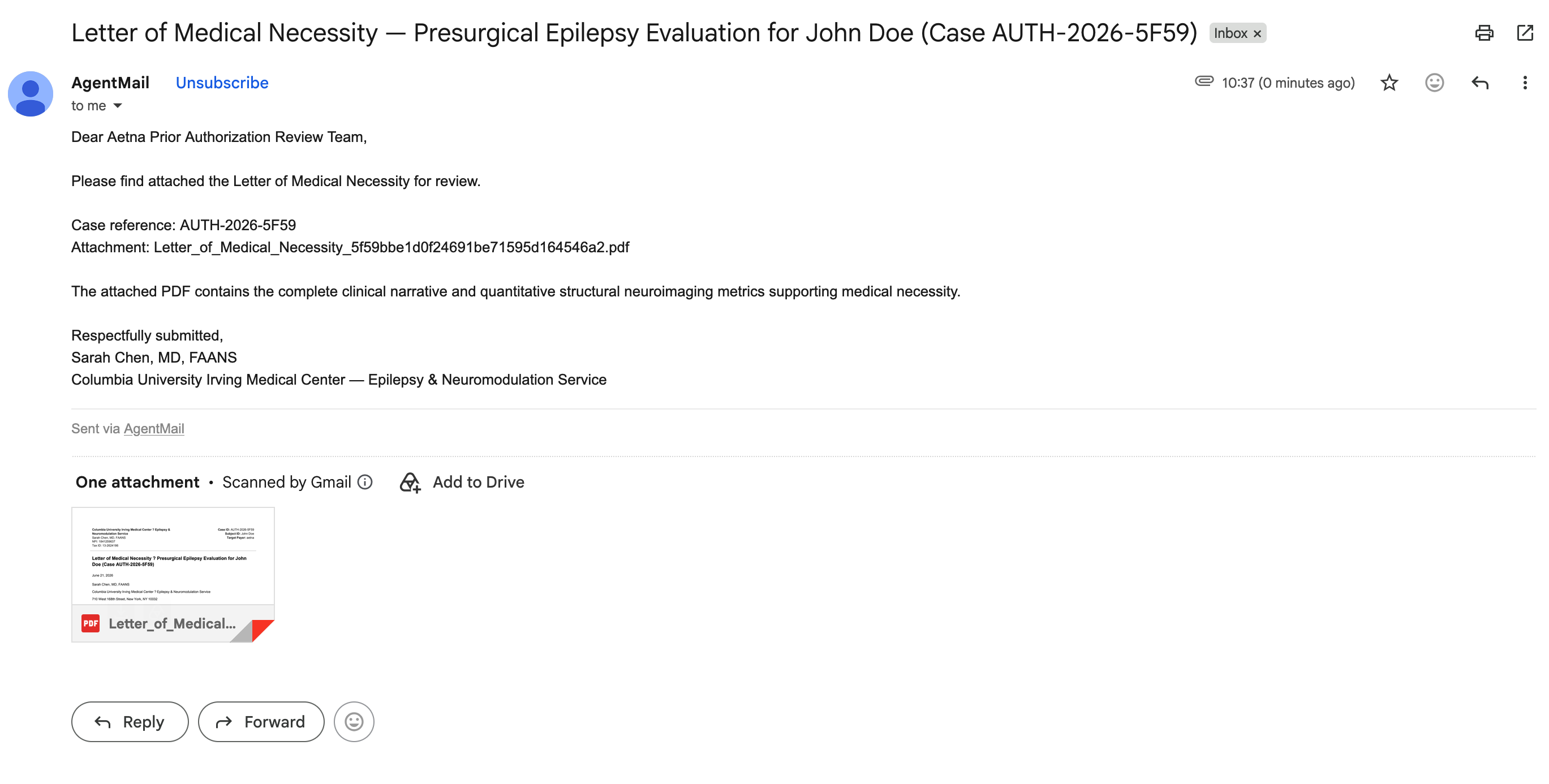
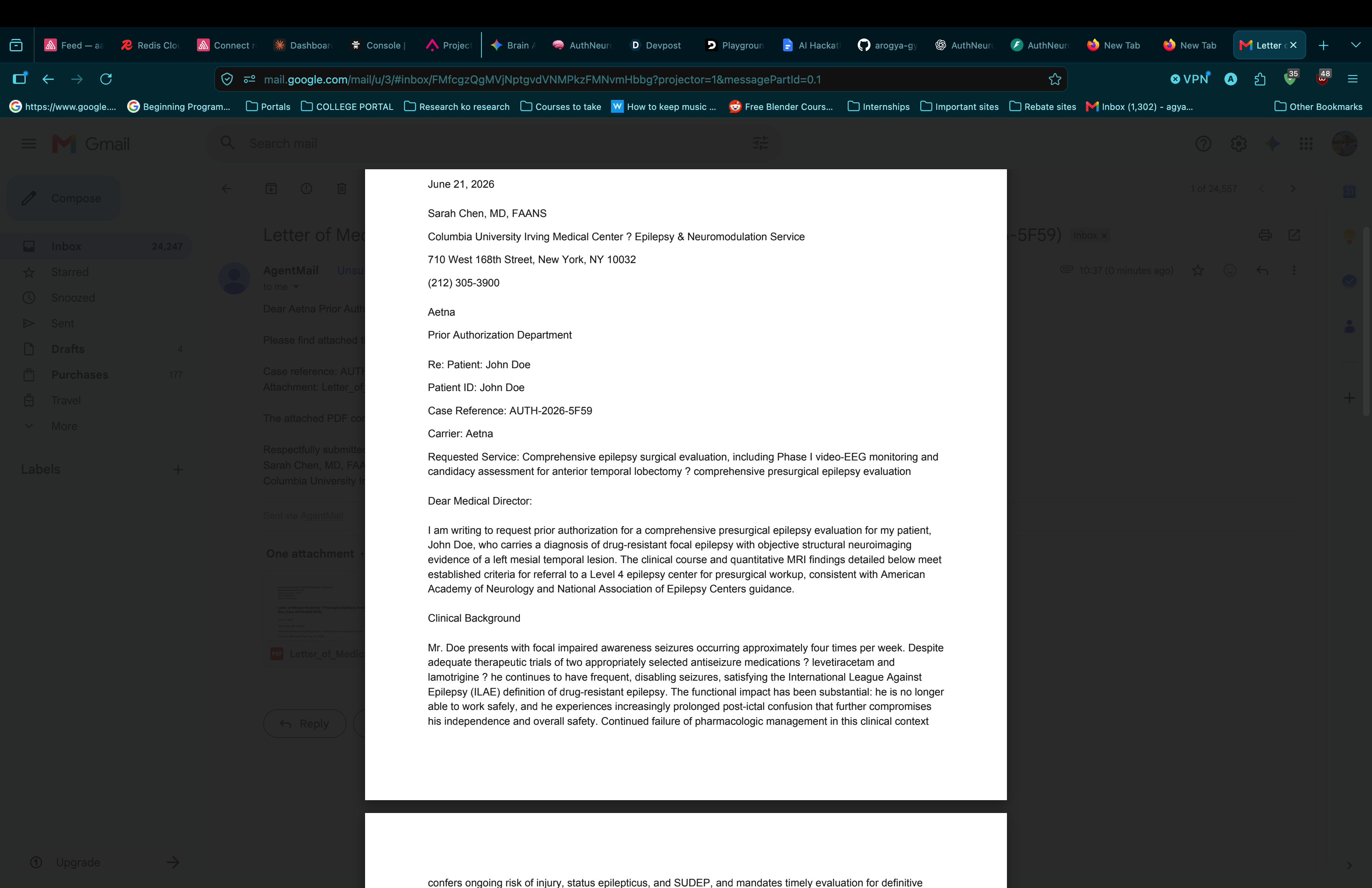
Email sent by an agent
-
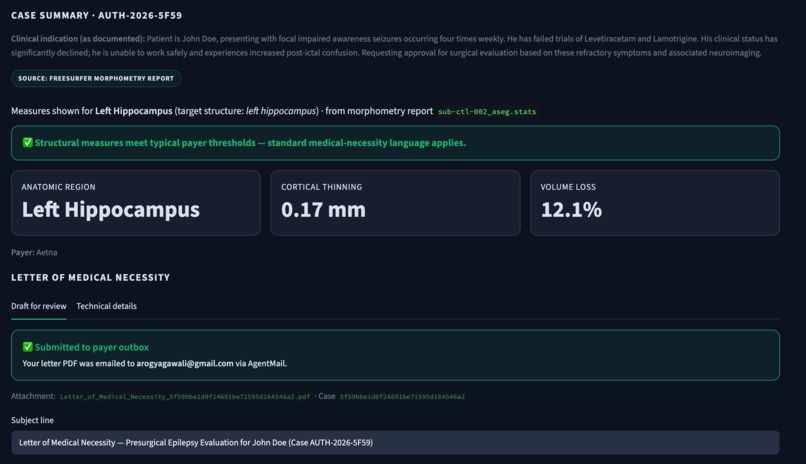
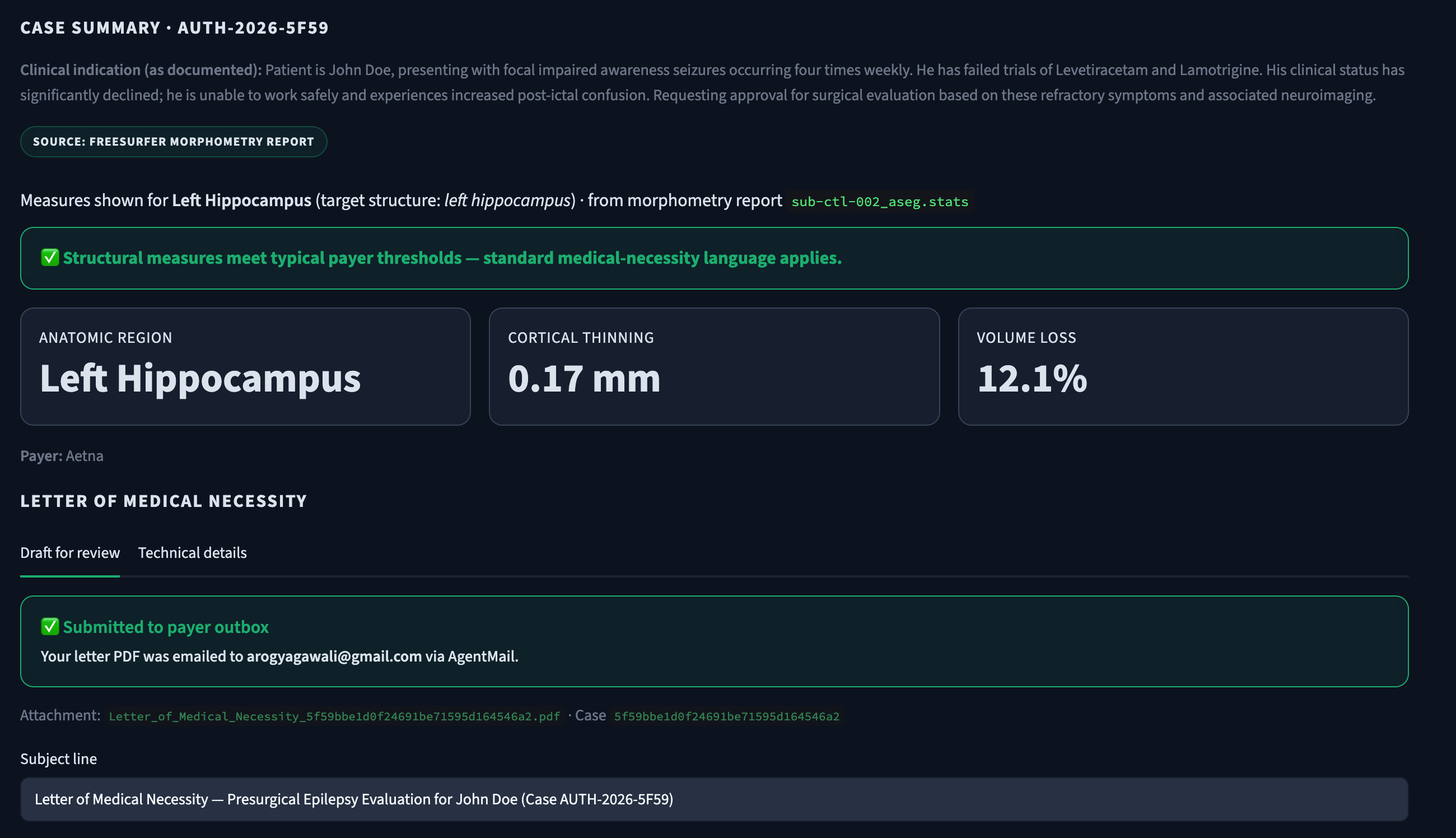
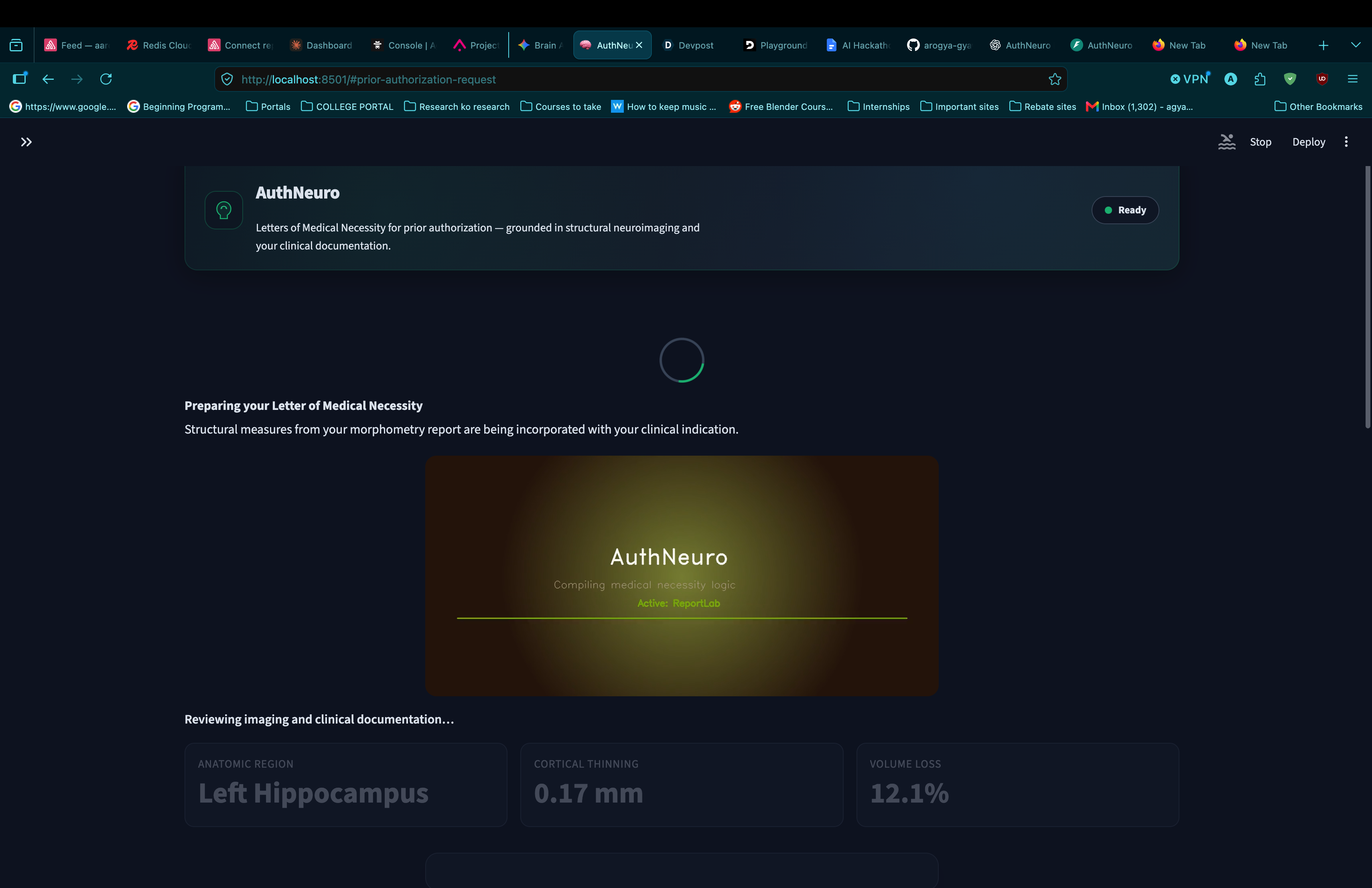
UI
-
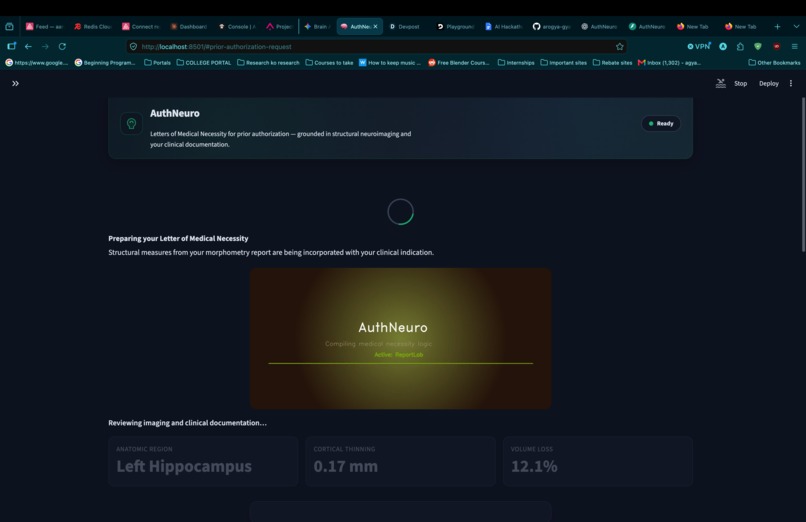
Generating letter draft
-
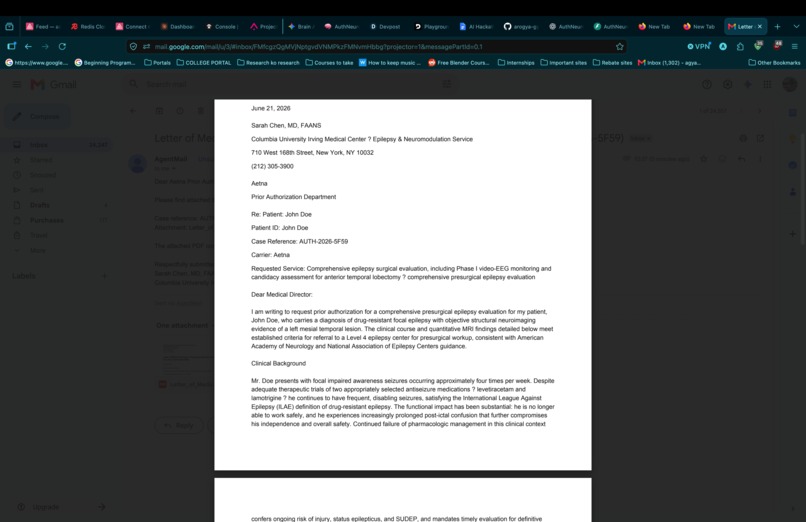
PDF
Inspiration
The inspiration for AuthNeuro was born from a realization of the disconnect between modern medical technology and administrative reality.
Having personally experienced the frustration of an insurance denial for a medically necessary surgical procedure, I understand what it feels like to be trapped in administrative limbo. While my own case involved a relatively minor surgery, the denial still resulted in a month-long delay in care.
That experience stayed with me. After developing my skills in software development and AI engineering, I wanted to solve this exact problem—the administrative "purgatory" patients face when insurers determine that treatment is not "medically necessary."
AuthNeuro is our attempt to bridge that gap and accelerate access to care.
What it does
AuthNeuro transforms neuroimaging data and physician documentation into payer-ready prior authorization packages.
The platform:
- Parses FreeSurfer
.statsneuroimaging files - Extracts clinically relevant structural metrics
- Combines imaging findings with physician dictation and clinical notes
- Generates professional Letters of Medical Necessity (LMNs)
- Validates generated content against source imaging data
- Produces submission-ready PDF and email outputs
The result is a streamlined workflow that reduces administrative burden while maintaining clinical integrity and traceability.
How we built it
AuthNeuro was architected as a high-integrity, end-to-end clinical workflow.
Clinical Reasoning Core
We utilized Claude Opus 4.7 to perform the heavy synthesis work, transforming raw structural neuroimaging metrics and physician documentation into professional, persuasive Letters of Medical Necessity.
Production Observability
To ensure reliability and operational visibility, we instrumented the backend using Sentry for:
- Real-time error monitoring
- Performance tracking
- Latency analysis
- Production debugging
Safety & Compliance
The backbone of the project is the Arize AX observability stack, where we implemented a multi-layered LLM-as-a-Judge evaluation framework.
Truth Layer
A dedicated evaluator mathematically verifies that generated clinical metrics exactly match the source-of-truth neuroimaging files.
Narrative Validation Layer
A second evaluator reviews outputs for completeness, ensuring the generated letter captures all clinically relevant details and patient context.
Challenges we ran into
Building AuthNeuro was not without significant hurdles.
Major Project Pivot
Midway through development, we were forced to abandon our original project direction entirely. This required rapid re-scoping, redesigning, and rebuilding under strict time constraints.
Overcoming Hallucinations
Clinical AI demands a much higher standard than traditional applications.
We learned that AI-generated clinical documentation must be treated as a hypothesis rather than a source of truth. To address this, we built programmatic guardrails that continuously cross-reference generated content against authoritative neuroimaging data sources.
This approach allowed us to create outputs that are both auditable and clinically trustworthy.
Accomplishments that we're proud of
We're incredibly proud of turning a complex vision into a functional, end-to-end prior authorization workflow.
True Clinical Integrity
The imaging data is honest.
Every metric appearing in the final Letter of Medical Necessity is derived directly from parsed FreeSurfer .stats morphometry rather than manual user input.
High Clinical Bar
We implemented a mandatory KPI attestation step requiring physicians to verify extracted metrics before document generation.
This was a deliberate design decision that prioritized patient safety over hackathon shortcuts.
Infrastructure Complexity
We successfully integrated an extensive healthcare AI stack, including:
- clabtoolkit
- Redis
- LangCache
- Sentry
- Claude Opus 4.7
- Arize AX
- Deepgram
- AgentMail
The resulting pipeline remains functional and resilient even when individual services experience configuration issues.
Resilient Pivoting
Perhaps most importantly, we're proud of our team's ability to completely change directions midway through development and still deliver a polished, production-quality solution.
What we learned
Systems Engineering > Prompt Engineering
Enterprise healthcare AI is fundamentally a systems engineering challenge.
While model prompting is important, the real innovation lies in building reliable validation, monitoring, and auditing infrastructure around AI systems.
The Necessity of Validation
Clinical AI becomes safer when generated outputs are treated as hypotheses that must be verified against authoritative data sources.
Programmatic guardrails and validation pipelines proved far more valuable than prompt optimization alone.
The Power of Pivoting
Being forced to abandon our initial idea taught us how to rapidly redefine scope, focus on core value, and still ship a high-quality product under pressure.
What's next for AuthNeuro
Version 1 proves the full workflow:
.stats → metrics → clinical note → LMN → PDF/email submission
The next phase is transforming the prototype into a deployable clinical product.
What we didn't do (and why)
EHR Integration & Auto-Fetch Imaging
Hospital integrations require PHI handling, compliance reviews, and institutional access. Manual uploads were sufficient to validate the core concept.
Real Payer APIs
Insurance authorization APIs remain fragmented and difficult to onboard. For demonstration purposes, AgentMail simulates successful submission workflows.
Authentication, Audit Trails & HIPAA Infrastructure
This project was intentionally built as a single-user localhost application. Compliance and enterprise security belong in the productization phase, not a weekend hackathon.
Appeals & Case Tracking
We intentionally scoped the project to first-pass prior authorization generation rather than the full appeals lifecycle.
Full Test Suite & CI/CD
Given time constraints, we prioritized live API smoke testing over comprehensive automated testing infrastructure.
How we move forward
Pilot Ingestion
- Automated watched-folder workflows
- FHIR-based imaging retrieval by MRN
- Manual upload retained as a fallback option
Trust Layer
- User authentication
- Comprehensive audit logging
- Attending physician sign-off prior to submission
Clinical Visualization
Provide physicians with interactive 3D visualizations of patient hippocampal, cortical, or vascular structures alongside extracted morphometric metrics.
Real Clinical Workflow
Expand from document generation to full authorization lifecycle management:
- Draft
- Submitted
- Under Review
- Approved
- Denied
- Appeals
- Case Tracking
Built With
- built-with-languages:-python-backend:-fastapi
- deepgram-(clinical-dictation)-neuroimaging:-clabtoolkit-(freesurfer-.stats-parsing)-caching-&-memory:-redis
- dictation
- github
- httpx
- job-state
- langcache
- metrics-extract
- openinference-(anthropic-instrumentation)-data-/-formats:-freesurfer-.stats
- pdf-download)-tools:-git
- pdf-infrastructure:-local-development-(redis-on-localhost);-api-keys-via-.env-apis:-rest-(/api/v1/authorize
- pydantic
- python-dotenv
- redis-agent-memory-email-/-outbox:-agentmail-api-observability:-arize-ax-(opentelemetry)
- reportlab-frontend:-streamlit-ai-/-llm:-anthropic-claude-(claude-opus-4-7)
- sentry
- uvicorn

Log in or sign up for Devpost to join the conversation.