Inspiration
Academic documents such as certificates, transcripts, research papers, and project reports play an important role in education and recruitment. However, verifying their authenticity manually can be time-consuming, and altered documents or copied content can be difficult to identify.
We were inspired to develop Authenticity Validator for Academia, a secure platform that combines cybersecurity techniques and AI-assisted analysis to help institutions assess the authenticity and integrity of academic documents.
What it does
Our platform is designed to analyze uploaded academic documents through multiple verification stages:
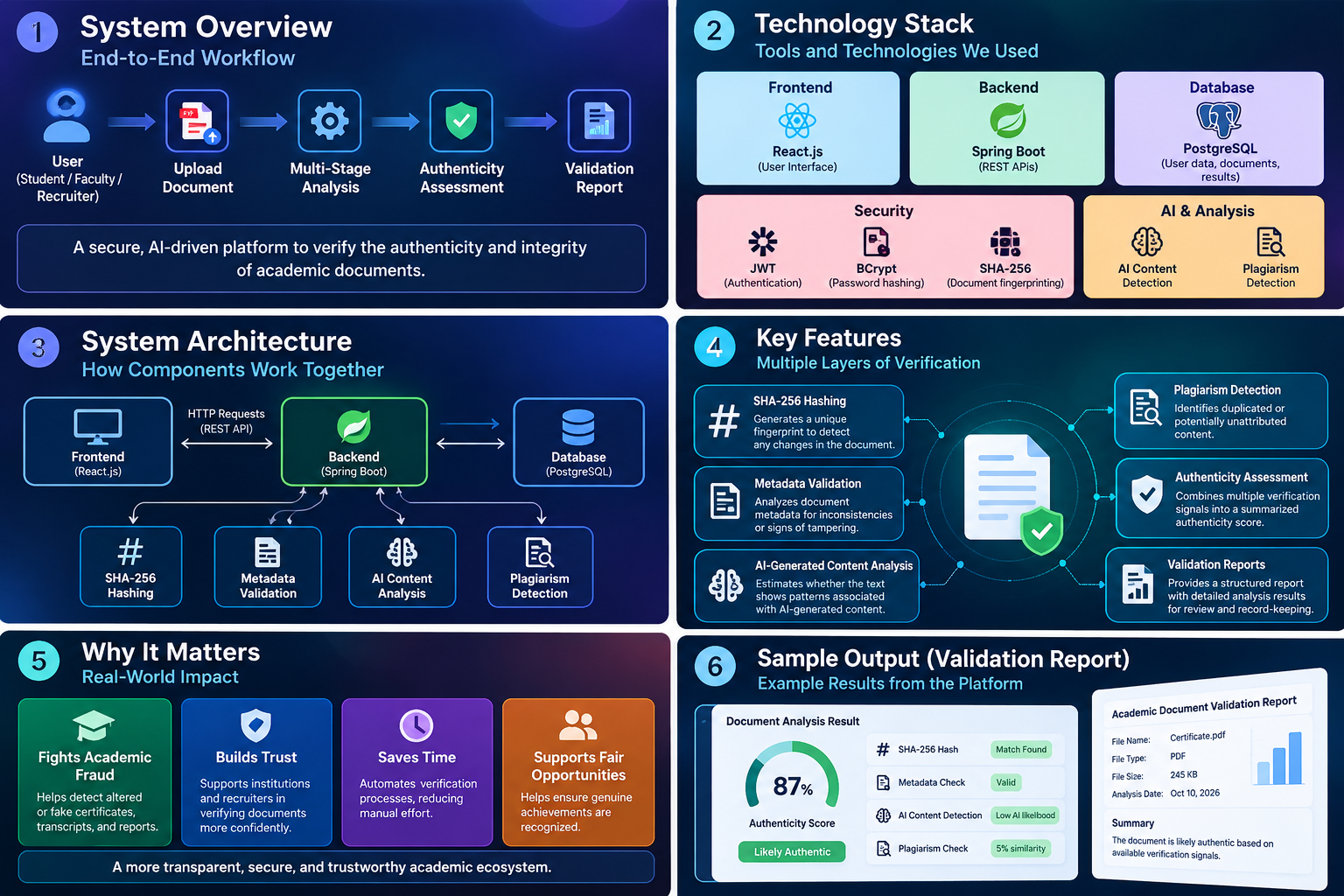
- SHA-256 Hashing: Generates a cryptographic fingerprint to help identify changes to a document.
- Metadata Validation: Examines available document metadata for inconsistencies that may indicate tampering.
- AI-Generated Content Analysis: Estimates whether document text contains patterns associated with AI-generated content.
- Plagiarism Detection: Helps identify duplicated or potentially unattributed text.
- Authenticity Assessment: Combines available verification signals into a summarized authenticity score.
- Validation Reports: Presents the analysis results in a structured report for review and record-keeping.
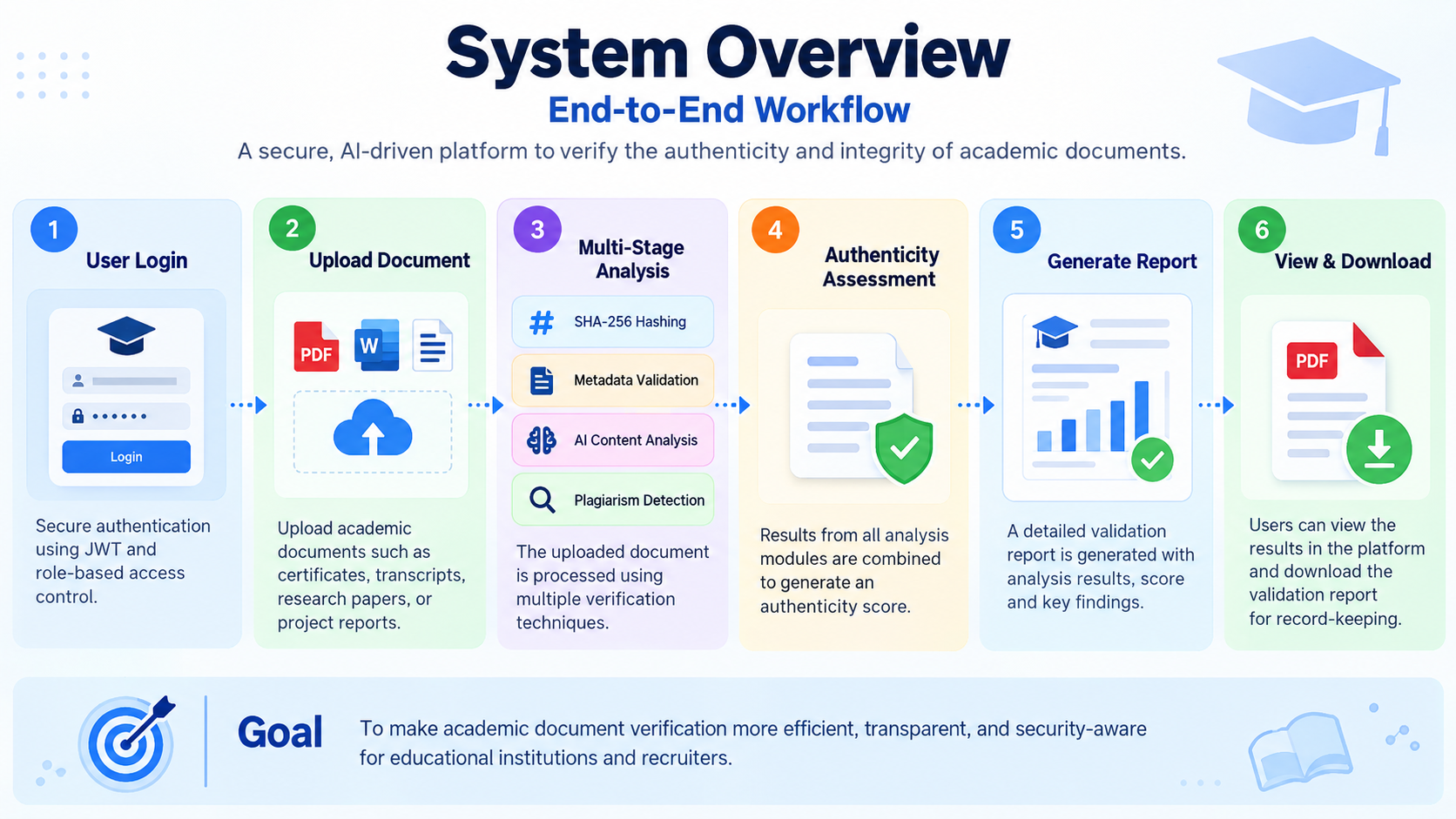
- Secure Authentication: Uses JWT-based authentication and role-based access control as part of the proposed security architecture.
How we built it
We designed the system around a modular web architecture:
- Frontend: React.js for the user interface, document uploads, dashboard, and reports.
- Backend: Java Spring Boot for REST APIs and application logic.
- Database: PostgreSQL for user accounts, document metadata, validation results, and audit logs.
- Security: Spring Security, JWT authentication, BCrypt password hashing, and SHA-256 document fingerprinting.
- Analysis pipeline: Metadata examination, AI-content analysis, and plagiarism checking.
The proposed workflow begins with user authentication, followed by document upload, analysis, authenticity assessment, and report generation.
Challenges we faced
One major challenge is that document authenticity cannot always be determined from a single signal. A matching hash can establish that a file matches a previously recorded fingerprint, but it cannot independently prove that the original document was genuine.
Another challenge is the reliability of AI-generated content detection. Human-written text may sometimes be incorrectly flagged, so AI detection results must be treated as estimates rather than definitive proof.
Plagiarism analysis also depends on the reference documents available for comparison. These limitations motivated our approach of combining multiple verification signals instead of relying on a single detection method.
What we learned
Through this project, we explored how cryptographic hashing, secure authentication, metadata analysis, AI-assisted text analysis, database design, and web application development can work together in a cybersecurity-focused application.
We also learned the importance of secure file handling, modular architecture, careful interpretation of AI results, and transparent reporting.
What's next
Our planned improvements include OCR support for scanned certificates, stronger verification through institutional records and digital signatures, performance testing, and further improvements to document integrity verification.
Our goal is to help educational institutions and recruiters make academic document verification more efficient, transparent, and security-aware.
Note: The platform is intended to support human verification, not replace official issuer checks or make definitive fraud judgments automatically.
Built With
- ai
- api
- css
- cybersecurity
- git
- github
- html5
- java
- javascript
- jwt
- machine-learning
- natural-language-processing
- postgresql
- react
- rest
- security
- sha-256
- spring
- spring-boot

Log in or sign up for Devpost to join the conversation.