-
Sanjivani Saathi Workflow: Watch agents track, redistribute, and deliver hope with drones, transforming rural healthcare!
-
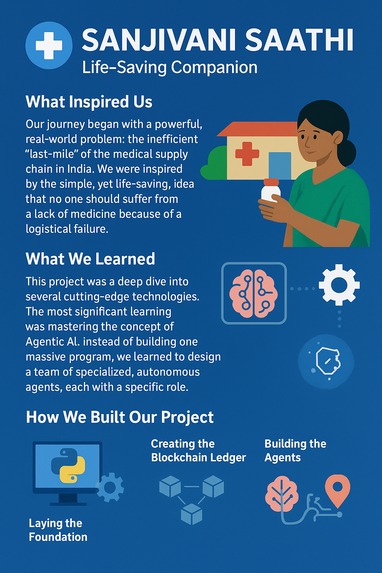


Our Project Story: Sanjivani Saathi What Inspired Us Our journey began with a powerful, real-world problem: the inefficient "last-mile" of the medical supply chain in India. We were inspired by the simple, yet life-saving, idea that no one should suffer from a lack of medicine because of a logistical failure. We often hear stories of rural clinics running out of crucial drugs, while a neighboring community has a surplus nearing its expiration date. We saw an opportunity to bridge this gap not just with technology, but with trust. This led to our project, Sanjivani Saathi (Life-Saving Companion), an agentic AI system designed to ensure every dose of medicine reaches its destination, minimizing waste and maximizing impact.
What We Learned This project was a deep dive into several cutting-edge technologies. The most significant learning was mastering the concept of Agentic AI. Instead of building one massive program, we learned to design a team of specialized, autonomous agents, each with a specific role. We understood how these agents could be orchestrated to work together to achieve a complex goal. We also gained invaluable hands-on experience with IBM's Generative AI models, using their capabilities for reasoning and decision-making—not just for generating text, but for predicting shortages and optimizing logistics. The project was also our first real-world encounter with blockchain, where we learned to appreciate its power as a public, immutable ledger for building a foundation of trust in a system.
How We Built Our Project Our implementation followed a structured, multi-stage approach:
Laying the Foundation: We started by setting up our core tools. We used Python as our main language and the IBM Agent Development Kit (ADK) as our primary framework for building and orchestrating the agents. For our secure, shared ledger, we provisioned an instance of the IBM Blockchain Platform.
Creating the Blockchain Ledger: We first designed the core asset of our system: the medical supply. We defined its properties—name, quantity, and expiration date—and programmed smart contracts to handle all transactions, such as a transfer of supplies from one clinic to another. This ensured every movement of medicine was transparent and verifiable.
Building the Agents: We then built our team of three specialized agents using the IBM ADK:
The Inventory Agent: This agent served as the "eyes" of our system. It continuously monitored a simulated inventory database and automatically updated the blockchain with any changes in stock.
The Shortage Prediction Agent: This was the "brain." It constantly read data from the blockchain. Using an IBM Granite model, it would analyze inventory patterns to predict potential shortages before they occurred, autonomously triggering the next agent.
The Logistics Agent: As the "hands" of the system, this agent received a command from the Shortage Agent. It used a generative AI model to calculate the optimal transfer route and executed the supply transfer via a smart contract on the blockchain.
Challenges We Faced Building an ambitious project in a hackathon environment came with its own set of unique challenges:
Agent Orchestration: The most significant hurdle was choreographing the interaction between our agents. Ensuring one agent correctly triggered another and that they communicated seamlessly proved to be more complex than initially thought. We overcame this through meticulous workflow design and extensive testing.
Blockchain Integration: As beginners, integrating with a live blockchain network was a learning curve. Understanding how to correctly define assets, submit transactions, and manage user permissions was a challenge that required a lot of trial and error.
Data Simulation: Since we didn't have access to real-world medical inventory data, we had to build our own data simulator. Creating realistic scenarios of fluctuating stock levels and expiration dates was crucial to effectively demonstrate our project's value. We spent a good amount of time carefully crafting these scenarios to test the agents' predictive and decision-making capabilities.
