Inspiration
When subscription customers start cancelling, the usual fix is a discount for everyone. It feels safe, but most of that money goes to people who were never going to leave, while the people leaving over price are only a small share. You also can't easily test a pricing change without risking real revenue, so most merchants guess.
I wanted a tool where an AI agent does the analysis and you test a decision on a model of your own customers before anything changes. When you approve one, it's carried out in PayPal, and what customers actually do updates the model.
What it does
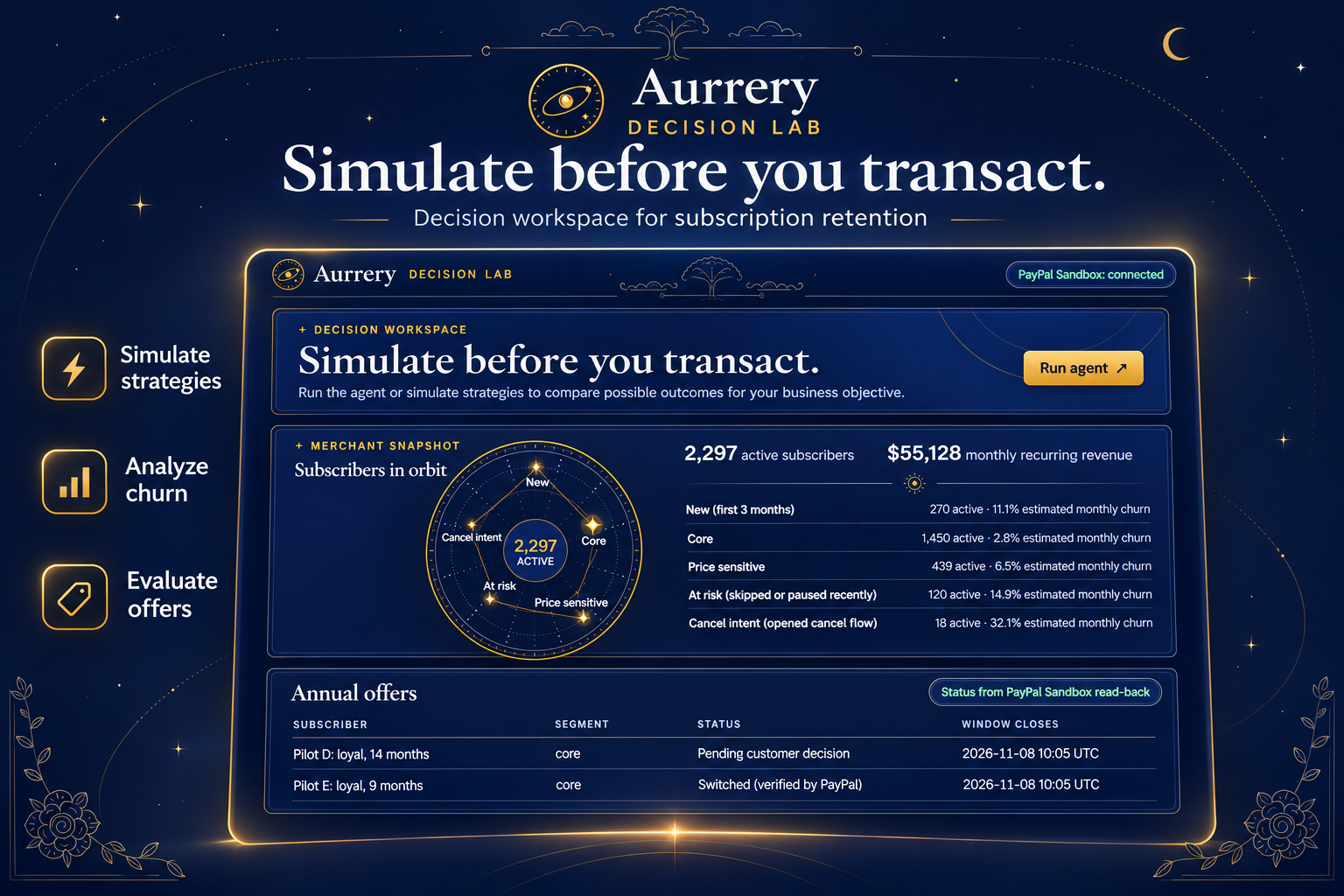
Aurrery is a decision workspace for subscription merchants.
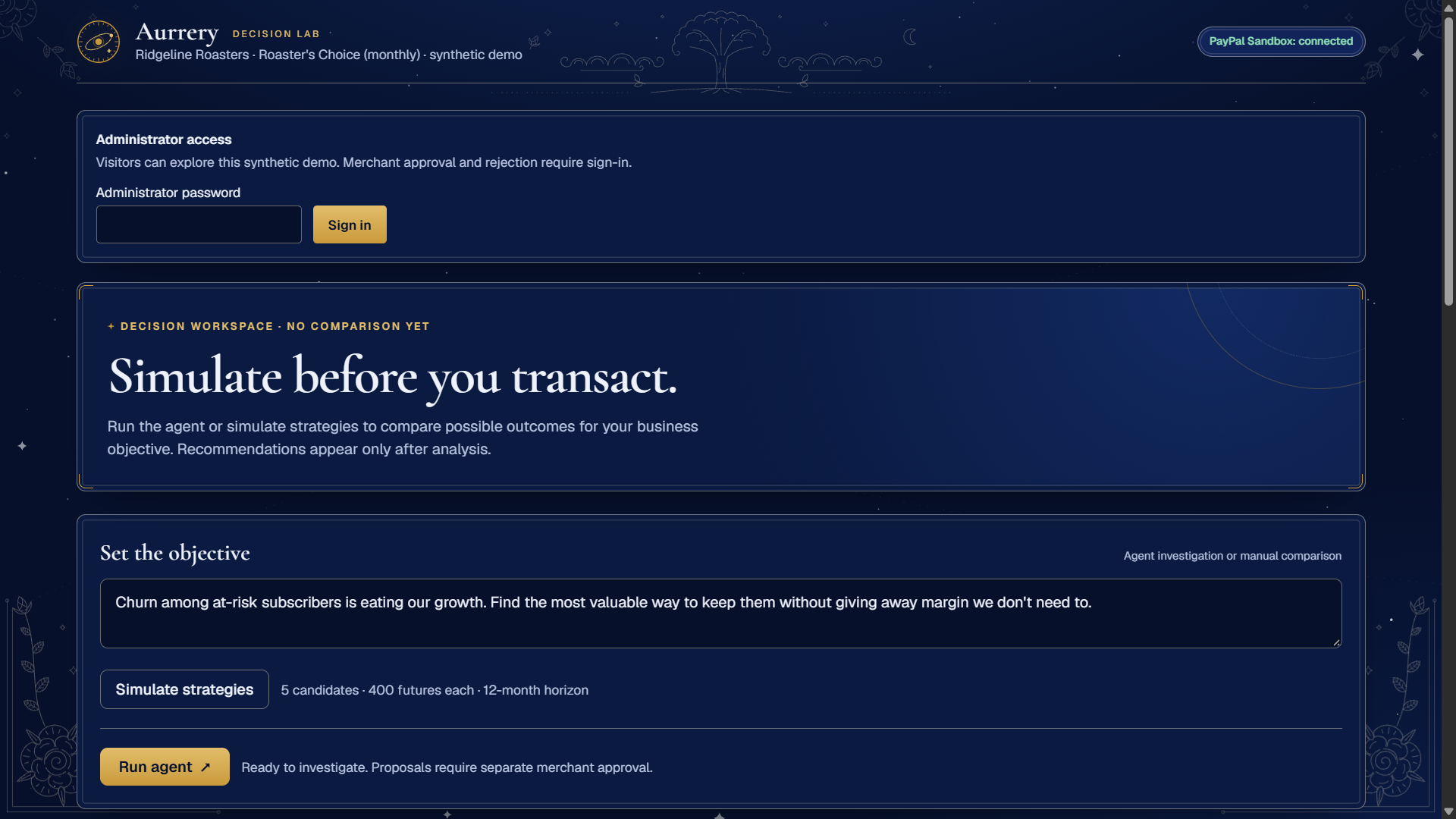
- You state a goal, for example "reduce churn without giving away margin".
- An AI agent investigates. Gemini reads customer cancellation feedback and sorts each message into "leaving over price" or "leaving for another reason". It then sets rules, compares candidate strategies on a digital twin of the subscriber base, and stress-tests the best ones.
- The twin simulates 400 possible futures for each strategy, so you see a range of outcomes, not a single guess. In the demo, a broad 20% discount gives away about $4,000 and still loses over $1,000 in value, and it does worse than doing nothing in about three of four futures. The agent instead proposes a 25% save offer only to customers cancelling over price.
- Every number is labelled as observed, estimated from history, or assumed. The stress test pushes only the assumed numbers to a pessimistic level, so you can see whether the decision still holds if the guesses are wrong.
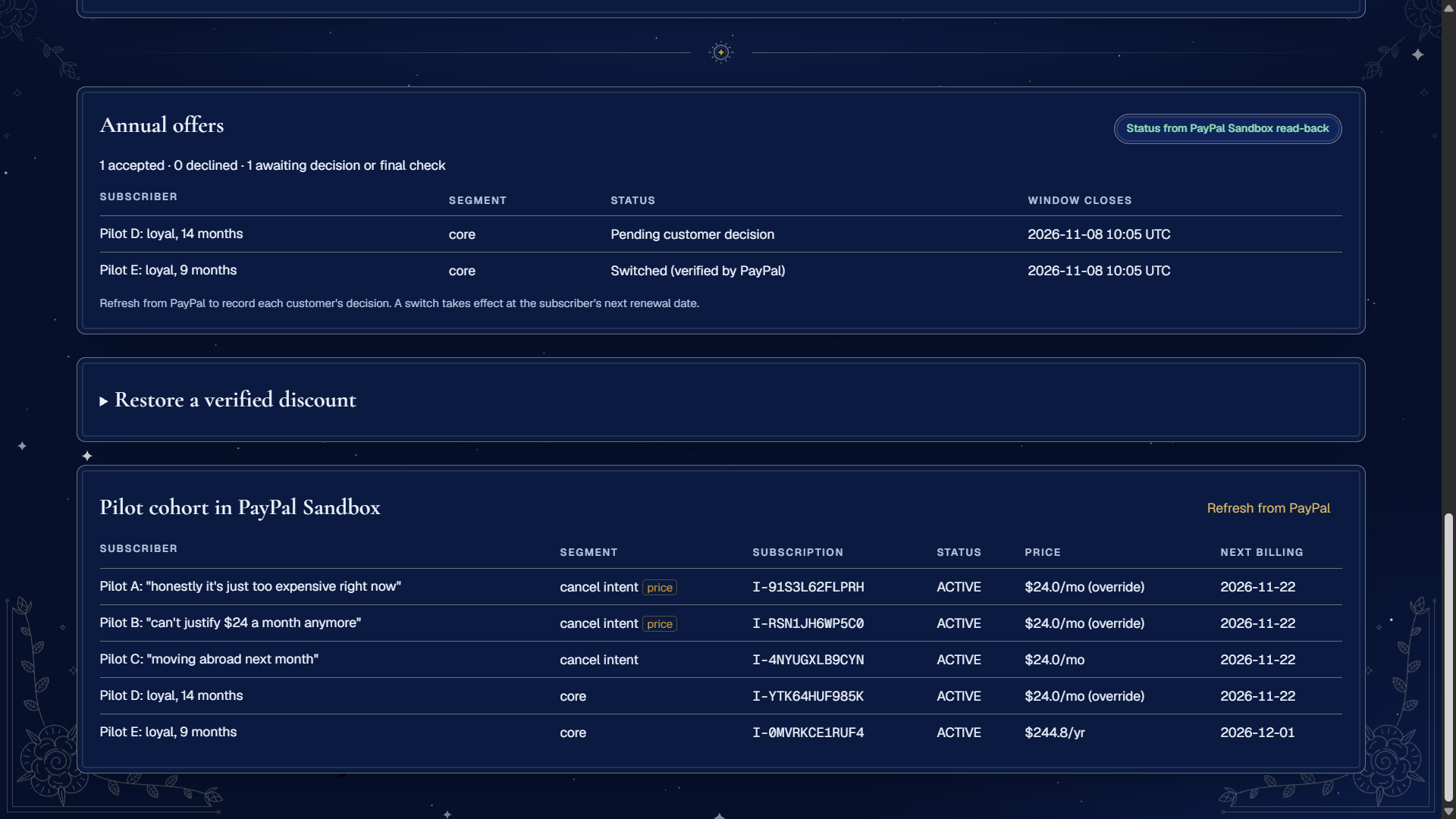
- You approve one exact action. It names the price, the customers it applies to and its duration, and is locked by a hash. Aurrery then carries it out through the PayPal Subscriptions API: it changes the price ($24 → $18), reads the subscription back and records what PayPal actually reports, not what was requested.
- It learns from the outcome. Annual-plan offers go out as PayPal plan-change approvals. When a customer accepts or declines, the twin updates; after one acceptance, the core segment's annual uptake moved from 12% to about 15%.
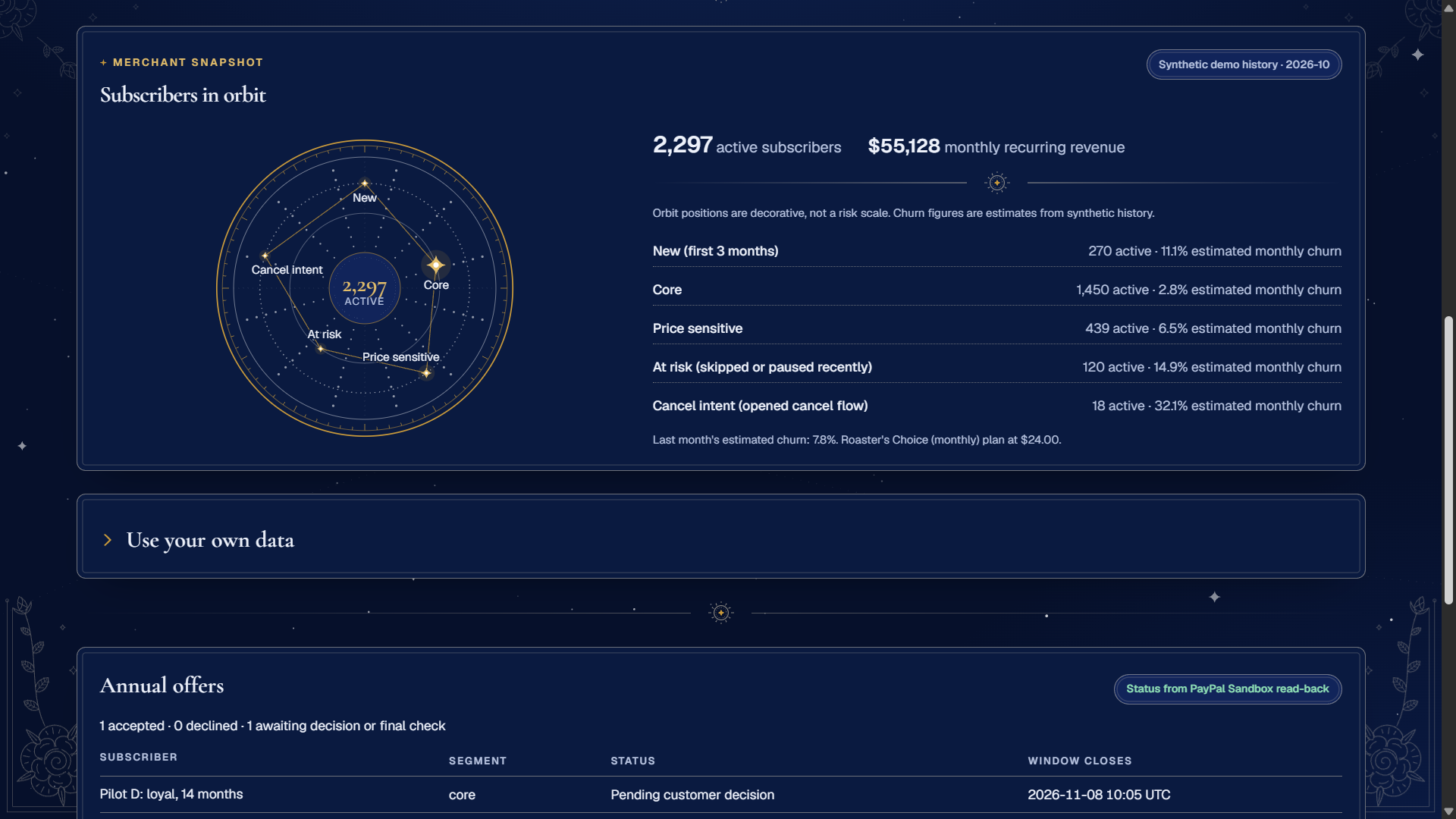
- It works for other merchants. Import a subscription history CSV, and optionally a feedback CSV, and Aurrery builds a twin of that business. The same 20% offer that loses money for the coffee merchant makes over $2,000 in simulation for a dog-treat box. Imported merchants are simulate-only.
The agent has no tool that can execute anything. It can only propose, and a merchant must confirm and approve before PayPal is touched.
How I built it
- App: Next.js 16, React 19 and TypeScript, styled with Tailwind v4. The comparison grid uses AG Grid, and the fan charts and range bars are custom SVG.
- Digital twin: a pure TypeScript Monte Carlo model.
- Customers are grouped by segment, cancellation reason, plan and discount state.
- Each month models signups, cancellations scaled by price sensitivity, payment failures, offer expiry and customers moving between segments.
- Cancel rates are estimated from history with Bayesian updating. Price sensitivity and discount effects start as labelled assumptions with wide uncertainty.
- Strategies share the same random draws for customers they don't touch, so differences come from the decision rather than noise.
- Simulations run in a separate worker process.
- AI: Gemini 3.5 Flash-Lite.
- Feedback classification: I evaluated it against a hand-labelled set of 200 messages. It agreed on 96% and classified every pilot customer correctly.
- Agent: it runs in a bounded loop with seven strict tools, capped at 10 tool calls, 11 turns and 48,000 tokens.
- Displayed numbers: these come from typed simulation results, never from the model's prose.
- PayPal: Sandbox Subscriptions API and webhooks.
- Price changes are sent as a patch, followed by a read-back.
- Annual offers are created as a yearly plan plus a plan-change approval link for the customer.
- Webhooks are only trusted after PayPal's verification call confirms them.
- Every execution claims its target customers in one database step, so the same action can't run twice.
- If PayPal's response is unclear, Aurrery stops for a manual check instead of retrying.
- Data and hosting:
- A Turso (libSQL) ledger holds proposals, executions, observations and audit records.
- It's hosted on Render.
- Admin sign-in is required for any action that changes PayPal.
- Testing:
- The test suite uses Vitest.
- Recorded agent runs replay offline through the real tools and simulator.
- Input validation uses Zod.
Challenges I ran into
- There was no price-change history to learn from. The twin can't measure price sensitivity from data that doesn't exist. Instead of hiding that, I labelled those numbers as assumptions and built the stress test around them.
- Keeping the AI honest. Early runs described assumptions as observed facts and confused the median with the mean. I moved every displayed number and label onto typed simulation results, so the model's text explains the numbers but never supplies them.
- Safe execution against a real API. PayPal has no conditional price update, and a network timeout can leave it unclear whether a change happened. I built a claim-then-execute flow that refuses to retry automatically and leaves an uncertain action for the merchant to check.
- Agent budgets. Free-tier limits and token caps meant the agent sometimes ran out mid-investigation. I tuned the limits, pacing and tool design until full runs completed reliably on free hosting.
Accomplishments that I'm proud of
- A real closed loop: the AI proposes, the merchant approves, PayPal executes, Aurrery verifies the result, and the model learns from it.
- The demo shows the AI-assisted answer beating the obvious one. The broad discount most merchants would reach for loses money, and the twin shows why.
- The app is open about uncertainty: every number says where it came from, and the stress test shows when a "win" could disappear.
- The AI never gets the power to move money. It can only propose.
What I learned
- A forecast is only useful if it's clear which parts are measured and which are guessed.
- Let the AI decide what to investigate, but let typed code produce the numbers people act on.
- With payment APIs, the hard part isn't the call that changes the price. It's knowing for certain what happened afterwards.
What's next for Aurrery
- Connect real merchant data directly from PayPal subscription history instead of CSV uploads.
- Learn price sensitivity from experiments. Run small, approved price tests on a few customers and feed the results back, so assumptions become estimates.
- Add more actions: pauses, plan downgrades and win-back offers, each under the same simulate-then-approve flow.
- Scheduled monitoring: the agent notices rising cancellations and proposes a response for the merchant to review.
