-
-
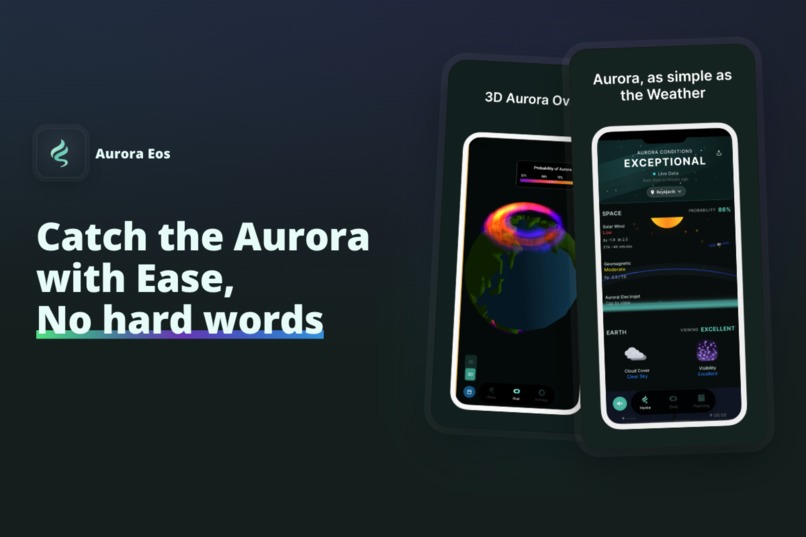
Aurora Eos—a beginner-friendly app that delivers intuitive and accurate forecasts.
-
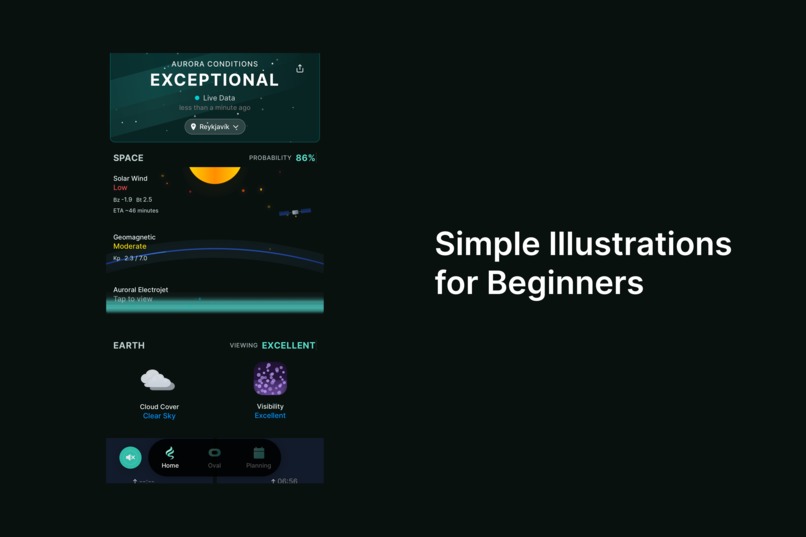
Illustrations of the full process: from the Sun, to Earth’s magnetic field, to the sky above us.
-
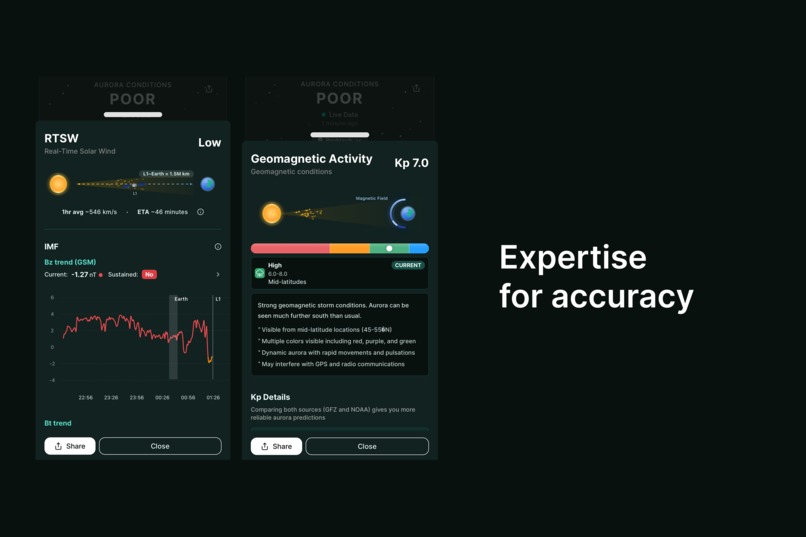
Professional charts for those who want more depth.
-
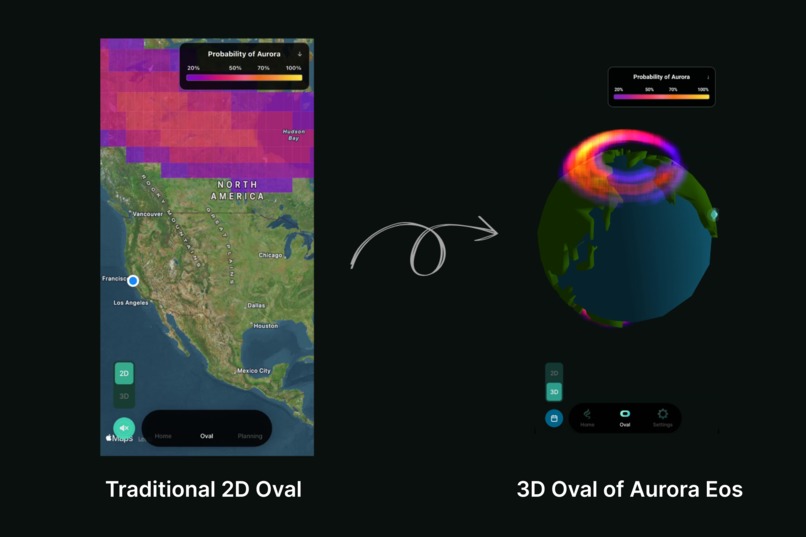
A 3D oval to see how far the aurora extends—your chance at a glance.
-
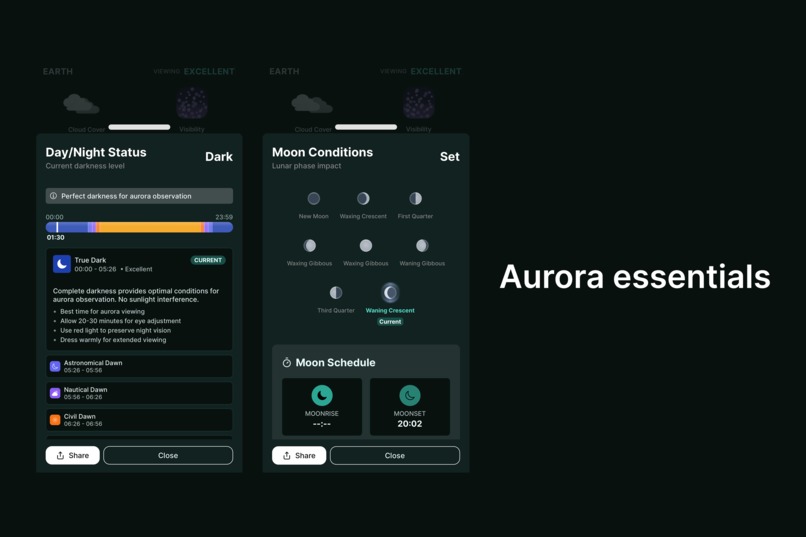
Integrated essentials for aurora hunting


Inspiration
Earlier this year, I left Korea to spend four months as a digital nomad in Ottawa, Canada. I learned that 2025 marks the Solar Maximum, which occurs only once every 11 years, and I wanted to see the Northern Lights with my own eyes. However, I quickly realized how difficult it was to interpret the scientific jargon and raw charts that most aurora forecast apps rely on. This challenge inspired me to create a tool that would make the aurora understandable for everyone.
What it does
Aurora Eos simplifies aurora forecasting so that even beginners can follow along. The app parses professional space weather data—such as the KP index, Bz component, and solar wind—and translates it into intuitive illustrations and 3D visuals. Each stage of auroral activity is arranged to mirror the real physical process, creating a forecast experience that feels both educational and visually intuitive.
How we built it
Aurora Eos was built with React Native + Expo for cross-platform support and integrated RevenueCat to handle subscriptions. Using Three.js, I developed animated 3D auroral ovals, while Firebase Functions and FCM power real-time alerts for geomagnetic events.
I studied the fundamentals of aurora science with the help of Perplexity and implemented APIs from NOAA, GFZ, and NASA to fetch live solar wind and geomagnetic data, along with local weather forecasts.
Challenges we ran into
- Complexity of the phenomenon: Aurora depends on many variables—solar wind, geomagnetic activity, and local viewing conditions. Grouping and presenting these indicators in a clear way was difficult.
- Forecast range: Users need both real-time alerts and long-term forecasts. I adopted familiar weather-app UX patterns to combine aurora data with location-based weather.
- Field testing: I went aurora hunting multiple times in Canada to validate the app against reality. Compared to other forecast apps, Aurora Eos was the first to notify me of KP index changes—an important differentiator.
Accomplishments that we're proud of
- Gained the first paying subscriber within one day of launch.
- Successfully used the app for real aurora hunting in Canada—after two months and three attempts, I finally saw the Northern Lights.
- Transformed complex datasets into intuitive 3D illustrations, making forecasts both accessible and accurate.
What we learned
- Visual explanations add tremendous value beyond simple numerical forecasts.
- SaaS tools like RevenueCat dramatically accelerated development in a short cycle.
- Field testing was crucial: direct aurora hunting experiences shaped feature design and improvements.
What's next for Aurora Eos
- Develop more precise models, including AI-driven interpretation of space weather data.
- Expand globally with multilingual support.
- Add community features, enabling users to share their aurora photos and stories.
- Extend beyond aurora to other space and astronomy data.


Log in or sign up for Devpost to join the conversation.