Inspiration
It's Monday morning. A customer emails — their $200 order never arrived, they've contacted support three times already, and each time a different agent gave a different answer. Not because the agents were careless. Because the system has no memory.
Every enterprise support platform treats LLMs as stateless oracles: paste the transcript, get a reply, throw the state away. The agent never knows the customer. It cannot see that this is their fourth contact about the same order, that they're a high-value customer at churn risk, or that the last agent promised a refund that was never actioned.
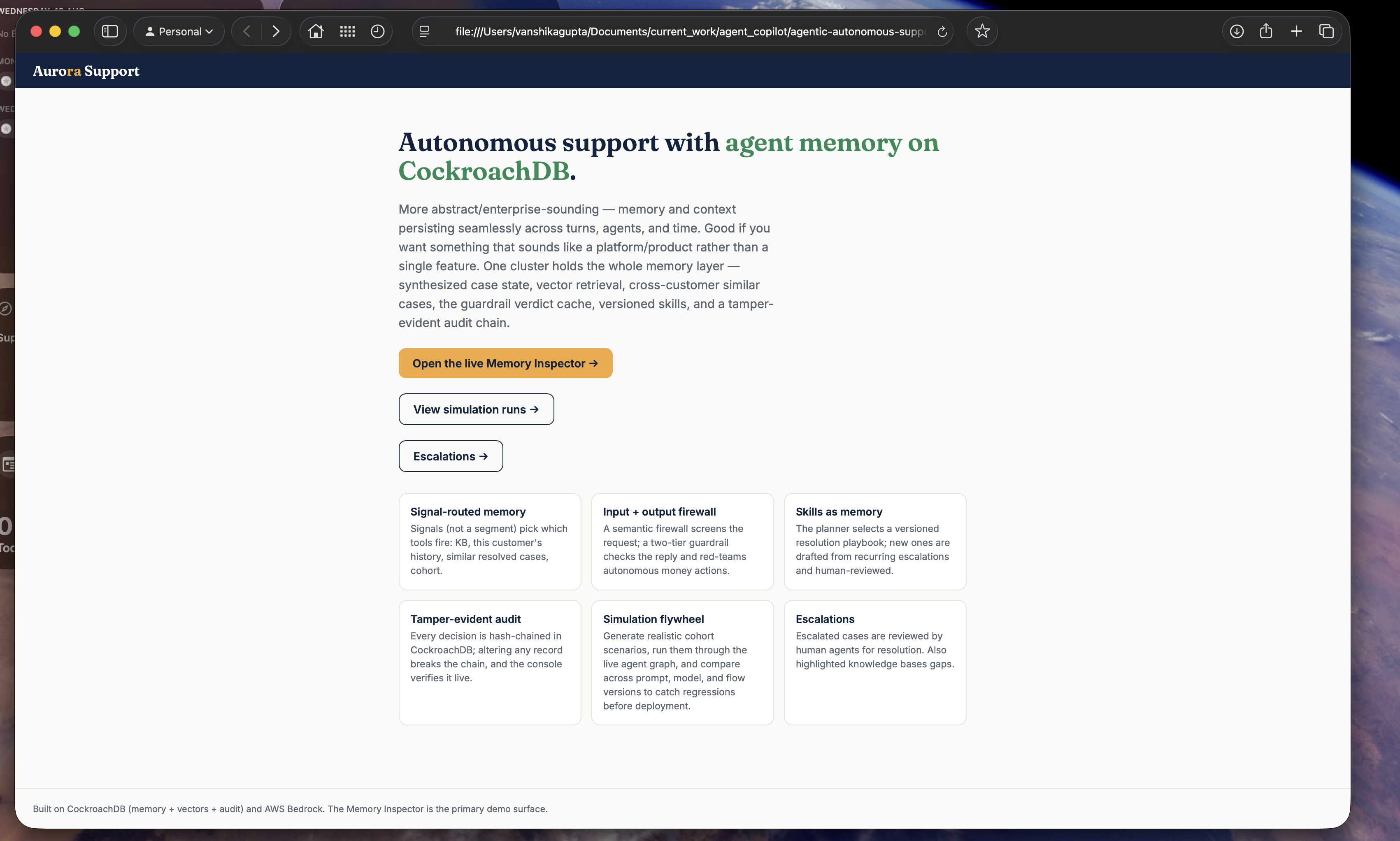
We built Aurora Support to fix that — not with a better prompt, but with a proper memory architecture.
What it does
Aurora is a fully autonomous e-commerce customer support agent built around a single principle:
CockroachDB is the agent's persistent, queryable, verifiable brain.
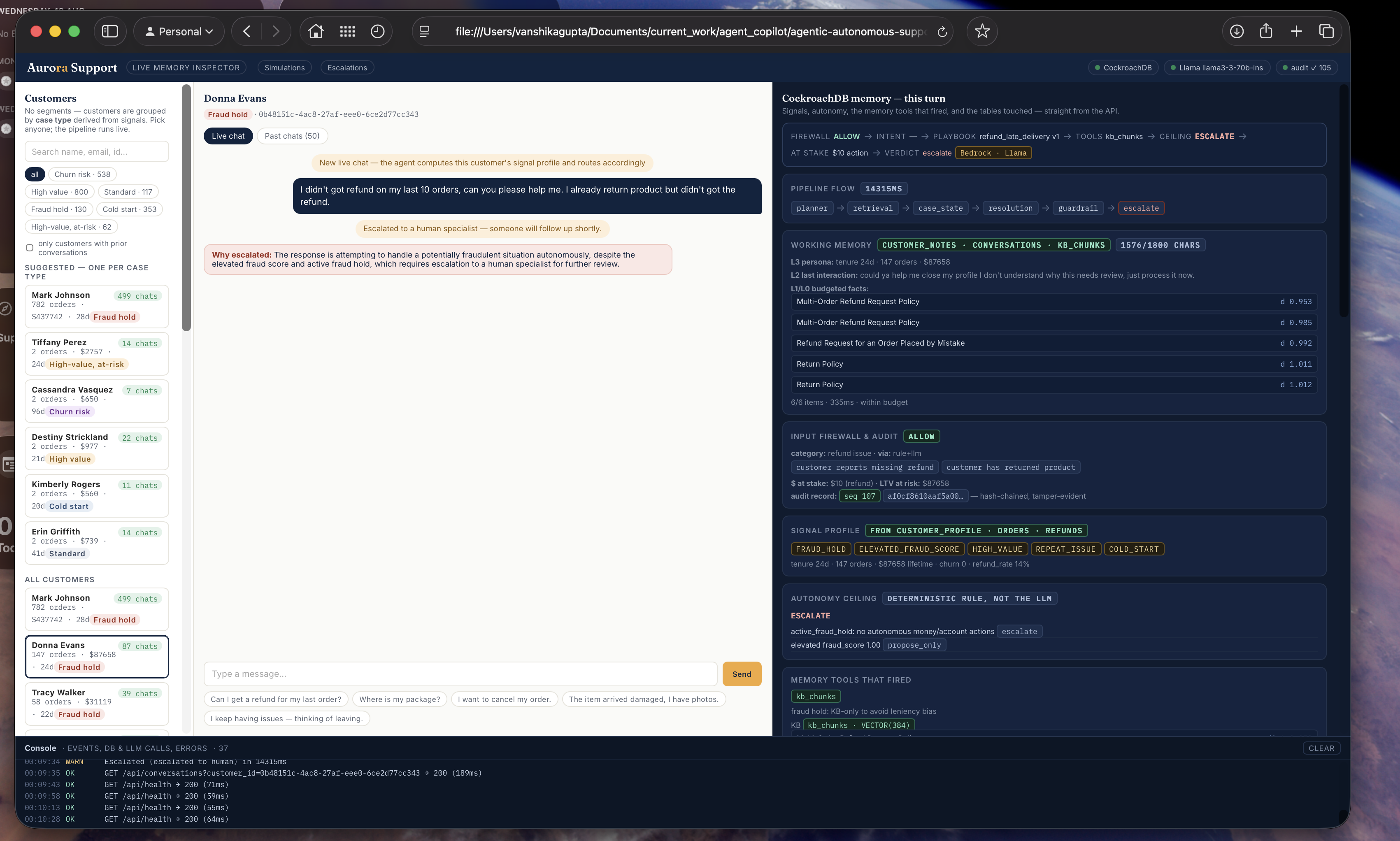
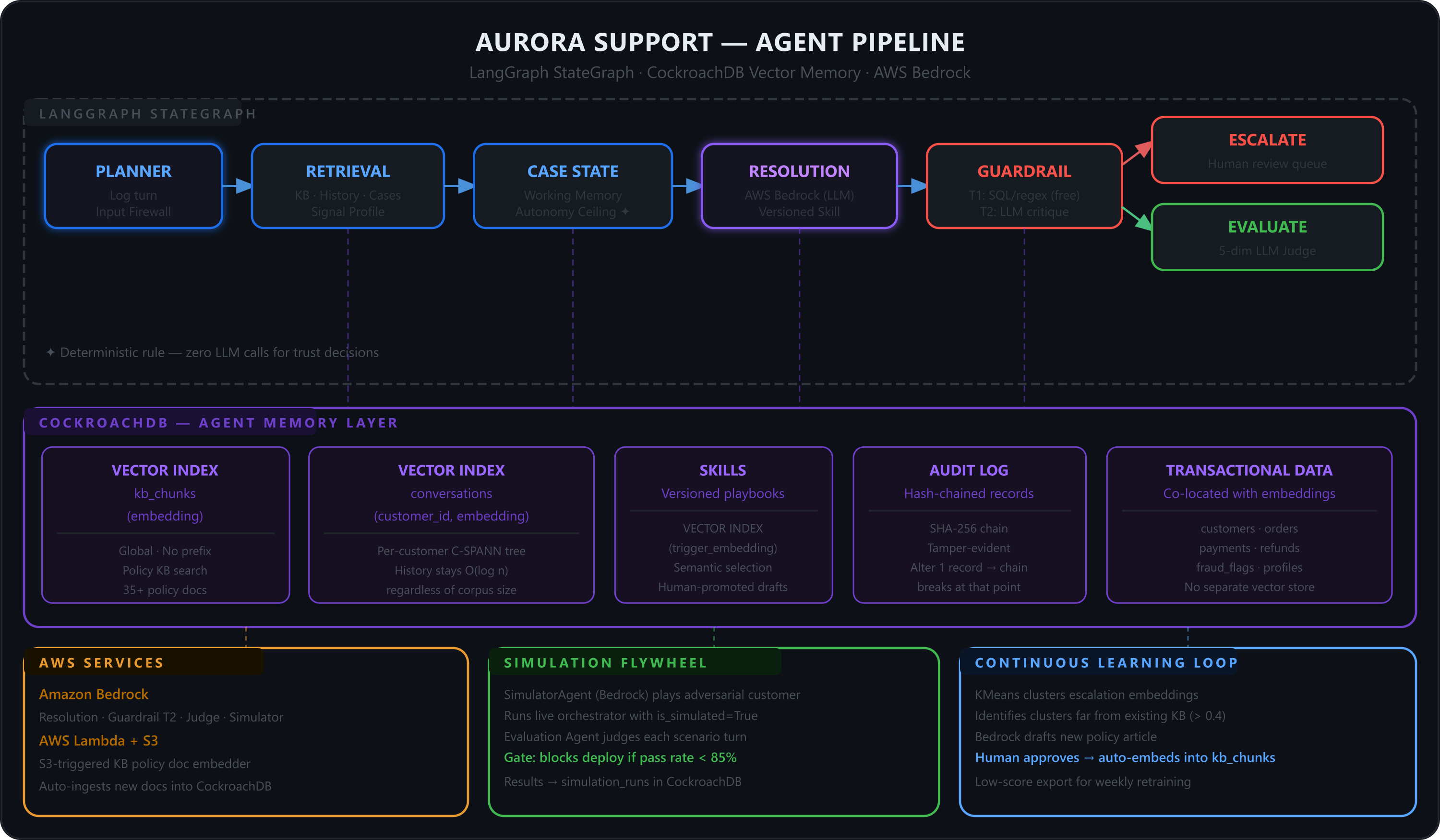
Every support request runs through a typed, 6-node LangGraph pipeline:
planner → retrieval → case_state → resolution → guardrail → {escalate | end}
Before the LLM writes a single word, the agent has already:
- Retrieved the customer's full transaction and conversation history via per-customer vector index (C-SPANN partition in CockroachDB)
- Pulled the 3 most relevant KB policy passages via
<->distance search - Found the most similar previously-resolved case across all customers
- Computed an autonomy ceiling —
act,propose_only, orescalate— from deterministic rules with zero LLM calls - Assembled bounded working memory (1800-char budget) so the model only sees what it needs
After the LLM responds, a two-tier guardrail fires:
- Tier 1 (SQL, no model call): checks groundedness against KB, DB fact consistency (dollar amounts, order status), language match, and autonomy compliance
- Tier 2 (LLM adversarial critique): fires only on tier-1 failures — with a SHA-256 verdict cache so we never pay twice for the same scenario
Every turn is hash-chained into a tamper-evident audit log. The system scores itself on 5 dimensions per turn with an LLM judge. When scores fall below threshold, it clusters its own escalations, drafts new KB articles, and queues them for human review — a continuous improvement loop that runs automatically.
Key design numbers:
| CockroachDB vector indexes on the critical path | 3 |
| Guardrail tier-1 LLM tokens cost | 0 |
| Autonomy ceiling LLM tokens cost | 0 |
| Evaluation dimensions per turn | 5 |
| Simulation flywheel deploy gate | 85% pass rate |
| KB policy documents | 35+ |
How we built it
Orchestration: LangGraph StateGraph. Every node is a typed Python function; graph state is checkpointed turn-by-turn into CockroachDB. The standard PostgresSaver uses JSONB SRFs that CockroachDB doesn't support, so we wrote a custom CRDBCheckpointSaver from scratch.
Memory: CockroachDB VECTOR(384) columns co-located with transactional data. Two index shapes:
kb_chunks:VECTOR INDEX (embedding)— global, no prefixconversations:VECTOR INDEX (customer_id, summary_embedding)— the prefix column gives C-SPANN a separate k-means tree per customer, so per-customer history search stays O(log n) regardless of total corpus size
LLM: Amazon Bedrock (Meta Llama 3.3 70B Instruct) for all reasoning. Google Gemini as a warm fallback. Circuit-breaker + retry on the Bedrock client; degrades to a clearly-labelled deterministic offline path if Bedrock is unreachable.
Embeddings: sentence-transformers/all-MiniLM-L6-v2 (384-dim) running locally — no external embedding API on the hot path.
Guardrails: Tier-1 is pure SQL + regex (groundedness via <-> distance, DB fact checks, regex for language and autonomy claims). Tier-2 calls Bedrock only on failures, with a guardrail_verdict_cache table keyed by SHA-256 of the decision context.
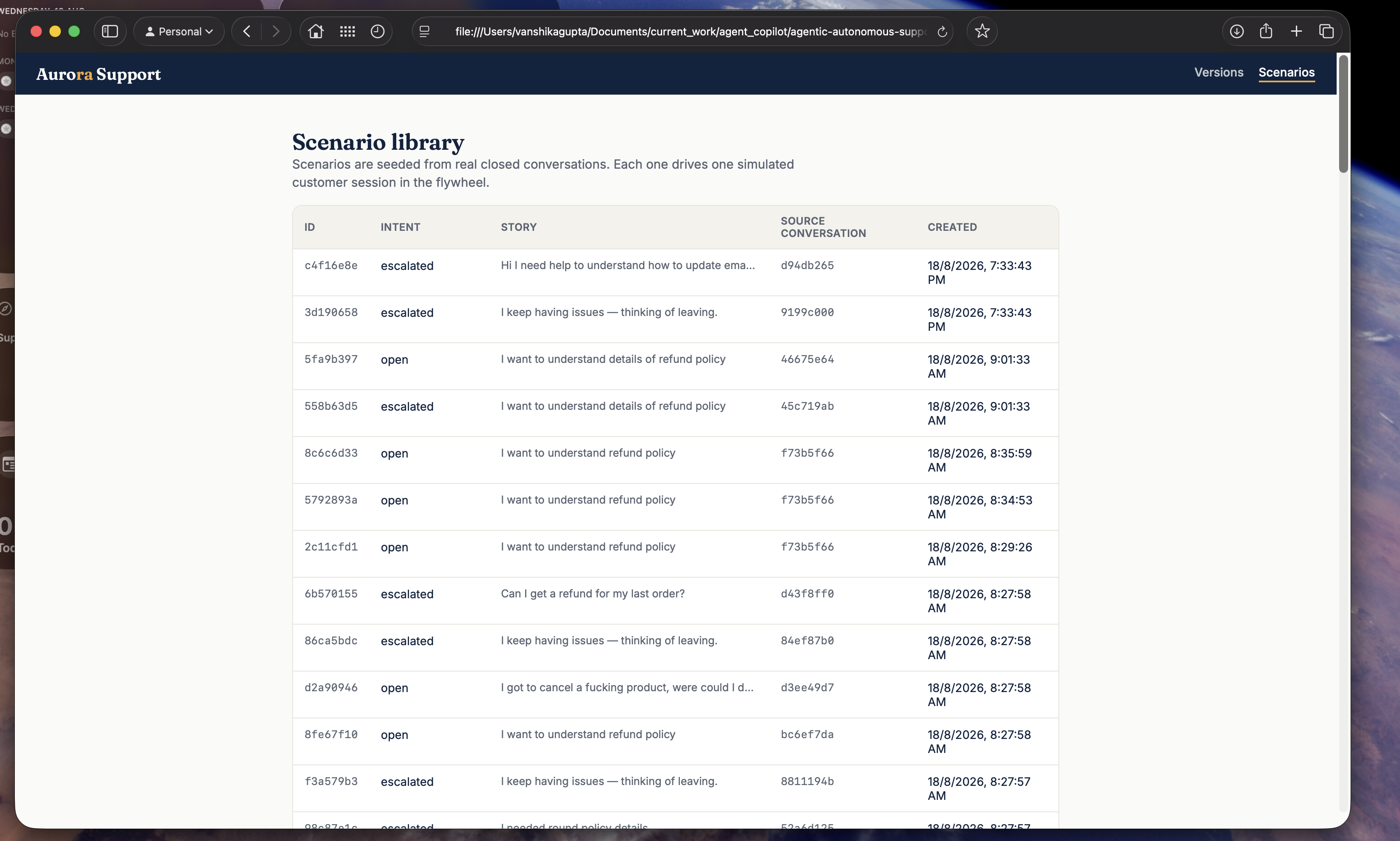
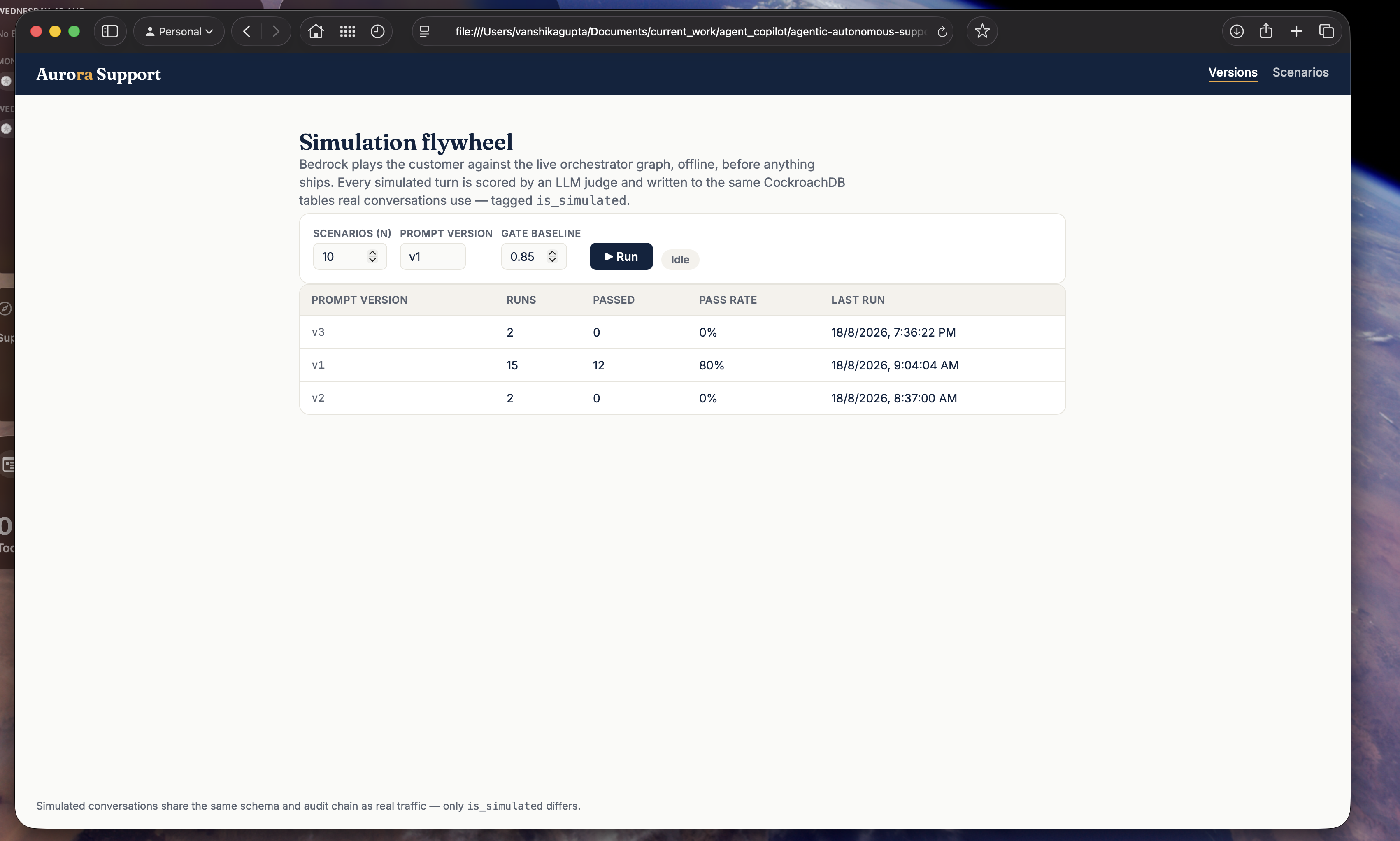
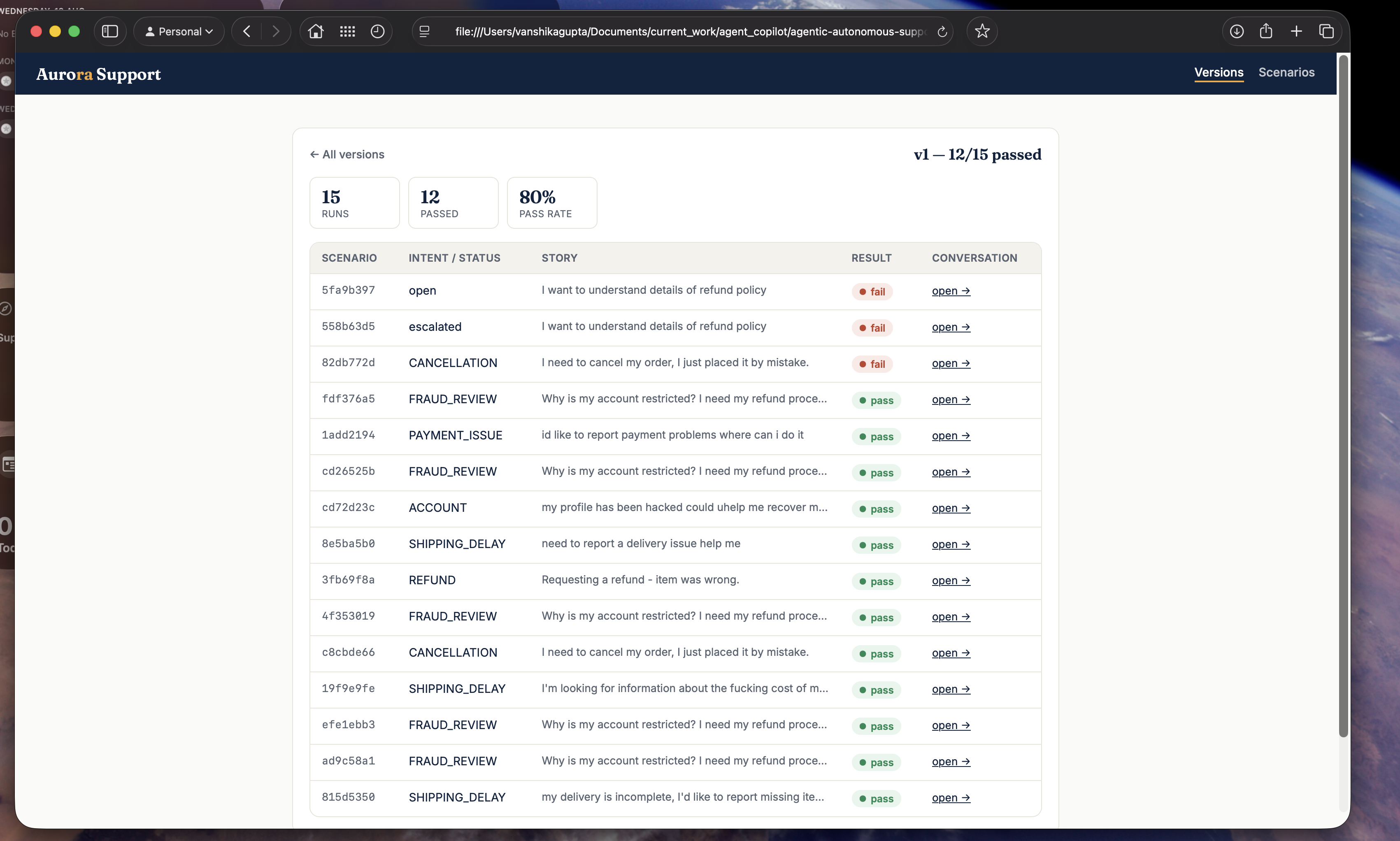
Simulation flywheel: A SimulatorAgent (Bedrock-powered) plays the customer, generates adversarial tone-driven push-back, and runs the full orchestrator graph with is_simulated=True. The evaluation agent judges each scenario. Deploy is blocked if pass rate is below 85%.
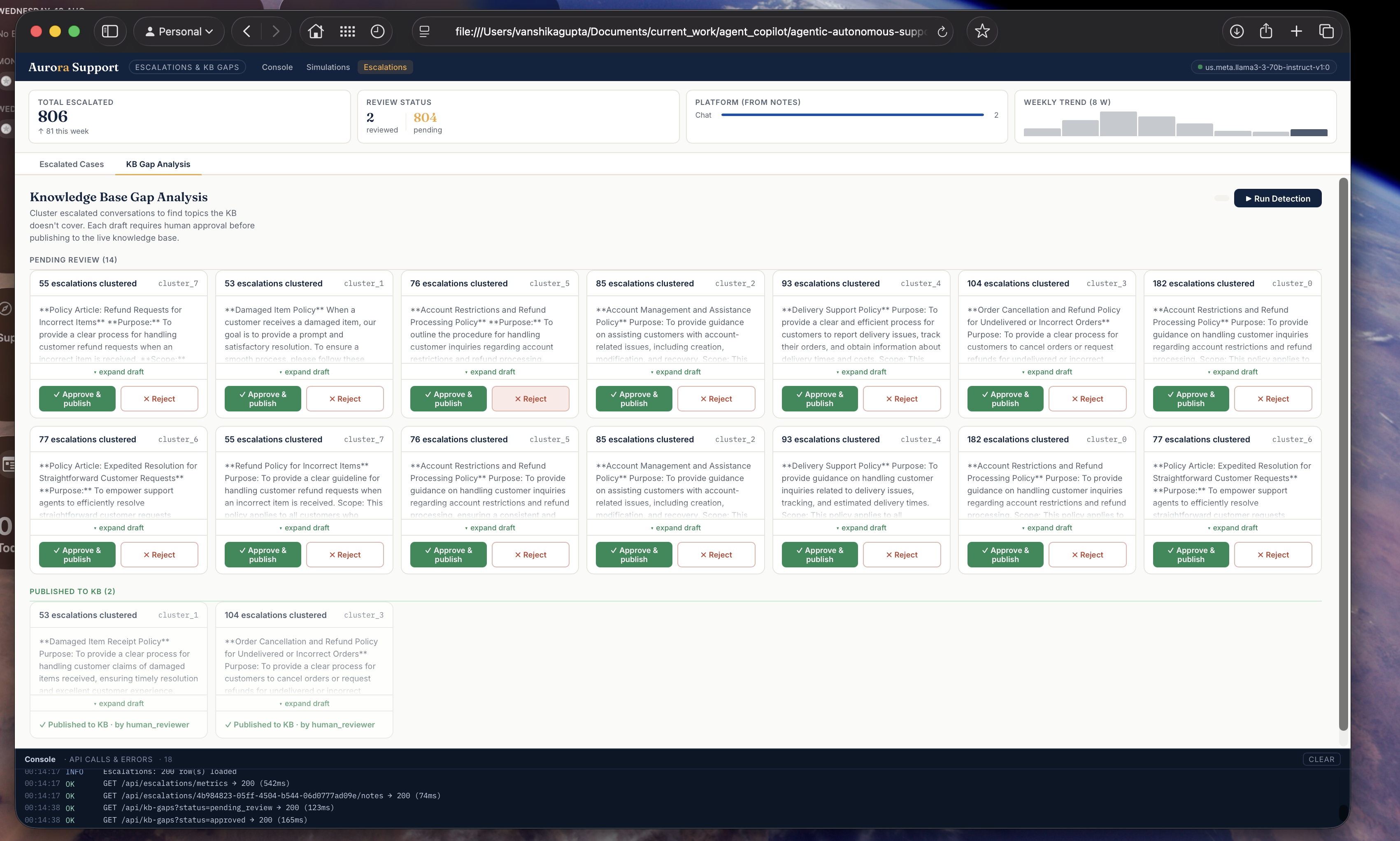
KB gap pipeline: KMeans on escalation embeddings → clusters far from existing KB (distance > 0.4) → Bedrock drafts a new policy article → written to kb_draft_articles as pending_review — never auto-published. A human approve_draft() call embeds it and promotes it to kb_chunks.
CockroachDB — What We Actually Had to Build
Four things nobody warned us about, and one design decision we're genuinely proud of:
Custom LangGraph checkpointer from scratch. LangGraph's built-in
PostgresSavercallsjsonb_each_textand similar set-returning functions in aFROMclause — a pattern CockroachDB's SQL dialect rejects withno data source matches prefix: jsonb_each_text. We reverse-engineered theBaseCheckpointSaverinterface and wrotecrdb_checkpointer.py: plainINSERT / SELECTonly, checkpoint state serialized asBYTEAvia LangGraph'sJsonPlusSerializer(notjson.dumps— graph state contains UUIDs and LangChain message objects), backed by aConnectionPoolso concurrent API requests don't serialize on a single shared connection.Per-customer C-SPANN partitioning. A flat
VECTOR INDEX (summary_embedding)over all conversations would scan every customer's history on every query. The fix:VECTOR INDEX (customer_id, summary_embedding)— the prefix column gives CockroachDB's C-SPANN a separate k-means tree per customer, so search stays O(log n) regardless of total corpus size. This was non-obvious; the index shape came from reading CockroachDB's C-SPANN internals.Embedding format: psycopg vs. VECTOR type. psycopg's default Python list adapter sends arrays as
{0.1, 0.2, ...}(Postgres array syntax). CockroachDB'sVECTORtype expects[0.1,0.2,...]. Every embedding write needs ato_vector_literal()wrapper. We also hit a double-wrapping bug: oneembed_fnwas already returning a vector literal string, and a downstream caller wrapped it again —to_vector_literal("[0.1,...]")iterates over string characters and callsfloat('['), crashing immediately. Fixed by standardizing:embed_fnalways returns a plain list; callers own theto_vector_literalcall.Guardrail verdict cache as a cost gate. Running a full LLM adversarial critique on every turn is expensive. We store verdicts in a
guardrail_verdict_cachetable keyed bySHA-256(autonomy_ceiling + failure_category + cited_chunk_ids). Same scenario → same key → tier-2 skipped. This is only possible because CockroachDB stores transactional data, vector indexes, and the verdict cache in the same cluster — a singleJOINis cheaper than a round-trip to a separate cache store.Metadata filter without JSONB SRFs. LangGraph's
list()API lets callers filter checkpoints by metadata fields. Standard Postgres would push this into SQL withjsonb_each_text. Since we can't, checkpoint metadata is stored as opaqueBYTEA;list()over-fetches on indexed columns and filters decoded metadata in Python. Acceptable at support-chat scale; we documented the tradeoff explicitly.
Challenges we ran into
CockroachDB checkpointing. LangGraph's built-in PostgresSaver uses jsonb_each and similar SRFs that CockroachDB's SQL dialect does not support. We reverse-engineered the checkpointer interface and wrote crdb_checkpointer.py from scratch — serializing the graph state as plain JSONB without any SRF-based extraction.
Per-customer vector isolation. A naive flat index over all conversation summaries means a customer-A query scans customer-B's history. The VECTOR INDEX (customer_id, summary_embedding) prefix design — a separate C-SPANN tree per customer — was the key architectural insight, and it required understanding CockroachDB's C-SPANN partitioning model.
Guardrail cost vs. coverage. Running a full LLM critique on every turn is expensive. The two-tier design — cheap SQL gate first, expensive LLM only on actual failures, with a verdict cache — brings tier-2 cost close to zero in steady state while preserving coverage for edge cases.
Circular trust. Trusting an LLM to decide whether an LLM should take a financial action is circular. The deterministic autonomy_ceiling() function — pure Python rules, no model call — enforces the trust boundary reliably and is auditable by any engineer without reading prompt logs.
Accomplishments we're proud of
- A memory architecture where every customer interaction builds on every prior one — across sessions, agents, and channels — without a separate vector database
- A guardrail that catches factual errors and policy violations on the happy path without spending a single LLM token
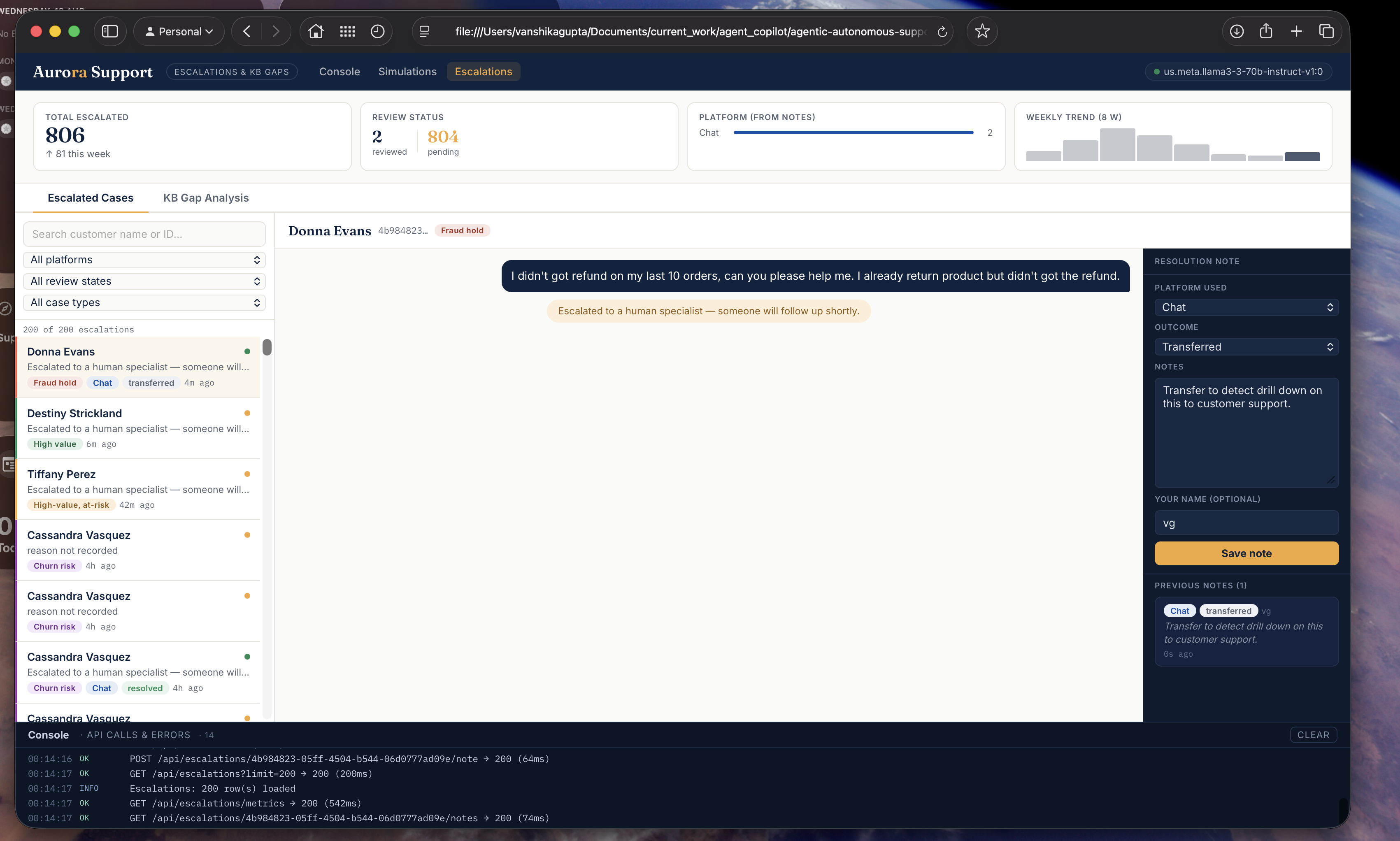
- A self-improving loop: the system uses its own escalation failures to automatically draft better knowledge base content, gated by human review before it goes live
- A simulation flywheel that gates deployment on adversarial scenario pass rates — not just static unit tests
What we learned
- Persistent memory in customer support is not about storing more — it's about retrieving the right thing under latency constraints, for the right customer, from the right layer
- Deterministic rules and LLM reasoning are complementary, not competing. Trust decisions (autonomy ceiling) belong in code; language tasks (response generation, article drafting) belong in the model
- CockroachDB's distributed vector indexing makes it possible to co-locate financial transaction data with the embeddings that describe it — removing an entire architectural tier (the standalone vector store) and the consistency problems that come with it
What's next
- Real-time streaming responses via WebSocket
- Multi-channel memory unification (email, chat, voice into one persistent profile)
- Operator dashboard for live autonomy-ceiling tuning without code changes
- Production CockroachDB deployment with
ccloudprovisioning automation - Bloomberg / CRM webhook integrations to pre-populate the customer signal profile
Built With
- amazon-bedrock
- amazon-web-services
- aws-lambda
- cockroachdb
- fastapi
- gemini-google
- langgraph
- meta-llama-3-70b
- psycopg3
- python
- scikit-learn
- sentence-transformers


Log in or sign up for Devpost to join the conversation.