Inspiration
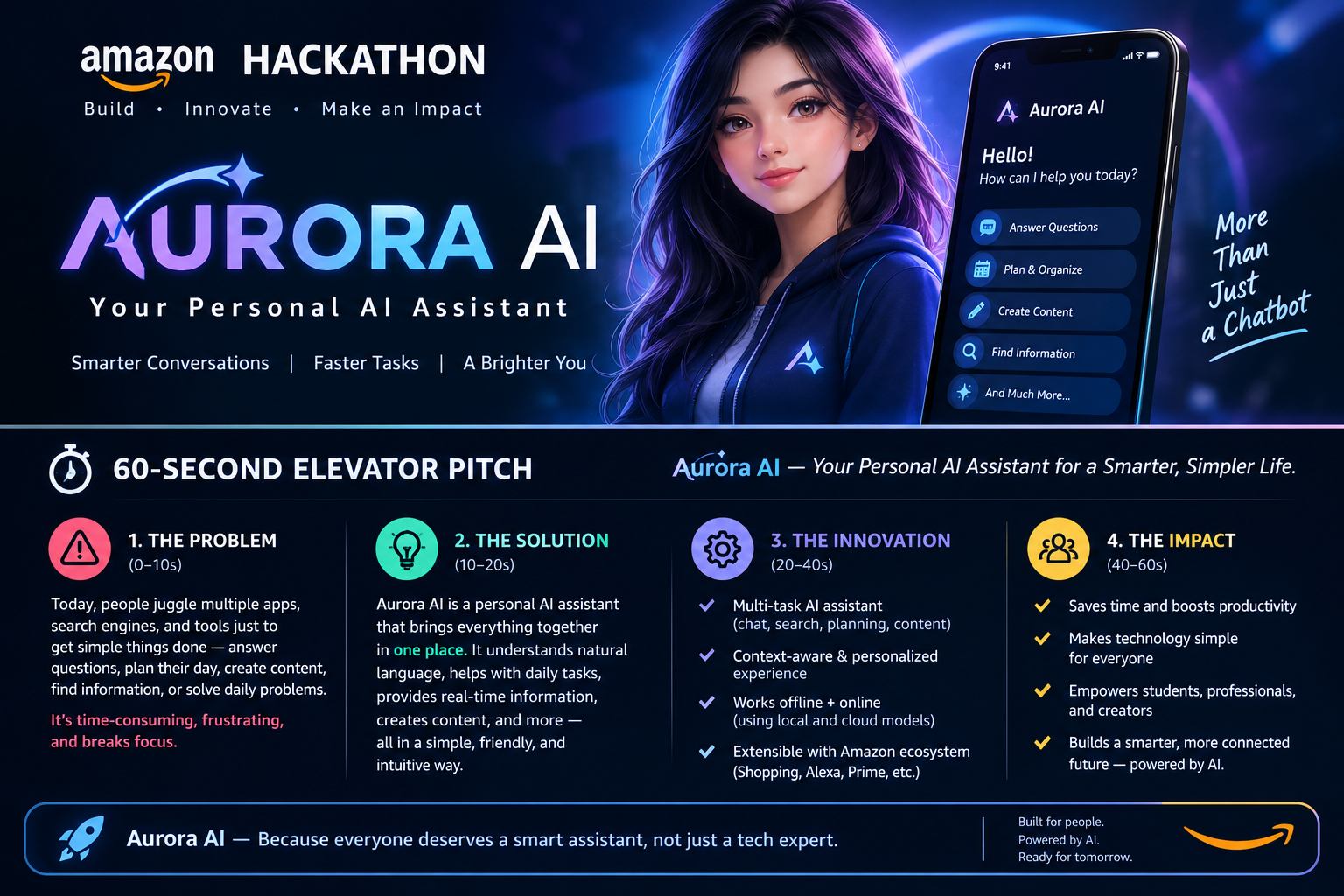
Aurora AI was inspired by the idea that powerful AI assistance should be accessible to everyone, not just people who can afford expensive subscriptions. We wanted to create a personal AI assistant that helps users learn, create, solve problems, and manage everyday tasks in one place, with a focus on free and local AI models.
What it does
Aurora AI aims to provide an all-in-one personal AI assistant through a simple, user-friendly interface. Its vision includes answering questions, helping with learning and writing, generating ideas, solving problems, and supporting everyday productivity. By prioritizing local AI models, Aurora AI aims to reduce dependence on paid cloud services and improve user privacy.
How we built it
Aurora AI is being developed as an Android application using Android Studio and Kotlin. Our approach focuses on a modular architecture, a beginner-friendly interface, and integration with free and local AI models. We are developing the project in phases, with an emphasis on maintainability, efficient resource usage, and testing each feature as it is implemented.
Challenges we ran into
One of our biggest challenges was setting up the Android development environment and resolving build configuration issues. Another challenge was planning how to integrate local AI models while balancing performance, memory usage, compatibility, and privacy on Android devices. We addressed these challenges by breaking development into smaller steps and prioritizing a reliable foundation before expanding the feature set.
Accomplishments that we're proud of
We established the vision for Aurora AI as an accessible, AI-powered Android assistant with a focus on free and local AI. We also defined a phased development approach to help organize a broad feature set into manageable milestones. We are proud to be building toward a solution that prioritizes accessibility, privacy, and practical everyday value.
What we learned
This project has taught us the importance of planning, modular development, debugging, and testing. We learned that building a useful AI assistant involves more than connecting a model: it also requires a thoughtful user experience, efficient resource management, privacy considerations, and reliable integration between software components.
What's next for Aurora ai
Our next steps are to complete the core Android application, integrate and test a local AI model, and build a reliable chat experience. We plan to expand the assistant with voice interaction, image understanding, productivity tools, and other useful capabilities in phases. Our long-term goal is to make Aurora AI a versatile, privacy-conscious personal assistant that helps more people benefit from AI without unnecessary costs.
Built With
- a
- ai
- and
- android
- android-studio
- kotlin
- local
- model
- planned


Log in or sign up for Devpost to join the conversation.